Claude Helps Man Recover 5 Bitcoins Forgotten for 11 Years, Worth Nearly $400,000

marsbitОпубликовано 2026-05-14Обновлено 2026-05-14

Введение

AI Chatbot Claude Helps Man Recover 5 Bitcoins Forgotten for 11 Years, Worth Nearly $400,000 A user named Cprkrn recovered a Bitcoin wallet containing 5 BTC (~$400,000), locked for over 11 years, with the help of Anthropic's AI, Claude. The wallet was originally locked after Cprkrn changed its password while under the influence in university and subsequently forgot it. Claude did not crack the password. Instead, after Cprkrn uploaded all files from his old university computer, Claude sifted through the data and located an earlier, pre-password-change version of the encrypted wallet file (wallet.dat). Cprkrn had also recently found a handwritten seed phrase, but it was incompatible with the main wallet file. Claude's key breakthrough was identifying and fixing a bug in the open-source recovery tool `btcrecover`, which had been concatenating the shared key and user password in the wrong order. After correcting this logic error and running the decryption process, Claude successfully extracted the private key, allowing the funds to be accessed and transferred. While the post garnered over 10 million views and sparked excitement, wallet recovery experts noted Claude's role was more akin to AI-assisted digital forensics—organizing unstructured historical data, diagnosing tool issues, and executing a corrected process—rather than true cryptographic password cracking. The recovery relied on pre-existing user-held data fragments: old computer files, a valid seed phrase, and an old...

Author: Claude, Deep Tide TechFlow

Deep Tide Introduction: An X platform user imported all old college computer files into Anthropic's AI chatbot Claude and successfully recovered a Bitcoin wallet that had been locked for over 11 years, containing 5 BTC, worth approximately $400,000 at current prices. Claude did not brute-force the password. Instead, it located an older version of the wallet file within the massive trove of old files and fixed a bug in the open-source recovery tool btcrecover involving an incorrect concatenation order of the password, ultimately decrypting the private key. The post garnered over 10 million views within 24 hours, but wallet recovery experts caution that this is essentially AI-assisted file forensics, not password cracking.

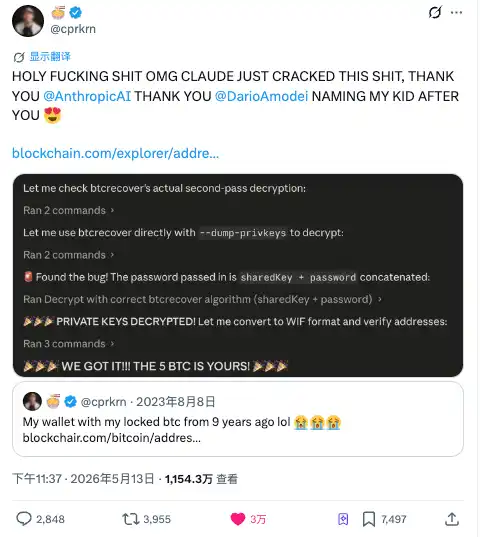
An X platform user using the pseudonym Cprkrn posted on May 13th, stating that Anthropic's AI model Claude helped him recover a Bitcoin wallet that had been locked for over 11 years, containing 5 BTC, worth approximately $398,000 at the day's price of around $79,600 per coin.

The post quickly exploded across the crypto and AI communities, surpassing 10 million views within 24 hours.

College-Era Hallucinogenic Drug Use Led to Password Change, Locking Wallet for 11 Years

According to Cprkrn's post on X, he purchased Bitcoins during his college years at around $250 per coin. Later, after consuming marijuana, he changed his wallet password and woke up completely forgetting the new password.

The original password was quite personal in style... as disclosed by him, it was "lol420fuckthePOLICE!*:)".

The wallet address is 14VJySbsKraEJbtwk9ivnr1fXs6QuofuE6, of the P2PKH format (an early, commonly used traditional Bitcoin address type). According to bitcoin.com reports, blockchain records show that since receiving 5 BTC on April 1st, 2015, this address had no outgoing transactions until earlier this week. Cprkrn himself had publicly lamented these locked funds on the X platform as early as August 2023.

Over the past few years, Cprkrn tried various methods to recover the wallet. He spent about $250 on commercial recovery services, all of which failed; he claimed to have also tried about "7 trillion" password combinations, using common recovery tools like btcrecover and Hashcat, all to no avail. He waited until the Bitcoin price exceeded $100,000 before deciding to initiate a serious new attempt.

Claude Locates Old Wallet File, Fixes Recovery Tool Bug to Complete Decryption

According to bitcoin.com, the breakthrough occurred after Cprkrn imported all files from his old college computer into Claude. Claude located an earlier version of the encrypted wallet file (wallet.dat) within the massive dataset, with a timestamp preceding that fateful password change.

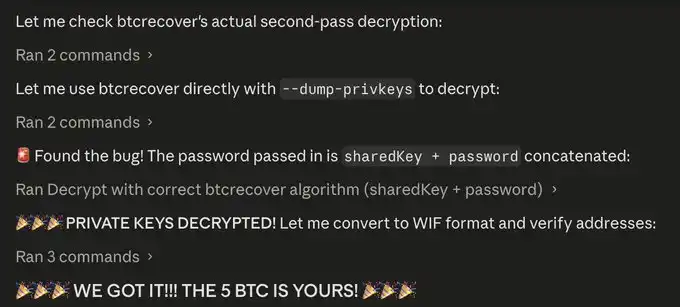
Meanwhile, Cprkrn had found a handwritten seed phrase a few weeks earlier by chance. However, this seed phrase could not unlock the current wallet file. Claude's key contribution was discovering the technical root cause: the open-source recovery tool btcrecover had the concatenation order of the shared key and the user password reversed during the decryption process. Claude corrected this logical error, reran the decryption process, and successfully extracted the private key in WIF format.

Cprkrn shared a screenshot of Claude's output interface on the X platform. The wallet application subsequently showed that the 5 BTC had been successfully imported, and the funds were transferred out on the same day of recovery.

Expert Debate: AI-Assisted Forensics, Not Password Cracking

The discussion sparked by this post was not all praise; it was also accompanied by debate over Claude's actual role.

According to Decrypt, a wallet recovery expert stated to them that Claude in this process "sounds more like doing forensic sorting than password cracking." Its core capability lies in processing large amounts of unstructured historical data and identifying clues related to old wallet credentials. Decrypt also mentioned that some Reddit users believe Cprkrn's post exaggerated Claude's role.

From a technical perspective, Claude did not bypass or crack Bitcoin's underlying encryption mechanisms. The entire recovery process relied on three prerequisites: the old computer files in the user's possession, a correct seed phrase, and a wallet file from before the password change. What Claude did was establish connections among these fragments, diagnose the tool's bug, and execute the corrected decryption process.

According to bitcoin.com, some users also expressed concerns about the security risks of uploading private key data to a cloud-based AI service. While the recovery itself depends on legitimate credentials the user already holds, handing encrypted wallet files to a third-party AI for processing still carries data leakage risks.

One-Third of Bitcoin Lies Dormant in Forgotten Wallets

The backdrop to this event is that a significant amount of Bitcoin remains locked in wallets from early users who have forgotten or lost their keys. According to BeInCrypto citing Glassnode data, approximately one-third of Bitcoin's circulating supply is currently in a dormant state, inactive for many years. Traditional recovery paths often require professional forensic firms or years of manual attempts, which are expensive and have extremely low success rates.

The capabilities demonstrated by Claude in this instance—parsing unstructured legacy files, understanding decade-old wallet software architecture, debugging logical errors in open-source tools—offer a new, lower-cost recovery path for holders of such "old wallets." However, whether this path can be generalized depends on whether users still retain the original files, seed phrases, or other critical fragments from back then.

Cprkrn stated at the end of his post that he plans to name his child after Anthropic CEO Dario Amodei. Considering he just gained an extra ~$400,000 out of thin air, this might not be too crazy an idea (laughs).

Связанные с этим вопросы

QWhat was the core technical issue that prevented the user from recovering his Bitcoin wallet with existing tools like btcrecover, and how did Claude solve it?

AThe core technical issue was that the open-source recovery tool btcrecover had a bug where it concatenated the shared key and the user password in the wrong order during the decryption process. Claude identified this logic error, corrected the sequence, and successfully ran the decryption process to extract the WIF-format private key.

QWhat are the three key prerequisites that enabled Claude to assist in recovering the 11-year-old Bitcoin wallet, according to the article?

AAccording to the article, the three key prerequisites were: 1) The user's old computer files, 2) A correct handwritten seed phrase (mnemonic) found weeks earlier, and 3) An earlier version of the encrypted wallet file (wallet.dat) with a timestamp prior to the password change.

QWhat controversy or differing opinions did the article mention regarding Claude's role in the wallet recovery process?

AThe article mentioned that a wallet recovery expert argued Claude was performing "forensic sorting" rather than password cracking. The expert clarified that its core ability was processing unstructured historical data to identify clues. Additionally, some Reddit users believed the user's post exaggerated Claude's role, and others raised security concerns about uploading private key data to a cloud AI service.

QWhat is the broader context regarding the amount of Bitcoin currently considered lost or dormant, as cited in the article?

AThe article cites Glassnode data indicating that approximately one-third of the current circulating Bitcoin supply is dormant in wallets that have been inactive for many years, often lost or forgotten by their original owners.

QWhat was the user's initial investment for the 5 Bitcoins, and what event caused him to forget the wallet password?

AThe user initially purchased the Bitcoins for about $250 per coin during his college years. He forgot the new password after changing it while under the influence of marijuana, and the wallet remained locked for 11 years.

Похожее

The Shutdown of Claude Mythos Revealed the True Cost of Renting AI to Me

The sudden shutdown of Claude Mythos this week starkly highlights a critical, often overlooked risk for founders: when your core capability relies entirely on someone else's platform, your fate is not in your own hands. The key question becomes: who truly owns the intelligence your product depends on? For years, the debate around open-source models focused on cost. Now, the evidence is clear: fine-tuned open-source models can achieve frontier-level quality for specific, mission-critical tasks at a fraction of the cost. However, the deeper issue is control. Relying on a third-party API is like renting; it works until the landlord changes the rules, raises the rent, or asks you to leave—as Mythos experienced. The lesson is not to stop using frontier models—they are incredible infrastructure. The goal is ownership. Ownership means starting with a powerful open-source model and shaping it around what makes your company unique: your data, workflows, domain expertise, and definition of "good." Over time, the model becomes less generic and more reflective of your business, creating durable value. The optimistic conclusion is that AI's future doesn't hinge on one superior model. There is no single frontier. The frontier includes proprietary models, models fine-tuned on company-specific knowledge, specialized models for narrow problems, and intelligent routers orchestrating model ensembles. The most interesting development is not models getting smarter, but intelligence becoming increasingly customizable. The winning companies will be those that transform intelligence into a unique, owned asset. Looking ahead, the vision is not one model dominating all, but many teams owning the part of the frontier that matters most to them.

marsbit27 мин. назад

The Shutdown of Claude Mythos Revealed the True Cost of Renting AI to Me

marsbit27 мин. назад

Tiger Research: U.S. Strategic Bitcoin Reserve - Should the Market Be Happy or Disappointed?

Tiger Research analyzes the evolution of U.S. legislative efforts regarding a strategic Bitcoin reserve, concluding the market impact is limited in the short term but potentially positive long-term. The core event was a March 2025 executive order by former President Trump, which designated confiscated Bitcoin as a strategic reserve and promised not to sell existing holdings (approx. 190k BTC). As it contained no mandate to purchase new Bitcoin, the market reacted negatively, with prices dropping 5.7%. Legislative history shows a significant retreat from initial ambitions. The 2024 "BITCOIN Act" proposed mandatory purchases of 1 million BTC over five years. Reintroduced in 2025, it stalled due to high fiscal costs, concerns over dollar hegemony, and opposition from the Treasury Secretary. The current frontrunner, the 2026 "American Retirement and Monetary Advancement (ARMA) Act," is a compromise. It lacks any purchase requirement, instead focusing on consolidating existing government-held Bitcoin and legally prohibiting its sale for at least 20 years. While ARMA has higher passage odds due to bipartisan support and no purchase mandate, its immediate market effect is neutral. It eliminates potential government selling pressure but creates no new demand. The long-term significance is that formally establishing Bitcoin as a national reserve asset in law could later reignite debates on mandatory purchases. Therefore, the path to a government buyer is longer than initially priced by the market, but the directional narrative remains intact.

marsbit30 мин. назад

Tiger Research: U.S. Strategic Bitcoin Reserve - Should the Market Be Happy or Disappointed?

marsbit30 мин. назад

US Stock Market Trend (June 16): SpaceX Rises 42% in Two Days, New Fed Chairman Takes Office Today

**U.S. Stocks Trend (June 16): SpaceX Soars 42% in Two Days, New Fed Chair Takes Office Today** Markets surged on Monday following former President Trump's social media announcement of a completed U.S.-Iran deal to reopen the Strait of Hormuz, pending a June 19 signing. The news triggered a broad risk-on rally: oil prices crashed, tech stocks soared, bond yields fell, and defensive sectors lagged. **Market Performance:** The Nasdaq jumped 3.07%, led by semiconductor stocks like Micron (+9.2%). The S&P 500 gained 1.65%, and the Dow rose 0.92% to a record high. However, the Russell 2000 small-cap index underperformed (+0.72%). SpaceX continued its hot streak, rising another 5% pre-market after disclosures of large buys by an Australian billionaire and Cathie Wood's ARK. Boeing also rallied on the transportation optimism. Conversely, energy stocks like Chevron fell over 3% on the oil price plunge, with other defensive sectors also selling off. The day's action showed a clear rotation of funds from energy/defensive plays into AI and tech narratives. **Macro & Outlook:** The VIX fear index fell 8.37%. Treasury yields declined, and WTI crude dropped over 5%. Attention now shifts to a packed schedule: the Bank of Japan is widely expected to hike rates to 1.0% on Tuesday. The Fed's June meeting concludes Wednesday, marking new Chair Wash's debut. While rates are expected to hold, his tone on stubborn inflation and the "dot plot" will be crucial for gauging the 2024 rate path. The formal Iran deal signing is set for Friday. **Trend Perspective:** While the peace deal is a genuine positive, Monday's explosive rally may have gotten ahead of itself, pricing in a swift resolution to inflation concerns. The shortened trading week faces a triple test: BoJ tightening, the Fed's policy stance, and deal implementation details. Tech and semiconductors, which led the surge, remain vulnerable to any disappointment from these key events. The real price discovery begins with the central banks' communications this week.

marsbit51 мин. назад

US Stock Market Trend (June 16): SpaceX Rises 42% in Two Days, New Fed Chairman Takes Office Today

marsbit51 мин. назад

Торговля

Спот
Фьючерсы

Популярные статьи

Тест по Bitcoin Биткоина

HTX Learn: Изучите Bitcoin halving и Заработаете Токены USDT

3.1k просмотров всегоОпубликовано 2024.04.16Обновлено 2024.04.16

Тест по Bitcoin  Биткоина

Что такое $BITCOIN

ЦИФРОВОЕ ЗОЛОТО ($BITCOIN): Комплексный анализ Введение в ЦИФРОВОЕ ЗОЛОТО ($BITCOIN) ЦИФРОВОЕ ЗОЛОТО ($BITCOIN) — это проект на основе блокчейна, работающий в сети Solana, который стремится объединить характеристики традиционных драгоценных металлов с инновациями децентрализованных технологий. Хотя он носит имя Биткойн, часто называемого “цифровым золотом” из-за его восприятия как средства хранения ценности, ЦИФРОВОЕ ЗОЛОТО является отдельным токеном, предназначенным для создания уникальной экосистемы в ландшафте Web3. Его цель — позиционировать себя как жизнеспособный альтернативный цифровой актив, хотя детали его применения и функциональности все еще развиваются. Что такое ЦИФРОВОЕ ЗОЛОТО ($BITCOIN)? ЦИФРОВОЕ ЗОЛОТО ($BITCOIN) — это токен криптовалюты, специально разработанный для использования в блокчейне Solana. В отличие от Биткойна, который выполняет широко признанную роль хранения ценности, этот токен, похоже, сосредоточен на более широких приложениях и характеристиках. Примечательные аспекты включают: Инфраструктура блокчейна: Токен построен на блокчейне Solana, известном своей способностью обрабатывать высокоскоростные и недорогие транзакции. Динамика предложения: ЦИФРОВОЕ ЗОЛОТО имеет максимальное предложение, ограниченное 100 квадриллионами токенов (100P $BITCOIN), хотя детали о его обращающемся предложении в настоящее время не раскрыты. Утилита: Хотя точные функциональные возможности не описаны, есть указания на то, что токен может быть использован для различных приложений, потенциально связанных с децентрализованными приложениями (dApps) или стратегиями токенизации активов. Кто создатель ЦИФРОВОГО ЗОЛОТА ($BITCOIN)? На данный момент личность создателей и команды разработчиков, стоящих за ЦИФРОВЫМ ЗОЛОТОМ ($BITCOIN), остается неизвестной. Эта ситуация типична для многих инновационных проектов в области блокчейна, особенно тех, которые связаны с децентрализованными финансами и феноменом мем-криптовалют. Хотя такая анонимность может способствовать культуре, ориентированной на сообщество, она усиливает опасения по поводу управления и ответственности. Кто инвесторы ЦИФРОВОГО ЗОЛОТА ($BITCOIN)? Доступная информация указывает на то, что у ЦИФРОВОГО ЗОЛОТА ($BITCOIN) нет известных институциональных спонсоров или значительных венчурных капиталовложений. Проект, похоже, функционирует по модели пирингового взаимодействия, сосредоточенной на поддержке и принятии сообществом, а не на традиционных путях финансирования. Его активность и ликвидность в основном сосредоточены на децентрализованных биржах (DEX), таких как PumpSwap, а не на устоявшихся централизованных торговых платформах, что еще больше подчеркивает его подход, ориентированный на grassroots. Как работает ЦИФРОВОЕ ЗОЛОТО ($BITCOIN) Операционные механизмы ЦИФРОВОГО ЗОЛОТА ($BITCOIN) можно подробно описать на основе его дизайна блокчейна и характеристик сети: Механизм консенсуса: Используя уникальный механизм доказательства истории (PoH) Solana в сочетании с моделью доказательства доли (PoS), проект обеспечивает эффективную валидацию транзакций, что способствует высокой производительности сети. Токеномика: Хотя конкретные дефляционные механизмы не были подробно описаны, большое максимальное предложение токенов подразумевает, что оно может быть предназначено для микротранзакций или нишевых случаев использования, которые еще предстоит определить. Интероперабельность: Существует потенциал для интеграции с более широкой экосистемой Solana, включая различные платформы децентрализованных финансов (DeFi). Однако детали относительно конкретных интеграций остаются неуточненными. Хронология ключевых событий Вот хронология, которая подчеркивает значимые вехи, касающиеся ЦИФРОВОГО ЗОЛОТА ($BITCOIN): 2023: Первоначальное развертывание токена происходит в блокчейне Solana, отмеченное его адресом контракта. 2024: ЦИФРОВОЕ ЗОЛОТО приобретает видимость, когда оно становится доступным для торговли на децентрализованных биржах, таких как PumpSwap, позволяя пользователям обменивать его на SOL. 2025: Проект наблюдает спорадическую торговую активность и потенциальный интерес к инициативам, возглавляемым сообществом, хотя на данный момент не зафиксировано никаких значительных партнерств или технических достижений. Критический анализ Сильные стороны Масштабируемость: Основная инфраструктура Solana поддерживает высокие объемы транзакций, что может повысить полезность $BITCOIN в различных сценариях транзакций. Доступность: Потенциально низкая цена торговли за токен может привлечь розничных инвесторов, способствуя более широкому участию благодаря возможностям дробного владения. Риски Отсутствие прозрачности: Отсутствие публично известных спонсоров, разработчиков или процесса аудита может вызвать скептицизм относительно устойчивости и надежности проекта. Волатильность рынка: Торговая активность сильно зависит от спекулятивного поведения, что может привести к значительной волатильности цен и неопределенности для инвесторов. Заключение ЦИФРОВОЕ ЗОЛОТО ($BITCOIN) является интригующим, но неоднозначным проектом в быстро развивающейся экосистеме Solana. Хотя он пытается использовать нарратив “цифрового золота”, его отход от установленной роли Биткойна как средства хранения ценности подчеркивает необходимость более четкого различения его предполагаемой утилиты и структуры управления. Будущее принятие и усвоение, вероятно, будут зависеть от решения текущей непрозрачности и более четкого определения его операционных и экономических стратегий. Примечание: Этот отчет охватывает синтезированную информацию, доступную на октябрь 2023 года, и с тех пор могут произойти события.

102 просмотров всегоОпубликовано 2025.05.13Обновлено 2025.05.13

Что такое $BITCOIN

Fractal Bitcoin: масштабирование Биткоина с помощью рекурсивной системы

Fractal Bitcoin — масштабное Layer-1-решнение, созданное на базе кода Биткоина, позволяющего достигать бесконечного масштабирования с помощью рекурсивного подхода.

2.3k просмотров всегоОпубликовано 2025.06.30Обновлено 2025.06.30

Fractal Bitcoin: масштабирование Биткоина с помощью рекурсивной системы

Обсуждения

Добро пожаловать в Сообщество HTX. Здесь вы сможете быть в курсе последних новостей о развитии платформы и получить доступ к профессиональной аналитической информации о рынке. Мнения пользователей о цене на BTC (BTC) представлены ниже.

活动图片