Bitcoin Treasury Demand Dominated By Strategy As Others’ Share Drops 99%

bitcoinistОпубликовано 2026-03-27Обновлено 2026-03-27

Введение

Bitcoin treasury demand is now overwhelmingly dominated by Strategy, which accounted for 98% of corporate purchases over the past month. While other companies have seen their buying share collapse by 99% to just 1,000 BTC, Strategy continued its aggressive accumulation, adding 45,000 BTC and now holding over 3.8% of the entire Bitcoin supply. This highlights a high concentration of corporate holdings with no broad demand from other firms. However, US spot Bitcoin ETFs have recently seen five consecutive weeks of net inflows, potentially signaling a return of institutional interest. Bitcoin is currently trading around $69,300.

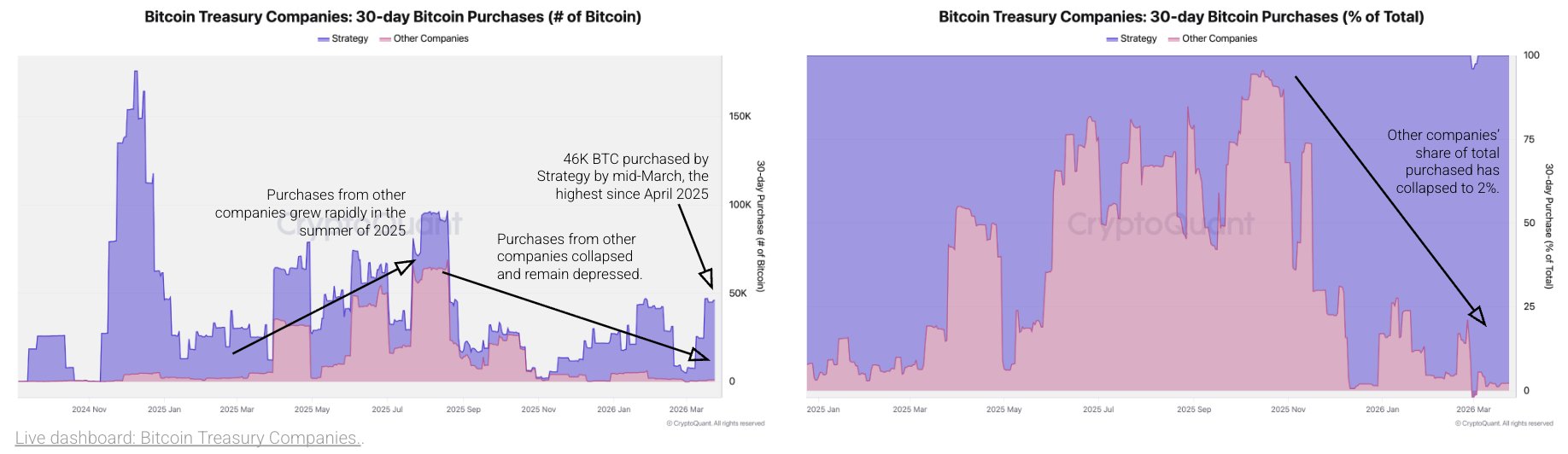
Data shows Strategy is currently the main driver of corporate Bitcoin demand, as other companies have seen their purchase share shrink to just 2%.

Strategy Behind Most Of The Bitcoin Treasury Buying From The Past Month

In a new post on X, on-chain analytics firm CryptoQuant has highlighted how Bitcoin treasury demand is now being driven entirely by Strategy. Treasury companies refer to corporates that keep BTC on their balance sheet as a way of providing their investors with indirect exposure to the cryptocurrency. This model was popularized by Strategy, which, under the leadership of Michael Saylor, has aggressively accumulated BTC.

While the cryptocurrency sector has gone through a bearish shift recently, the firm hasn’t lost its conviction, with regular purchases only continuing. As a result of this steady accumulation, Strategy today controls over 3.8% of the entire Bitcoin supply in circulation, making it by far the largest digital asset treasury company in the world.

It would appear, though, that while the company hasn’t faltered by the change of winds in the market, the same hasn’t been true for the other corporate investors.

How purchases from BTC treasury companies have changed over the past year | Source: CryptoQuant on X

As is visible in the data shared by CryptoQuant, the middle portion of 2025 saw a rapid expansion of Bitcoin purchases from companies other than Strategy. These buys meant that total corporate demand far outweighed the accumulation from Saylor’s firm alone.

As the market has gone downhill, however, buying from other companies has dried up. In the past month, Strategy bought about 45,000 BTC, but purchases from other companies totaled just 1,000 BTC. This reflects a collapse of a whopping 99% for the latter.

In percentage terms, Strategy’s buying made up for 98% of the corporate demand from the last 30 days, once again capturing the current asymmetry in the sector. “With ~76% of holdings, the industry is highly concentrated; there is no broad corporate demand right now,” noted the analytics firm.

That said, while Bitcoin treasury companies other than Strategy may have paused accumulation, it doesn’t mean that the firm is the sole treasury buyer in the entire digital asset sector. Bitmine, the largest public holder of Ethereum, has also continued to make regular purchases recently.

Another source of institutional demand in the market today is the US spot exchange-traded funds (ETFs), exchange vehicles that allow traders to invest in BTC without directly having to interact with blockchain infrastructure.

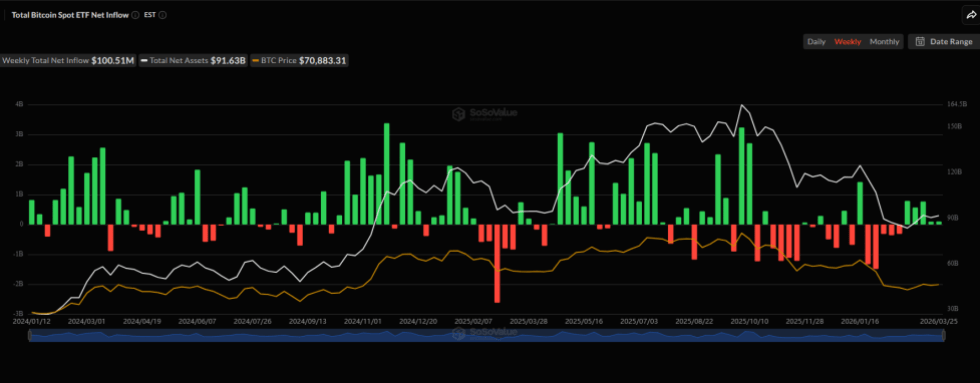
Earlier, these funds were facing net outflows, but recently, the weekly netflow has managed to get a green streak going, according to data from SoSoValue. These recent small but steady inflows could be an early sign that some institutional interest may be pouring back into Bitcoin.

Looks like the last five weeks have all seen net inflows | Source: SoSoValue

BTC Price

At the time of writing, Bitcoin is floating around $69,300, down 3% over the last 24 hours.

The trend in the price of the coin over the last five days | Source: BTCUSDT on TradingView

Связанные с этим вопросы

QAccording to the article, which company is currently the main driver of corporate Bitcoin treasury demand?

AStrategy is currently the main driver of corporate Bitcoin treasury demand.

QWhat percentage of the total corporate Bitcoin demand from the last 30 days did Strategy account for?

AStrategy accounted for 98% of the total corporate Bitcoin demand from the last 30 days.

QHow much did the purchase share from other companies (non-Strategy) change, as mentioned in the data?

AThe purchase share from other companies collapsed by 99%, shrinking to just 2% of the total.

QBesides corporate treasuries, what is another source of institutional demand for Bitcoin mentioned in the article?

AAnother source of institutional demand mentioned is the US spot exchange-traded funds (ETFs).

QWhat is the approximate price of Bitcoin at the time the article was written?

AAt the time of writing, Bitcoin was floating around $69,300.

Похожее

The Right Way to Use Skills: 5 Reflections After Anthropic Publicly Shared Its Internal Methodology

A deep dive into Anthropic's internal methodology for building effective AI "Skills" reveals five key insights for maximizing their value. First, Skills should focus on capturing "Gotchas" and tacit organizational knowledge—like common pitfalls and undocumented rules—rather than restating general information the AI already knows. Second, think of Skills as a form of "Context Engineering"; they are best structured as folders, not monolithic documents. A core `SKILL.md` file should act as a navigational index, progressively pulling in detailed references, examples, and assets only as needed to avoid overwhelming the model's context window. Third, whenever possible, automate repetitive tasks with scripts. This preserves the model's reasoning capacity for judgment and analysis, while scripts reliably handle the execution, saving tokens and improving accuracy. Instructions within a Skill provide the "why" and the expert judgment, while scripts provide the concrete "how." Fourth, a Skill's description is critical and often misunderstood. It should not be a list of features but a routing rule that clearly signals *when* the Skill should be triggered based on user intent and common phrasing. Finally, as Skills scale from personal tools to team-wide assets, management is crucial. Anthropic advocates for a lightweight, organic approach: let new Skills spread organically within small groups first. Those that prove genuinely useful through adoption naturally graduate to a formal marketplace, ensuring the curated library contains only high-value, battle-tested tools.

marsbit4 мин. назад

The Right Way to Use Skills: 5 Reflections After Anthropic Publicly Shared Its Internal Methodology

marsbit4 мин. назад

Vying for the AI Payment Track: Traditional Card Networks Face Off Against Coinbase

As AI agents increasingly conduct commercial transactions, a battle for control over the underlying payment infrastructure is unfolding. The competition centers on two divergent and incompatible technical approaches for autonomous AI payments. One camp, led by traditional card networks Visa and Mastercard, relies on tokenized card credentials within the established banking rails. Visa's "Intelligent Commerce" and Mastercard's "Agent Pay" services extend their existing tokenization technology to authorized AI agents for consumer retail transactions, leveraging decades of fraud protection and dispute resolution systems. Their partners include major AI firms like Anthropic, OpenAI, and Microsoft. The opposing camp, spearheaded by Coinbase, advocates for an open internet protocol using stablecoins. Coinbase's x402 protocol utilizes the HTTP 402 status code to enable direct, machine-to-machine micropayments with USDC on-chain. This model eliminates card fees and is designed for high-frequency, low-value transactions between AI agents, such as paying for API calls or data streams, where traditional card costs are prohibitive. Currently, application scenarios are clearly divided. Mainstream consumer-facing AI shopping services (e.g., ChatGPT's "one-click checkout," Amazon's AI-assisted shopping) predominantly use card channels due to their mature consumer protections and merchant networks. Conversely, the stablecoin channel dominates machine-to-machine payments, as seen in Amazon Bedrock's core payment service using Base blockchain. Significantly, traditional card networks are not solely defending their turf; they are also investing in the stablecoin arena. Visa has rapidly expanded its stablecoin settlement volume and partnered with Coinbase on interoperability, while Mastercard moved to acquire stablecoin platform BVNK. This dual-strategy indicates their intent to become the fee-collecting gateway for all payment flows, regardless of the underlying rail. The short-term outlook is for coexistence: cards for personal retail, stablecoins for machine transactions. The long-term outcome hinges on whether AI-driven commerce will resemble traditional retail or evolve into a vast network of machine micropayments. Visa and Mastercard's hedging strategy suggests they are prepared for either future, while companies betting on a single channel face greater risk.

Foresight News6 мин. назад

Vying for the AI Payment Track: Traditional Card Networks Face Off Against Coinbase

Foresight News6 мин. назад

For the First Time, Pure Human Video Pretrained VLA for Dexterous Manipulation: Deployable with Minimal Fine-Tuning Data

For the first time, a purely human-video-pretrained Vision-Language-Action (VLA) model for dexterous manipulation requires only a small amount of data for fine-tuning to achieve successful real-world deployment. Achieving human-level dexterous manipulation remains a core challenge in robotics. While multi-fingered hands offer hardware potential, Visual-Language-Action (VLA) models lag behind due to the high cost of collecting diverse, high-quality robot data. A novel framework, VITRA, developed by Microsoft Research Asia and Tsinghua University, addresses this by automatically transforming massive, unlabeled real-world human activity videos into a structured V-L-A training dataset. Key innovations include precise 3D hand motion annotation from monocular video, atomic action segmentation based on hand-speed minima, and automated instruction generation using VLMs combined with 3D trajectory visualization. This process created a massive dataset of 1 million clips. Pretrained exclusively on this human video data, the VLA model (combining a VLM backbone with a Diffusion Transformer action expert) demonstrates strong zero-shot hand motion prediction in unseen environments. Crucially, it requires minimal fine-tuning (~1.2k demonstrations) on real robot data to achieve high-success-rate dexterous manipulation tasks like grasping, placing, pouring, and sweeping on hardware like the Realman robot with the XHAND1 dexterous hand. The model shows exceptional generalization to novel objects and environments. The research also observes promising scaling behavior, where performance improves with more pretraining data, paving the way for more generalized embodied intelligence.

marsbit16 мин. назад

For the First Time, Pure Human Video Pretrained VLA for Dexterous Manipulation: Deployable with Minimal Fine-Tuning Data

marsbit16 мин. назад

Торговля

Спот
Фьючерсы

Популярные статьи

Тест по Bitcoin Биткоина

HTX Learn: Изучите Bitcoin halving и Заработаете Токены USDT

3.1k просмотров всегоОпубликовано 2024.04.16Обновлено 2024.04.16

Тест по Bitcoin  Биткоина

Что такое $BITCOIN

ЦИФРОВОЕ ЗОЛОТО ($BITCOIN): Комплексный анализ Введение в ЦИФРОВОЕ ЗОЛОТО ($BITCOIN) ЦИФРОВОЕ ЗОЛОТО ($BITCOIN) — это проект на основе блокчейна, работающий в сети Solana, который стремится объединить характеристики традиционных драгоценных металлов с инновациями децентрализованных технологий. Хотя он носит имя Биткойн, часто называемого “цифровым золотом” из-за его восприятия как средства хранения ценности, ЦИФРОВОЕ ЗОЛОТО является отдельным токеном, предназначенным для создания уникальной экосистемы в ландшафте Web3. Его цель — позиционировать себя как жизнеспособный альтернативный цифровой актив, хотя детали его применения и функциональности все еще развиваются. Что такое ЦИФРОВОЕ ЗОЛОТО ($BITCOIN)? ЦИФРОВОЕ ЗОЛОТО ($BITCOIN) — это токен криптовалюты, специально разработанный для использования в блокчейне Solana. В отличие от Биткойна, который выполняет широко признанную роль хранения ценности, этот токен, похоже, сосредоточен на более широких приложениях и характеристиках. Примечательные аспекты включают: Инфраструктура блокчейна: Токен построен на блокчейне Solana, известном своей способностью обрабатывать высокоскоростные и недорогие транзакции. Динамика предложения: ЦИФРОВОЕ ЗОЛОТО имеет максимальное предложение, ограниченное 100 квадриллионами токенов (100P $BITCOIN), хотя детали о его обращающемся предложении в настоящее время не раскрыты. Утилита: Хотя точные функциональные возможности не описаны, есть указания на то, что токен может быть использован для различных приложений, потенциально связанных с децентрализованными приложениями (dApps) или стратегиями токенизации активов. Кто создатель ЦИФРОВОГО ЗОЛОТА ($BITCOIN)? На данный момент личность создателей и команды разработчиков, стоящих за ЦИФРОВЫМ ЗОЛОТОМ ($BITCOIN), остается неизвестной. Эта ситуация типична для многих инновационных проектов в области блокчейна, особенно тех, которые связаны с децентрализованными финансами и феноменом мем-криптовалют. Хотя такая анонимность может способствовать культуре, ориентированной на сообщество, она усиливает опасения по поводу управления и ответственности. Кто инвесторы ЦИФРОВОГО ЗОЛОТА ($BITCOIN)? Доступная информация указывает на то, что у ЦИФРОВОГО ЗОЛОТА ($BITCOIN) нет известных институциональных спонсоров или значительных венчурных капиталовложений. Проект, похоже, функционирует по модели пирингового взаимодействия, сосредоточенной на поддержке и принятии сообществом, а не на традиционных путях финансирования. Его активность и ликвидность в основном сосредоточены на децентрализованных биржах (DEX), таких как PumpSwap, а не на устоявшихся централизованных торговых платформах, что еще больше подчеркивает его подход, ориентированный на grassroots. Как работает ЦИФРОВОЕ ЗОЛОТО ($BITCOIN) Операционные механизмы ЦИФРОВОГО ЗОЛОТА ($BITCOIN) можно подробно описать на основе его дизайна блокчейна и характеристик сети: Механизм консенсуса: Используя уникальный механизм доказательства истории (PoH) Solana в сочетании с моделью доказательства доли (PoS), проект обеспечивает эффективную валидацию транзакций, что способствует высокой производительности сети. Токеномика: Хотя конкретные дефляционные механизмы не были подробно описаны, большое максимальное предложение токенов подразумевает, что оно может быть предназначено для микротранзакций или нишевых случаев использования, которые еще предстоит определить. Интероперабельность: Существует потенциал для интеграции с более широкой экосистемой Solana, включая различные платформы децентрализованных финансов (DeFi). Однако детали относительно конкретных интеграций остаются неуточненными. Хронология ключевых событий Вот хронология, которая подчеркивает значимые вехи, касающиеся ЦИФРОВОГО ЗОЛОТА ($BITCOIN): 2023: Первоначальное развертывание токена происходит в блокчейне Solana, отмеченное его адресом контракта. 2024: ЦИФРОВОЕ ЗОЛОТО приобретает видимость, когда оно становится доступным для торговли на децентрализованных биржах, таких как PumpSwap, позволяя пользователям обменивать его на SOL. 2025: Проект наблюдает спорадическую торговую активность и потенциальный интерес к инициативам, возглавляемым сообществом, хотя на данный момент не зафиксировано никаких значительных партнерств или технических достижений. Критический анализ Сильные стороны Масштабируемость: Основная инфраструктура Solana поддерживает высокие объемы транзакций, что может повысить полезность $BITCOIN в различных сценариях транзакций. Доступность: Потенциально низкая цена торговли за токен может привлечь розничных инвесторов, способствуя более широкому участию благодаря возможностям дробного владения. Риски Отсутствие прозрачности: Отсутствие публично известных спонсоров, разработчиков или процесса аудита может вызвать скептицизм относительно устойчивости и надежности проекта. Волатильность рынка: Торговая активность сильно зависит от спекулятивного поведения, что может привести к значительной волатильности цен и неопределенности для инвесторов. Заключение ЦИФРОВОЕ ЗОЛОТО ($BITCOIN) является интригующим, но неоднозначным проектом в быстро развивающейся экосистеме Solana. Хотя он пытается использовать нарратив “цифрового золота”, его отход от установленной роли Биткойна как средства хранения ценности подчеркивает необходимость более четкого различения его предполагаемой утилиты и структуры управления. Будущее принятие и усвоение, вероятно, будут зависеть от решения текущей непрозрачности и более четкого определения его операционных и экономических стратегий. Примечание: Этот отчет охватывает синтезированную информацию, доступную на октябрь 2023 года, и с тех пор могут произойти события.

99 просмотров всегоОпубликовано 2025.05.13Обновлено 2025.05.13

Что такое $BITCOIN

Fractal Bitcoin: масштабирование Биткоина с помощью рекурсивной системы

Fractal Bitcoin — масштабное Layer-1-решнение, созданное на базе кода Биткоина, позволяющего достигать бесконечного масштабирования с помощью рекурсивного подхода.

2.3k просмотров всегоОпубликовано 2025.06.30Обновлено 2025.06.30

Fractal Bitcoin: масштабирование Биткоина с помощью рекурсивной системы

Обсуждения

Добро пожаловать в Сообщество HTX. Здесь вы сможете быть в курсе последних новостей о развитии платформы и получить доступ к профессиональной аналитической информации о рынке. Мнения пользователей о цене на BTC (BTC) представлены ниже.

活动图片