Bitcoin Returns to $70K: Rebound or Real Trap?

marsbitОпубликовано 2026-02-09Обновлено 2026-02-09

Введение

Bitcoin surged from $60,000 to over $70,000 in under 24 hours, erasing a 14% drop, but the rebound was driven more by macro-market stabilization and forced liquidations than strong spot buying. The sell-off was triggered by risk-off sentiment across assets, including tech stocks and metals, exacerbated by expectations of tighter liquidity under a potential Trump-appointed Fed chair. Despite the rebound, derivatives markets show persistent bearish signals: negative funding rates, skewed put options, and ETF outflows. Options traders are pricing in a significant chance of a drop to $50,000–$60,000 by late February. Holding $70,000 depends on sustained macro stability, reduced leverage, improved miner conditions, and a reversal in institutional outflows. The rebound appears fragile, with underlying sentiment remaining cautious.

Author: CryptoSlate

Compiled by: Deep Tide TechFlow

Original link: https://cryptoslate.com/bitcoin-rocketed-15-to-get-back-above-70000-but-the-options-market-is-currently-pricing-in-a-terrifying-new-floor/

Deep Tide Insights:

After a violent 24-hour rebound from $60,000 to $70,000, Bitcoin appears to have recouped its losses. However, the fundamental logic reveals that this was not driven by firm spot buying but rather by forced position adjustments and short squeezes triggered by a recovery in the broader macro market. This article delves into the causes of this "hair-raising turmoil" in early February 2026: from liquidity contraction expectations following Trump's appointment of Kevin Warsh to the pressure on miners' profits hitting a historical low. Despite the price climbing back above $70,000, options traders are heavily betting on a potential secondary dip to $50,000-$60,000 by the end of February, revealing the still-fragile sentiment and complex financial games beneath the surface of this "violent rebound."

Bitcoin surged from $60,000 to above $70,000 in less than 24 hours, erasing the brutal 14% drop that had tested all the "buy-the-dip" theories in the market.

The speed of this reversal—a 12% single-day rally, rebounding 17% from the intraday low—was so intense that it felt like the dust settling after a liquidation. However, the mechanism behind the rebound tells another story: it was more a combination of cross-asset stabilization and forced position rebalancing, rather than conviction-driven, large-scale spot demand.

Meanwhile, the derivatives market remains crowded with bearish protective positions, pricing in that $70,000 might be just a waystation, not a true bottom.

Liquidation Wave Meets Macro Pressure

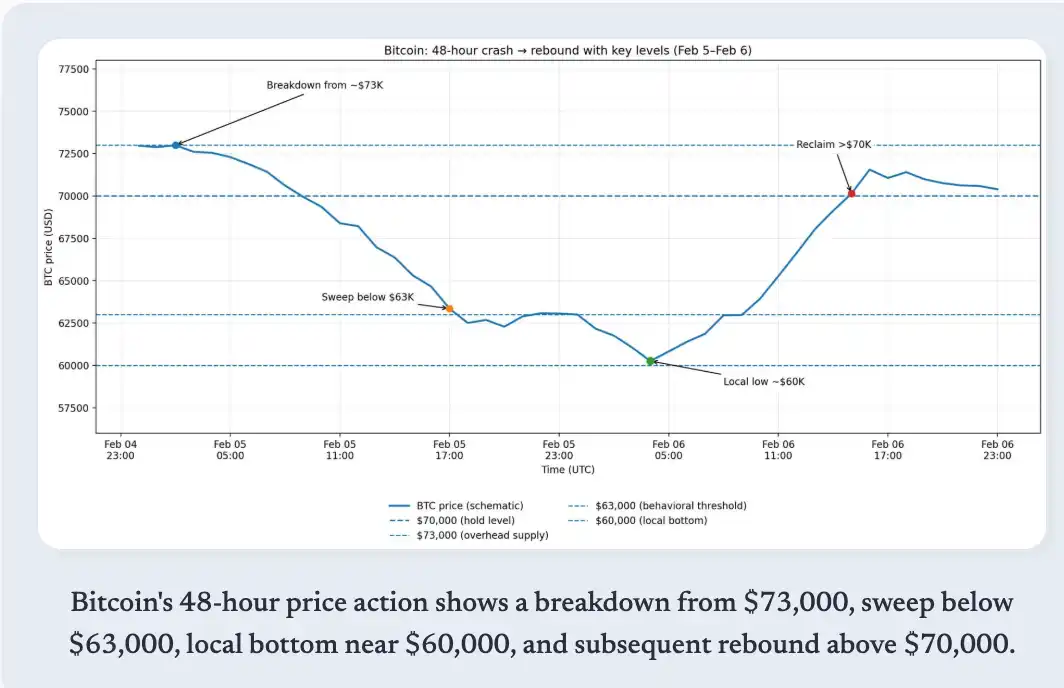
On February 5th, the market opened around $73,100, briefly attempted an upward move, then collapsed, closing at $62,600. According to CoinGlass data, the single-day decline led to the liquidation of approximately $1 billion in leveraged Bitcoin positions.

This figure alone speaks volumes about the chain reaction of forced selling, but the broader context was even worse.

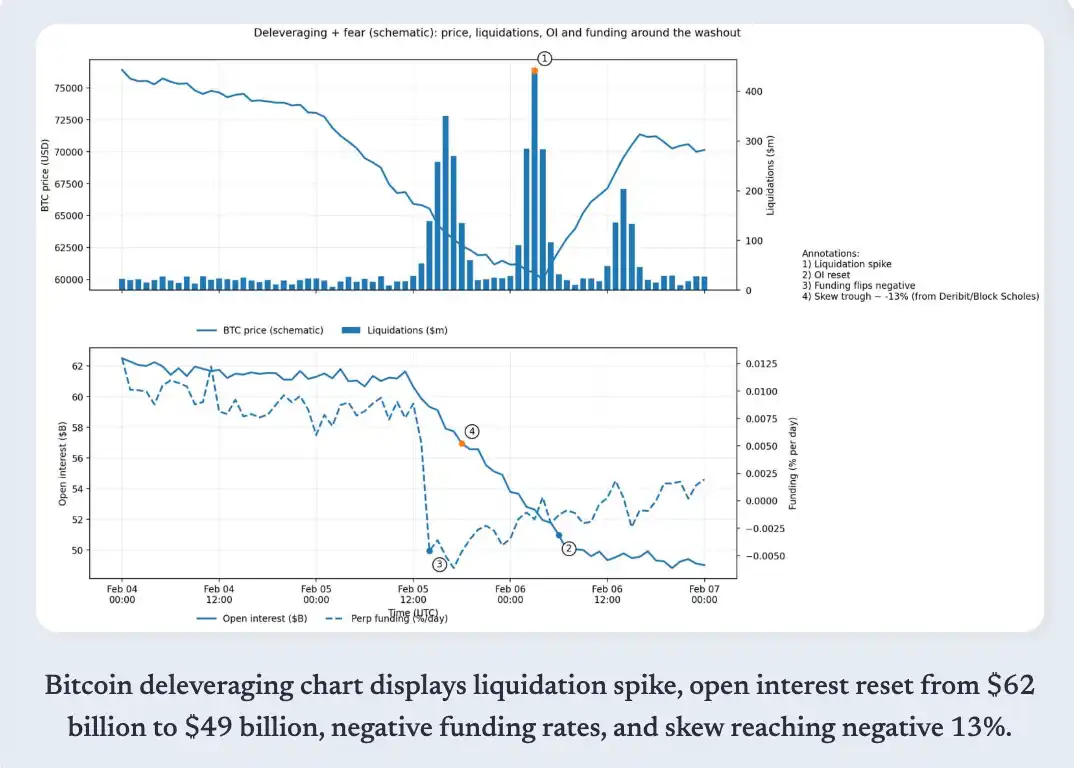
CoinGlass data shows that Bitcoin futures open interest (OI) had already dropped from around $61 billion to $49 billion last week, meaning the market was already deleveraging before the final wave of冲击 hit.

The trigger was not internal to cryptocurrency. Media reports characterized the sell-off as a deterioration in risk sentiment, primarily driven by a sell-off in tech stocks and volatility shocks in precious metals—silver plummeted by up to 18% to around $72.21, dragging down all correlated risk assets.

Deribit's research confirmed this spillover effect, pointing to a shift in derivatives sentiment to extreme pessimism: negative funding rates, an inverted implied volatility term structure, and the 25-delta risk-reversal skew depressed to around -13%.

This is a classic state of "extreme fear," where positioning amplifies price swings in both directions.

Policy narratives added fuel to the fire. According to Reuters, the market reacted strongly to reports that President-elect Donald Trump might choose Kevin Warsh as Fed Chair, with traders interpreting this as a signal of future balance sheet contraction and liquidity tightening.

Simultaneously, miners faced immense profit pressure. According to TheMinerMag, the hash price fell below $32 per PH/s, and the network difficulty was expected to下调 (adjust downward) by approximately 13.37% in two days. However, this relief mechanism had not yet taken effect before price broke below support levels.

Bitcoin's price action over 48 hours, showing the crash from $73K, the sweep below $63K, local basing near $60K, and the subsequent rebound back above $70K.

Macro Reversal and Squeeze Mechanism

February 6th opened at the previous day's close, then fell to a daily low near $60,000 before rocketing to a high of $71,422. After three failed attempts to break above this level, the price fell back below $70,000.

The catalyst did not originate from within the crypto industry but was a sharp U-turn in cross-asset movements. Wall Street performed strongly: the S&P 500 rose 1.97%, the Nasdaq gained 2.18%, the Dow Jones increased 2.47%, and the Philadelphia Semiconductor Index (SOX) surged 5.7%.

Metal prices rebounded violently, with gold up 3.9% and silver up 8.6%, while the US Dollar Index fell 0.2%, signaling easier financial conditions.

Bitcoin moved mechanically with this shift. The correlation was evident: as tech stocks stabilized and metals rebounded, Bitcoin was pulled up through common risk exposures.

However, the violence of this rebound also reflected derivatives positioning. The near -13% skew, negative funding rates, and inverted volatility structure created conditions where any macro-positive catalyst could trigger short-covering and forced position adjustments.

This rally was essentially driven by a liquidity event and amplified by the unwinding of crowded short positions.

Nevertheless, forward-looking signals remain bearish. Data from Deribit shows that for options expiring on February 27th, put open interest is heavily concentrated at strike prices between $60,000 and $50,000.

Sean Dawson from Deribit told Reuters that the demand for downside protection is "extreme." This is not hindsight analysis; traders are explicitly hedging against the next leg down, even after the rebound.

Bitcoin deleveraging chart showing liquidation spikes, OI reset from $62B to $49B, negative funding, and skew hitting -13%.

Can $70K Hold? Analytical Framework

The logic for holding $70,000 is based on three conditions.

First, the macro rebound needs to persist, with tech stocks continuing to stabilize, and US Treasury yields and the dollar not tightening again. This rally was clearly a cross-asset correlation; if US stocks turn lower again, Bitcoin will not be immune.

Second, leverage needs to continue cooling off with no new forced selling emerging. Open interest has already declined significantly, reducing the risk of a "vacuum drop."

Third, miner pressure needs substantive relief when the difficulty adjustment takes effect. If prices can hold steady within the adjustment window, the anticipated 13.37% difficulty下调 should reduce marginal selling pressure and allow the hash rate to stabilize.

Arguments supporting another washout also have three reasons:

First, options positioning remains skewed bearish. The largest put concentrations for late February are at $60K-$50K, a forward-looking signal embedded in market-implied probabilities, not lagging sentiment.

Second, derivatives signals remain fragile. Extreme skew, the recent prevalence of negative funding rates, and an inverted volatility structure align more with the characteristics of a "relief rally" within a fear regime, not a trend reversal.

Third, ETF flow data shows continued outflows. As of February 5th, Bitcoin ETF net monthly outflows had reached $690 million. Although data for February 6th is not yet available, the existing pattern suggests institutional allocators have not shifted from "de-risking" to "re-engagement."

Signal Dashboard

Indicator Latest Reading / Status (As of Publishing) Bull Confirmation (What Needs to Change) Bear Continuation (What to Watch For) Source
Derivatives Perp Funding Rate Negative (below 0%) -- "Extremely Bearish" state Funding turns positive & stabilizes on major platforms (not just 1-2 hour spikes) Funding stays negative / oscillates wildly during price chops → "Bull Trap" risk
Options Risk 25D Risk Reversal (Skew) Short-term skew as low as ~-13% (Surge in put demand) Skew recovers towards 0 (Less downside protection demand) & stabilizes Skew remains deeply negative (Sustained protective buying)
Leverage Futures OI Deleveraging / OI drop (Forced liquidation phase); Recent reports show ~$55B equiv exited in 30d OI flattens out (No rapid re-levering) & price holds $70K OI accumulates quickly during bounce → Probability of next liquidation leg increases
Fund Flows Spot BTC ETF Net Flow Net Outflows: Feb 4 -$544.9M, Feb 5 -$434.1M Outflows decelerate to flat, then turn to slight inflows Outflows accelerate (Consecutive -$400M to -$500M days)→ Repeat washout risk
Mining Hash Price + Difficulty Adj Hash Price < $32/PH/s (Historic lows); Difficulty下调 ~13.37% expected Difficulty下调 arrives & hashrate stabilizes (Reduces miner sell pressure) Hash price falls further / Hashrate drops significantly → Increased miner selling/inventory outflow

The True Meaning of $70K

This price level itself holds no magic. Its importance lies in its position just above the $66,900 to $70,600 on-chain absorption cluster identified by Glassnode.

Holding $70,000 means this cluster has absorbed enough supply to temporarily stabilize prices. However, holding firm depends not just on technical support but also on the return of spot demand, the unwinding of derivatives hedge positions, and the stabilization of institutional flows.

The rebound from $60,000 was real, but its composition is crucial. If macro conditions change, cross-asset stability will reverse.

The unwinding of forced positions created a mechanical rebound, which does not necessarily translate into a sustained trend. Options traders are still pricing in a significant probability of a move down towards $50,000-$60,000 within the next three weeks.

Bitcoin reclaimed $70,000 but is currently consolidating below it. This suggests a pause before the next test, and the outcome of that next test depends on three conditions occurring in sequence: sustained macro risk appetite, deceleration or reversal of ETF outflows, and normalization of derivatives sentiment.

The market delivered a violent snap-back, but the forward curve and flow data indicate traders are not yet betting on its persistence. $70,000 is not the endgame; it is merely the baseline that will determine the winner of the next phase of the debate.

Связанные с этим вопросы

QWhat were the main factors that triggered the violent Bitcoin price drop to around $60,000 on February 5th, 2026?

AThe main triggers were a broader risk-off sentiment in financial markets, including a sell-off in tech stocks and extreme volatility in precious metals (like silver dropping ~18%), which negatively impacted all risk assets. Additionally, market concerns about potential future liquidity tightening—sparked by reports that Donald Trump might appoint Kevin Warsh as Fed Chair—exacerbated the sell-off. Forced liquidations of leveraged Bitcoin positions (around $1 billion in BTC liquidations) also amplified the downward move.

QHow did the rebound from ~$60,000 to over $70,000 occur within 24 hours, and what was the primary mechanism behind it?

AThe rebound was primarily driven by a macro market reversal, where tech stocks rallied (S&P 500 +1.97%, Nasdaq +2.18%), metals recovered sharply (gold +3.9%, silver +8.6%), and the Dollar Index weakened. This cross-asset stabilization created a mechanical lift for Bitcoin. The violent nature of the bounce was amplified by a short squeeze—derivatives positioning was extremely bearish (with negative funding rates, inverted volatility, and a -13% risk-reversal skew), so any macro improvement forced short covering and rapid position rebalancing.

QWhat does the options market indicate about traders' expectations for Bitcoin's price by the end of February 2026?

AThe options market shows significant bearish hedging, with a large concentration of put open interest at strike prices between $50,000 and $60,000 for February 27th expiries. This indicates that traders are pricing in a substantial risk of a second downturn to those levels, despite the recent rebound. The demand for downside protection is described as 'extreme,' suggesting a lack of conviction in the sustainability of the $70,000 recovery.

QWhat three conditions are necessary for Bitcoin to sustainably hold above $70,000, according to the analysis?

A1. Sustained macro rebound: Tech stocks must continue to stabilize, with no renewed tightening in Treasury yields or the US Dollar. 2. Leverage cooling: Further forced selling must be avoided, and open interest should not rapidly re-leverage. 3. Miner relief: The expected 13.37% network difficulty adjustment must take effect, reducing mining pressure and stabilizing hash rate to minimize marginal selling from miners.

QWhat key on-chain level is referenced as important for Bitcoin's price stability, and why is holding $70,000 significant in that context?

AThe $66,900 to $70,600 range is identified as an on-chain absorption cluster by Glassnode. Holding above $70,000 means that this cluster has absorbed enough supply to provide temporary price support. However, for the level to be sustained, it requires genuine spot demand, normalization of derivatives sentiment, and a reversal in ETF outflows—not just technical absorption.

Похожее

From Madison Square Garden to Kalshi: Prediction Markets Break into the NBA Finals

From Madison Square Garden to Kalshi: Prediction Markets Break into the NBA Finals Prediction markets are playing a significant role in the 2026 NBA Finals, particularly around the New York Knicks' unexpected 2-0 series lead. Platforms like Kalshi and Polymarket have seen massive trading volumes, exceeding hundreds of millions of dollars on championship and related markets. Their influence extends beyond online trading. Kalshi's official partnership with Madison Square Garden has given it prominent physical branding at the arena. Furthermore, local businesses like The Jeffrey bar are using prediction market contracts to hedge the risk of game-result-based promotions, turning potential losses into manageable costs—a concept similar to the famous "Mattress Mack" strategy from traditional sports betting. These markets differentiate themselves by offering a wider, more entertainment-focused range of "event contracts" beyond typical game outcomes, such as predicting celebrity attendance. They also have broader accessibility across the U.S. compared to age- and location-restricted traditional sportsbooks. However, their rapid integration into sports raises regulatory and ethical questions. The NBA is cautiously engaging, discussing integrity frameworks with regulators like the CFTC. While the league permits minor investments like Giannis Antetokounmpo's stake in Kalshi, it advocates for strict rules to prevent insider trading. Many fans express concern on platforms like Reddit, fearing that the close ties between prediction markets, the league, and players could compromise the game's integrity. The NBA Finals has thus become a high-stakes testing ground, showcasing prediction markets' commercial potential while challenging traditional boundaries between financial trading, entertainment, and gambling.

marsbit2 ч. назад

From Madison Square Garden to Kalshi: Prediction Markets Break into the NBA Finals

marsbit2 ч. назад

Recursive Self-Improvement AI Gains Traction, Google Pours Cold Water, While DeepSeek and Others Approach the Fringes

The term "recursive self-improvement" (RSI), where AI improves itself autonomously, is gaining momentum in the AI industry. Startups like Recursive Superintelligence and projects such as Andrej Karpathy's Auto-Research aim to create systems where AI designs, implements, and validates its own research, moving toward superintelligence. While Google CEO Sundar Pichai cautions that such exponential acceleration is not yet a reality, progress is evident. For instance, Anthropic reported its Claude Code writes nearly 100% of the team's code, though it still lacks true self-direction. Analysts frame RSI development in stages: "adequacy" (systems functioning without humans), "parity" (matching human research quality), and "supremacy" (exceeding human-AI collaboration). Reaching parity could trigger rapid, unpredictable advancement due to AI's continuous operation. In China, companies like DeepSeek and Baidu incorporate self-optimization techniques without explicitly branding them as RSI, focusing on algorithmic efficiency and reinforcement learning. However, challenges remain, including "model collapse" from training on AI-generated data and the immense computational and open-collaboration requirements. Ultimately, RSI represents a trend of increasing automation in AI development, potentially reducing human oversight in the creation process itself.

marsbit2 ч. назад

Recursive Self-Improvement AI Gains Traction, Google Pours Cold Water, While DeepSeek and Others Approach the Fringes

marsbit2 ч. назад

Торговля

Спот
Фьючерсы

Популярные статьи

Тест по Bitcoin Биткоина

HTX Learn: Изучите Bitcoin halving и Заработаете Токены USDT

3.1k просмотров всегоОпубликовано 2024.04.16Обновлено 2024.04.16

Тест по Bitcoin  Биткоина

Что такое $BITCOIN

ЦИФРОВОЕ ЗОЛОТО ($BITCOIN): Комплексный анализ Введение в ЦИФРОВОЕ ЗОЛОТО ($BITCOIN) ЦИФРОВОЕ ЗОЛОТО ($BITCOIN) — это проект на основе блокчейна, работающий в сети Solana, который стремится объединить характеристики традиционных драгоценных металлов с инновациями децентрализованных технологий. Хотя он носит имя Биткойн, часто называемого “цифровым золотом” из-за его восприятия как средства хранения ценности, ЦИФРОВОЕ ЗОЛОТО является отдельным токеном, предназначенным для создания уникальной экосистемы в ландшафте Web3. Его цель — позиционировать себя как жизнеспособный альтернативный цифровой актив, хотя детали его применения и функциональности все еще развиваются. Что такое ЦИФРОВОЕ ЗОЛОТО ($BITCOIN)? ЦИФРОВОЕ ЗОЛОТО ($BITCOIN) — это токен криптовалюты, специально разработанный для использования в блокчейне Solana. В отличие от Биткойна, который выполняет широко признанную роль хранения ценности, этот токен, похоже, сосредоточен на более широких приложениях и характеристиках. Примечательные аспекты включают: Инфраструктура блокчейна: Токен построен на блокчейне Solana, известном своей способностью обрабатывать высокоскоростные и недорогие транзакции. Динамика предложения: ЦИФРОВОЕ ЗОЛОТО имеет максимальное предложение, ограниченное 100 квадриллионами токенов (100P $BITCOIN), хотя детали о его обращающемся предложении в настоящее время не раскрыты. Утилита: Хотя точные функциональные возможности не описаны, есть указания на то, что токен может быть использован для различных приложений, потенциально связанных с децентрализованными приложениями (dApps) или стратегиями токенизации активов. Кто создатель ЦИФРОВОГО ЗОЛОТА ($BITCOIN)? На данный момент личность создателей и команды разработчиков, стоящих за ЦИФРОВЫМ ЗОЛОТОМ ($BITCOIN), остается неизвестной. Эта ситуация типична для многих инновационных проектов в области блокчейна, особенно тех, которые связаны с децентрализованными финансами и феноменом мем-криптовалют. Хотя такая анонимность может способствовать культуре, ориентированной на сообщество, она усиливает опасения по поводу управления и ответственности. Кто инвесторы ЦИФРОВОГО ЗОЛОТА ($BITCOIN)? Доступная информация указывает на то, что у ЦИФРОВОГО ЗОЛОТА ($BITCOIN) нет известных институциональных спонсоров или значительных венчурных капиталовложений. Проект, похоже, функционирует по модели пирингового взаимодействия, сосредоточенной на поддержке и принятии сообществом, а не на традиционных путях финансирования. Его активность и ликвидность в основном сосредоточены на децентрализованных биржах (DEX), таких как PumpSwap, а не на устоявшихся централизованных торговых платформах, что еще больше подчеркивает его подход, ориентированный на grassroots. Как работает ЦИФРОВОЕ ЗОЛОТО ($BITCOIN) Операционные механизмы ЦИФРОВОГО ЗОЛОТА ($BITCOIN) можно подробно описать на основе его дизайна блокчейна и характеристик сети: Механизм консенсуса: Используя уникальный механизм доказательства истории (PoH) Solana в сочетании с моделью доказательства доли (PoS), проект обеспечивает эффективную валидацию транзакций, что способствует высокой производительности сети. Токеномика: Хотя конкретные дефляционные механизмы не были подробно описаны, большое максимальное предложение токенов подразумевает, что оно может быть предназначено для микротранзакций или нишевых случаев использования, которые еще предстоит определить. Интероперабельность: Существует потенциал для интеграции с более широкой экосистемой Solana, включая различные платформы децентрализованных финансов (DeFi). Однако детали относительно конкретных интеграций остаются неуточненными. Хронология ключевых событий Вот хронология, которая подчеркивает значимые вехи, касающиеся ЦИФРОВОГО ЗОЛОТА ($BITCOIN): 2023: Первоначальное развертывание токена происходит в блокчейне Solana, отмеченное его адресом контракта. 2024: ЦИФРОВОЕ ЗОЛОТО приобретает видимость, когда оно становится доступным для торговли на децентрализованных биржах, таких как PumpSwap, позволяя пользователям обменивать его на SOL. 2025: Проект наблюдает спорадическую торговую активность и потенциальный интерес к инициативам, возглавляемым сообществом, хотя на данный момент не зафиксировано никаких значительных партнерств или технических достижений. Критический анализ Сильные стороны Масштабируемость: Основная инфраструктура Solana поддерживает высокие объемы транзакций, что может повысить полезность $BITCOIN в различных сценариях транзакций. Доступность: Потенциально низкая цена торговли за токен может привлечь розничных инвесторов, способствуя более широкому участию благодаря возможностям дробного владения. Риски Отсутствие прозрачности: Отсутствие публично известных спонсоров, разработчиков или процесса аудита может вызвать скептицизм относительно устойчивости и надежности проекта. Волатильность рынка: Торговая активность сильно зависит от спекулятивного поведения, что может привести к значительной волатильности цен и неопределенности для инвесторов. Заключение ЦИФРОВОЕ ЗОЛОТО ($BITCOIN) является интригующим, но неоднозначным проектом в быстро развивающейся экосистеме Solana. Хотя он пытается использовать нарратив “цифрового золота”, его отход от установленной роли Биткойна как средства хранения ценности подчеркивает необходимость более четкого различения его предполагаемой утилиты и структуры управления. Будущее принятие и усвоение, вероятно, будут зависеть от решения текущей непрозрачности и более четкого определения его операционных и экономических стратегий. Примечание: Этот отчет охватывает синтезированную информацию, доступную на октябрь 2023 года, и с тех пор могут произойти события.

99 просмотров всегоОпубликовано 2025.05.13Обновлено 2025.05.13

Что такое $BITCOIN

Fractal Bitcoin: масштабирование Биткоина с помощью рекурсивной системы

Fractal Bitcoin — масштабное Layer-1-решнение, созданное на базе кода Биткоина, позволяющего достигать бесконечного масштабирования с помощью рекурсивного подхода.

2.3k просмотров всегоОпубликовано 2025.06.30Обновлено 2025.06.30

Fractal Bitcoin: масштабирование Биткоина с помощью рекурсивной системы

Обсуждения

Добро пожаловать в Сообщество HTX. Здесь вы сможете быть в курсе последних новостей о развитии платформы и получить доступ к профессиональной аналитической информации о рынке. Мнения пользователей о цене на BTC (BTC) представлены ниже.

活动图片