Bitcoin Plunged on Christmas Eve, Loses 'Santa Rally', Set for Worst Quarterly Performance in Three Years

华尔街日报Опубликовано 2025-12-25Обновлено 2025-12-25

Введение

Bitcoin experienced a rare flash crash on Binance’s BTC/USD1 trading pair, plummeting over 70% from $87.6k to $24.1k before quickly rebounding. The incident, attributed to thin liquidity in the emerging stablecoin pair, did not affect other major trading pairs. Currently trading around $87k, Bitcoin is down over 7% year-to-date and is on track for its worst quarterly performance since Q2 2022. The flash crash highlights the risks of low-liquidity trading environments, where large orders or technical issues can cause extreme short-term price deviations. Meanwhile, Bitcoin has missed the typical "Santa rally," underperforming compared to traditional assets like the S&P 500 and gold, which hit all-time highs. Gold has surged over 70% this year, while Bitcoin has failed to attract similar safe-haven inflows. Technical factors like falling below the 365-day moving average and significant options expiries have contributed to the stagnation. Persistent selling by long-term holders and ongoing outflows from Bitcoin and Ethereum ETFs—$175 million and $57 million respectively on December 24—have further dampened momentum. Analysts expect limited movement until January due to year-end risk reduction and tax-related selling.

While traditional financial markets are enjoying a year-end rebound, Bitcoin has not only missed out on the 'Santa Rally' but also experienced a rare flash crash on the Binance exchange.

On Wednesday evening U.S. time, Bitcoin on the Binance BTC/USD1 trading pair suddenly flash-crashed from $87,600 to $24,100, a plunge of over 70%, before rapidly rebounding to around $87,000 within seconds.

This extreme volatility was confined to the USD1 pair, a stablecoin issued by the Trump family-backed World Liberty Financial, and was not seen on other major trading pairs.

Bitcoin is currently hovering around $87,000, trapped in a range between $85,000 and $90,000, with a year-to-date decline of over 7%. Since retreating from its all-time high in October, Bitcoin has fallen approximately 30% and is on track for its worst quarterly performance since the Q2 2022 collapse of TerraUSD and Three Arrows Capital.

This asset, known for its high volatility and speculative sentiment, has unexpectedly stalled at year-end, standing in stark contrast to the S&P 500 and gold, which are repeatedly hitting new highs.

Technical Flash Crash Triggered by Insufficient Liquidity

Analysts point out that such 'flash candles' are typically triggered by insufficient liquidity or display issues.

Emerging or low-volume stablecoin trading pairs often lack market makers providing dense quotes, resulting in shallow order book depth.A large market sell order, forced liquidation, or automated trading can quickly exhaust the buy-side liquidity, causing the price to briefly deviate from true market levels.

Cryptocurrency analyst and Coin Bureau co-founder Cryptonews stated:

This highlights the risks of executing operations on illiquid trading pairs, especially when the stablecoin trading path is still in its liquidity-building phase. Many spot investors found their positions largely unaffected before and after the flash crash.

He believes that in an environment of geopolitical uncertainty and fluctuating market liquidity, this serves as a warning against excessive leverage.

Temporary pricing issues caused by widening spreads, faulty market maker quotes, or trading bots reacting to anomalous quotes can also trigger such price dislocations.During thin trading hours, this effect is amplified as there are fewer participants to absorb the order flow and restore price equilibrium.

Missing the 'Santa Rally' and Diverging from Gold

In sharp contrast to Bitcoin's sluggish trend, traditional markets are sending截然不同的 signals.

U.S. stocks are experiencing a typical 'Santa Rally', with the S&P 500 closing at a record high of 6,921.42 points on December 24th, as tech stocks and momentum trading once again rewarded retail traders who held their positions.

Gold is also performing strongly, with the spot price hitting a record high of $4,525.18 per ounce on December 24th. Although it has since pulled back, its yearly gain remains over 70%, poised for its best annual performance since 1979 and the second strongest annual gain in over a century.
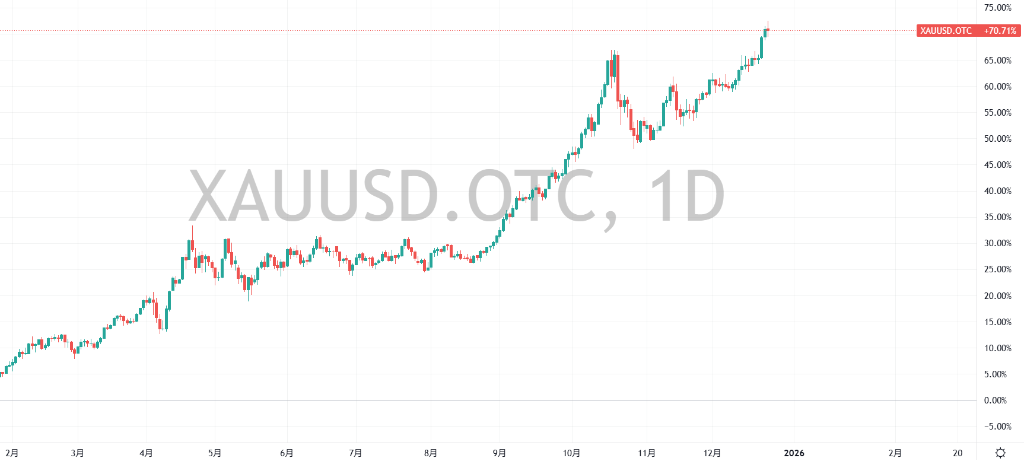
(Spot gold is up over 70% year-to-date)

Bitcoin, however, is missing out on both fronts. For a period in early 2025, Bitcoin's movement was highly synchronized with risk assets, but it has fallen behind noticeably in the year-end行情.

Furthermore, its long-touted 'digital gold' attribute has failed to attract the defensive capital inflows driving the gold price higher. Timothy Misir, Head of Research at digital asset research firm BRN, stated:

“Hard assets” are attracting funds as long-term hedges, while crypto assets remain marginalized.

Historically, Bitcoin's performance during the 'Santa Rally' has been unstable.

Although it posted gains of 33% and 46% during the Christmas to New Year period in 2011 and 2016 respectively, it fell 14% and 10% in 2014 and 2021.Since 2011, Bitcoin has averaged a gain of 7.9% during the Christmas period.

Deteriorating Technicals and Lack of Buying

Some market inertia stems from technical factors.

Bitcoin has broken below its 365-day moving average around $102,000, a level that had acted as key support during this cycle. Failure to reclaim this threshold increases the risk of a deeper correction.

Over $23 billion in options expiring on December 26th have locked in directional bets, reinforcing the stalemate. Thin holiday liquidity has further reduced market activity. But these factors only highlight a deeper缺失: a clear absence of buyers willing to step in.

Continued selling by long-term holders constitutes another drag.

Pratik Kala, Portfolio Manager at hedge fund Apollo Crypto, said Bitcoin's price action this year has been "clearly disconnected from the extremely bullish news cycle surrounding the asset".

He attributes this gap to persistent selling by early holders, including the sharp pullback in October, factors that have collectively prevented rallies from gaining momentum.

Kala stated that much of the selling pressure now appears to have subsided, leaving Bitcoin in a consolidation range,which he believes could lay the groundwork for stronger performance next year.

Continued ETF Outflows

As traders entered the Christmas holiday, market liquidity declining and risk appetite waning, spot Bitcoin and Ethereum ETFs saw renewed outflows on December 24th.

According to SoSoValue data, spot Bitcoin ETFs recorded net outflows of $175 million on Wednesday, while spot Ethereum ETFs saw outflows of $57 million.

The single largest outflow came from BlackRock's IBIT, which lost $91.37 million, followed by Grayscale's GBTC with net outflows of $24.62 million.

Spot Ethereum ETFs saw net outflows of $52.7 million that day, with Grayscale's ETHE leading the selling pressure with outflows of $33.78 million, bringing its historical cumulative net outflows to $5.083 billion.

This pattern aligns with market norms during major holidays: trading volume plummets, market making desks reduce positions, and持仓 strategies turn defensive.

Konstantin Vasilenko, co-founder of Paybis cryptocurrency exchange, told media thathe did not expect a 'Santa Rally'.

Due to tax reasons, traders in some regions liquidate cryptocurrencies and exit some risk positions before the new year, so he does not anticipate major moves before January.

For now, while U.S. stocks rise and gold shines, Bitcoin's stagnation is sending its own signal: an asset built on excitement has little to be excited about at year's end.

Связанные с этим вопросы

QWhat caused the flash crash of Bitcoin on Binance's BTC/USD1 trading pair?

AThe flash crash was caused by liquidity issues in the emerging stablecoin trading pair, where a large market sell order, forced liquidation, or automated trading quickly depleted the buy-side order book, leading to a temporary price deviation from the true market level.

QHow did Bitcoin's performance compare to traditional assets like the S&P 500 and gold during the Christmas period?

ABitcoin underperformed significantly, with a year-to-date decline of over 7% and a drop of 'Christmas rally,' while the S&P 500 hit a record high and gold surged over 70% for the year, marking its best annual performance since 1979.

QWhat technical factors contributed to Bitcoin's stagnant performance and increased risk of a deeper correction?

ABitcoin broke below the 365-day moving average around $102,000, a key support level in this cycle, and faced over $23 billion in options expiring on December 26, which froze directional bets and highlighted a lack of buyers.

QWhy did Bitcoin fail to attract defensive inflows as a 'digital gold' despite gold's strong rally?

AAccording to digital asset research, 'hard assets' like gold attracted long-term hedging funds, while crypto assets remained marginalized, failing to draw the same defensive capital.

QWhat was the trend in Bitcoin and Ethereum ETF flows during the holiday period, and what does it indicate?

ABitcoin spot ETFs saw a net outflow of $175 million, and Ethereum spot ETFs had an outflow of $57 million, reflecting reduced risk appetite and typical holiday market behavior with lower liquidity and defensive positioning.

Похожее

Торговля

Спот
Фьючерсы

Популярные статьи

Тест по Bitcoin Биткоина

HTX Learn: Изучите Bitcoin halving и Заработаете Токены USDT

3.0k просмотров всегоОпубликовано 2024.04.16Обновлено 2024.04.16

Тест по Bitcoin  Биткоина

Что такое $BITCOIN

ЦИФРОВОЕ ЗОЛОТО ($BITCOIN): Комплексный анализ Введение в ЦИФРОВОЕ ЗОЛОТО ($BITCOIN) ЦИФРОВОЕ ЗОЛОТО ($BITCOIN) — это проект на основе блокчейна, работающий в сети Solana, который стремится объединить характеристики традиционных драгоценных металлов с инновациями децентрализованных технологий. Хотя он носит имя Биткойн, часто называемого “цифровым золотом” из-за его восприятия как средства хранения ценности, ЦИФРОВОЕ ЗОЛОТО является отдельным токеном, предназначенным для создания уникальной экосистемы в ландшафте Web3. Его цель — позиционировать себя как жизнеспособный альтернативный цифровой актив, хотя детали его применения и функциональности все еще развиваются. Что такое ЦИФРОВОЕ ЗОЛОТО ($BITCOIN)? ЦИФРОВОЕ ЗОЛОТО ($BITCOIN) — это токен криптовалюты, специально разработанный для использования в блокчейне Solana. В отличие от Биткойна, который выполняет широко признанную роль хранения ценности, этот токен, похоже, сосредоточен на более широких приложениях и характеристиках. Примечательные аспекты включают: Инфраструктура блокчейна: Токен построен на блокчейне Solana, известном своей способностью обрабатывать высокоскоростные и недорогие транзакции. Динамика предложения: ЦИФРОВОЕ ЗОЛОТО имеет максимальное предложение, ограниченное 100 квадриллионами токенов (100P $BITCOIN), хотя детали о его обращающемся предложении в настоящее время не раскрыты. Утилита: Хотя точные функциональные возможности не описаны, есть указания на то, что токен может быть использован для различных приложений, потенциально связанных с децентрализованными приложениями (dApps) или стратегиями токенизации активов. Кто создатель ЦИФРОВОГО ЗОЛОТА ($BITCOIN)? На данный момент личность создателей и команды разработчиков, стоящих за ЦИФРОВЫМ ЗОЛОТОМ ($BITCOIN), остается неизвестной. Эта ситуация типична для многих инновационных проектов в области блокчейна, особенно тех, которые связаны с децентрализованными финансами и феноменом мем-криптовалют. Хотя такая анонимность может способствовать культуре, ориентированной на сообщество, она усиливает опасения по поводу управления и ответственности. Кто инвесторы ЦИФРОВОГО ЗОЛОТА ($BITCOIN)? Доступная информация указывает на то, что у ЦИФРОВОГО ЗОЛОТА ($BITCOIN) нет известных институциональных спонсоров или значительных венчурных капиталовложений. Проект, похоже, функционирует по модели пирингового взаимодействия, сосредоточенной на поддержке и принятии сообществом, а не на традиционных путях финансирования. Его активность и ликвидность в основном сосредоточены на децентрализованных биржах (DEX), таких как PumpSwap, а не на устоявшихся централизованных торговых платформах, что еще больше подчеркивает его подход, ориентированный на grassroots. Как работает ЦИФРОВОЕ ЗОЛОТО ($BITCOIN) Операционные механизмы ЦИФРОВОГО ЗОЛОТА ($BITCOIN) можно подробно описать на основе его дизайна блокчейна и характеристик сети: Механизм консенсуса: Используя уникальный механизм доказательства истории (PoH) Solana в сочетании с моделью доказательства доли (PoS), проект обеспечивает эффективную валидацию транзакций, что способствует высокой производительности сети. Токеномика: Хотя конкретные дефляционные механизмы не были подробно описаны, большое максимальное предложение токенов подразумевает, что оно может быть предназначено для микротранзакций или нишевых случаев использования, которые еще предстоит определить. Интероперабельность: Существует потенциал для интеграции с более широкой экосистемой Solana, включая различные платформы децентрализованных финансов (DeFi). Однако детали относительно конкретных интеграций остаются неуточненными. Хронология ключевых событий Вот хронология, которая подчеркивает значимые вехи, касающиеся ЦИФРОВОГО ЗОЛОТА ($BITCOIN): 2023: Первоначальное развертывание токена происходит в блокчейне Solana, отмеченное его адресом контракта. 2024: ЦИФРОВОЕ ЗОЛОТО приобретает видимость, когда оно становится доступным для торговли на децентрализованных биржах, таких как PumpSwap, позволяя пользователям обменивать его на SOL. 2025: Проект наблюдает спорадическую торговую активность и потенциальный интерес к инициативам, возглавляемым сообществом, хотя на данный момент не зафиксировано никаких значительных партнерств или технических достижений. Критический анализ Сильные стороны Масштабируемость: Основная инфраструктура Solana поддерживает высокие объемы транзакций, что может повысить полезность $BITCOIN в различных сценариях транзакций. Доступность: Потенциально низкая цена торговли за токен может привлечь розничных инвесторов, способствуя более широкому участию благодаря возможностям дробного владения. Риски Отсутствие прозрачности: Отсутствие публично известных спонсоров, разработчиков или процесса аудита может вызвать скептицизм относительно устойчивости и надежности проекта. Волатильность рынка: Торговая активность сильно зависит от спекулятивного поведения, что может привести к значительной волатильности цен и неопределенности для инвесторов. Заключение ЦИФРОВОЕ ЗОЛОТО ($BITCOIN) является интригующим, но неоднозначным проектом в быстро развивающейся экосистеме Solana. Хотя он пытается использовать нарратив “цифрового золота”, его отход от установленной роли Биткойна как средства хранения ценности подчеркивает необходимость более четкого различения его предполагаемой утилиты и структуры управления. Будущее принятие и усвоение, вероятно, будут зависеть от решения текущей непрозрачности и более четкого определения его операционных и экономических стратегий. Примечание: Этот отчет охватывает синтезированную информацию, доступную на октябрь 2023 года, и с тех пор могут произойти события.

99 просмотров всегоОпубликовано 2025.05.13Обновлено 2025.05.13

Что такое $BITCOIN

Fractal Bitcoin: масштабирование Биткоина с помощью рекурсивной системы

Fractal Bitcoin — масштабное Layer-1-решнение, созданное на базе кода Биткоина, позволяющего достигать бесконечного масштабирования с помощью рекурсивного подхода.

2.2k просмотров всегоОпубликовано 2025.06.30Обновлено 2025.06.30

Fractal Bitcoin: масштабирование Биткоина с помощью рекурсивной системы

Обсуждения

Добро пожаловать в Сообщество HTX. Здесь вы сможете быть в курсе последних новостей о развитии платформы и получить доступ к профессиональной аналитической информации о рынке. Мнения пользователей о цене на BTC (BTC) представлены ниже.

活动图片















