Bitcoin Market Stress Isn’t Over: Short-Term Holders Remain Underwater

bitcoinistОпубликовано 2026-01-01Обновлено 2026-01-01

Введение

Bitcoin has reclaimed $88,000 but struggles to break the key $90,000 resistance, reflecting weak upside momentum and persistent market indecision. Analysts warn of a potential 2026 bear market due to unfavorable structural conditions. On-chain data shows short-term holders (STHs) remain underwater, with BTC trading below their average cost basis since mid-October. The declining STH Realized Price signals weak new demand and ongoing distribution at lower prices. While Bitcoin holds above long-term moving averages, it faces strong resistance near $90,000–$95,000. Low trading volume suggests apathy, and without improved STH profitability or sustained demand, the stress regime is likely to continue.

Bitcoin has managed to reclaim the $88,000 level, yet it continues to struggle below the key $90,000 threshold, failing to sustain any meaningful breakout since early December. Despite several recovery attempts, upside momentum remains weak, reinforcing a broader sense of indecision across the market.

As fear and apathy dominate investor behavior, a growing number of analysts are now openly calling for a bear market to unfold in 2026, arguing that the current structure lacks the conditions needed for a renewed bullish phase.

This cautious outlook is reinforced by on-chain data shared by top analyst Axel Adler. According to his latest report, short-term holders (STHs) are firmly underwater, with Bitcoin trading well below their average cost basis. The STH Realized Price continues to trend lower, a signal that new demand entering the market is weak and increasingly price-insensitive.

Adler notes that this environment reflects pressure from above rather than outright capitulation. While sellers are active, the market has not yet reached the type of forced liquidation typically associated with cycle lows.

Instead, Bitcoin appears trapped in a prolonged stress regime, where confidence erodes gradually and rallies are sold into rather than followed through. Until short-term holder profitability improves, sentiment is likely to remain constrained.

Short-Term Holder Stress Persists

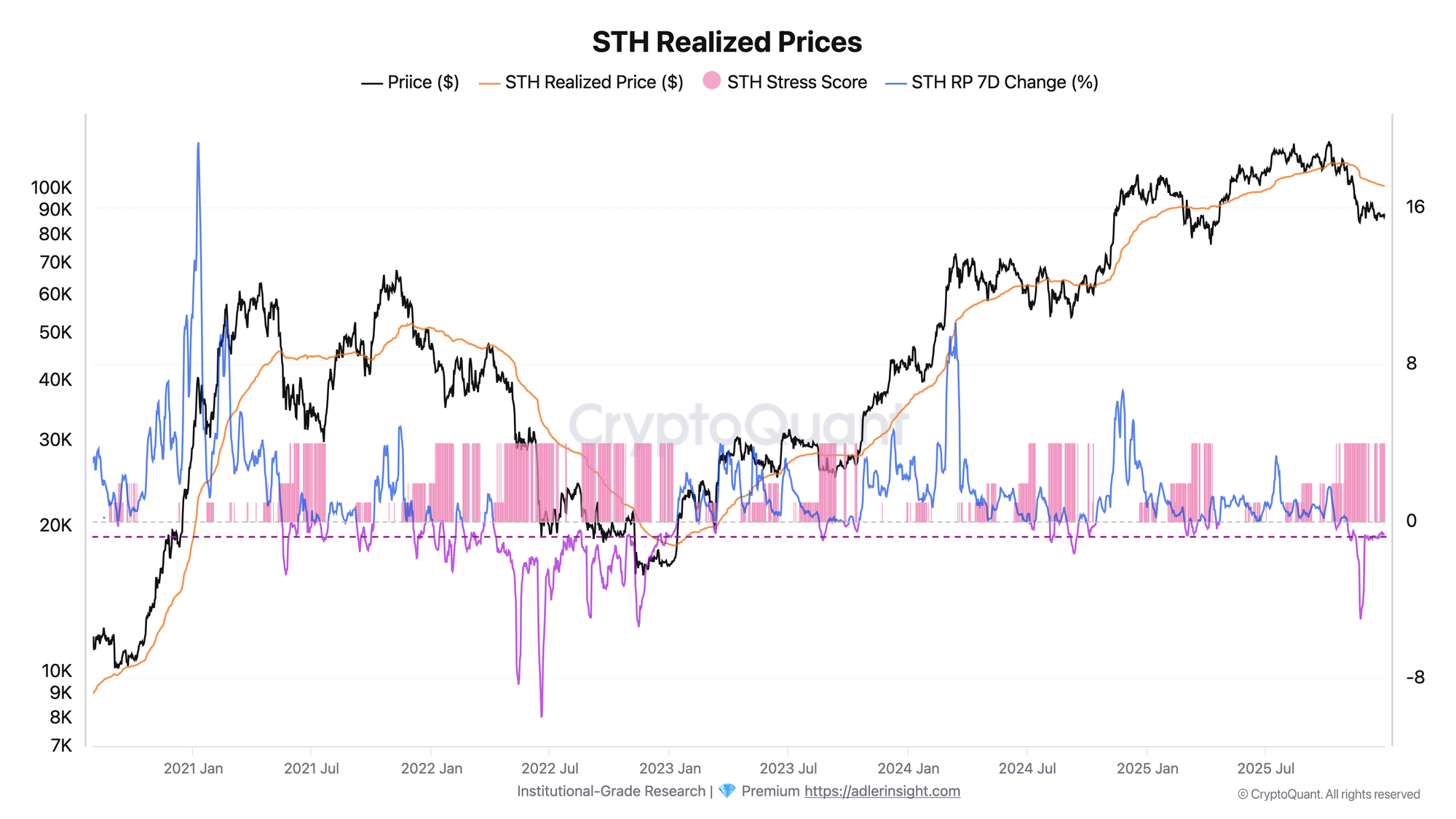
Adler’s latest analysis of Short-Term Holder (STH) Realized Price highlights why Bitcoin remains locked in a stress regime despite recent attempts to stabilize. The chart compares BTC price with the STH Realized Price—the average cost basis of coins held for less than 155 days—alongside stress indicators and weekly changes in that cost basis.

Bitcoin STH Realized Price | Source: Axel Adler

In this framework, the black line represents Bitcoin’s market price, while the orange line tracks the STH Realized Price. Additional overlays, including the STH Stress Score and weekly percentage changes, help contextualize shifts in short-term positioning.

According to Adler, Bitcoin has traded consistently below the STH Realized Price since October 17, confirming that stress mode remains active. The weekly change in STH Realized Price has stayed in negative territory and recently reached local lows, signaling that short-term holders continue to redistribute coins at lower prices rather than accumulate at higher levels. This behavior reflects weak incoming demand and reinforces overhead pressure.

Price performance across timeframes remains mixed. While Bitcoin has shown modest stabilization over shorter horizons—up roughly 0.9% on the week and 2.3% on the month—the broader picture remains fragile.

The 90-day performance is deeply negative at −26.7%, indicating that stress dominates across all major timeframes. Adler’s forecast model points to continued downside pressure, with an expected weekly decline of around 3% if current conditions persist.

Crucially, the declining STH Realized Price lowers the resistance “ceiling,” reducing the distance required to return to healthier conditions. However, it also underscores persistent weakness in new demand. A meaningful improvement would require the STH Realized Price to stabilize and turn higher while Bitcoin holds current price levels.

Bitcoin Holds Structure But Remains Capped Below Resistance

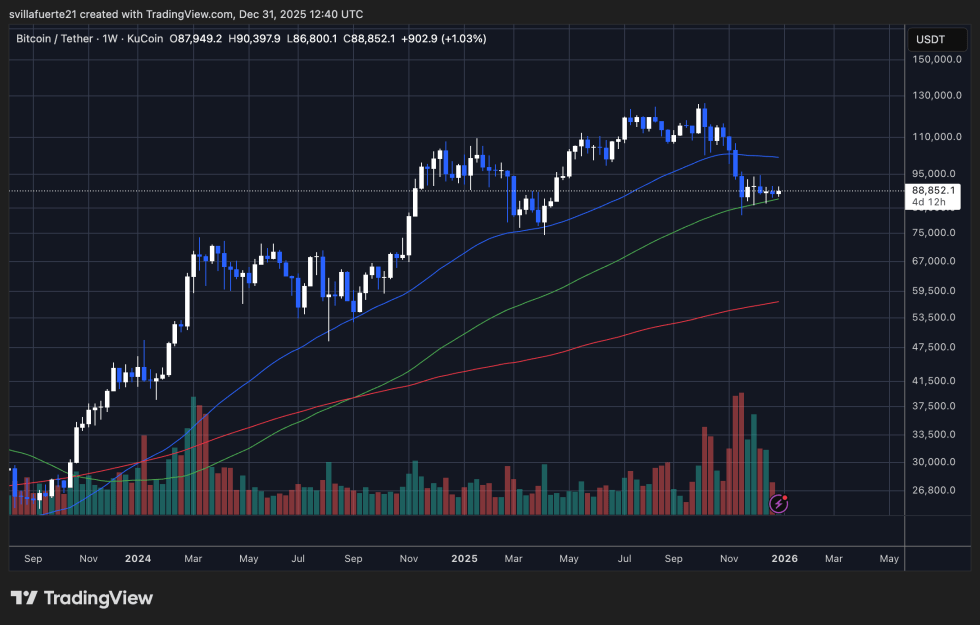
The weekly Bitcoin chart highlights a market caught between long-term structural support and persistent overhead resistance. BTC is trading near the $88,000–$89,000 zone, a level that has acted as a pivot since late November. While price has managed to reclaim this area, it has repeatedly failed to sustain a breakout above $90,000, signaling hesitation rather than renewed bullish momentum.

BTC consolidates above key level | Source: BTCUSDT chart on TradingView

From a trend perspective, Bitcoin remains above its 200-week moving average, which continues to slope upward and currently sits well below price, preserving the broader bullish market structure. The 100-week moving average is also rising and has provided dynamic support during recent pullbacks, reinforcing the idea that long-term buyers are still defending key levels. However, the 50-week moving average has flattened and now acts as immediate resistance, aligning with the broader supply zone between $90,000 and $95,000.

After a surge in activity during the sharp correction from October highs, recent weeks show declining volume, suggesting reduced participation and growing apathy among market participants. This environment often precedes a directional move but does not yet favor a clear upside resolution.

Technically, as long as Bitcoin holds above the rising 100-week moving average, downside risk appears structurally contained. However, failure to reclaim the 50-week average keeps the market vulnerable to extended consolidation or a deeper corrective phase before any sustainable recovery can develop.

Featured image from ChatGPT, chart from TradingView.com

Связанные с этим вопросы

QWhat is the current key resistance level that Bitcoin is struggling to break above?

ABitcoin is struggling to break above the key $90,000 threshold.

QAccording to analyst Axel Adler, what does the declining STH Realized Price signal about new market demand?

AThe declining STH Realized Price signals that new demand entering the market is weak and increasingly price-insensitive.

QSince when has Bitcoin been trading below the Short-Term Holder Realized Price, confirming the stress mode?

ABitcoin has been trading below the Short-Term Holder Realized Price since October 17.

QWhat is the 90-day performance percentage for Bitcoin, and what does it indicate?

AThe 90-day performance is -26.7%, indicating that stress dominates across all major timeframes.

QWhich moving average is currently acting as immediate resistance for Bitcoin's price on the weekly chart?

AThe 50-week moving average is acting as immediate resistance, aligning with the supply zone between $90,000 and $95,000.

Похожее

Yang Ge Gary: Agent Economy and AI Sub-Microeconomics

"Agent Economy and AI Submicroeconomics" by Gary Yang discusses the evolution of AI Agent economies, written from Singapore in June 2026. The author observes a significant "civilizational generational gap" in AI development, particularly highlighted by events in Silicon Valley. The article identifies a current bottleneck in the transition from Human-to-Agent (H2A) economies to true Agent-to-Agent (A2A) ecosystems. While AI Payment protocols are rapidly emerging, many implementations remain non-AI-native, focusing on traditional human decision-making models rather than leveraging autonomous Agent decision-making. A core thesis is the inevitable formation of an **Agent Economy**, defined as a system where autonomous AI Agents create, exchange, and capitalize value independently. This requires new infrastructure: **AI Protocols**, which are the foundational rules and standards for Agent interaction. The piece explores the relationship and current gap between AI Protocols and Crypto Protocols, suggesting political and regulatory factors from traditional finance are temporarily constraining development. However, a future fusion into a mature Digital Protocol system is deemed inevitable based on first principles. The author introduces **AI Agent Submicroeconomics**, contrasting it with human economics. Key differences include higher transaction frequency, lower value per transaction, efficiency-driven (not emotion-driven) decisions, task-oriented (not consumption-oriented) behavior, and near-zero organizational and communication costs. A biological analogy is drawn, comparing an Agent to a cell, its LLM to a nucleus, and its protocol stack to a cell membrane. The rise of **AIFi** (AI Finance) is presented as a natural consequence, where value originates from AI-native activities and is subsequently tokenized and financialized. This contrasts with DeFi/TradFi, where finance is the source of value. The concept of a **Financial Chip (FinChip)**—an autonomous AI Agent integrated with a crypto smart contract—is highlighted as key infrastructure for this new economy. The conclusion emphasizes that **AI-Native** thinking represents a paradigm shift distinct from "Internet+" upgrades. It requires reasoning from first principles, focusing on energy-value shortest paths and maximum efficiency, which presents a steep learning curve and significant challenge for all participants in this rapidly evolving field.

marsbit35 мин. назад

Yang Ge Gary: Agent Economy and AI Sub-Microeconomics

marsbit35 мин. назад

ViaBTC CEO Haipo Yang: Looking Back at the Decade, Re-understanding the Value of Crypto

In "A Decade in Retrospect: Re-evaluating the Value of Crypto," ViaBTC & CoinEx CEO Haipo Yang reflects on the cryptocurrency industry's evolution since founding ViaBTC in 2016. Initially a niche interest, Crypto has fundamentally transformed key financial infrastructures like market making, trading, settlement, and issuance through open protocols, as seen with Uniswap and GMX, and enabled efficient cross-border transfers via stablecoins. While acknowledging speculation's role in fueling innovation and liquidity, Yang warns it often overshadows real demand. He distinguishes between blockchain (a trust-minimizing technology), Web3 (an application model requiring genuine utility), and Crypto assets. The latter's value derives from block space as a commodity (e.g., gas fees) and "sovereign liquidity premium" (e.g., Bitcoin's censorship resistance), with most tokens lacking such dual support. Looking ahead, Yang argues the next decade's focus should shift from "open participation" to "sustainable participation," emphasizing reliable infrastructure. He predicts consolidation towards networks with strong security and liquidity (like Bitcoin and Ethereum), and sees DeFi becoming a specialized tool rather than a mass replacement for traditional finance. Crypto will integrate into traditional finance (e.g., via Bitcoin ETFs) but may sacrifice some decentralization for mainstream adoption. Real future demand may come from AI agents and machine economies needing permissionless settlement. Ultimately, Yang believes Crypto's enduring value lies not in hype or replacing everything, but in verifiably reducing trust costs, increasing efficiency, and providing stable, transparent services across market cycles.

marsbit35 мин. назад

ViaBTC CEO Haipo Yang: Looking Back at the Decade, Re-understanding the Value of Crypto

marsbit35 мин. назад

Торговля

Спот
Фьючерсы

Популярные статьи

Тест по Bitcoin Биткоина

HTX Learn: Изучите Bitcoin halving и Заработаете Токены USDT

3.1k просмотров всегоОпубликовано 2024.04.16Обновлено 2024.04.16

Тест по Bitcoin  Биткоина

Что такое $BITCOIN

ЦИФРОВОЕ ЗОЛОТО ($BITCOIN): Комплексный анализ Введение в ЦИФРОВОЕ ЗОЛОТО ($BITCOIN) ЦИФРОВОЕ ЗОЛОТО ($BITCOIN) — это проект на основе блокчейна, работающий в сети Solana, который стремится объединить характеристики традиционных драгоценных металлов с инновациями децентрализованных технологий. Хотя он носит имя Биткойн, часто называемого “цифровым золотом” из-за его восприятия как средства хранения ценности, ЦИФРОВОЕ ЗОЛОТО является отдельным токеном, предназначенным для создания уникальной экосистемы в ландшафте Web3. Его цель — позиционировать себя как жизнеспособный альтернативный цифровой актив, хотя детали его применения и функциональности все еще развиваются. Что такое ЦИФРОВОЕ ЗОЛОТО ($BITCOIN)? ЦИФРОВОЕ ЗОЛОТО ($BITCOIN) — это токен криптовалюты, специально разработанный для использования в блокчейне Solana. В отличие от Биткойна, который выполняет широко признанную роль хранения ценности, этот токен, похоже, сосредоточен на более широких приложениях и характеристиках. Примечательные аспекты включают: Инфраструктура блокчейна: Токен построен на блокчейне Solana, известном своей способностью обрабатывать высокоскоростные и недорогие транзакции. Динамика предложения: ЦИФРОВОЕ ЗОЛОТО имеет максимальное предложение, ограниченное 100 квадриллионами токенов (100P $BITCOIN), хотя детали о его обращающемся предложении в настоящее время не раскрыты. Утилита: Хотя точные функциональные возможности не описаны, есть указания на то, что токен может быть использован для различных приложений, потенциально связанных с децентрализованными приложениями (dApps) или стратегиями токенизации активов. Кто создатель ЦИФРОВОГО ЗОЛОТА ($BITCOIN)? На данный момент личность создателей и команды разработчиков, стоящих за ЦИФРОВЫМ ЗОЛОТОМ ($BITCOIN), остается неизвестной. Эта ситуация типична для многих инновационных проектов в области блокчейна, особенно тех, которые связаны с децентрализованными финансами и феноменом мем-криптовалют. Хотя такая анонимность может способствовать культуре, ориентированной на сообщество, она усиливает опасения по поводу управления и ответственности. Кто инвесторы ЦИФРОВОГО ЗОЛОТА ($BITCOIN)? Доступная информация указывает на то, что у ЦИФРОВОГО ЗОЛОТА ($BITCOIN) нет известных институциональных спонсоров или значительных венчурных капиталовложений. Проект, похоже, функционирует по модели пирингового взаимодействия, сосредоточенной на поддержке и принятии сообществом, а не на традиционных путях финансирования. Его активность и ликвидность в основном сосредоточены на децентрализованных биржах (DEX), таких как PumpSwap, а не на устоявшихся централизованных торговых платформах, что еще больше подчеркивает его подход, ориентированный на grassroots. Как работает ЦИФРОВОЕ ЗОЛОТО ($BITCOIN) Операционные механизмы ЦИФРОВОГО ЗОЛОТА ($BITCOIN) можно подробно описать на основе его дизайна блокчейна и характеристик сети: Механизм консенсуса: Используя уникальный механизм доказательства истории (PoH) Solana в сочетании с моделью доказательства доли (PoS), проект обеспечивает эффективную валидацию транзакций, что способствует высокой производительности сети. Токеномика: Хотя конкретные дефляционные механизмы не были подробно описаны, большое максимальное предложение токенов подразумевает, что оно может быть предназначено для микротранзакций или нишевых случаев использования, которые еще предстоит определить. Интероперабельность: Существует потенциал для интеграции с более широкой экосистемой Solana, включая различные платформы децентрализованных финансов (DeFi). Однако детали относительно конкретных интеграций остаются неуточненными. Хронология ключевых событий Вот хронология, которая подчеркивает значимые вехи, касающиеся ЦИФРОВОГО ЗОЛОТА ($BITCOIN): 2023: Первоначальное развертывание токена происходит в блокчейне Solana, отмеченное его адресом контракта. 2024: ЦИФРОВОЕ ЗОЛОТО приобретает видимость, когда оно становится доступным для торговли на децентрализованных биржах, таких как PumpSwap, позволяя пользователям обменивать его на SOL. 2025: Проект наблюдает спорадическую торговую активность и потенциальный интерес к инициативам, возглавляемым сообществом, хотя на данный момент не зафиксировано никаких значительных партнерств или технических достижений. Критический анализ Сильные стороны Масштабируемость: Основная инфраструктура Solana поддерживает высокие объемы транзакций, что может повысить полезность $BITCOIN в различных сценариях транзакций. Доступность: Потенциально низкая цена торговли за токен может привлечь розничных инвесторов, способствуя более широкому участию благодаря возможностям дробного владения. Риски Отсутствие прозрачности: Отсутствие публично известных спонсоров, разработчиков или процесса аудита может вызвать скептицизм относительно устойчивости и надежности проекта. Волатильность рынка: Торговая активность сильно зависит от спекулятивного поведения, что может привести к значительной волатильности цен и неопределенности для инвесторов. Заключение ЦИФРОВОЕ ЗОЛОТО ($BITCOIN) является интригующим, но неоднозначным проектом в быстро развивающейся экосистеме Solana. Хотя он пытается использовать нарратив “цифрового золота”, его отход от установленной роли Биткойна как средства хранения ценности подчеркивает необходимость более четкого различения его предполагаемой утилиты и структуры управления. Будущее принятие и усвоение, вероятно, будут зависеть от решения текущей непрозрачности и более четкого определения его операционных и экономических стратегий. Примечание: Этот отчет охватывает синтезированную информацию, доступную на октябрь 2023 года, и с тех пор могут произойти события.

99 просмотров всегоОпубликовано 2025.05.13Обновлено 2025.05.13

Что такое $BITCOIN

Fractal Bitcoin: масштабирование Биткоина с помощью рекурсивной системы

Fractal Bitcoin — масштабное Layer-1-решнение, созданное на базе кода Биткоина, позволяющего достигать бесконечного масштабирования с помощью рекурсивного подхода.

2.3k просмотров всегоОпубликовано 2025.06.30Обновлено 2025.06.30

Fractal Bitcoin: масштабирование Биткоина с помощью рекурсивной системы

Обсуждения

Добро пожаловать в Сообщество HTX. Здесь вы сможете быть в курсе последних новостей о развитии платформы и получить доступ к профессиональной аналитической информации о рынке. Мнения пользователей о цене на BTC (BTC) представлены ниже.

活动图片