Bitcoin Long-Term Holder Holdings Hit Eight-Month Low: Bullish Precursor or Bearish Signal?

marsbitОпубликовано 2025-12-16Обновлено 2025-12-16

Введение

Bitcoin's long-term holder (LTH) supply has reached an eight-month low, dropping to 14.3 million BTC, or 71.92% of the circulating supply—levels last seen in April. This decline suggests some LTHs are selling amid recent market pressure, with 761,000 BTC sold in the past 30 days. Historically, such reductions have occurred during retail-driven bull runs or near cycle tops when LTHs take profits. Technically, Bitcoin has broken below key supports, including the 50-week moving average and a bear flag pattern, with potential further downside toward the $80,000–$84,000 support area. A break below could see a test of the 200-week moving average near $68,500. While increased selling by whales ($2.78 billion in BTC sold recently) and weak technical indicators suggest short-term bearish momentum, the current LTH supply drop may also present an accumulation opportunity. If history repeats, as it did in April–July when LTH buying helped drive a 65% price surge, this could set the stage for a future rally. Market direction hinges on whether Bitcoin holds the $80k–$84k support zone.

The Bitcoin market has recently seen a key development: the amount of Bitcoin in long-term holder wallets has dropped to a cyclical low. This change has drawn widespread market attention—could it be enough to help bullish forces stabilize and prevent further declines toward $70,000?

Long-Term Holder Supply Falls to April Levels

So-called "Long-Term Holders" (LTHs) typically refer to entities holding Bitcoin for at least 155 days. According to the latest data from Glassnode, Bitcoin holdings by these investors have gradually decreased from 14.8 million in mid-July to approximately 14.3 million in December.

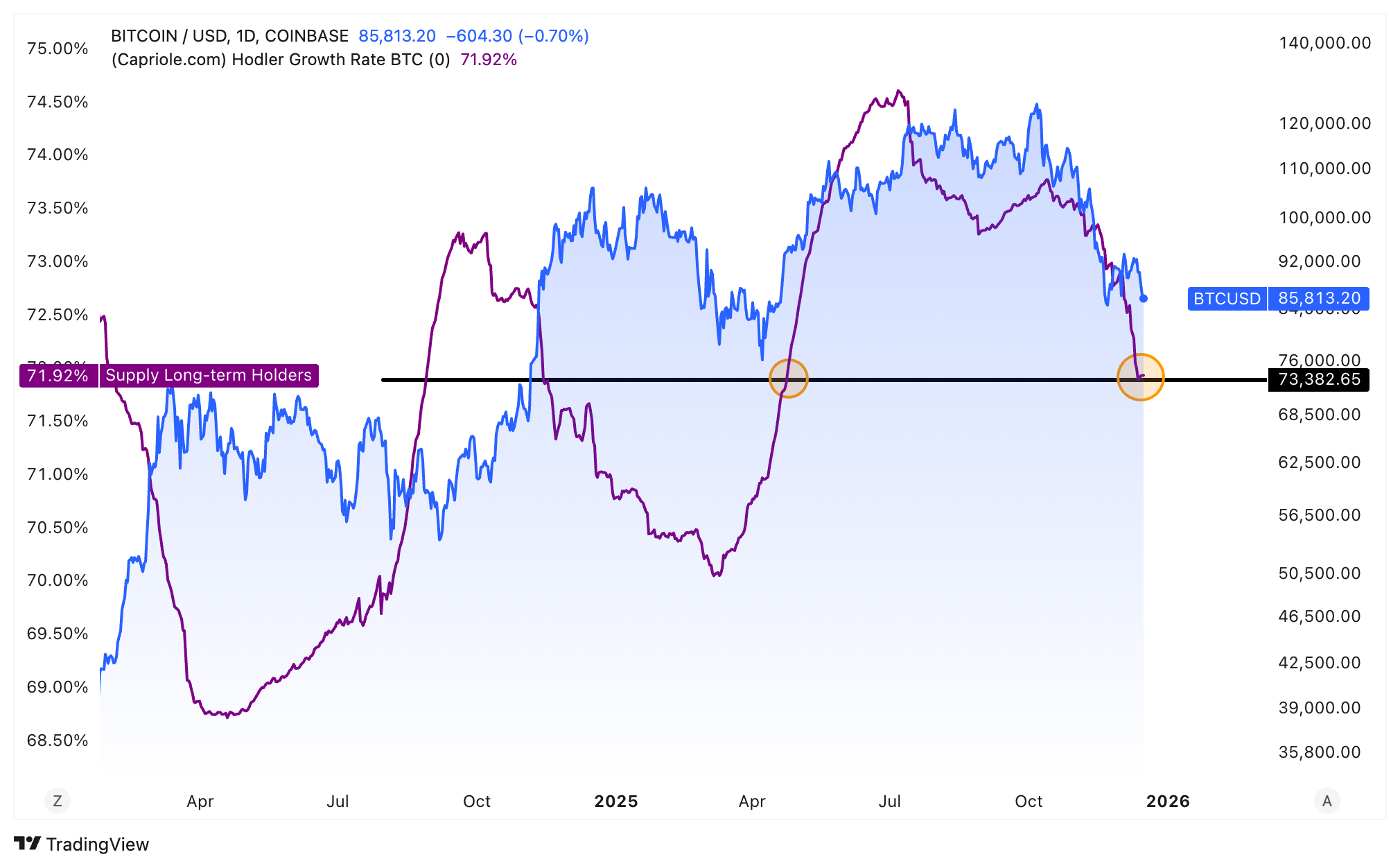
Correspondingly, the proportion of Bitcoin held by long-term holders relative to the total circulating supply has also fallen to 71.92%, a level comparable to that of April this year, as shown in the chart below.

Chart of Bitcoin Long-Term Holder Supply Percentage Change, Source: Capriole Investments


Looking back at the market in April, Bitcoin's price was retreating from its all-time high of $109,000 on January 20, falling to around $74,000 at one point. At that time, long-term holders took the opportunity to buy at lower levels, pushing their holding ratio to around 76% by July. The market then saw a rebound, with Bitcoin's price reaching a new high of approximately $123,000 on July 14, marking a gain of about 65% during that period.


If history repeats itself, current long-term holders are likely to view the recent drop in Bitcoin's price to around $84,000 as another accumulation opportunity, potentially driving the price to challenge all-time highs again in the coming months.


Cyclical Perspective: Patterns in Long-Term Holder Supply Changes


From a broader cyclical perspective, long-term holder supply typically shows significant declines during two phases:


First, during periods of market euphoria dominated by retail investors;


Second, near cycle tops, when long-term holders begin to take profits. This was evident in the bull markets of 2017 and 2021.


Focusing on recent data, CryptoQuant's statistics show that in the 30 days leading up to November 26, long-term holder supply decreased by approximately 1.1 million Bitcoin, the second-largest decline in history. As of December 15, long-term holder holdings have decreased by about 761,000 Bitcoin over the past 30 days. This seems to indicate that, as prices continue to face pressure, some long-term holders are choosing to exit, reflecting increased market concern.

Bitcoin 30-Day Rolling Long-Term Holder Supply Change Chart, Source: CryptoQuant


According to a Marsbit report, over the past month, Bitcoin whale addresses (typically entities holding large amounts of Bitcoin) have collectively sold approximately $2.78 billion worth of Bitcoin, adding sustained downward pressure to the market.


Technical Analysis: Can Bitcoin Hold Key Support Levels?


From a technical structure perspective, Bitcoin's recent performance has weakened, having successively lost support at the 50-week moving average and the year's opening price level of around $93,300.


The chart below shows that the BTC/USD trading pair broke below the lower boundary of the flag consolidation pattern near $92,000 on December 12, confirming a bearish flag pattern. Currently, the first support area of focus lies between the local low of $83,800 on December 1 and the multi-month low of $80,500 on November 21. If this area is breached, Bitcoin could further test the 200-week moving average near $68,500. This potential decline implies a drop of approximately 20% from the current price.

BTC/USD Daily Chart, Source: TradingView


Analyst Nic pointed out via social platform X on Tuesday: "Bitcoin has broken below key levels again, confirming a bearish signal." He added that the next "potential support" is the 100-week exponential moving average, around $85,500.


He further analyzed: "If this level is also broken, subsequent attention should turn to some important on-chain cost levels, such as $83,800 (ETF average cost basis) and $81,200 (realized market average cost), before potentially testing the psychological $80,000 level."


As previously analyzed by Marsbit, Bitcoin's 20-day exponential moving average has begun to turn downward, and the Relative Strength Index (RSI) is also in negative territory, both indicating that bears are dominant in the short term.


Summary and Outlook


The current Bitcoin market is in a delicate phase. The drop in the long-term holder supply ratio to an eight-month low can be interpreted from two angles:

On one hand, this may mean that some steadfast investors are choosing to sell during the price adjustment, perhaps due to concerns about further declines ahead or to take profits, which puts short-term pressure on the market.


On the other hand, historical patterns show that accumulation by long-term holders during price pullbacks often builds momentum for subsequent rallies.


The current decline in holding ratios might also create conditions for them to buy back at lower prices, thus forming new support. However, the market also faces clear short-term challenges: whale selling is adding pressure, technical charts show weakness, and key support levels are being tested one by one. Whether Bitcoin can find effective support in the $80,000 to $84,000 range will be crucial for determining the medium-term trend.


Связанные с этим вопросы

QWhat does the recent drop in Bitcoin long-term holder supply to an eight-month low indicate?

AThe recent decline in Bitcoin long-term holder (LTH) supply to an eight-month low, falling from 14.8 million BTC in mid-July to around 14.3 million BTC in December, can be interpreted in two ways. It may signal selling by steadfast investors due to concerns about further price declines or profit-taking, which adds short-term pressure. Alternatively, historically, such reductions have often preceded accumulation during price dips, potentially setting the stage for future rally, as seen in April when LTH buying helped drive a 65% price surge.

QHow does the current long-term holder supply percentage compare to April levels, and what was the market context then?

AThe current long-term holder supply percentage has decreased to 71.92%, which is comparable to the level seen in April. In April, Bitcoin's price had retreated from a high of $109,000 to around $74,000, and long-term holders seized the opportunity to accumulate at lower prices, boosting their holdings to about 76% by July. This accumulation phase preceded a significant price rebound, with Bitcoin reaching a new high of approximately $123,000 by mid-July.

QWhat are the key technical support levels for Bitcoin if the price continues to decline?

AKey technical support levels for Bitcoin include the region between the local low of $83,800 on December 1 and the multi-month low of $80,500 from November 21. If this area fails, the next major support is the 200-week moving average around $68,500. Additionally, the 100-week exponential moving average at approximately $85,500 and on-chain cost bases like the ETF average cost benchmark at $83,800 and the realized market average cost at $81,200 are critical levels to watch.

QWhat recent activity by Bitcoin whales has impacted the market, according to the article?

AAccording to the article, Bitcoin whale addresses have sold approximately $2.78 billion worth of Bitcoin over the past month. This substantial selling activity has contributed to ongoing downward pressure on the market, exacerbating the price decline and testing key support levels.

QHow do historical cycles show long-term holder supply changes typically behaving during market peaks?

AHistorically, long-term holder supply tends to decrease significantly during two phases: retail investor-driven market euphoria and near cycle tops when long-term holders begin profit-taking. This pattern was evident in the 2017 and 2021 bull markets, where LTHs reduced their holdings as prices peaked, indicating distribution to new buyers and often signaling a market top or correction.

Похожее

Stuck Polymarket: The Real Test After Riding the Traffic Boom Has Arrived

Polymarket, a leading prediction market platform, is facing significant technical challenges as its growth outpaces its current infrastructure on Polygon. Users are experiencing laggy transactions, unresponsive orders, and delayed confirmations, severely impacting the trading experience. In response, DeFi Engineering VP Josh Stevens outlined a comprehensive engineering overhaul. The plan includes reducing on-chain data delays, fixing order cancellation issues, rebuilding the central limit order book (CLOB), improving website performance, and developing a unified SDK and API. A major revelation was the ongoing "chain migration," indicating a potential move away from Polygon. The core issue is that Polymarket has evolved from a simple prediction market into a high-frequency trading platform, making Polygon's limitations—such as block space, gas fees, and block time—a ceiling for further growth. The migration is not just a simple chain switch but a fundamental rebuild of its trading system to support more complex products like perpetual contracts (Perps). This announcement has sparked competition among chains like Solana, Sui, and Algorand, all vying to host Polymarket. For Polygon, losing this key application, which contributes significantly to its gas fee revenue, would be a major setback. The real test for Polymarket is no longer attracting users but proving it can provide a stable, reliable trading environment that retains them.

Odaily星球日报1 ч. назад

Stuck Polymarket: The Real Test After Riding the Traffic Boom Has Arrived

Odaily星球日报1 ч. назад

Торговля

Спот
Фьючерсы

Популярные статьи

Тест по Bitcoin Биткоина

HTX Learn: Изучите Bitcoin halving и Заработаете Токены USDT

3.0k просмотров всегоОпубликовано 2024.04.16Обновлено 2024.04.16

Тест по Bitcoin  Биткоина

Что такое $BITCOIN

ЦИФРОВОЕ ЗОЛОТО ($BITCOIN): Комплексный анализ Введение в ЦИФРОВОЕ ЗОЛОТО ($BITCOIN) ЦИФРОВОЕ ЗОЛОТО ($BITCOIN) — это проект на основе блокчейна, работающий в сети Solana, который стремится объединить характеристики традиционных драгоценных металлов с инновациями децентрализованных технологий. Хотя он носит имя Биткойн, часто называемого “цифровым золотом” из-за его восприятия как средства хранения ценности, ЦИФРОВОЕ ЗОЛОТО является отдельным токеном, предназначенным для создания уникальной экосистемы в ландшафте Web3. Его цель — позиционировать себя как жизнеспособный альтернативный цифровой актив, хотя детали его применения и функциональности все еще развиваются. Что такое ЦИФРОВОЕ ЗОЛОТО ($BITCOIN)? ЦИФРОВОЕ ЗОЛОТО ($BITCOIN) — это токен криптовалюты, специально разработанный для использования в блокчейне Solana. В отличие от Биткойна, который выполняет широко признанную роль хранения ценности, этот токен, похоже, сосредоточен на более широких приложениях и характеристиках. Примечательные аспекты включают: Инфраструктура блокчейна: Токен построен на блокчейне Solana, известном своей способностью обрабатывать высокоскоростные и недорогие транзакции. Динамика предложения: ЦИФРОВОЕ ЗОЛОТО имеет максимальное предложение, ограниченное 100 квадриллионами токенов (100P $BITCOIN), хотя детали о его обращающемся предложении в настоящее время не раскрыты. Утилита: Хотя точные функциональные возможности не описаны, есть указания на то, что токен может быть использован для различных приложений, потенциально связанных с децентрализованными приложениями (dApps) или стратегиями токенизации активов. Кто создатель ЦИФРОВОГО ЗОЛОТА ($BITCOIN)? На данный момент личность создателей и команды разработчиков, стоящих за ЦИФРОВЫМ ЗОЛОТОМ ($BITCOIN), остается неизвестной. Эта ситуация типична для многих инновационных проектов в области блокчейна, особенно тех, которые связаны с децентрализованными финансами и феноменом мем-криптовалют. Хотя такая анонимность может способствовать культуре, ориентированной на сообщество, она усиливает опасения по поводу управления и ответственности. Кто инвесторы ЦИФРОВОГО ЗОЛОТА ($BITCOIN)? Доступная информация указывает на то, что у ЦИФРОВОГО ЗОЛОТА ($BITCOIN) нет известных институциональных спонсоров или значительных венчурных капиталовложений. Проект, похоже, функционирует по модели пирингового взаимодействия, сосредоточенной на поддержке и принятии сообществом, а не на традиционных путях финансирования. Его активность и ликвидность в основном сосредоточены на децентрализованных биржах (DEX), таких как PumpSwap, а не на устоявшихся централизованных торговых платформах, что еще больше подчеркивает его подход, ориентированный на grassroots. Как работает ЦИФРОВОЕ ЗОЛОТО ($BITCOIN) Операционные механизмы ЦИФРОВОГО ЗОЛОТА ($BITCOIN) можно подробно описать на основе его дизайна блокчейна и характеристик сети: Механизм консенсуса: Используя уникальный механизм доказательства истории (PoH) Solana в сочетании с моделью доказательства доли (PoS), проект обеспечивает эффективную валидацию транзакций, что способствует высокой производительности сети. Токеномика: Хотя конкретные дефляционные механизмы не были подробно описаны, большое максимальное предложение токенов подразумевает, что оно может быть предназначено для микротранзакций или нишевых случаев использования, которые еще предстоит определить. Интероперабельность: Существует потенциал для интеграции с более широкой экосистемой Solana, включая различные платформы децентрализованных финансов (DeFi). Однако детали относительно конкретных интеграций остаются неуточненными. Хронология ключевых событий Вот хронология, которая подчеркивает значимые вехи, касающиеся ЦИФРОВОГО ЗОЛОТА ($BITCOIN): 2023: Первоначальное развертывание токена происходит в блокчейне Solana, отмеченное его адресом контракта. 2024: ЦИФРОВОЕ ЗОЛОТО приобретает видимость, когда оно становится доступным для торговли на децентрализованных биржах, таких как PumpSwap, позволяя пользователям обменивать его на SOL. 2025: Проект наблюдает спорадическую торговую активность и потенциальный интерес к инициативам, возглавляемым сообществом, хотя на данный момент не зафиксировано никаких значительных партнерств или технических достижений. Критический анализ Сильные стороны Масштабируемость: Основная инфраструктура Solana поддерживает высокие объемы транзакций, что может повысить полезность $BITCOIN в различных сценариях транзакций. Доступность: Потенциально низкая цена торговли за токен может привлечь розничных инвесторов, способствуя более широкому участию благодаря возможностям дробного владения. Риски Отсутствие прозрачности: Отсутствие публично известных спонсоров, разработчиков или процесса аудита может вызвать скептицизм относительно устойчивости и надежности проекта. Волатильность рынка: Торговая активность сильно зависит от спекулятивного поведения, что может привести к значительной волатильности цен и неопределенности для инвесторов. Заключение ЦИФРОВОЕ ЗОЛОТО ($BITCOIN) является интригующим, но неоднозначным проектом в быстро развивающейся экосистеме Solana. Хотя он пытается использовать нарратив “цифрового золота”, его отход от установленной роли Биткойна как средства хранения ценности подчеркивает необходимость более четкого различения его предполагаемой утилиты и структуры управления. Будущее принятие и усвоение, вероятно, будут зависеть от решения текущей непрозрачности и более четкого определения его операционных и экономических стратегий. Примечание: Этот отчет охватывает синтезированную информацию, доступную на октябрь 2023 года, и с тех пор могут произойти события.

99 просмотров всегоОпубликовано 2025.05.13Обновлено 2025.05.13

Что такое $BITCOIN

Fractal Bitcoin: масштабирование Биткоина с помощью рекурсивной системы

Fractal Bitcoin — масштабное Layer-1-решнение, созданное на базе кода Биткоина, позволяющего достигать бесконечного масштабирования с помощью рекурсивного подхода.

2.2k просмотров всегоОпубликовано 2025.06.30Обновлено 2025.06.30

Fractal Bitcoin: масштабирование Биткоина с помощью рекурсивной системы

Обсуждения

Добро пожаловать в Сообщество HTX. Здесь вы сможете быть в курсе последних новостей о развитии платформы и получить доступ к профессиональной аналитической информации о рынке. Мнения пользователей о цене на BTC (BTC) представлены ниже.

活动图片