Bitcoin Enters Bull Regime As Taker Flow Surge Drives $3,400 Premium

bitcoinistОпубликовано 2026-03-17Обновлено 2026-03-17

Введение

Bitcoin has reclaimed the $70,000 level and is testing resistance near $74,000, signaling renewed bullish momentum. According to analyst Axel Adler, the Bitcoin Integrated Market Index has flipped back into a bullish regime, currently at 96, after a bearish period from mid-February. Key indicators show Bitcoin trading at a $3,453 premium above its Fair Value, with a Price Index of 95.35, suggesting strong buyer interest. The market structure shifted on March 10 as taker flow reversed and open interest expanded. A break above $74K could target the $82K–$90K range, though failure may lead to consolidation.

Bitcoin has reclaimed the $70,000 level and is now testing resistance near $74,000, signaling renewed strength after several weeks of volatile price action. The recent move higher suggests that buyers are regaining control as market sentiment begins to improve, with traders closely watching whether BTC can sustain momentum above this critical resistance zone.

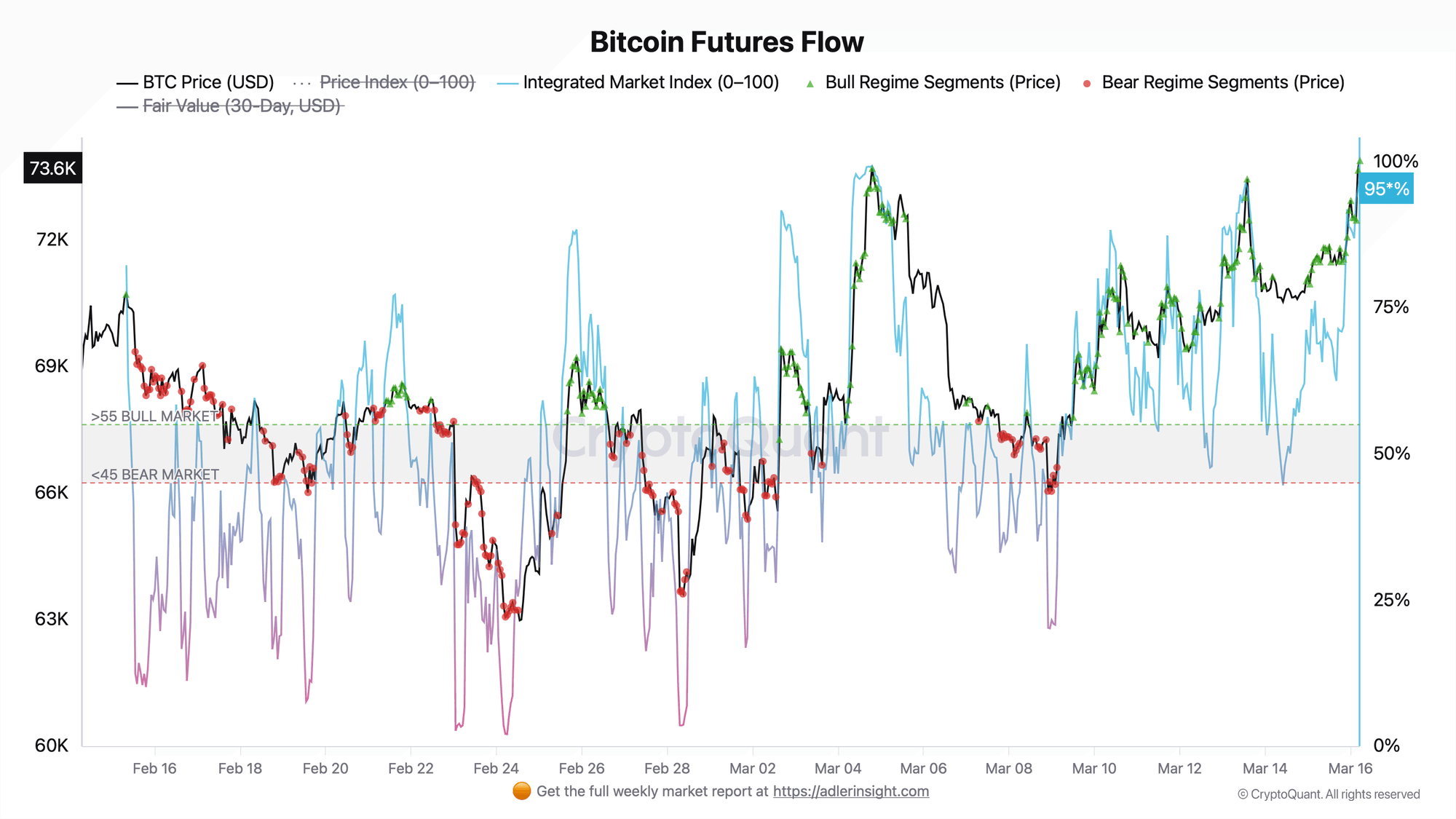
Beyond the price chart, derivatives market data is beginning to reflect a notable structural shift. According to top analyst Axel Adler, Bitcoin’s Integrated Market Index, a model designed to measure aggregate pressure from the derivatives market, has recently flipped back into a bullish regime.

The indicator operates on a 0–100 scale and combines normalized metrics of price behavior and futures market flows. Readings above 55 typically indicate a bullish regime, while values below 45 suggest bearish conditions.

Bitcoin Integrated Market Index (0-100) | Source: CryptoQuant

From February 15 onward, the model remained firmly in a bear regime. During that period, both price dynamics and futures market flows deteriorated simultaneously as sustained negative net taker volume and compression in open interest pushed the Flow Index below the bearish threshold. As Bitcoin’s price dropped toward $63,000, the Integrated Index reached its lowest levels.

However, the structure shifted on March 10, when taker flow reversed, and open interest began expanding again. Since that moment, the model has remained firmly bullish, with the index currently standing at 96, its highest level in weeks.

Price Index and Fair Value Confirm Bitcoin’s Regime Shift

Adler further explains that Bitcoin’s Price Index (0–100) and 30-day Fair Value model provide additional insight into how the market is behaving relative to its statistical equilibrium. The Price Index represents the normalized z-score of price, measuring how far Bitcoin deviates from its recent average, while Fair Value acts as an adjusted benchmark that reflects the prevailing market regime.

During the previous bear regime, Bitcoin consistently traded below Fair Value, signaling persistent market weakness. At the peak of selling pressure on February 24, the discount widened significantly. At that moment, Bitcoin was trading more than $3,300 below Fair Value, while the Price Index dropped to 1.85, indicating that price had deviated sharply below the statistical norm for that market environment.

Today, the situation has reversed. According to Adler’s data, the Price Index currently stands at 95.35, with Bitcoin trading around $73,886, while the model estimates Fair Value at approximately $70,433. This places the market at a premium of about $3,453 above Fair Value.

Adler notes that premiums exceeding $3,000 with a Price Index above 90 represent zones of heightened attention. However, this does not automatically imply an imminent reversal. As long as the Integrated Index remains strong—currently around 0.94—the premium is considered structurally justified, supporting the view that the current breakout reflects a genuine regime shift rather than a temporary price anomaly.

Bitcoin Tests Major Resistance After Recovery From February Selloff

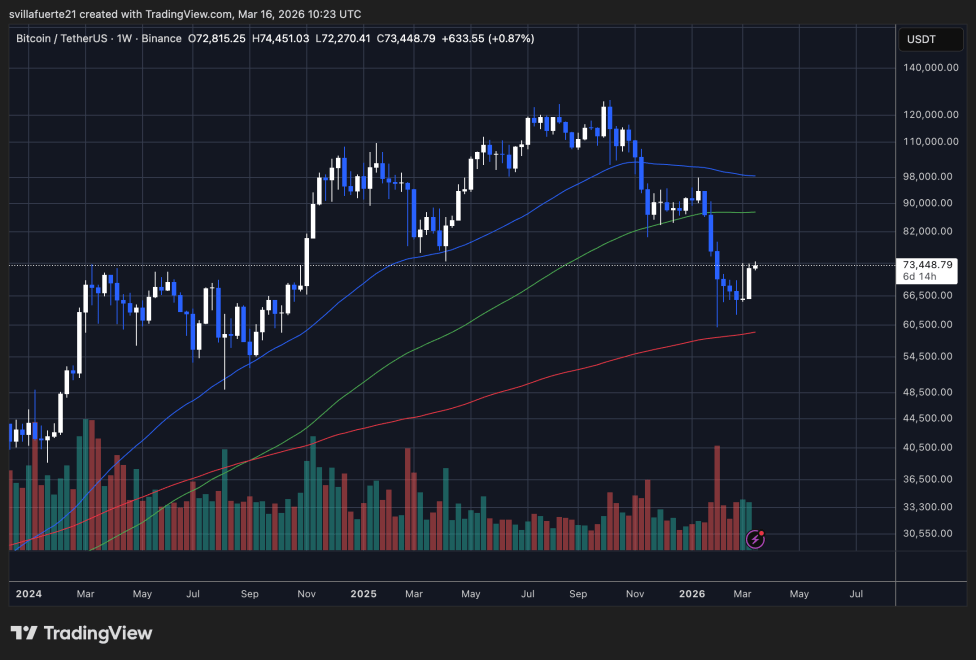
The weekly chart shows Bitcoin attempting to extend its recovery after the sharp decline that unfolded earlier in 2026. Following a prolonged uptrend that pushed BTC above the $110,000 region in late 2025, the market entered a corrective phase characterized by strong selling pressure and a sequence of lower highs.

BTC testing critical resistance | Source: BTCUSDT chart on TradingView

That correction accelerated in February, when Bitcoin dropped toward the $60,000–$65,000 zone, triggering a surge in trading volume that likely reflected forced liquidations and broader market capitulation. However, buyers stepped in quickly after the decline, allowing BTC to stabilize and begin a gradual rebound.

In recent weeks, Bitcoin has reclaimed the $70,000 level and is now trading near $73,400, approaching an important resistance zone around $74,000–$75,000. This region previously acted as a key support level before the February breakdown and is now functioning as overhead resistance.

From a technical perspective, Bitcoin remains above its 200-week moving average, which continues to slope upward and serves as a critical long-term support indicator. Meanwhile, the 100-week moving average sits above the current price, suggesting that BTC must reclaim higher levels to fully confirm a bullish continuation.

If Bitcoin manages to break above the $74K resistance zone, the next upside targets could emerge around the $82K–$90K range. However, failure to sustain momentum may lead to renewed consolidation as the market absorbs recent volatility.

Featured image from ChatGPT, chart from TradingView.com

Связанные с этим вопросы

QWhat does Bitcoin's Integrated Market Index flipping back into a bullish regime indicate?

AIt indicates a notable structural shift in the derivatives market, with the index (on a 0-100 scale) now at 96, reflecting renewed strength and bullish conditions as taker flow reversed and open interest began expanding again.

QHow is the current Bitcoin price premium above Fair Value interpreted according to analyst Axel Adler?

AThe premium of about $3,453 above Fair Value, coupled with a Price Index above 90, represents a zone of heightened attention but is considered structurally justified as long as the Integrated Index remains strong (around 0.94), supporting a genuine regime shift rather than a temporary anomaly.

QWhat critical resistance level is Bitcoin currently testing after its recent recovery?

ABitcoin is currently testing resistance near the $74,000–$75,000 zone, which previously acted as key support before the February breakdown and now functions as overhead resistance.

QWhat were the key factors that pushed the Integrated Market Index into a bear regime from February 15 onward?

ASustained negative net taker volume and compression in open interest simultaneously deteriorated price dynamics and futures market flows, pushing the Flow Index below the bearish threshold and causing the Integrated Index to reach its lowest levels as Bitcoin's price dropped toward $63,000.

QWhat are the potential upside targets if Bitcoin breaks above the $74K resistance zone?

AIf Bitcoin breaks above the $74K resistance zone, the next upside targets could emerge around the $82K–$90K range.

Похожее

I Built Myself an Investment Workbench Using AI

For the past two weeks, I've been immersed in Vibe Coding—using AI to write code from natural language descriptions. This process has enabled me to quickly build functional tools that address long-standing personal ideas. Previously, I had many concepts but found execution too cumbersome. Key ideas included a unified dashboard for assets across US stocks, Crypto, HK stocks, and A-shares; a real-time alert system for price movements; an investment map visualizing sector relationships; and a tool to correlate prediction market bets with news and market data. Traditional development hurdles meant these often remained unrealized. Using AI (Codex, Claude Code, and DeepSeek API), I built four initial tools: 1. A **Cross-Market Asset Dashboard** showing total assets, daily P&L, and holdings by market, with added features for alerts and sector mapping. It's deployed locally for privacy. 2. A **Prediction Market (PM) Monitor** tracking bets on events (e.g., company valuations) and correlating probability shifts with news and market movements. I categorize bets by conviction to filter noise. 3. A **Simple Operations Backend** for managing my writing workflow (topics, progress, publishing). It's cloud-deployed for mobile access. 4. A **One-Click Formatting Tool** that automates converting drafts into various platform-specific formats, saving manual effort. While these tools are basic, they represent a significant shift: AI lowers the barrier to creating personalized systems. I believe individual investors can now feasibly build core systems for: * **Asset Observation** (tracking holdings and changes) * **Signal Monitoring** (watching for key market shifts) * **Sector Mapping** (understanding network relationships within a sector) * **Performance Review** (documenting rationale and outcomes) The power of Vibe Coding is its fast feedback loop. Ideas can be implemented, tested, and iterated on rapidly, turning "want-to-do" into "done." This marks the start of my new phase, where I'll share investment thoughts, tool tests, on-chain operations, and educational Web3 content.

marsbit2 мин. назад

I Built Myself an Investment Workbench Using AI

marsbit2 мин. назад

After Tokenization of Assets, How to Exit?

Title: How to Exit After Asset Tokenization? Author: Symbiotic Compiled by: Hu Tao, ChainCatcher Summary: Tokenization addresses how assets go on-chain but largely leaves the redemption question unresolved. While tokenized assets can settle instantly, the underlying redemption for assets like treasuries, private credit, or real estate can take from T+1 to 180 days. This gap hinders DeFi adoption of Real World Assets (RWAs). Three emerging models aim to provide instant exit liquidity, differing primarily in their capital structure and efficiency: 1. **Balance Sheet Model (e.g., Grove Basin):** A single entity (like Sky) provides immediate liquidity from its balance sheet, acting as a bridge during the settlement period. It offers simplicity and deep initial liquidity but is constrained by a single entity's capacity and risk appetite. 2. **Asset-Specific Vault Model (e.g., Upshift Clear):** Independent liquidity providers fund dedicated vaults for each supported asset, earning fees. It decentralizes capital sources but isolates liquidity and capital per asset, leading to potential fragmentation. 3. **Shared Liquidity Layer Model (e.g., Symbiotic Liquid Lane):** A shared capital pool supports multiple RWA types simultaneously. Funds remain productive between redemptions (e.g., earning yield in lending markets). Exits are settled via a competitive RFQ market. This model aims for higher capital efficiency, scalability across assets, and serves longer-duration assets like private credit. Key differentiators are: 1) Source of capital and risk bearer, 2) Redemption pricing mechanism, 3) Capital efficiency, 4) Scalability to new asset types, and 5) Composability. The shared liquidity layer model represents a move from piecemeal solutions toward scalable infrastructure, enabling T+0 exits by pooling capital, maintaining yield, and using competitive pricing, thus enhancing RWA utility in DeFi.

marsbit15 мин. назад

After Tokenization of Assets, How to Exit?

marsbit15 мин. назад

After Tokenizing Assets, How to Exit?

After tokenization, a key unresolved issue is providing holders with a reliable exit mechanism, as underlying asset settlement (taking days to months) lags far behind on-chain token settlement. Three primary models for instant liquidity have emerged, differing in their capital structure and efficiency: 1. **Balance Sheet Model (e.g., Grove Basin):** A single, well-capitalized entity (like Sky) provides immediate liquidity from its own reserves. This offers simplicity and deep initial liquidity but is constrained by that single balance sheet's capacity and risk appetite, limiting scalability. 2. **Dedicated Vault Model (e.g., Upshift Clear):** Independent liquidity providers (LPs) fund separate vaults for each supported asset. This decentralizes capital sources but isolates liquidity and capital, which becomes inefficient as the number of tokenized assets grows. 3. **Shared Liquidity Layer Model (Symbiotic Liquid Lane):** Independent capital providers fund shared vaults that can support multiple tokenized assets simultaneously. Capital remains productive between redemptions (e.g., earning yield in DeFi markets). Exits are settled via a competitive RFQ market where market makers bid. The article argues that the shared layer model offers superior capital efficiency and scalability. It transforms exit liquidity from an asset-specific patch into shared market infrastructure, allowing liquidity capacity to grow with overall market participation rather than being fragmented per asset. This is particularly valuable for longer-duration assets like private credit, where reliable T+0 exits can significantly enhance their utility in DeFi.

链捕手29 мин. назад

After Tokenizing Assets, How to Exit?

链捕手29 мин. назад

Anthropic's Triple Moment: Code Leak, Government Confrontation, and Weaponization

This article analyzes Anthropic's recent conflicts and strategic moves following the U.S. government's emergency halt of its new Fable model, citing national security concerns over potential "jailbreaks." The author argues this incident reveals deeper tensions between AI labs, governments, and the software industry. While critics view Anthropic's safety-focused rhetoric as marketing fear, the author suggests it serves as a commercial moat masking the company's core economic imperative: moving closer to end-users and their valuable data to avoid being commoditized. The piece outlines a coming clash between frontier AI labs like Anthropic and established software companies. Labs need real-world usage data for model improvement via reinforcement learning, creating a cycle where better products attract more users and more data. This threatens software firms who, as Microsoft's Satya Nadella warns, risk having their value captured by a few dominant models. Anthropic's controversial policy changes—initially secretly degrading Fable's performance for LLM development and expanding data retention—are framed as assertions of control, justified by its safety narrative. The company's foundational belief that it alone is sufficiently concerned about superintelligent AI dangers legitimizes its actions, from resisting government demands to shaping usage policies. The author concludes that this alignment of mission, talent, and business strategy is powerful but concerning, as it concentrates immense potential power in the hands of those convinced of their own righteous understanding.

marsbit39 мин. назад

Anthropic's Triple Moment: Code Leak, Government Confrontation, and Weaponization

marsbit39 мин. назад

Торговля

Спот
Фьючерсы

Популярные статьи

Как купить FLOW

Добро пожаловать на HTX.com! Мы сделали приобретение Flow (FLOW) простым и удобным. Следуйте нашему пошаговому руководству и отправляйтесь в свое крипто-путешествие.Шаг 1: Создайте аккаунт на HTXИспользуйте свой адрес электронной почты или номер телефона, чтобы зарегистрироваться и бесплатно создать аккаунт на HTX. Пройдите удобную регистрацию и откройте для себя весь функционал.Создать аккаунтШаг 2: Перейдите в Купить криптовалюту и выберите свой способ оплатыКредитная/Дебетовая Карта: Используйте свою карту Visa или Mastercard для мгновенной покупки Flow (FLOW).Баланс: Используйте средства с баланса вашего аккаунта HTX для простой торговли.Третьи Лица: Мы добавили популярные способы оплаты, такие как Google Pay и Apple Pay, для повышения удобства.P2P: Торгуйте напрямую с другими пользователями на HTX.Внебиржевая Торговля (OTC): Мы предлагаем индивидуальные услуги и конкурентоспособные обменные курсы для трейдеров.Шаг 3: Хранение Flow (FLOW)После приобретения вами Flow (FLOW) храните их в своем аккаунте на HTX. В качестве альтернативы вы можете отправить их куда-либо с помощью перевода в блокчейне или использовать для торговли с другими криптовалютами.Шаг 4: Торговля Flow (FLOW)С легкостью торгуйте Flow (FLOW) на спотовом рынке HTX. Просто зайдите в свой аккаунт, выберите торговую пару, совершайте сделки и следите за ними в режиме реального времени. Мы предлагаем удобный интерфейс как для начинающих, так и для опытных трейдеров.

532 просмотров всегоОпубликовано 2024.03.29Обновлено 2026.06.02

Как купить FLOW

Обсуждения

Добро пожаловать в Сообщество HTX. Здесь вы сможете быть в курсе последних новостей о развитии платформы и получить доступ к профессиональной аналитической информации о рынке. Мнения пользователей о цене на FLOW (FLOW) представлены ниже.

活动图片