Bitcoin Developers Kick Off Quantum-Safety Track With BIP-360

bitcoinistОпубликовано 2026-02-13Обновлено 2026-02-13

Введение

Bitcoin developers have advanced quantum-resistance efforts by merging an updated draft of BIP-360 into the official repository. The proposal introduces Pay-to-Merkle-Root (P2MR), a new SegWit v2 output type that removes Taproot’s key-path spend—deemed most vulnerable to quantum attacks—while retaining script-tree functionality. P2MR addresses long-exposure quantum risks, where public keys remain on-chain for extended periods, but does not protect against short-exposure attacks targeting unconfirmed transactions. As a soft fork, it creates a new address type (bc1z) without affecting existing Taproot outputs. Trade-offs include larger witness sizes and reduced privacy, as all spends reveal script usage. The proposal marks a concrete step in formalizing quantum-preparedness, though future work on post-quantum signatures may be needed.

Bitcoin’s quantum-security discussion just gained a concrete new artifact in the code-and-spec pipeline: an updated draft of BIP-360 has been merged into the official Bitcoin Improvement Proposals repository, proposing a Taproot-adjacent output type designed to limit exposure to future quantum key-recovery attacks.

The change matters less because it “solves” quantum risk today, and more because it formalizes a specific, opt-in path that preserves Taproot’s script-tree functionality while removing the spending route considered most problematic under a quantum-threat model.

Bitcoin Devs Make First Formal Quantum-Resistance Move

Anduro, a research-focused platform incubated by Marathon Digital (MARA), said on X that the merged update “introduces Pay-to-Merkle-Root (P2MR), a proposed new output type that omits Taproot’s quantum-vulnerable key-path spend while preserving compatibility with Tapscript and script trees.”

In BIP terms, the proposal is scoped as “Consensus (soft fork)” and defines P2MR as a new SegWit v2 output that commits directly to the Merkle root of a script tree, rather than to a tweaked public key as in Pay-to-Taproot (P2TR). The practical implication is straightforward: P2MR outputs can only be spent via script-path logic; the key-path spend is removed entirely.

The BIP’s abstract frames the goal in terms of minimizing changes while providing an option set for users who want additional protection:

“This document proposes a new output type: Pay-to-Merkle-Root (P2MR), via a soft fork. P2MR outputs operate with nearly the same functionality as P2TR (Pay-to-Taproot) outputs, but with the key path spend removed.”
It adds that the intended protection is against “long exposure attacks by Cryptographically Relevant Quantum Computers (CRQCs),” as well as “future cryptanalytic approaches that may compromise the elliptic curve cryptography (ECC) used by Bitcoin.”

A key element of the BIP is definitional discipline: it distinguishes “long exposure” attacks (where public keys are available on-chain for extended periods) from “short exposure” attacks, which would target public keys revealed briefly in the mempool during an unconfirmed spend.

The document is explicit that P2MR is not a complete quantum shield. “It is worth noting that proposed P2MR outputs are only resistant to ‘long exposure attacks’ on elliptic curve cryptography; that is, attacks on keys exposed for time periods longer than needed to confirm a spending transaction,” the BIP states.

“Protection against more sophisticated quantum attacks, including protection against private key recovery from public keys exposed in the mempool while a transaction is waiting to be confirmed (a.k.a. ‘short exposure attacks’), may require the introduction of post-quantum signatures in Bitcoin.” The authors add they “intend to offer a separate proposal for this purpose upon further research.”

That split is also why the proposal emphasizes tapscript compatibility. It positions P2MR as a script-tree output type that could, if Bitcoin ever adopts post-quantum signature opcodes, provide a cleaner upgrade runway than older script mechanisms that don’t support tapscript’s evolution path.

Anduro highlighted that the change is designed as a soft fork and “does not affect existing Taproot outputs.” P2MR would be a new output type (with bech32m addresses starting with bc1z) rather than a retrofit of existing bc1p Taproot UTXOs.

The proposal also doesn’t pretend the swap is free. By removing key-path spends, P2MR gives up Taproot’s most compact witness path (a single Schnorr signature). The BIP estimates that a minimal P2MR spend witness is 37 bytes larger than a Taproot key-path spend, though it can be smaller than an equivalent Taproot script-path spend because P2MR’s control block omits an internal public key.

Privacy shifts too. Because every spend is script-path, P2MR users necessarily reveal they are spending from a script tree—something Taproot key-path spends can avoid signaling.

Anduro said the update also “addresses criticism about Bitcoin devs not taking the quantum threat seriously,” and noted the addition of Isabel Foxen Duke as co-author to make the BIP clearer “to the general public, not just the Bitcoin developer community.”

BIP-360 remains in “Draft” status. But its merge into the canonical repository is still a meaningful process marker: it moves the quantum-safety conversation from abstract worry and mailing-list hypotheticals toward a specific consensus change proposal that wallets, libraries, and reviewers can now analyze line-by-line.

If the debate has a next phase, it’s likely to center on whether “prepared not scared” opt-ins like P2MR are sufficient groundwork or whether Bitcoin will eventually need to grapple directly with post-quantum signatures and the operational realities of migrating value at scale.

At press time, BTC traded at $66,558.
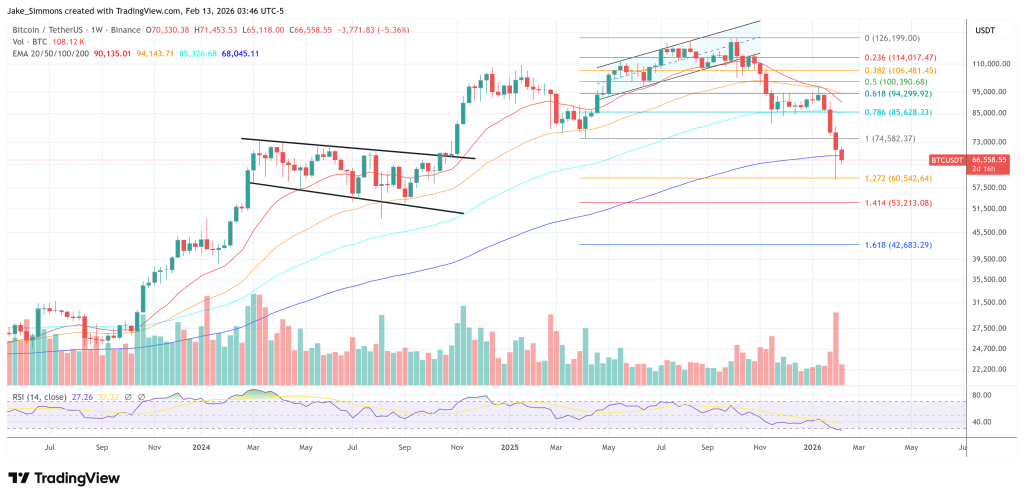
Bitcoin must reclaim the 200-week EMA, 1-week chart | Source: BTCUSDT on TradingView.com

Связанные с этим вопросы

QWhat is the main purpose of the newly proposed BIP-360 update?

AThe main purpose of BIP-360 is to propose a new output type called Pay-to-Merkle-Root (P2MR), which removes the quantum-vulnerable key-path spend from Taproot while preserving compatibility with Tapscript and script trees, offering protection against long exposure quantum threats.

QHow does the Pay-to-Merkle-Root (P2MR) output type differ from Pay-to-Taproot (P2TR)?

AP2MR commits directly to the Merkle root of a script tree, removing the key-path spend entirely, whereas P2TR commits to a tweaked public key and allows for both key-path and script-path spends.

QWhat specific quantum threat does P2MR aim to protect against, and what does it not protect against?

AP2MR aims to protect against 'long exposure attacks' where public keys are exposed on-chain for extended periods. It does not protect against 'short exposure attacks' where keys are briefly revealed in the mempool, which would require post-quantum signatures.

QWhat are some trade-offs of using P2MR outputs compared to Taproot?

AP2MR gives up Taproot's most compact witness path, resulting in a minimal spend witness that is 37 bytes larger. It also reduces privacy because every spend reveals the use of a script tree, unlike Taproot key-path spends which can avoid signaling.

QWhat is the current status of BIP-360 and why is its merge into the repository significant?

ABIP-360 is in 'Draft' status. Its merge into the official Bitcoin Improvement Proposals repository is significant because it moves the quantum-safety discussion from abstract concerns to a specific, analyzable consensus change proposal for the community.

Похожее

Yao Shunyu's 88 Days

Yao Shunyu, a 27-year-old AI expert with a background from Princeton and OpenAI, joined Tencent in September 2025. Within 88 days, he led a major overhaul of Tencent’s AI strategy and organization, resulting in the release of Hunyuan Hy3 preview—a MoE model with 295B total parameters and 21B active parameters, supporting up to 256K context length. The launch came after Tencent leadership, including CEO Ma Huateng and President Martin Lau, openly criticized Hunyuan's earlier underperformance—citing slow development, over-reliance on superficial benchmark optimization, and poor generalization in real-world applications. Internal adoption was low, with key business units like WeChat and gaming seeking external AI solutions. Yao reshaped Tencent’s AI approach by integrating previously siloed teams, dissolving the ten-year-old Tencent AI Lab, and establishing new units focused on AI infrastructure and data. Hy3 preview was developed using co-design principles, closely aligned with product teams to ensure practical usability from the start. It has already been integrated into core products like Yuanbao, QQ, and enterprise tools. The release signals a shift from chasing rankings to building usable, scalable AI grounded in Tencent’s ecosystem. While external partnerships (like with DeepSeek and OpenClaw) helped retain users temporarily, the focus is now on making Hunyuan a reliable internal foundation. The real test lies in sustaining this new organizational momentum amid fierce competition from Alibaba, DeepSeek, and others.

marsbit58 мин. назад

Yao Shunyu's 88 Days

marsbit58 мин. назад

Торговля

Спот
Фьючерсы

Популярные статьи

Тест по Bitcoin Биткоина

HTX Learn: Изучите Bitcoin halving и Заработаете Токены USDT

3.0k просмотров всегоОпубликовано 2024.04.16Обновлено 2024.04.16

Тест по Bitcoin  Биткоина

Что такое $BITCOIN

ЦИФРОВОЕ ЗОЛОТО ($BITCOIN): Комплексный анализ Введение в ЦИФРОВОЕ ЗОЛОТО ($BITCOIN) ЦИФРОВОЕ ЗОЛОТО ($BITCOIN) — это проект на основе блокчейна, работающий в сети Solana, который стремится объединить характеристики традиционных драгоценных металлов с инновациями децентрализованных технологий. Хотя он носит имя Биткойн, часто называемого “цифровым золотом” из-за его восприятия как средства хранения ценности, ЦИФРОВОЕ ЗОЛОТО является отдельным токеном, предназначенным для создания уникальной экосистемы в ландшафте Web3. Его цель — позиционировать себя как жизнеспособный альтернативный цифровой актив, хотя детали его применения и функциональности все еще развиваются. Что такое ЦИФРОВОЕ ЗОЛОТО ($BITCOIN)? ЦИФРОВОЕ ЗОЛОТО ($BITCOIN) — это токен криптовалюты, специально разработанный для использования в блокчейне Solana. В отличие от Биткойна, который выполняет широко признанную роль хранения ценности, этот токен, похоже, сосредоточен на более широких приложениях и характеристиках. Примечательные аспекты включают: Инфраструктура блокчейна: Токен построен на блокчейне Solana, известном своей способностью обрабатывать высокоскоростные и недорогие транзакции. Динамика предложения: ЦИФРОВОЕ ЗОЛОТО имеет максимальное предложение, ограниченное 100 квадриллионами токенов (100P $BITCOIN), хотя детали о его обращающемся предложении в настоящее время не раскрыты. Утилита: Хотя точные функциональные возможности не описаны, есть указания на то, что токен может быть использован для различных приложений, потенциально связанных с децентрализованными приложениями (dApps) или стратегиями токенизации активов. Кто создатель ЦИФРОВОГО ЗОЛОТА ($BITCOIN)? На данный момент личность создателей и команды разработчиков, стоящих за ЦИФРОВЫМ ЗОЛОТОМ ($BITCOIN), остается неизвестной. Эта ситуация типична для многих инновационных проектов в области блокчейна, особенно тех, которые связаны с децентрализованными финансами и феноменом мем-криптовалют. Хотя такая анонимность может способствовать культуре, ориентированной на сообщество, она усиливает опасения по поводу управления и ответственности. Кто инвесторы ЦИФРОВОГО ЗОЛОТА ($BITCOIN)? Доступная информация указывает на то, что у ЦИФРОВОГО ЗОЛОТА ($BITCOIN) нет известных институциональных спонсоров или значительных венчурных капиталовложений. Проект, похоже, функционирует по модели пирингового взаимодействия, сосредоточенной на поддержке и принятии сообществом, а не на традиционных путях финансирования. Его активность и ликвидность в основном сосредоточены на децентрализованных биржах (DEX), таких как PumpSwap, а не на устоявшихся централизованных торговых платформах, что еще больше подчеркивает его подход, ориентированный на grassroots. Как работает ЦИФРОВОЕ ЗОЛОТО ($BITCOIN) Операционные механизмы ЦИФРОВОГО ЗОЛОТА ($BITCOIN) можно подробно описать на основе его дизайна блокчейна и характеристик сети: Механизм консенсуса: Используя уникальный механизм доказательства истории (PoH) Solana в сочетании с моделью доказательства доли (PoS), проект обеспечивает эффективную валидацию транзакций, что способствует высокой производительности сети. Токеномика: Хотя конкретные дефляционные механизмы не были подробно описаны, большое максимальное предложение токенов подразумевает, что оно может быть предназначено для микротранзакций или нишевых случаев использования, которые еще предстоит определить. Интероперабельность: Существует потенциал для интеграции с более широкой экосистемой Solana, включая различные платформы децентрализованных финансов (DeFi). Однако детали относительно конкретных интеграций остаются неуточненными. Хронология ключевых событий Вот хронология, которая подчеркивает значимые вехи, касающиеся ЦИФРОВОГО ЗОЛОТА ($BITCOIN): 2023: Первоначальное развертывание токена происходит в блокчейне Solana, отмеченное его адресом контракта. 2024: ЦИФРОВОЕ ЗОЛОТО приобретает видимость, когда оно становится доступным для торговли на децентрализованных биржах, таких как PumpSwap, позволяя пользователям обменивать его на SOL. 2025: Проект наблюдает спорадическую торговую активность и потенциальный интерес к инициативам, возглавляемым сообществом, хотя на данный момент не зафиксировано никаких значительных партнерств или технических достижений. Критический анализ Сильные стороны Масштабируемость: Основная инфраструктура Solana поддерживает высокие объемы транзакций, что может повысить полезность $BITCOIN в различных сценариях транзакций. Доступность: Потенциально низкая цена торговли за токен может привлечь розничных инвесторов, способствуя более широкому участию благодаря возможностям дробного владения. Риски Отсутствие прозрачности: Отсутствие публично известных спонсоров, разработчиков или процесса аудита может вызвать скептицизм относительно устойчивости и надежности проекта. Волатильность рынка: Торговая активность сильно зависит от спекулятивного поведения, что может привести к значительной волатильности цен и неопределенности для инвесторов. Заключение ЦИФРОВОЕ ЗОЛОТО ($BITCOIN) является интригующим, но неоднозначным проектом в быстро развивающейся экосистеме Solana. Хотя он пытается использовать нарратив “цифрового золота”, его отход от установленной роли Биткойна как средства хранения ценности подчеркивает необходимость более четкого различения его предполагаемой утилиты и структуры управления. Будущее принятие и усвоение, вероятно, будут зависеть от решения текущей непрозрачности и более четкого определения его операционных и экономических стратегий. Примечание: Этот отчет охватывает синтезированную информацию, доступную на октябрь 2023 года, и с тех пор могут произойти события.

99 просмотров всегоОпубликовано 2025.05.13Обновлено 2025.05.13

Что такое $BITCOIN

Fractal Bitcoin: масштабирование Биткоина с помощью рекурсивной системы

Fractal Bitcoin — масштабное Layer-1-решнение, созданное на базе кода Биткоина, позволяющего достигать бесконечного масштабирования с помощью рекурсивного подхода.

2.2k просмотров всегоОпубликовано 2025.06.30Обновлено 2025.06.30

Fractal Bitcoin: масштабирование Биткоина с помощью рекурсивной системы

Обсуждения

Добро пожаловать в Сообщество HTX. Здесь вы сможете быть в курсе последних новостей о развитии платформы и получить доступ к профессиональной аналитической информации о рынке. Мнения пользователей о цене на BTC (BTC) представлены ниже.

活动图片