Bitcoin Current Cycle Breaks Pattern As LTH-To-STH Supply Transfer Fails To Materialize

bitcoinistОпубликовано 2026-03-16Обновлено 2026-03-16

Введение

Bitcoin's current market cycle is breaking historical patterns as the typical large-scale supply transfer from Long-Term Holders (LTHs) to Short-Term Holders (STHs) has not materialized. Despite the price rebounding above $73,000, on-chain data shows LTHs still control about 79% of the supply, unlike previous cycles where their dominance decreased significantly during bull markets. Analyst Darkfost notes that supply shifts occurred in six waves, with sufficient liquidity allowing LTHs to find counterparties without drastic selling pressure. Additionally, increased speculation and institutional inflows via ETFs and Digital Asset Treasuries are reshaping market dynamics, indicating stronger long-term confidence and a structural shift in Bitcoin’s holder composition.

The cryptocurrency market is turning bullish again, and Bitcoin has experienced a bounce, triggering optimism among investors. While Bitcoin’s price is holding firm above the $73,000 mark, its market dynamics are undergoing a major shift that could shape the flagship asset’s direction in the short term.

A Key Change In Bitcoin’s Market Structure?

Bitcoin’s price is showing bullish strength once again, recovering above the $73,000 level during the weekend. However, on-chain market data reveals that the way supply is shifting between long-term BTC holders (LTHs) and short-term BTC holders (STHs) throughout the current cycle is clearly changing.

Darkfost, in a post on X, highlighted that this transfer of supply between the two groups has not occurred in the ongoing cycle the same way it did in previous cycles. As prices rise, long-term investors have historically transferred their holdings to more recent market players during significant bull market periods.

This trend suggests a major reset in the initial market structure of Bitcoin, where supply is equally controlled by short-term and long-term holders. Moving on, the expert stated that the first key thing to remember in the current cycle is that long-term holders still hold the majority of the BTC supply.
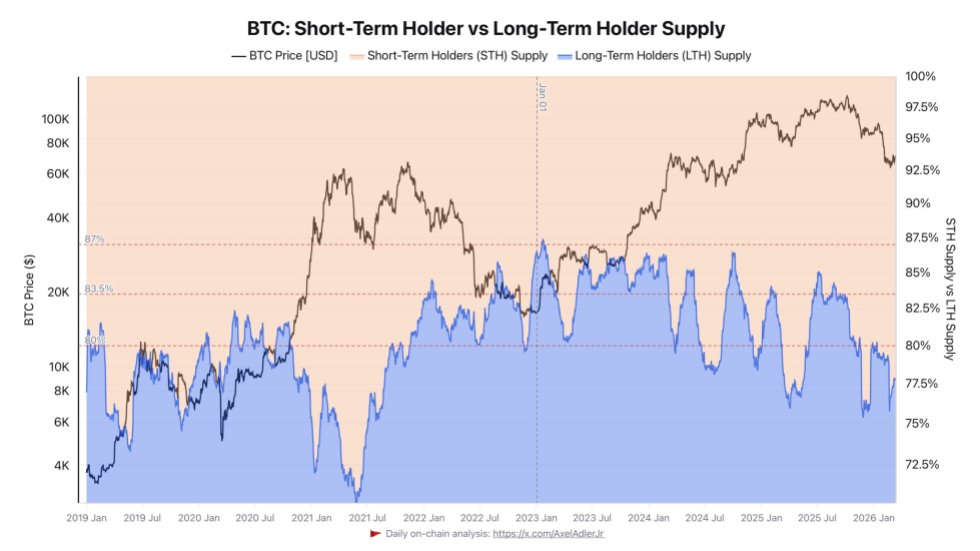
A shift in supply transfer between Bitcoin STHs and LTHs | Source: Chart from Darkfost on X

Rather than witnessing a rapid decline in LTH-held supply as Bitcoin nears the conclusion of its cycle, this time the process took a different turn. As of Sunday, these key investors represent roughly 79% of the total BTC supply.

The development is similar to that of the 2021 cycle, where the share of supply held by long-term holders fell from 82% to 70% in a space of 6 months. A major trigger is the insufficient liquidity from short-term holders to absorb the selling pressure from long-term investors.

The Movement Of BTC In 6 Separate Waves

During the current cycle, Darkfost reports that this transfer occurred in 6 waves. Meanwhile, STHs were observed swooping in to absorb the supply at every stage. These investors eventually turned into LTHs over time. After examining the coin movement within the 6 waves, Darkfost has underscored two major observations.

One is that liquidity appears to have been substantial during this cycle, and this allowed LTHs to steadily discover counterparties while Bitcoin’s price action extends. Secondly, speculation seems to have been stronger than before, with some short-term holders offloading their stash shortly after holding their BTC for more than 6 months in order to quickly realize profits.

Another key development observed in the market is the arrival of new participants via the Exchange-Traded Funds (ETFs) and Digital Asset Treasuries (DATs). Such a trend points to renewed capital and demand for the flagship asset from institutional investors who are confident about its long-term prospects. According to Darkfost, all of these factors are adding to a changing market structure for Bitcoin.

At the time of trading, Bitcoin’s price was trading at $73,815, following a more than 3% bounce over the last 24 hours. Its trading volume has followed suit, spiking by over 77% within the past day.

BTC trading at $73,807 on the 1D chart | Source: BTCUSDT on Tradingview.com

Связанные с этим вопросы

QWhat is the main difference in Bitcoin's supply transfer pattern between long-term holders (LTHs) and short-term holders (STHs) in the current cycle compared to previous cycles?

AIn the current cycle, the transfer of supply from long-term holders to short-term holders has not occurred in the same way as in previous cycles. Long-term holders still hold the majority of the supply (roughly 79%), and the process has been more gradual, occurring in 6 distinct waves, rather than a rapid decline in LTH-held supply.

QWhat percentage of the total Bitcoin supply do long-term holders (LTHs) currently control, according to the article?

AAs of the time of the article, long-term holders (LTHs) represent roughly 79% of the total Bitcoin supply.

QWhat are the two major observations made by Darkfost after examining the coin movement within the 6 waves of supply transfer?

AThe two major observations are: 1) Liquidity has been substantial, allowing LTHs to steadily find counterparties as Bitcoin's price extends. 2) Speculation has been stronger, with some STHs selling their BTC shortly after holding for more than 6 months to realize profits quickly.

QWhat new participants are cited as a key development contributing to Bitcoin's changing market structure?

AThe arrival of new participants via Exchange-Traded Funds (ETFs) and Digital Asset Treasuries (DATs) is a key development, pointing to renewed capital and demand from institutional investors confident in Bitcoin's long-term prospects.

QWhat was Bitcoin's price and 24-hour performance at the time the article was written?

AAt the time of writing, Bitcoin's price was $73,815, following a more than 3% bounce over the last 24 hours.

Похожее

From Payment to Deployment: Stripe Bets on the AI Agent Economy

From Payments to Deployment: Stripe Bets on the AI Agent Economy Stripe is redefining economic infrastructure for the AI era, shifting its focus from serving primarily human users and software companies to enabling machine agents as active economic participants. The core thesis is that AI agents are evolving from tools into independent buyers and builders on the internet, necessitating a complete overhaul of traditional payment, billing, and deployment models. To empower agents as **buyers**, Stripe, in collaboration with Tempo, developed the Machine Payments Protocol. This protocol allows businesses to programmatically accept payments from agents without human intervention, using machine-readable payment instructions. Furthermore, Stripe's consumer wallet, Link, is being adapted to let users securely authorize agents to spend on their behalf. To empower agents as **builders**, Stripe Projects aims to simplify the deployment process. It allows developers and their agents to register, manage, and integrate the services needed to deploy applications directly from the command line, making "vibe-deploying" as seamless as "vibe-coding." This agent-driven economy, where products have real, variable costs (like AI tokens), disrupts traditional SaaS models. **Token-based monetization** is becoming central, requiring usage-based billing that charges for actual resource consumption, as seen with companies like Lovable and ElevenLabs. However, this model introduces new challenges like **token theft**, where fraudsters exploit services and vanish before billing. Stripe Radar helps combat this by assessing new accounts and predicting abuse risks. A critical innovation to balance customer experience and financial risk is **streaming payments**. By combining Metronome (for real-time usage tracking) with Tempo (for low-cost, high-frequency stablecoin payments), Stripe enables AI companies to collect fees *as tokens are consumed*. This eliminates the trade-off between imposing hard usage caps and risking unpaid invoices. In summary, Stripe's vision for AI economic infrastructure now encompasses providing a commercial framework for agents, wallets for agents, deployment tools for agents, token-based billing, fraud prevention for token abuse, and streaming payment capabilities. As AI transforms both commerce and software creation, Stripe is building the foundational infrastructure to support it.

marsbit4 мин. назад

From Payment to Deployment: Stripe Bets on the AI Agent Economy

marsbit4 мин. назад

Has the 'Digital Gold' Narrative for BTC Failed?

**Title: Has the "Digital Gold" Narrative for Bitcoin Failed?** The article argues that Bitcoin's "digital gold" narrative remains valid despite a recent sharp price decline (from a peak near $126k in Oct 2025 to briefly under $61k in Feb 2026). It presents a long-term investment framework based on three core points: **1. Viewing Bitcoin as an Asset:** Bitcoin is presented as a superior potential store of value compared to gold. Key arguments are its absolute scarcity (21 million cap), superior portability, and transparent auditability via its public ledger. While acknowledging its current use in early, volatile stages (~3-4% global adoption), the author draws parallels to the early, disruptive phases of the internet and e-commerce. **2. Understanding the Recent Downturn:** The current ~50% correction is framed as a predictable, consensus-driven cycle following its post-halving peak (the 2024 halving preceded the Oct 2025 high). A crucial factor is a historic "changing of hands": the influx of new institutional buyers via ETFs allowed early, low-cost holders (miners, OG believers) to take profits. The author notes that while severe, Bitcoin's historical drawdowns (e.g., 93% in 2011, 77% in 2021-22) have been progressively smaller, suggesting maturing holder structure and decreasing volatility over time. **3. The Long-Term Perspective:** The long-term thesis hinges on Bitcoin capturing a portion of gold's market value. With Bitcoin's market cap at ~$1.4 trillion (at $70k) versus gold's ~$20 trillion, significant upside potential exists if the "digital gold" narrative is partially realized. However, the author strongly cautions that short-term risks remain, the bottom is unpredictable, and high volatility is inherent. The real risk is not Bitcoin failing but poor personal position management (over-leverage, wrong capital) and a lack of deep understanding, which can force investors out during severe downturns. The conclusion uses Amazon's 95% crash post-2000 dot-com bubble and subsequent 42x recovery as an analogy. The ultimate question is not if Bitcoin's price will rise, but if an investor's strategy and conviction can withstand the volatility to see the long-term play out. The recent divergence (gold up, Bitcoin down) is posed not as a narrative failure, but as potential evidence of this ongoing, painful transition from a speculative asset to a mainstream allocation.

marsbit10 ч. назад

Has the 'Digital Gold' Narrative for BTC Failed?

marsbit10 ч. назад

Торговля

Спот
Фьючерсы

Популярные статьи

Тест по Bitcoin Биткоина

HTX Learn: Изучите Bitcoin halving и Заработаете Токены USDT

3.1k просмотров всегоОпубликовано 2024.04.16Обновлено 2024.04.16

Тест по Bitcoin  Биткоина

Что такое $BITCOIN

ЦИФРОВОЕ ЗОЛОТО ($BITCOIN): Комплексный анализ Введение в ЦИФРОВОЕ ЗОЛОТО ($BITCOIN) ЦИФРОВОЕ ЗОЛОТО ($BITCOIN) — это проект на основе блокчейна, работающий в сети Solana, который стремится объединить характеристики традиционных драгоценных металлов с инновациями децентрализованных технологий. Хотя он носит имя Биткойн, часто называемого “цифровым золотом” из-за его восприятия как средства хранения ценности, ЦИФРОВОЕ ЗОЛОТО является отдельным токеном, предназначенным для создания уникальной экосистемы в ландшафте Web3. Его цель — позиционировать себя как жизнеспособный альтернативный цифровой актив, хотя детали его применения и функциональности все еще развиваются. Что такое ЦИФРОВОЕ ЗОЛОТО ($BITCOIN)? ЦИФРОВОЕ ЗОЛОТО ($BITCOIN) — это токен криптовалюты, специально разработанный для использования в блокчейне Solana. В отличие от Биткойна, который выполняет широко признанную роль хранения ценности, этот токен, похоже, сосредоточен на более широких приложениях и характеристиках. Примечательные аспекты включают: Инфраструктура блокчейна: Токен построен на блокчейне Solana, известном своей способностью обрабатывать высокоскоростные и недорогие транзакции. Динамика предложения: ЦИФРОВОЕ ЗОЛОТО имеет максимальное предложение, ограниченное 100 квадриллионами токенов (100P $BITCOIN), хотя детали о его обращающемся предложении в настоящее время не раскрыты. Утилита: Хотя точные функциональные возможности не описаны, есть указания на то, что токен может быть использован для различных приложений, потенциально связанных с децентрализованными приложениями (dApps) или стратегиями токенизации активов. Кто создатель ЦИФРОВОГО ЗОЛОТА ($BITCOIN)? На данный момент личность создателей и команды разработчиков, стоящих за ЦИФРОВЫМ ЗОЛОТОМ ($BITCOIN), остается неизвестной. Эта ситуация типична для многих инновационных проектов в области блокчейна, особенно тех, которые связаны с децентрализованными финансами и феноменом мем-криптовалют. Хотя такая анонимность может способствовать культуре, ориентированной на сообщество, она усиливает опасения по поводу управления и ответственности. Кто инвесторы ЦИФРОВОГО ЗОЛОТА ($BITCOIN)? Доступная информация указывает на то, что у ЦИФРОВОГО ЗОЛОТА ($BITCOIN) нет известных институциональных спонсоров или значительных венчурных капиталовложений. Проект, похоже, функционирует по модели пирингового взаимодействия, сосредоточенной на поддержке и принятии сообществом, а не на традиционных путях финансирования. Его активность и ликвидность в основном сосредоточены на децентрализованных биржах (DEX), таких как PumpSwap, а не на устоявшихся централизованных торговых платформах, что еще больше подчеркивает его подход, ориентированный на grassroots. Как работает ЦИФРОВОЕ ЗОЛОТО ($BITCOIN) Операционные механизмы ЦИФРОВОГО ЗОЛОТА ($BITCOIN) можно подробно описать на основе его дизайна блокчейна и характеристик сети: Механизм консенсуса: Используя уникальный механизм доказательства истории (PoH) Solana в сочетании с моделью доказательства доли (PoS), проект обеспечивает эффективную валидацию транзакций, что способствует высокой производительности сети. Токеномика: Хотя конкретные дефляционные механизмы не были подробно описаны, большое максимальное предложение токенов подразумевает, что оно может быть предназначено для микротранзакций или нишевых случаев использования, которые еще предстоит определить. Интероперабельность: Существует потенциал для интеграции с более широкой экосистемой Solana, включая различные платформы децентрализованных финансов (DeFi). Однако детали относительно конкретных интеграций остаются неуточненными. Хронология ключевых событий Вот хронология, которая подчеркивает значимые вехи, касающиеся ЦИФРОВОГО ЗОЛОТА ($BITCOIN): 2023: Первоначальное развертывание токена происходит в блокчейне Solana, отмеченное его адресом контракта. 2024: ЦИФРОВОЕ ЗОЛОТО приобретает видимость, когда оно становится доступным для торговли на децентрализованных биржах, таких как PumpSwap, позволяя пользователям обменивать его на SOL. 2025: Проект наблюдает спорадическую торговую активность и потенциальный интерес к инициативам, возглавляемым сообществом, хотя на данный момент не зафиксировано никаких значительных партнерств или технических достижений. Критический анализ Сильные стороны Масштабируемость: Основная инфраструктура Solana поддерживает высокие объемы транзакций, что может повысить полезность $BITCOIN в различных сценариях транзакций. Доступность: Потенциально низкая цена торговли за токен может привлечь розничных инвесторов, способствуя более широкому участию благодаря возможностям дробного владения. Риски Отсутствие прозрачности: Отсутствие публично известных спонсоров, разработчиков или процесса аудита может вызвать скептицизм относительно устойчивости и надежности проекта. Волатильность рынка: Торговая активность сильно зависит от спекулятивного поведения, что может привести к значительной волатильности цен и неопределенности для инвесторов. Заключение ЦИФРОВОЕ ЗОЛОТО ($BITCOIN) является интригующим, но неоднозначным проектом в быстро развивающейся экосистеме Solana. Хотя он пытается использовать нарратив “цифрового золота”, его отход от установленной роли Биткойна как средства хранения ценности подчеркивает необходимость более четкого различения его предполагаемой утилиты и структуры управления. Будущее принятие и усвоение, вероятно, будут зависеть от решения текущей непрозрачности и более четкого определения его операционных и экономических стратегий. Примечание: Этот отчет охватывает синтезированную информацию, доступную на октябрь 2023 года, и с тех пор могут произойти события.

99 просмотров всегоОпубликовано 2025.05.13Обновлено 2025.05.13

Что такое $BITCOIN

Fractal Bitcoin: масштабирование Биткоина с помощью рекурсивной системы

Fractal Bitcoin — масштабное Layer-1-решнение, созданное на базе кода Биткоина, позволяющего достигать бесконечного масштабирования с помощью рекурсивного подхода.

2.3k просмотров всегоОпубликовано 2025.06.30Обновлено 2025.06.30

Fractal Bitcoin: масштабирование Биткоина с помощью рекурсивной системы

Обсуждения

Добро пожаловать в Сообщество HTX. Здесь вы сможете быть в курсе последних новостей о развитии платформы и получить доступ к профессиональной аналитической информации о рынке. Мнения пользователей о цене на BTC (BTC) представлены ниже.

活动图片















