Bitcoin Axed By Top Wall Street Strategist On Quantum Fears

bitcoinistОпубликовано 2026-01-20Обновлено 2026-01-20

Введение

Jefferies strategist Chris Wood has removed Bitcoin from his long-term model portfolio, citing quantum computing as a threat to Bitcoin's store-of-value proposition for long-term investors like pension funds. While not predicting an immediate price crash, Wood expressed concern that quantum computers could compromise Bitcoin’s cryptographic security within years rather than decades, making private keys vulnerable. He reallocated the 10% Bitcoin exposure to gold and gold miners. VanEck’s Matthew Sigel acknowledged the move but emphasized the difference between Bitcoin's decentralized, hard-to-upgrade nature and traditional reversible banking systems. He views quantum risk as a solvable challenge rather than a fatal flaw and maintains spot Bitcoin exposure while making small hedges. The article notes Bitcoin's significant outperformance versus gold since 2020 despite the recent strategic shift.

Jefferies strategist Chris Wood has removed Bitcoin from his long-term model portfolio, citing quantum computing as a risk that weakens Bitcoin’s store-of-value framing for pension-style allocations. VanEck head of research Matthew Sigel flagged the change on X, calling it a notable “downgrade” from one of the Street’s most widely followed global strategists.

Veteran Strategist Chris Wood Exits Bitcoin

Wood wrote that he is not positioning for an imminent price shock, but that the long-duration mandate is where the quantum question bites. “While GREED & fear does not believe that the quantum issue is about to hit the Bitcoin price dramatically in the near term, the store of value concept is clearly on less solid foundation from the standpoint of a long-term pension portfolio,” Wood wrote. “For that reason, GREED & fear will remove the 10% allocation to Bitcoin this week with 5% reallocated to gold and 5% reallocated to gold-mining stocks.”

The move is framed as risk management rather than a retrospective performance critique. Wood noted that despite gold’s recent outperformance versus Bitcoin, Bitcoin remained well ahead since his model first added it: Bitcoin had risen 325% since December 17, 2020, while gold bullion was up 145% over the same period.

In a note dated January 15, 2026, Wood described how the quantum discussion has moved from abstract theory into something asset allocators are being asked to underwrite. “GREED & fear is no pure mathematician,” he wrote, adding that he has found himself pulled into conversations about “elliptic curves” because of “the growing focus in recent months on the threat posed to the Bitcoin system by the arrival of quantum computing.”

His core claim is that the perceived timeline is compressing. He referenced rising concern that cryptographically relevant quantum computers could arrive “a few years away rather than a decade or more,” and argued that any credible threat to Bitcoin’s security model is “potentially existential” because it undermines the store-of-value concept that underpins the “digital alternative to gold” narrative.

Wood’s mechanism is straightforward: what is computationally infeasible today could become tractable under CRQCs. He wrote that the current asymmetry, easy to derive a public key from a private key, effectively impossible to reverse, could collapse, with the time to derive a private key from a public key shrinking to “mere hours or days.”

Wood said the industry is already debating potential responses, including whether to “burn” quantum-vulnerable coins to protect system integrity or to do nothing and accept the possibility that vulnerable coins could be stolen by entities with CRQCs. He presented the dispute as a conflict between preserving Bitcoin’s property-rights ethos and avoiding a policy choice that looks confiscatory, adding that one computer scientist he spoke with described the do-nothing stance as a “suicidal delusion.”

Wood said his thinking was informed by discussions with knowledgeable parties and pointed to a Chaincode report as background reading, without treating it as a near-term trading trigger.

VanEck’s Sigel Responds

Sigel’s takeaway was less about whether quantum risk exists and more about how different systems respond. When one user argued that quantum would wipe out bank accounts, email, and brokerage systems as well, Sigel dismissed that as “not a sufficient take anymore,” drawing a sharp distinction between upgrade paths and reversibility.

“Banks upgrade top-down; BTC requires years of consensus,” Sigel wrote. “Banks have an ‘undo’ button; BTC is finality-first.”

Sigel also linked the debate to a familiar fault line inside Bitcoin governance. Asked how representative Wood’s view might be, Sigel said that in the “Adam Back vs. Nic Carter” debate he is “on Nic’s side,” and described Wood’s decision as supporting evidence. At the same time, Sigel emphasized process: he met Wood in New York before the note was published and said that although he disagreed with the conclusion, Wood “came to it honestly.”

On positioning, Sigel said he has “added quantum exposure” previously to VanEck’s Onchain Economy ETF (NODE) and made small hedges, with a preference for “diversified” AI miners over “DATs / leveraged BTC,” while keeping spot BTC via an ETF as the largest holding. He framed the quantum issue as “solvable” and akin to a “wall of worry like blocksize wars,” rather than a thesis-breaker.

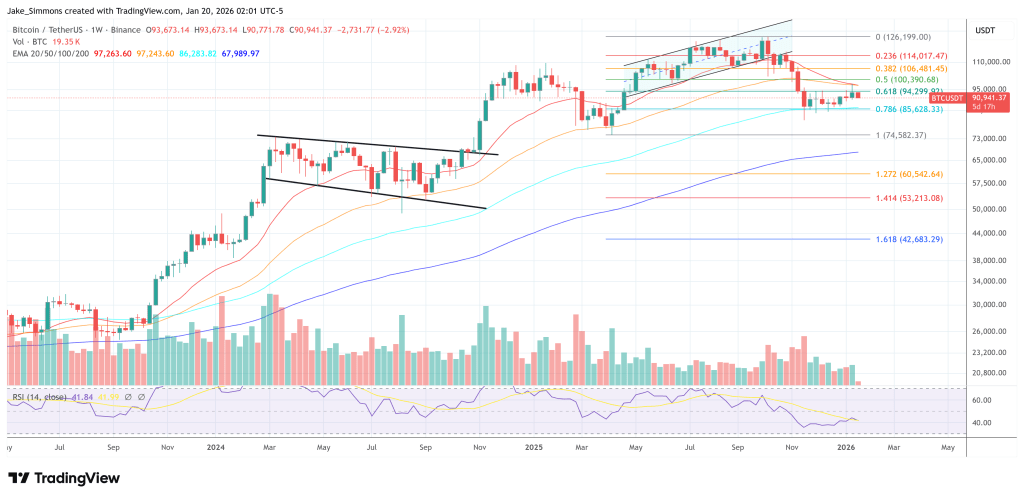
At press time, BTC traded at $90,941.

Bitcoin rejected at the 0.618 Fib, 1-week chart | Source: BTCUSDT on TradingView.com

Связанные с этим вопросы

QWhy did Jefferies strategist Chris Wood remove Bitcoin from his long-term model portfolio?

AChris Wood removed Bitcoin from his long-term model portfolio due to concerns that quantum computing poses a risk to Bitcoin's store-of-value narrative, which is critical for pension-style allocations.

QWhat specific actions did Chris Wood take in reallocating the portfolio after removing Bitcoin?

AAfter removing the 10% allocation to Bitcoin, Wood reallocated 5% to gold and 5% to gold-mining stocks.

QHow does Matthew Sigel of VanEck distinguish between the impact of quantum computing on traditional banking systems versus Bitcoin?

ASigel argues that banks can upgrade their systems top-down and have an 'undo' button for reversibility, whereas Bitcoin requires years of consensus for upgrades and is finality-first, making it more vulnerable to quantum threats.

QWhat is the core concern regarding quantum computing and Bitcoin's security model as presented by Chris Wood?

AThe core concern is that cryptographically relevant quantum computers could drastically reduce the time required to derive a private key from a public key from being effectively impossible to 'mere hours or days,' undermining Bitcoin's security and store-of-value proposition.

QHow does Matthew Sigel view the solvability of the quantum computing threat to Bitcoin?

ASigel views the quantum issue as 'solvable' and compares it to a 'wall of worry like blocksize wars,' suggesting it is a manageable challenge rather than a thesis-breaker for Bitcoin.

Похожее

Торговля

Спот
Фьючерсы

Популярные статьи

Тест по Bitcoin Биткоина

HTX Learn: Изучите Bitcoin halving и Заработаете Токены USDT

3.0k просмотров всегоОпубликовано 2024.04.16Обновлено 2024.04.16

Тест по Bitcoin  Биткоина

Что такое $BITCOIN

ЦИФРОВОЕ ЗОЛОТО ($BITCOIN): Комплексный анализ Введение в ЦИФРОВОЕ ЗОЛОТО ($BITCOIN) ЦИФРОВОЕ ЗОЛОТО ($BITCOIN) — это проект на основе блокчейна, работающий в сети Solana, который стремится объединить характеристики традиционных драгоценных металлов с инновациями децентрализованных технологий. Хотя он носит имя Биткойн, часто называемого “цифровым золотом” из-за его восприятия как средства хранения ценности, ЦИФРОВОЕ ЗОЛОТО является отдельным токеном, предназначенным для создания уникальной экосистемы в ландшафте Web3. Его цель — позиционировать себя как жизнеспособный альтернативный цифровой актив, хотя детали его применения и функциональности все еще развиваются. Что такое ЦИФРОВОЕ ЗОЛОТО ($BITCOIN)? ЦИФРОВОЕ ЗОЛОТО ($BITCOIN) — это токен криптовалюты, специально разработанный для использования в блокчейне Solana. В отличие от Биткойна, который выполняет широко признанную роль хранения ценности, этот токен, похоже, сосредоточен на более широких приложениях и характеристиках. Примечательные аспекты включают: Инфраструктура блокчейна: Токен построен на блокчейне Solana, известном своей способностью обрабатывать высокоскоростные и недорогие транзакции. Динамика предложения: ЦИФРОВОЕ ЗОЛОТО имеет максимальное предложение, ограниченное 100 квадриллионами токенов (100P $BITCOIN), хотя детали о его обращающемся предложении в настоящее время не раскрыты. Утилита: Хотя точные функциональные возможности не описаны, есть указания на то, что токен может быть использован для различных приложений, потенциально связанных с децентрализованными приложениями (dApps) или стратегиями токенизации активов. Кто создатель ЦИФРОВОГО ЗОЛОТА ($BITCOIN)? На данный момент личность создателей и команды разработчиков, стоящих за ЦИФРОВЫМ ЗОЛОТОМ ($BITCOIN), остается неизвестной. Эта ситуация типична для многих инновационных проектов в области блокчейна, особенно тех, которые связаны с децентрализованными финансами и феноменом мем-криптовалют. Хотя такая анонимность может способствовать культуре, ориентированной на сообщество, она усиливает опасения по поводу управления и ответственности. Кто инвесторы ЦИФРОВОГО ЗОЛОТА ($BITCOIN)? Доступная информация указывает на то, что у ЦИФРОВОГО ЗОЛОТА ($BITCOIN) нет известных институциональных спонсоров или значительных венчурных капиталовложений. Проект, похоже, функционирует по модели пирингового взаимодействия, сосредоточенной на поддержке и принятии сообществом, а не на традиционных путях финансирования. Его активность и ликвидность в основном сосредоточены на децентрализованных биржах (DEX), таких как PumpSwap, а не на устоявшихся централизованных торговых платформах, что еще больше подчеркивает его подход, ориентированный на grassroots. Как работает ЦИФРОВОЕ ЗОЛОТО ($BITCOIN) Операционные механизмы ЦИФРОВОГО ЗОЛОТА ($BITCOIN) можно подробно описать на основе его дизайна блокчейна и характеристик сети: Механизм консенсуса: Используя уникальный механизм доказательства истории (PoH) Solana в сочетании с моделью доказательства доли (PoS), проект обеспечивает эффективную валидацию транзакций, что способствует высокой производительности сети. Токеномика: Хотя конкретные дефляционные механизмы не были подробно описаны, большое максимальное предложение токенов подразумевает, что оно может быть предназначено для микротранзакций или нишевых случаев использования, которые еще предстоит определить. Интероперабельность: Существует потенциал для интеграции с более широкой экосистемой Solana, включая различные платформы децентрализованных финансов (DeFi). Однако детали относительно конкретных интеграций остаются неуточненными. Хронология ключевых событий Вот хронология, которая подчеркивает значимые вехи, касающиеся ЦИФРОВОГО ЗОЛОТА ($BITCOIN): 2023: Первоначальное развертывание токена происходит в блокчейне Solana, отмеченное его адресом контракта. 2024: ЦИФРОВОЕ ЗОЛОТО приобретает видимость, когда оно становится доступным для торговли на децентрализованных биржах, таких как PumpSwap, позволяя пользователям обменивать его на SOL. 2025: Проект наблюдает спорадическую торговую активность и потенциальный интерес к инициативам, возглавляемым сообществом, хотя на данный момент не зафиксировано никаких значительных партнерств или технических достижений. Критический анализ Сильные стороны Масштабируемость: Основная инфраструктура Solana поддерживает высокие объемы транзакций, что может повысить полезность $BITCOIN в различных сценариях транзакций. Доступность: Потенциально низкая цена торговли за токен может привлечь розничных инвесторов, способствуя более широкому участию благодаря возможностям дробного владения. Риски Отсутствие прозрачности: Отсутствие публично известных спонсоров, разработчиков или процесса аудита может вызвать скептицизм относительно устойчивости и надежности проекта. Волатильность рынка: Торговая активность сильно зависит от спекулятивного поведения, что может привести к значительной волатильности цен и неопределенности для инвесторов. Заключение ЦИФРОВОЕ ЗОЛОТО ($BITCOIN) является интригующим, но неоднозначным проектом в быстро развивающейся экосистеме Solana. Хотя он пытается использовать нарратив “цифрового золота”, его отход от установленной роли Биткойна как средства хранения ценности подчеркивает необходимость более четкого различения его предполагаемой утилиты и структуры управления. Будущее принятие и усвоение, вероятно, будут зависеть от решения текущей непрозрачности и более четкого определения его операционных и экономических стратегий. Примечание: Этот отчет охватывает синтезированную информацию, доступную на октябрь 2023 года, и с тех пор могут произойти события.

99 просмотров всегоОпубликовано 2025.05.13Обновлено 2025.05.13

Что такое $BITCOIN

Fractal Bitcoin: масштабирование Биткоина с помощью рекурсивной системы

Fractal Bitcoin — масштабное Layer-1-решнение, созданное на базе кода Биткоина, позволяющего достигать бесконечного масштабирования с помощью рекурсивного подхода.

2.2k просмотров всегоОпубликовано 2025.06.30Обновлено 2025.06.30

Fractal Bitcoin: масштабирование Биткоина с помощью рекурсивной системы

Обсуждения

Добро пожаловать в Сообщество HTX. Здесь вы сможете быть в курсе последних новостей о развитии платформы и получить доступ к профессиональной аналитической информации о рынке. Мнения пользователей о цене на BTC (BTC) представлены ниже.

活动图片