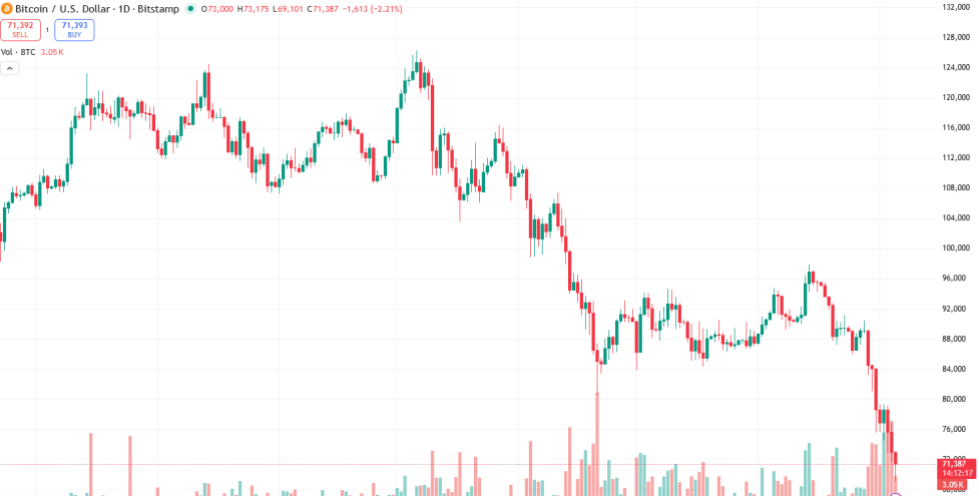
Bitcoin at $70,000: When Will the BTC Decline Stop?

bitcoinistОпубликовано 2026-02-05Обновлено 2026-02-05

Введение

Bitcoin is steadily declining towards the symbolic $70,000 mark, signaling a deeper issue of waning demand rather than panic selling. On-chain data reveals a structurally bearish market: the Bull Score Index has hit zero, spot volumes are low, and institutional flows have reversed, with US spot Bitcoin ETFs becoming net sellers. The negative Coinbase premium indicates sustained disengagement from US investors, while a contraction in USDT's market cap suggests reduced fresh capital entering the ecosystem. Technically, BTC is trading below its 365-day moving average, with key on-chain support between $60,000 and $70,000. The lack of immediate catalysts, such as Federal Reserve rate cuts, and political uncertainty further dampen sentiment. Bitcoin now behaves like a high-beta tech asset, correlating with equity market pressures. However, current data reflects an absence of buyers rather than excessive selling, potentially setting the stage for slow accumulation if prices reach long-term value zones. The end of the downturn hinges on a gradual return of liquidity and confidence, not just a technical signal.

Bitcoin continues to slide, slowly but surely, towards the symbolic $70,000 zone. After several failed stabilization attempts, the market now seems to be facing a more uncomfortable reality: waning demand. Behind the price drop, on-chain signals tell a deeper story.

Bitcoin Continues Its Fall and Approaches $70,000

For several weeks, BTC has been moving in a clearly unfavorable trend. Bounces exist, but they lack follow-through. Every recovery attempt is quickly sold, reflecting less a panic and more a lack of conviction. This is precisely what the latest on-chain data highlights.

CryptoQuant indicators show a market that has entered a structural bear mode. The Bull Score Index has fallen to zero, a level rarely seen outside of outright bearish market phases. Unlike a mere technical correction, participation itself is contracting. Spot volumes remain low, and liquidity is gradually tightening.

The reversal of institutional flows weighs heavily in the equation. US spot Bitcoin ETFs, major drivers of demand in 2025, are now net sellers. This shift creates a demand gap measured in tens of thousands of BTC over a year. The signal is all the more concerning as the Coinbase premium remains negative, suggesting a persistent disengagement from US investors.

Even the stablecoin market sends a clear message. The market capitalization of USDT is declining for the first time since 2023, indicating that fresh money is no longer entering the ecosystem at the same pace. Historically, without monetary expansion or an influx of stablecoins, bullish phases struggle to build.

Technically, the picture remains fragile. Bitcoin is trading below its 365-day moving average, and on-chain valuation zones are converging towards a major support level between $70,000 and $60,000. A zone that could attract buyers, but only if the context is right.

When Will the Bearish Movement on BTC End?

The question is not so much whether Bitcoin can rebound, but under what conditions a lasting floor can form. In the short term, the elements are missing. The market remains dependent on one key factor: overall liquidity.

From a macroeconomic perspective, expectations are clear. Prediction markets largely anticipate a status quo from the Federal Reserve at the April meeting, with little hope for a rate cut before June. This lack of a monetary catalyst limits appetite for risk assets, including Bitcoin.

The political context adds a layer of uncertainty. Recent statements by Donald Trump on monetary policy and his future Fed chair blur the reading of the calendar. Investors hesitate to anticipate a rapid easing, preferring to stay on the sidelines.

In this framework, Bitcoin is behaving more and more like a high-beta technology asset, sensitive to tensions in the stock markets. As long as this correlation persists, every pressure on tech stocks mechanically impacts BTC.

This does not mean an imminent capitulation, however. Glassnode data shows more of a demand vacuum than an excess of selling. In short, the market is not panicking; it is absent. This type of configuration can precede a phase of slow accumulation, especially if prices sink towards long-term value zones.

The end of the bearish movement will therefore depend less on an isolated technical signal and more on a gradual return of liquidity and confidence. On its side, Bitcoin Hyper is a Bitcoin layer-2 in presale that is managing to attract millions of $ in just a few weeks.

Связанные с этим вопросы

QWhat is the current price level that Bitcoin is approaching, and what does it symbolize?

ABitcoin is approaching the symbolic zone of $70,000.

QAccording to on-chain data from CryptoQuant, what does a Bull Score Index of zero indicate?

AA Bull Score Index of zero, as shown by CryptoQuant, is a level rarely seen outside of clearly bearish market phases, indicating a structural bear market.

QWhat is the significance of the declining market capitalization of USDT (Tether)?

AThe declining market capitalization of USDT indicates that fresh money is no longer entering the crypto ecosystem at the same pace, which historically makes it difficult to build bullish phases without monetary expansion or an influx of stablecoins.

QWhat major macroeconomic factor is currently limiting appetite for risk assets like Bitcoin?

AThe expectation that the U.S. Federal Reserve will maintain the status quo on interest rates, with little hope for a rate cut before June, is a key macroeconomic factor limiting appetite for risk assets like Bitcoin.

QAccording to the article, what is the primary driver needed to end the current bearish movement in Bitcoin, rather than a specific technical signal?

AThe end of the bearish movement depends less on an isolated technical signal and more on a gradual return of liquidity and confidence to the market.

Похожее

Bitcoin's 'Rally Ends,' Officially Entering the Later Stage of a Bear Market?

Bitcoin prices declined 13% this week, reversing the recent rebound and signaling a likely transition into the later stages of a bear market. Key on-chain metrics deteriorated, with the short-term holder cost basis falling below the Realized Price—a pattern last seen in early 2022, characteristic of bear market maturity. The rally to ~$82k proved to be a bear market bounce, as evidenced by the 90-day realized profit/loss ratio failing to sustain above the bullish threshold of 2. Daily realized losses surged to $1.35B, including significant selling from long-term holders who accumulated near cycle tops, indicating ongoing supply redistribution. Price was rejected almost precisely at the aggregate US spot ETF cost basis of ~$83k, turning that level into resistance and leaving the average ETF investor underwater again. Spot market selling pressure intensified, with the 7-day volume delta turning significantly negative to its weakest level since February. While a major long liquidation event cleared over $400M in leverage, spot demand has not yet stepped in to absorb the resulting supply. Options markets continue pricing in higher future volatility (elevated volatility risk premium) and maintain a skew toward put options, reflecting persistent demand for downside protection, though not yet panic. Overall, market structure remains fragile. Sustained recovery likely requires a reclaim of the ETF cost basis, a shift back to positive spot demand, and a slowdown in realized loss-taking. Until then, the market risks further downside or extended consolidation within the broader bear trend.

Foresight News40 мин. назад

Bitcoin's 'Rally Ends,' Officially Entering the Later Stage of a Bear Market?

Foresight News40 мин. назад

How Risky is the "Death Spiral" of MSTR and STRC?

Summary: This article explores the perceived "death spiral" risk between MicroStrategy (MSTR), its Bitcoin holdings, and its perpetual preferred stock (STRC), drawing comparisons to the LUNA-UST collapse. While both systems feature price anchors, high yields for holders, and potential feedback loops, their core mechanisms differ fundamentally. The MSTR-STRC structure relies on continuous financing to sustain its high dividend payouts, primarily through stock ATM offerings. A negative feedback cycle could occur: falling MSTR stock price makes raising equity capital harder, increasing pressure to sell Bitcoin, which undermines STRC confidence and further depresses MSTR. However, unlike LUNA-UST's automated, direct linkage, the MSTR-STRC loop is weaker and has brakes: STRC dividends can be deferred or rates lowered, and STRC holders have a $100/share liquidation preference in bankruptcy, providing a price floor. The company's sustainability hinges on its ability to continue financing. Its current ~$900 million USD reserves cover only about 6.3 months of its ~$1.71 billion annual interest/dividend burden. The next six months are critical, aligning with both the potential bottom in Bitcoin's four-year cycle and the depletion timeline of its reserves. While a LUNA-style catastrophic collapse is deemed highly unlikely due to structural differences, the key question is whether MicroStrategy can navigate this period through healthy deleveraging to restart its capital engine.

Foresight News58 мин. назад

How Risky is the "Death Spiral" of MSTR and STRC?

Foresight News58 мин. назад

How Much Debt Does Strategy Really Have? Is There a Risk of Implosion?

MicroStrategy's Debt Risk: A Turning Point in the "Never Sell" Strategy As of June 3, 2026, MicroStrategy holds 843,706 bitcoins (valued at ~$53.1B) but faces significant financial obligations. Its capital structure includes $6.75B in convertible notes and $15.48B in perpetual preferred stock (led by the $8.5B STRC series), creating an annual payout burden of ~$1.71B. With software revenue at only ~$500M, interest and dividend obligations far exceed operating income. A critical shift occurred in late May 2026 when the company sold 32 bitcoins for ~$2.5M to cover dividends, breaking CEO Michael Saylor's long-standing "never sell" pledge. This symbolic move triggered a sharp decline in both Bitcoin's price and MSTR stock, reflecting market fears about cash flow sustainability. The core of the strain is the STRC perpetual preferred stock, designed as a "permanent loan" with no maturity date but requiring high monthly dividends (currently 11.5%). Its business model relies on a three-part cycle: issuing new STRC shares, using proceeds to buy more Bitcoin and fund a USD reserve, and using that reserve to pay dividends. This cycle depends on continuous investor demand for STRC and Bitcoin's price appreciation. Analysis shows Bitcoin needs to appreciate at least 2.3% annually to cover the $1.71B in yearly obligations at current holdings. With Bitcoin price down ~22% from March 2026 highs, this pressure has intensified. The company's $900M USD reserve can only cover about 7 months of payments if STRC issuance stalls. Key risks are not immediate bankruptcy or forced Bitcoin liquidation (as BTC is not collateral), but rather: 1) The erosion of MSTR's premium to its Bitcoin holdings (mNAV), which would cripple its ability to raise cheap capital; 2) A vicious cycle where stagnant Bitcoin prices reduce STRC demand, draining the USD reserve and forcing BTC sales, further depressing prices. The period from February 2027 to September 2028 is a crucial test, with over $5.9B in convertible notes facing put options or maturity. In essence, MicroStrategy has evolved from a simple Bitcoin holder into a complex financial entity acting like a "private Bitcoin bank," leveraging its BTC holdings to create layered financial products. Its survival depends on maintaining Bitcoin's price trend, its stock premium, and market appetite for its preferred shares. The recent token sale marks not a betrayal of its Bitcoin thesis, but an admission that the leveraged strategy must eventually be paid for.

marsbit1 ч. назад

How Much Debt Does Strategy Really Have? Is There a Risk of Implosion?

marsbit1 ч. назад

Торговля

Спот
Фьючерсы

Популярные статьи

Тест по Bitcoin Биткоина

HTX Learn: Изучите Bitcoin halving и Заработаете Токены USDT

3.1k просмотров всегоОпубликовано 2024.04.16Обновлено 2024.04.16

Тест по Bitcoin  Биткоина

Что такое $BITCOIN

ЦИФРОВОЕ ЗОЛОТО ($BITCOIN): Комплексный анализ Введение в ЦИФРОВОЕ ЗОЛОТО ($BITCOIN) ЦИФРОВОЕ ЗОЛОТО ($BITCOIN) — это проект на основе блокчейна, работающий в сети Solana, который стремится объединить характеристики традиционных драгоценных металлов с инновациями децентрализованных технологий. Хотя он носит имя Биткойн, часто называемого “цифровым золотом” из-за его восприятия как средства хранения ценности, ЦИФРОВОЕ ЗОЛОТО является отдельным токеном, предназначенным для создания уникальной экосистемы в ландшафте Web3. Его цель — позиционировать себя как жизнеспособный альтернативный цифровой актив, хотя детали его применения и функциональности все еще развиваются. Что такое ЦИФРОВОЕ ЗОЛОТО ($BITCOIN)? ЦИФРОВОЕ ЗОЛОТО ($BITCOIN) — это токен криптовалюты, специально разработанный для использования в блокчейне Solana. В отличие от Биткойна, который выполняет широко признанную роль хранения ценности, этот токен, похоже, сосредоточен на более широких приложениях и характеристиках. Примечательные аспекты включают: Инфраструктура блокчейна: Токен построен на блокчейне Solana, известном своей способностью обрабатывать высокоскоростные и недорогие транзакции. Динамика предложения: ЦИФРОВОЕ ЗОЛОТО имеет максимальное предложение, ограниченное 100 квадриллионами токенов (100P $BITCOIN), хотя детали о его обращающемся предложении в настоящее время не раскрыты. Утилита: Хотя точные функциональные возможности не описаны, есть указания на то, что токен может быть использован для различных приложений, потенциально связанных с децентрализованными приложениями (dApps) или стратегиями токенизации активов. Кто создатель ЦИФРОВОГО ЗОЛОТА ($BITCOIN)? На данный момент личность создателей и команды разработчиков, стоящих за ЦИФРОВЫМ ЗОЛОТОМ ($BITCOIN), остается неизвестной. Эта ситуация типична для многих инновационных проектов в области блокчейна, особенно тех, которые связаны с децентрализованными финансами и феноменом мем-криптовалют. Хотя такая анонимность может способствовать культуре, ориентированной на сообщество, она усиливает опасения по поводу управления и ответственности. Кто инвесторы ЦИФРОВОГО ЗОЛОТА ($BITCOIN)? Доступная информация указывает на то, что у ЦИФРОВОГО ЗОЛОТА ($BITCOIN) нет известных институциональных спонсоров или значительных венчурных капиталовложений. Проект, похоже, функционирует по модели пирингового взаимодействия, сосредоточенной на поддержке и принятии сообществом, а не на традиционных путях финансирования. Его активность и ликвидность в основном сосредоточены на децентрализованных биржах (DEX), таких как PumpSwap, а не на устоявшихся централизованных торговых платформах, что еще больше подчеркивает его подход, ориентированный на grassroots. Как работает ЦИФРОВОЕ ЗОЛОТО ($BITCOIN) Операционные механизмы ЦИФРОВОГО ЗОЛОТА ($BITCOIN) можно подробно описать на основе его дизайна блокчейна и характеристик сети: Механизм консенсуса: Используя уникальный механизм доказательства истории (PoH) Solana в сочетании с моделью доказательства доли (PoS), проект обеспечивает эффективную валидацию транзакций, что способствует высокой производительности сети. Токеномика: Хотя конкретные дефляционные механизмы не были подробно описаны, большое максимальное предложение токенов подразумевает, что оно может быть предназначено для микротранзакций или нишевых случаев использования, которые еще предстоит определить. Интероперабельность: Существует потенциал для интеграции с более широкой экосистемой Solana, включая различные платформы децентрализованных финансов (DeFi). Однако детали относительно конкретных интеграций остаются неуточненными. Хронология ключевых событий Вот хронология, которая подчеркивает значимые вехи, касающиеся ЦИФРОВОГО ЗОЛОТА ($BITCOIN): 2023: Первоначальное развертывание токена происходит в блокчейне Solana, отмеченное его адресом контракта. 2024: ЦИФРОВОЕ ЗОЛОТО приобретает видимость, когда оно становится доступным для торговли на децентрализованных биржах, таких как PumpSwap, позволяя пользователям обменивать его на SOL. 2025: Проект наблюдает спорадическую торговую активность и потенциальный интерес к инициативам, возглавляемым сообществом, хотя на данный момент не зафиксировано никаких значительных партнерств или технических достижений. Критический анализ Сильные стороны Масштабируемость: Основная инфраструктура Solana поддерживает высокие объемы транзакций, что может повысить полезность $BITCOIN в различных сценариях транзакций. Доступность: Потенциально низкая цена торговли за токен может привлечь розничных инвесторов, способствуя более широкому участию благодаря возможностям дробного владения. Риски Отсутствие прозрачности: Отсутствие публично известных спонсоров, разработчиков или процесса аудита может вызвать скептицизм относительно устойчивости и надежности проекта. Волатильность рынка: Торговая активность сильно зависит от спекулятивного поведения, что может привести к значительной волатильности цен и неопределенности для инвесторов. Заключение ЦИФРОВОЕ ЗОЛОТО ($BITCOIN) является интригующим, но неоднозначным проектом в быстро развивающейся экосистеме Solana. Хотя он пытается использовать нарратив “цифрового золота”, его отход от установленной роли Биткойна как средства хранения ценности подчеркивает необходимость более четкого различения его предполагаемой утилиты и структуры управления. Будущее принятие и усвоение, вероятно, будут зависеть от решения текущей непрозрачности и более четкого определения его операционных и экономических стратегий. Примечание: Этот отчет охватывает синтезированную информацию, доступную на октябрь 2023 года, и с тех пор могут произойти события.

99 просмотров всегоОпубликовано 2025.05.13Обновлено 2025.05.13

Что такое $BITCOIN

Fractal Bitcoin: масштабирование Биткоина с помощью рекурсивной системы

Fractal Bitcoin — масштабное Layer-1-решнение, созданное на базе кода Биткоина, позволяющего достигать бесконечного масштабирования с помощью рекурсивного подхода.

2.3k просмотров всегоОпубликовано 2025.06.30Обновлено 2025.06.30

Fractal Bitcoin: масштабирование Биткоина с помощью рекурсивной системы

Обсуждения

Добро пожаловать в Сообщество HTX. Здесь вы сможете быть в курсе последних новостей о развитии платформы и получить доступ к профессиональной аналитической информации о рынке. Мнения пользователей о цене на BTC (BTC) представлены ниже.

活动图片