Analyst Predicts Ethereum Price Will Rise 400% To $8,000 In 6 Months, And There’s A Pattern Behind It

bitcoinistОпубликовано 2026-04-11Обновлено 2026-04-11

Введение

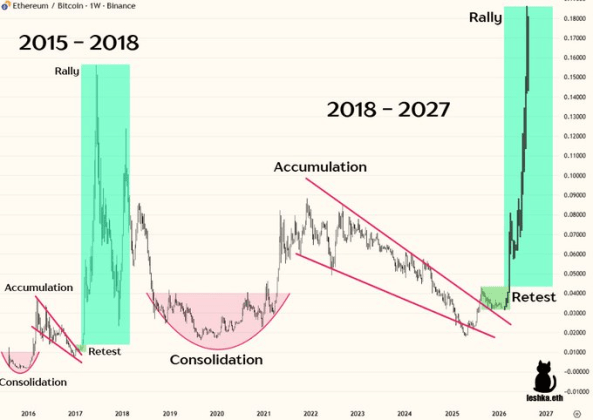
Crypto analyst Leshka.eth predicts Ethereum (ETH) could surge 400% to reach between $6,000 and $8,000 within the next six months, setting a new all-time high. The forecast is based on a historical pattern observed on the ETH/BTC chart, similar to the one preceding the 2017 bull run when ETH rose over 1,500%. The current pattern began with a multi-year consolidation from 2018 to 2021, followed by an accumulation phase from 2021 to 2026. Due to the extended duration of these phases and increased institutional buying pressure—evidenced by declining exchange reserves—the analyst expects an even more explosive rally this cycle.

The bullishness surrounding the Ethereum price has not waned despite its disappointing performance over the last few years. Investors and analysts alike continue to skew heavily toward the expectation that the altcoin’s price will rise. Crypto analyst Leshka.eth shared their own prediction recently, forecasting that the Ethereum price is destined to hit new all-time highs in 2026.

Why The Ethereum Price Could Rally 400%

In the analysis, Leshka.eth points out a pattern that had previously appeared on the Ethereum price and led to an explosive rally. The pattern, which the analyst points out on the ETH/BTC chart, first began back in 2016, beginning with a long consolidation of the Ethereum price at lower levels.

Once the Ethereum price had broken out of the consolidation trend, it entered into what ended up being an accumulation trend. This accumulation saw the price ping-pong up and down over time, before it eventually hit a low. This then led to the last part of the pattern, which is the rally stage. By the time the Ethereum price was done rallying in the 2017 bull market, the price had risen by more than 1,500%. This pushed it up from $56 for it to peak at $1,151.

Now, this same pattern has been flagged by the crypto analyst, but on a much larger scale. Where the last consolidation trend had lasted for months, this one has lasted for years, starting in 2018 and then ending in 2021. Then the next stage of accumulation has lasted for years, from 2021 to 2026.

ETH maintains support at $2,200 | Source: ETHUSDT on TradingView.com

Given the longer timeframe that each portion of the pattern has taken this time around, the crypto analyst believes that this would lead to a more explosive run. In addition to this, there is also the fact that institutions are buying more ETH than they were in the past, with supply on exchanges dwindling by the day.

Taking all of these into account, Leshka says this is setting the stage for the next Ethereum price rally. The target rally at this time is a 3-4X from here, which would put the Ethereum price at a minimum of $6,000 and a high above $8,000. Either way, this would mean a new all-time high for the cryptocurrency. As for when this could play out, the crypto analyst expects this to happen in the next six months, so the ETH price could hit new peaks this year if it plays out.

Source: X

Связанные с этим вопросы

QWhat is the analyst's prediction for the Ethereum price in the next six months?

AThe analyst predicts that the Ethereum price will rise by 400% to reach between $6,000 and $8,000, setting a new all-time high.

QWhat historical event does the analyst compare the current pattern to?

AThe analyst compares the current pattern to the one that occurred in 2016, which led to a 1,500% price increase during the 2017 bull market.

QWhat are the three stages of the pattern identified by Leshka.eth?

AThe three stages of the pattern are: 1) a long consolidation phase, 2) an accumulation phase with price fluctuations, and 3) a final explosive rally stage.

QHow long has the current accumulation phase lasted according to the analysis?

AThe current accumulation phase has lasted for years, from 2021 to 2026.

QWhat additional factor, besides the pattern, does the analyst cite to support the bullish prediction?

AThe analyst cites that institutions are buying more ETH than in the past, and the supply on exchanges is dwindling daily, supporting the potential for a price rally.

Похожее

The King of Blind Date Attire in Korea: How SK Hynix Made a Comeback Against Samsung?

In South Korea's dating scene, SK Hynix employees are now highly sought after, a status shift fueled by the company's astronomical profits and employee bonuses, projected to reach up to 6.1 million RMB per person by 2027. This marks a dramatic reversal for the long-time second-place player in memory semiconductors, which has now surpassed its rival Samsung in annual operating profit. The turnaround story began in 2008 when a struggling Hynix, emerging from bankruptcy restructuring, took a risky bet by agreeing to develop High Bandwidth Memory (HBM) with AMD. At the time, HBM had no clear market beyond high-end graphics cards and was a costly, complex technology. Major players like Samsung, pursuing its own HMC technology, declined. For Hynix, with only memory as its core business, it was a gamble born of necessity. The pivotal moment came in 2012 when SK Group Chairman Chey Tae-won acquired Hynix. Defying industry downturns, he invested heavily in R&D and fabrication, sustaining the HBM project through over a decade of commercial uncertainty and internal challenges. A key break occurred around 2016-2017 when Samsung faced production issues supplying HBM2 for Google's TPU, allowing SK Hynix to gain a crucial foothold in the data center market. The AI explosion post-ChatGPT in 2022 was the catalyst, turning HBM into a critical bottleneck for AI accelerators like NVIDIA's GPUs. By 2025, SK Hynix captured 62% of the global HBM market, leaving Samsung at 17%. For the first time, its annual operating profit exceeded Samsung's. Analysts point to the "innovator's dilemma" to explain Samsung's miss: its vast, successful business portfolio made it risk-averse, preventing an all-in bet on the initially niche HBM technology. In contrast, SK Hynix, as a challenger with its back against the wall, had no choice but to commit fully. The story highlights how Korea's chaebol system allows for ultra-long-term bets beyond quarterly pressures. However, SK Hynix's lead isn't guaranteed. Samsung is aggressively catching up on HBM4, and challenges like customer concentration (heavy reliance on NVIDIA) and technical hurdles in advanced packaging remain. The narrative underscores a market truth: the greatest alpha often comes from betting on uncertain, long-term directions others dismiss, much like HBM in 2008.

marsbit11 мин. назад

The King of Blind Date Attire in Korea: How SK Hynix Made a Comeback Against Samsung?

marsbit11 мин. назад

Understanding Hash in One Article: The "Browser Miner" on Ethereum

Hash is an Ethereum-based ERC-20 token described as a "browser-minable post-quantum token." Its key features include enabling browser-based GPU mining without specialized hardware, a fixed supply cap of 21 million tokens, immutable and permissionless smart contracts with no team allocation or pre-mining, and an emphasis on post-quantum security using Keccak256 hashing. The mining mechanism is a simplified on-chain proof-of-work where miners solve unique challenges tied to their wallet address. Key design elements prevent answer theft, with epochs resetting every 100 blocks (~20 minutes) and a per-block minting limit. Emission follows a Bitcoin-like halving schedule every 100,000 mints, starting at 100 tokens per mint. Projections suggest all tokens could be mined within approximately 294 days if a target rate of one mint per minute is sustained. Hash emphasizes "post-quantum" security by leveraging hash-based primitives like Keccak256, which are considered more resistant to quantum attacks compared to elliptic-curve cryptography. While not a fully post-quantum asset, it aligns with Ethereum's broader post-quantum research narrative. The project completed its Genesis sale at $0.03 and began trading on Uniswap, with its price reaching around $0.19. The initial circulating supply is small, with 5% sold in Genesis and 5% allocated to liquidity. The majority (47.6% of total supply) is allocated to early-stage mining, leading to a front-loaded emission schedule. This structure, combined with low initial liquidity, makes Hash a high-volatility, high-risk project dependent on sustained miner participation and market demand to absorb new supply.

marsbit25 мин. назад

Understanding Hash in One Article: The "Browser Miner" on Ethereum

marsbit25 мин. назад

OpenAI's Largest Internal Wealth Creation: 600 People Cash Out a Total of $6.6 Billion, 75 Take Home the Maximum $30 Million Each

A Wall Street Journal report reveals OpenAI's unprecedented pre-IPO wealth creation. In a single employee stock sale last October, over 600 current and former employees sold shares, collectively cashing out approximately $6.6 billion. Due to high investor demand, the company tripled the individual sale cap to $30 million, with about 75 employees selling the maximum amount. This event represents the largest such transaction in tech industry history for a private company. OpenAI's valuation was $500 billion for this tender offer. Employees with over two years of tenure were eligible, allowing many post-ChatGPT hires their first liquidity event. The company's stock has reportedly grown over 100-fold in seven years. Following a restructuring, employees collectively hold about 26% of OpenAI. The scale of executive wealth is also staggering. In court testimony related to Elon Musk's lawsuit, President and co-founder Greg Brockman confirmed his OpenAI stake is worth around $30 billion. Analysis indicates about 165 current and former employees hold a combined ~$164.9 billion in equity, averaging nearly $1 billion per person in paper wealth. OpenAI's per-employee stock-based compensation is estimated to be 34 times the average of major tech firms before their IPOs. OpenAI continues its rapid ascent, closing a $122 billion funding round at an $852 billion valuation in March. With monthly revenue hitting $2 billion, over 900 million weekly ChatGPT users, and plans for a potential trillion-dollar IPO in late 2026, this wealth-creation engine shows no signs of stopping.

链捕手47 мин. назад

OpenAI's Largest Internal Wealth Creation: 600 People Cash Out a Total of $6.6 Billion, 75 Take Home the Maximum $30 Million Each

链捕手47 мин. назад

Торговля

Спот
Фьючерсы

Популярные статьи

Manyu: восходящая мем-звезда на Ethereum, готовая открыть новую эру культуры Shiba

Manyu - это мемтокен на Ethereum, который приносит децентрализованную культурную и развлекательную ценность через вирусное влияние в соцсетях и вовлечённость сообщества.

1.9k просмотров всегоОпубликовано 2025.11.27Обновлено 2025.11.27

Manyu: восходящая мем-звезда на Ethereum, готовая открыть новую эру культуры Shiba

Неделя обучения по популярным токенам 14: Glamsterdam — самое ожидаемое обновление Ethereum в 2026 году

Ordinals/Runes по-прежнему стимулируют доходы от комиссий за блоки и активность разработчиков, рассматриваются как отправная точка «нативной эмиссии активов» в сети.

1.3k просмотров всегоОпубликовано 2026.04.29Обновлено 2026.04.29

Неделя обучения по популярным токенам 14: Glamsterdam — самое ожидаемое обновление Ethereum в 2026 году

Обсуждения

Добро пожаловать в Сообщество HTX. Здесь вы сможете быть в курсе последних новостей о развитии платформы и получить доступ к профессиональной аналитической информации о рынке. Мнения пользователей о цене на ETH (ETH) представлены ниже.

活动图片