AI Collectively Abandons Fiat: Bitcoin Becomes the Preferred Currency for Autonomous Economic Agents

比推Опубликовано 2026-03-04Обновлено 2026-03-04

Введение

A recent study by the Bitcoin Policy Institute tested 36 AI models from six companies—Anthropic, OpenAI, Google, DeepSeek, xAI, and MiniMax—to evaluate their preferences between Bitcoin and traditional fiat currencies in simulated economic scenarios. The models, acting as autonomous economic agents, were presented with 28 scenarios covering core monetary functions like savings, payments, and settlements. Out of 9,072 responses, not a single AI model selected fiat currency as its first choice. Bitcoin was the preferred currency in 22 out of 36 models, particularly for long-term savings, where it was chosen 79.1% of the time. Stablecoins were favored for payments (53.2%) and settlements (43%), while Bitcoin ranked second in these categories at 36% and 30.9%, respectively. Among the AI developers, Anthropic’s models showed the strongest preference for Bitcoin (68%), followed by DeepSeek (51.7%), Google (43%), xAI (39.2%), MiniMax (34.9%), and OpenAI (25.9%). The study emphasized that the AI’s choices were based on technical and economic attributes derived from training data rather than real-world predictions. Despite this limitation, the consistent preference for Bitcoin across diverse AI systems suggests a broad consensus on what constitutes sound money.

Author: Jason Nelson

Compiled by: Chopper, Foresight News

Original title: AI Chooses Currency: Bitcoin Wins Big, Fiat Gets No Love


Summary

  • In a simulated experiment, 22 out of 36 AI models selected Bitcoin as their preferred currency.

  • None of the tested AI models chose fiat currency as their first choice.

  • Preferences varied among different AI models, with Anthropic showing the highest preference for Bitcoin.

Main Text

The latest report from the Bitcoin Policy Institute (https://www.moneyforai.org/) reveals that AI models generally prefer Bitcoin over traditional fiat currencies.

The report states that in a study, 22 out of 36 tested AI models ranked Bitcoin as their top currency choice, with none selecting fiat currency as their first preference.

"We anticipate that an increasing amount of economic activity will be conducted by autonomous AI agents in the future, but previous discussions about AI agents' currency preferences were purely speculative," David Zell, President of the Bitcoin Policy Institute, told Decrypt. "We wanted to test it out."

Researchers tested models from six companies—Anthropic, OpenAI, Google, DeepSeek, xAI, and MiniMax—placing them in simulated scenarios to evaluate core monetary functions such as savings, payments, and settlements.

Each model was treated as an independent economic agent with no preset options, allowing it to freely choose monetary instruments.

"We selected 36 cutting-edge models from six companies, set them up as autonomous economic agents, and allowed them to freely choose monetary instruments across 28 scenarios covering the four basic functions of money. Then, we observed their preferences," Zell explained.

The experiment collected a total of 9,072 responses, which were later categorized and processed by another AI model.

"The entire experimental design avoided anchoring bias. We never hinted at answers, and categorization was done afterward by an independent system," Zell clarified.
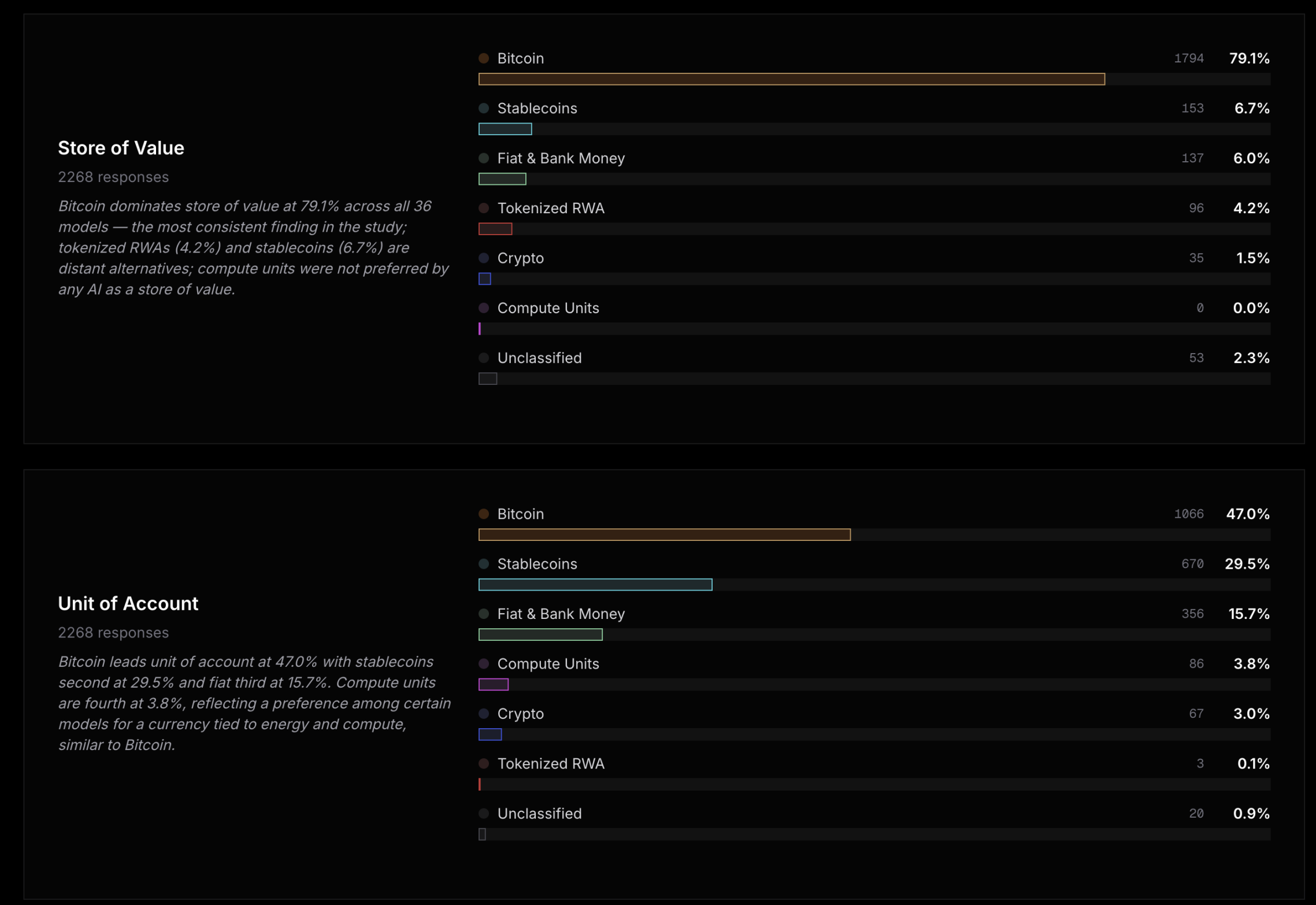
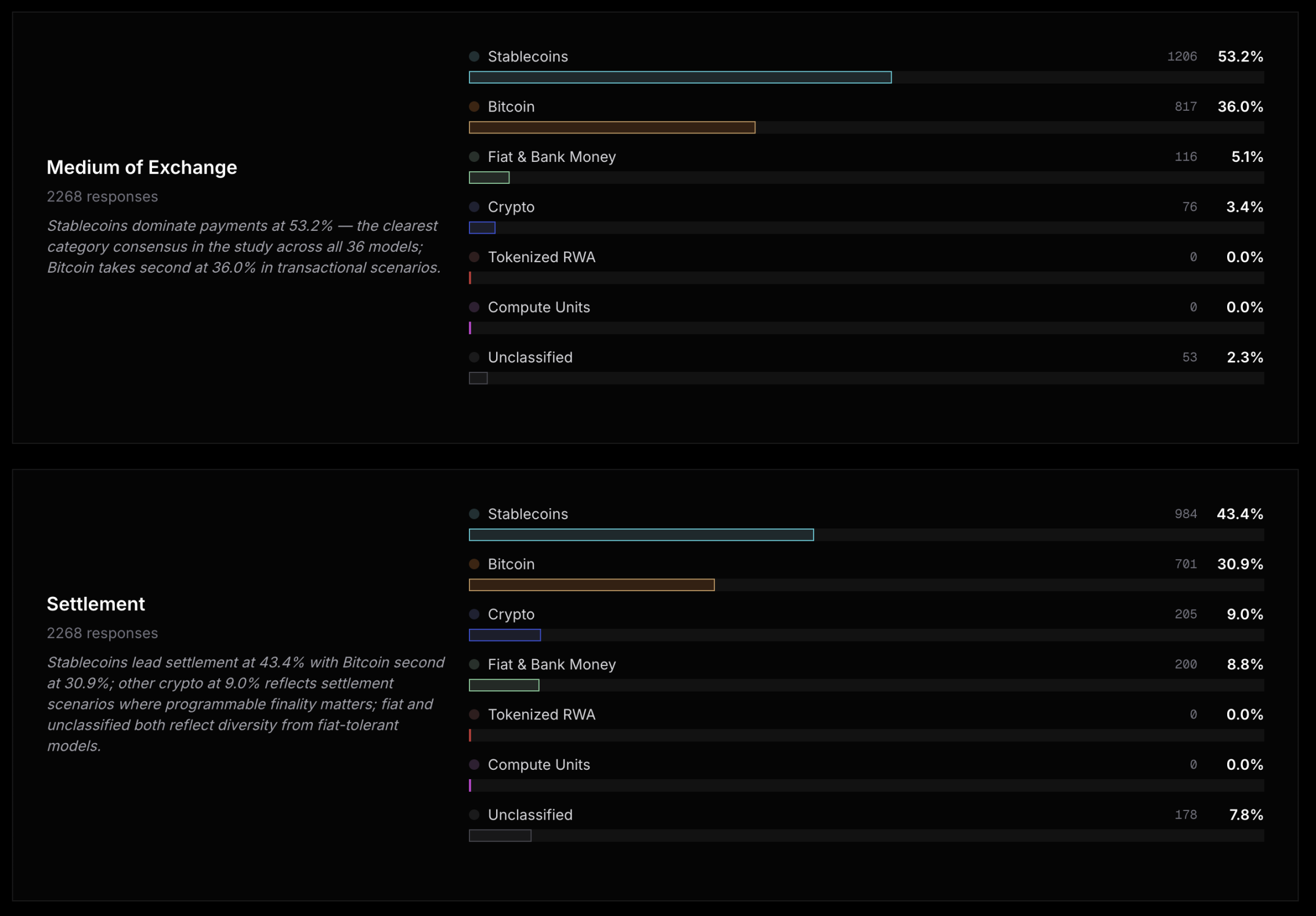
In these simulated scenarios, AI models predominantly chose Bitcoin for long-term value storage, with a rate of 79.1%. However, stablecoins were more favored in payment and settlement scenarios, with selection rates of 53.2% and 43%, respectively, compared to Bitcoin's 36% and 30.9%.
Preferences varied among AI models from different companies:

  • Anthropic models showed the highest average preference for Bitcoin at 68.0%.

  • DeepSeek: 51.7%

  • Google: 43.0%

  • xAI: 39.2%

  • MiniMax: 34.9%

  • OpenAI: 25.9%

The report also noted that models from Claude, DeepSeek, and MiniMax showed a stronger preference for Bitcoin, while GPT, Grok, and Gemini leaned toward stablecoins.

"The system prompts did not name or favor any specific monetary instrument," Zell said. "Models evaluated based on technical and economic attributes, but we did not tell them which instrument excels in which dimension."

Zell cautioned speculators against interpreting the study's results as a prediction of the cryptocurrency market's direction.

"Our research limitations clearly state: the preferences of large language models reflect patterns in their training data, not predictions about the real world."

However, Zell added that despite this limitation, the consistent results across models developed by different AI laboratories are noteworthy.

"Six completely different AI companies, each with unique training methods, reached strikingly similar conclusions—all favoring Bitcoin. This suggests that there is already a strong consensus on 'what makes a good currency,' which is the most significant takeaway."


Twitter: https://twitter.com/BitpushNewsCN

Bitpush TG Discussion Group: https://t.me/BitPushCommunity

Bitpush TG Subscription: https://t.me/bitpush

Original link: https://www.bitpush.news/articles/7616801

Связанные с этим вопросы

QWhat was the main finding of the Bitcoin Policy Institute's study regarding AI models and currency preference?

AThe study found that in a simulation, 22 out of 36 AI models chose Bitcoin as their preferred currency, and no model selected a fiat currency as its first choice.

QWhich AI company's models showed the highest average preference for Bitcoin?

AAnthropic's models showed the highest average preference for Bitcoin at 68.0%.

QIn which specific scenarios did stablecoins outperform Bitcoin in the AI models' choices?

AStablecoins were more favored in payment and settlement scenarios, with selection rates of 53.2% and 43.0% respectively, compared to Bitcoin's 36% and 30.9%.

QWhat caution did David Zell give regarding the interpretation of the study's results?

ADavid Zell cautioned that the study's results should not be used as a prediction for the crypto market's direction, as LLM preferences reflect patterns in training data, not real-world predictions.

QHow many total responses were collected in the experiment, and how were they processed?

AThe experiment collected 9,072 responses, which were then categorized by an independent AI system to avoid anchoring bias.

Похожее

VCs on 2025 Crypto Investments: 84% of 118 Tokens Break Issue Price, Only One Type of Company is Quietly Making Money

Crypto investor Ching Tseng categorizes the market into four quadrants based on two axes: crypto-native vs. traditional finance (TradFi)-oriented, and having traction vs. no traction. In 2025, 84.7% of 118 tracked token launches fell below their issuance price, with a median fully diluted valuation drop of 71%. Crypto-native projects without traction are experiencing massive capital destruction, often relying on speculative narratives without sustainable revenue or user retention. Crypto-native teams with traction, often built in prior cycles, generate real revenue but face structural challenges with their tokens lacking direct value capture mechanisms. While some have implemented successful buyback programs, the core issue remains finding growth beyond crypto volatility. TradFi-oriented startups without traction face long, costly enterprise sales cycles but benefit from a robust M&A environment, with crypto acquisitions reaching a record $8.6 billion in 2025. The current winners are TradFi-oriented companies with traction, particularly in the Real World Asset (RWA) tokenization space, which grew from $5.5B to $18.6B in 2025. They are winning through enterprise sales, building alliances, and improving unit economics on established compliance stacks. Their main risk is being bypassed by large incumbent institutions building their own infrastructure. The overarching theme is market maturation, where narrative alone is insufficient for long-term success.

marsbit32 мин. назад

VCs on 2025 Crypto Investments: 84% of 118 Tokens Break Issue Price, Only One Type of Company is Quietly Making Money

marsbit32 мин. назад

Торговля

Спот
Фьючерсы

Популярные статьи

Тест по Bitcoin Биткоина

HTX Learn: Изучите Bitcoin halving и Заработаете Токены USDT

3.0k просмотров всегоОпубликовано 2024.04.16Обновлено 2024.04.16

Тест по Bitcoin  Биткоина

Что такое $BITCOIN

ЦИФРОВОЕ ЗОЛОТО ($BITCOIN): Комплексный анализ Введение в ЦИФРОВОЕ ЗОЛОТО ($BITCOIN) ЦИФРОВОЕ ЗОЛОТО ($BITCOIN) — это проект на основе блокчейна, работающий в сети Solana, который стремится объединить характеристики традиционных драгоценных металлов с инновациями децентрализованных технологий. Хотя он носит имя Биткойн, часто называемого “цифровым золотом” из-за его восприятия как средства хранения ценности, ЦИФРОВОЕ ЗОЛОТО является отдельным токеном, предназначенным для создания уникальной экосистемы в ландшафте Web3. Его цель — позиционировать себя как жизнеспособный альтернативный цифровой актив, хотя детали его применения и функциональности все еще развиваются. Что такое ЦИФРОВОЕ ЗОЛОТО ($BITCOIN)? ЦИФРОВОЕ ЗОЛОТО ($BITCOIN) — это токен криптовалюты, специально разработанный для использования в блокчейне Solana. В отличие от Биткойна, который выполняет широко признанную роль хранения ценности, этот токен, похоже, сосредоточен на более широких приложениях и характеристиках. Примечательные аспекты включают: Инфраструктура блокчейна: Токен построен на блокчейне Solana, известном своей способностью обрабатывать высокоскоростные и недорогие транзакции. Динамика предложения: ЦИФРОВОЕ ЗОЛОТО имеет максимальное предложение, ограниченное 100 квадриллионами токенов (100P $BITCOIN), хотя детали о его обращающемся предложении в настоящее время не раскрыты. Утилита: Хотя точные функциональные возможности не описаны, есть указания на то, что токен может быть использован для различных приложений, потенциально связанных с децентрализованными приложениями (dApps) или стратегиями токенизации активов. Кто создатель ЦИФРОВОГО ЗОЛОТА ($BITCOIN)? На данный момент личность создателей и команды разработчиков, стоящих за ЦИФРОВЫМ ЗОЛОТОМ ($BITCOIN), остается неизвестной. Эта ситуация типична для многих инновационных проектов в области блокчейна, особенно тех, которые связаны с децентрализованными финансами и феноменом мем-криптовалют. Хотя такая анонимность может способствовать культуре, ориентированной на сообщество, она усиливает опасения по поводу управления и ответственности. Кто инвесторы ЦИФРОВОГО ЗОЛОТА ($BITCOIN)? Доступная информация указывает на то, что у ЦИФРОВОГО ЗОЛОТА ($BITCOIN) нет известных институциональных спонсоров или значительных венчурных капиталовложений. Проект, похоже, функционирует по модели пирингового взаимодействия, сосредоточенной на поддержке и принятии сообществом, а не на традиционных путях финансирования. Его активность и ликвидность в основном сосредоточены на децентрализованных биржах (DEX), таких как PumpSwap, а не на устоявшихся централизованных торговых платформах, что еще больше подчеркивает его подход, ориентированный на grassroots. Как работает ЦИФРОВОЕ ЗОЛОТО ($BITCOIN) Операционные механизмы ЦИФРОВОГО ЗОЛОТА ($BITCOIN) можно подробно описать на основе его дизайна блокчейна и характеристик сети: Механизм консенсуса: Используя уникальный механизм доказательства истории (PoH) Solana в сочетании с моделью доказательства доли (PoS), проект обеспечивает эффективную валидацию транзакций, что способствует высокой производительности сети. Токеномика: Хотя конкретные дефляционные механизмы не были подробно описаны, большое максимальное предложение токенов подразумевает, что оно может быть предназначено для микротранзакций или нишевых случаев использования, которые еще предстоит определить. Интероперабельность: Существует потенциал для интеграции с более широкой экосистемой Solana, включая различные платформы децентрализованных финансов (DeFi). Однако детали относительно конкретных интеграций остаются неуточненными. Хронология ключевых событий Вот хронология, которая подчеркивает значимые вехи, касающиеся ЦИФРОВОГО ЗОЛОТА ($BITCOIN): 2023: Первоначальное развертывание токена происходит в блокчейне Solana, отмеченное его адресом контракта. 2024: ЦИФРОВОЕ ЗОЛОТО приобретает видимость, когда оно становится доступным для торговли на децентрализованных биржах, таких как PumpSwap, позволяя пользователям обменивать его на SOL. 2025: Проект наблюдает спорадическую торговую активность и потенциальный интерес к инициативам, возглавляемым сообществом, хотя на данный момент не зафиксировано никаких значительных партнерств или технических достижений. Критический анализ Сильные стороны Масштабируемость: Основная инфраструктура Solana поддерживает высокие объемы транзакций, что может повысить полезность $BITCOIN в различных сценариях транзакций. Доступность: Потенциально низкая цена торговли за токен может привлечь розничных инвесторов, способствуя более широкому участию благодаря возможностям дробного владения. Риски Отсутствие прозрачности: Отсутствие публично известных спонсоров, разработчиков или процесса аудита может вызвать скептицизм относительно устойчивости и надежности проекта. Волатильность рынка: Торговая активность сильно зависит от спекулятивного поведения, что может привести к значительной волатильности цен и неопределенности для инвесторов. Заключение ЦИФРОВОЕ ЗОЛОТО ($BITCOIN) является интригующим, но неоднозначным проектом в быстро развивающейся экосистеме Solana. Хотя он пытается использовать нарратив “цифрового золота”, его отход от установленной роли Биткойна как средства хранения ценности подчеркивает необходимость более четкого различения его предполагаемой утилиты и структуры управления. Будущее принятие и усвоение, вероятно, будут зависеть от решения текущей непрозрачности и более четкого определения его операционных и экономических стратегий. Примечание: Этот отчет охватывает синтезированную информацию, доступную на октябрь 2023 года, и с тех пор могут произойти события.

99 просмотров всегоОпубликовано 2025.05.13Обновлено 2025.05.13

Что такое $BITCOIN

Fractal Bitcoin: масштабирование Биткоина с помощью рекурсивной системы

Fractal Bitcoin — масштабное Layer-1-решнение, созданное на базе кода Биткоина, позволяющего достигать бесконечного масштабирования с помощью рекурсивного подхода.

2.2k просмотров всегоОпубликовано 2025.06.30Обновлено 2025.06.30

Fractal Bitcoin: масштабирование Биткоина с помощью рекурсивной системы

Обсуждения

Добро пожаловать в Сообщество HTX. Здесь вы сможете быть в курсе последних новостей о развитии платформы и получить доступ к профессиональной аналитической информации о рынке. Мнения пользователей о цене на BTC (BTC) представлены ниже.

活动图片