Saylor Bought 1,550 BTC, But This Might Be Strategy's Worst Trade Recently

marsbitОпубликовано 2026-06-09Обновлено 2026-06-09

Введение

Saylor purchased 1,550 BTC, but this may be one of MicroStrategy's worst recent trades for its MSTR shareholders. The article explains that for MSTR to increase its Bitcoin-per-share (BPS) metric, it must issue new shares at an mNAV (market cap to net asset value) ratio above a "breakeven" level, calculated here as 1.30. In this transaction, MSTR raised $181 million via an ATM offering and used only $101.3 million to buy Bitcoin, with the rest reportedly added to its dollar reserves. Crucially, the author argues the shares were likely sold below the 1.30 mNAV threshold. This combination—selling below breakeven mNAV and not deploying all proceeds into Bitcoin—resulted in a slight dilution of BPS, estimated at a 0.19% decrease. The trade is framed as a sacrifice of MSTR shareholder value (BPS) to extend the dollar reserve runway for its Sustainable Treasury Reserve Coin (STRC) subsidiary from 6.3 to 7 months. The author concludes that Strategy is gambling that this move will improve market sentiment for STRC and MSTR, allowing future value-accretive fundraising. If it fails, the company may face the difficult choice of further diluting MSTR or delaying STRC dividends.

Author:100y

Compiled by: Deep Tide TechFlow

Deep Tide Intro: While Saylor is shouting about increasing the BTC per share, he is issuing shares below the break-even point and only using half of the raised money to buy BTC—this is not bottom fishing, this is using MSTR shareholders' interests to subsidize STRC's sustainability. For investors holding MSTR, understanding the logic behind this trade is more important than focusing on how much BTC was bought.

Saylor first sold 32 BTC, then turned around and bought 1,550 BTC today.

I don't want Strategy to fail. But some things must be made clear.

This is one of the worst trades.

On the surface, this trade looks beautiful. Strategy bought a large amount of BTC near recent lows and even increased its dollar reserve for preferred stock dividends from $900 million to $1 billion.

Is this Strategy's revival?

If you think this is positive, it means you don't fully understand Strategy yet.

1. You Need to Understand the Break-Even mNAV

One of Strategy's core objectives is to increase the BTC per share (BPS) for MSTR shareholders.

The method to increase BPS is simple: issue common stock at a premium and use the raised funds to buy BTC.

So, how high a premium does MSTR need to issue shares via ATM offerings to truly increase BPS?

According to the 2026 Q1 earnings call, the mNAV needs to be above 1.22.

This is the so-called "break-even mNAV."

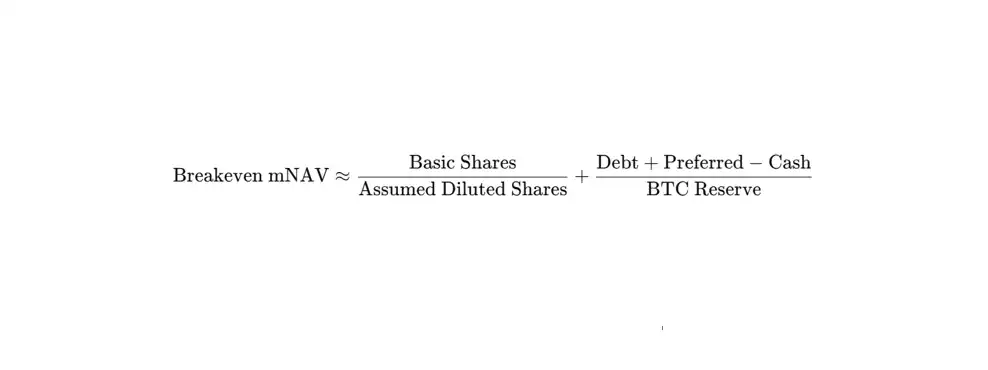
This concept comes from a simple condition: the amount of BTC that can be bought by selling 1 share of MSTR must be greater than the BTC amount corresponding to each existing MSTR share.

The complete derivation process can be referred to in my previous article.

In the end, the break-even mNAV is calculated as follows:

By the way, the current break-even mNAV is no longer 1.22.

Based on the data before this purchase of 1,550 BTC, my calculated result is 1.30.

2. The Worst Trade

Now back to Strategy's purchase of these 1,550 BTC.

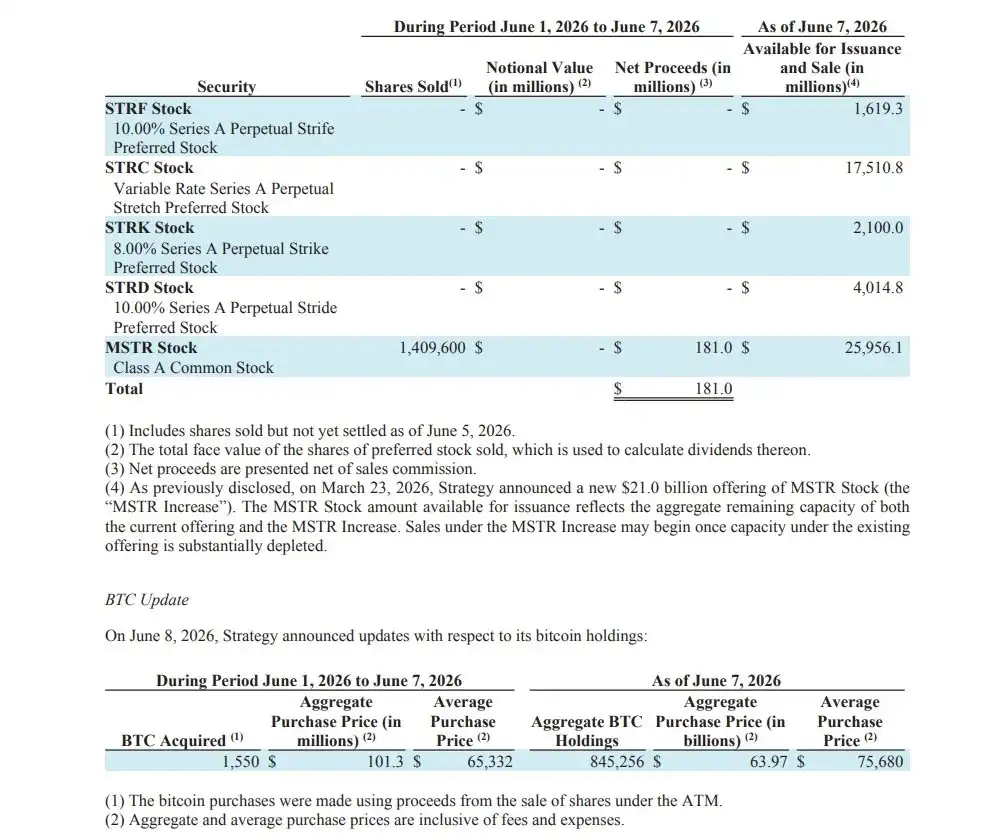
Strategy raised $181 million through MSTR's ATM offering, of which $101.3 million was used to purchase 1,550 BTC.

There are two issues here:

First, MSTR's ATM offering seems to have been conducted at an mNAV below 1.30. Selling shares to buy BTC below the break-even mNAV is not increasing BPS; it's diluting it.

Second, and this is the key point: not all ATM-raised funds were used to buy BTC. The entire concept of break-even mNAV is based on the premise that 100% of the raised funds are used to buy BTC. Even if the mNAV is high enough, if only part of the funds flows into BTC, this trade can still lower BPS.

Strategy seems to have added the remaining unused funds to the dollar reserve.

In other words: Strategy sacrificed MSTR shareholders' shares and BPS to maintain STRC's sustainability.

In fact, after this trade, Strategy's BPS decreased by approximately 0.19% compared to before the trade.

What did they gain in return?

The available time for the dollar reserve was extended from about 6.3 months to 7 months.

3. Strategy's Bet

"Our goal is to drive the BTC per share up, and we are doing everything we can to drive the BTC per share up."

These are the words of Michael Saylor in the 2026 Q1 earnings call.

But in this trade, Strategy sacrificed MSTR's BPS for STRC.

Strategy has rolled the dice.

If sacrificing BPS can reverse market sentiment, restore STRC's price, and pull the mNAV back up, then Strategy can continue raising funds through MSTR and STRC's ATM offerings.

But what if sentiment doesn't improve?

Then Strategy may have no choice but to continue sacrificing MSTR.

In the worst-case scenario, either delaying STRC's dividend payments...

Or slowly bleeding out.

Pray for BTC, MSTR, and STRC to recover.

Amen.

Связанные с этим вопросы

QAccording to the author, why is Saylor's recent purchase of 1,550 BTC potentially a bad deal for MSTR shareholders?

AThe author argues it's a bad deal because the shares were likely sold via MSTR's ATM offering at an mNAV below the breakeven point of 1.30, and only part of the raised funds were used to buy BTC. This dilutes the Bitcoin per Share (BPS) for MSTR shareholders while using the remaining capital to shore up the STRATOS (STRC) sustainability fund.

QWhat is the 'breakeven mNAV' and why is it important for MSTR's strategy?

AThe 'breakeven mNAV' is the minimum premium to MicroStrategy's Bitcoin holdings (mNAV) at which the company can issue new shares via its ATM program and use the proceeds to buy Bitcoin *without* diluting the Bitcoin per Share (BPS) for existing shareholders. It's crucial because MSTR's core goal is to increase BPS.

QWhat specific negative outcome for MSTR shareholders resulted from the 1,550 BTC purchase transaction?

AAs a result of this transaction, the author calculates that MSTR's Bitcoin per Share (BPS) decreased by approximately 0.19%.

QWhat trade-off did Strategy (the company) make in this transaction, according to the article?

AStrategy traded off and sacrificed the Bitcoin per Share (BPS) of MSTR shareholders in order to maintain the sustainability of its STRATOS (STRC) project by extending its dollar reserve runway.

QWhat does the author suggest is Strategy's underlying gamble with this move?

AThe author suggests Strategy is gambling that sacrificing MSTR's BPS in the short term will help restore market sentiment, recover the STRC token price, and pull the mNAV premium back up. This would then allow them to resume successful fundraising through ATM offerings for both MSTR and STRC in the future.

Похожее

Vitalik's Vision for the Next Evolution of On-Chain Finance: How to Reconstruct DeFi with an 'Options Mindset'?

Vitalik Buterin recently proposed a conceptual shift for DeFi: replacing traditional Collateralized Debt Positions (CDPs) and forced liquidations with an options-based mechanism. This aims to address key vulnerabilities in current DeFi lending. The traditional CDP model, foundational to protocols like MakerDAO and Aave, allows users to borrow against collateral but relies on real-time oracles and triggers sudden, mandatory liquidations during price volatility. This can cause cascading sell-offs, oracle manipulation risks, and significant MEV extraction, exacerbating market stress. Vitalik's alternative envisions splitting an asset like 1 ETH into two complementary components: one offering stable/index-like exposure and the other absorbing the opposite risk/reward. Instead of a hard liquidation threshold, a user's exposure to the target asset would gradually and smoothly deviate (following a near-quadratic curve) as the collateral price moves. The system would primarily depend on "slow oracles" for periodic settlement rather than instant price feeds. Key potential benefits include: the elimination of abrupt, forced liquidations; drastically reduced reliance on vulnerable real-time oracles; and inherent resistance to certain MEV exploits centered on liquidation auctions. The article posits that for Ethereum DeFi to maintain its relevance amid competition from faster, cheaper chains, it must compete on sophisticated financial engineering and robustness—not just transaction speed or yields. The core value proposition should shift towards offering users clearer, more manageable risk structures, greater autonomy, and resilience in extreme scenarios, moving DeFi from high-risk experimentation towards becoming reliable financial infrastructure.

marsbit8 мин. назад

Vitalik's Vision for the Next Evolution of On-Chain Finance: How to Reconstruct DeFi with an 'Options Mindset'?

marsbit8 мин. назад

AI Agent Completely Transforms Web3 Gaming: From the Rugpull Bakery Bot Controversy to the New 2026 Agent Paradigm

This article explores how the AI Agent paradigm is fundamentally transforming Web3 gaming, moving from a disruptive force to a core, legitimized element. It begins with the controversy in the competitive baking game Rugpull Bakery, where automated scripts caused fairness issues. Instead of banning them, the developers integrated AI Agents into the official gameplay by providing technical documentation (skill.md, agent.json), marking a shift towards "Agentic Gaming." The piece outlines three primary implementation models for AI Agents in Web3 games by 2026: 1. **Autonomous Competitors & Economic Entities:** AI Agents act as independent players with unique strategies. Examples include TEN Protocol's poker agents, AI Arena's trainable NFT fighters, and Satoshi Strike Force's "Digital Athletes" trained on player data. The Somnia blockchain is highlighted as a dedicated "Agentic L1" infrastructure supporting this model at scale. 2. **Modular Infrastructure & Programmable Environments:** This model, exemplified by EVE Frontier, allows AI Agents to program game world logic itself. Using "Smart Assemblies" (e.g., Smart Turrets, Smart Gates), Agents can modify shared economic and physical rules on-chain, creating dynamic, player/AI-built worlds. The ERC-8183 standard further enables these automated entities to hire other AI services for complex tasks. 3. **Hybrid Companions & Dynamic Adaptation:** Here, AI serves as a collaborative partner. In Parallel Colony, highly autonomous AI Avatars work alongside human players who provide high-level guidance. Illuvium plans to use AI to make NPCs dynamic and responsive, creating personalized, emergent narratives for each player. The conclusion posits that Web3 gaming has reached a "post-human" inflection point. Blockchains' transparency and programmability, combined with new standards and infrastructure like Somnia, make integrating and governing AI Agents not just viable but essential. The future lies in a symbiotic digital order where players transition from manual laborers to commanders and partners of algorithmic intelligence.

marsbit1 ч. назад

AI Agent Completely Transforms Web3 Gaming: From the Rugpull Bakery Bot Controversy to the New 2026 Agent Paradigm

marsbit1 ч. назад

Saylor's Purchase of 1550 Bitcoin Is a Bad Trade

**Title: Saylor's Purchase of 1,550 Bitcoins Was a Bad Trade** The article critically analyzes Strategy's recent move of selling 32 bitcoins followed by a much larger purchase of 1,550 bitcoins. While appearing bullish, the author argues this trade is detrimental to MSTR shareholders. The core argument revolves around the concept of "breakeven modified Net Asset Value (mNAV)," a key metric for Strategy. To increase Bitcoin per share (BPS) for MSTR holders, Strategy must issue new shares at a premium high enough that the funds raised can buy more bitcoin than the bitcoin backing each existing share. Currently, this breakeven mNAV is estimated at 1.30. The recent trade failed on two counts: 1. The shares for the $181 million raise were issued at an mNAV *below* the 1.30 breakeven point. Selling "cheap" shares to buy bitcoin actually *reduces* BPS. 2. Only $101.3 million of the raised funds were used to buy bitcoin; the rest went to boost the company's dollar reserves. The breakeven mNAV calculation assumes *100%* of proceeds are used for bitcoin purchases. Diverting funds, even if mNAV were high, dilutes BPS. The result is an estimated 0.19% decrease in Bitcoin per share for MSTR holders. In exchange, Strategy merely extended its operational runway for its dollar reserves from ~6.3 months to 7 months. The author interprets this as Strategy prioritizing the survival and development of its STRC business over its stated core goal of increasing MSTR's BPS. This constitutes a gamble: if sacrificing MSTR value leads to improved market sentiment and a recovery in STRC's price (and thus mNAV), the whole system could work. If not, Strategy may be forced into a cycle of further diluting MSTR to stay afloat, potentially leading to deferred STRC dividends or corporate decline. The article concludes with a hope for price recovery for Bitcoin, MSTR, and STRC.

Foresight News1 ч. назад

Saylor's Purchase of 1550 Bitcoin Is a Bad Trade

Foresight News1 ч. назад

Торговля

Спот
Фьючерсы

Популярные статьи

Тест по Bitcoin Биткоина

HTX Learn: Изучите Bitcoin halving и Заработаете Токены USDT

3.1k просмотров всегоОпубликовано 2024.04.16Обновлено 2024.04.16

Тест по Bitcoin  Биткоина

Что такое $BITCOIN

ЦИФРОВОЕ ЗОЛОТО ($BITCOIN): Комплексный анализ Введение в ЦИФРОВОЕ ЗОЛОТО ($BITCOIN) ЦИФРОВОЕ ЗОЛОТО ($BITCOIN) — это проект на основе блокчейна, работающий в сети Solana, который стремится объединить характеристики традиционных драгоценных металлов с инновациями децентрализованных технологий. Хотя он носит имя Биткойн, часто называемого “цифровым золотом” из-за его восприятия как средства хранения ценности, ЦИФРОВОЕ ЗОЛОТО является отдельным токеном, предназначенным для создания уникальной экосистемы в ландшафте Web3. Его цель — позиционировать себя как жизнеспособный альтернативный цифровой актив, хотя детали его применения и функциональности все еще развиваются. Что такое ЦИФРОВОЕ ЗОЛОТО ($BITCOIN)? ЦИФРОВОЕ ЗОЛОТО ($BITCOIN) — это токен криптовалюты, специально разработанный для использования в блокчейне Solana. В отличие от Биткойна, который выполняет широко признанную роль хранения ценности, этот токен, похоже, сосредоточен на более широких приложениях и характеристиках. Примечательные аспекты включают: Инфраструктура блокчейна: Токен построен на блокчейне Solana, известном своей способностью обрабатывать высокоскоростные и недорогие транзакции. Динамика предложения: ЦИФРОВОЕ ЗОЛОТО имеет максимальное предложение, ограниченное 100 квадриллионами токенов (100P $BITCOIN), хотя детали о его обращающемся предложении в настоящее время не раскрыты. Утилита: Хотя точные функциональные возможности не описаны, есть указания на то, что токен может быть использован для различных приложений, потенциально связанных с децентрализованными приложениями (dApps) или стратегиями токенизации активов. Кто создатель ЦИФРОВОГО ЗОЛОТА ($BITCOIN)? На данный момент личность создателей и команды разработчиков, стоящих за ЦИФРОВЫМ ЗОЛОТОМ ($BITCOIN), остается неизвестной. Эта ситуация типична для многих инновационных проектов в области блокчейна, особенно тех, которые связаны с децентрализованными финансами и феноменом мем-криптовалют. Хотя такая анонимность может способствовать культуре, ориентированной на сообщество, она усиливает опасения по поводу управления и ответственности. Кто инвесторы ЦИФРОВОГО ЗОЛОТА ($BITCOIN)? Доступная информация указывает на то, что у ЦИФРОВОГО ЗОЛОТА ($BITCOIN) нет известных институциональных спонсоров или значительных венчурных капиталовложений. Проект, похоже, функционирует по модели пирингового взаимодействия, сосредоточенной на поддержке и принятии сообществом, а не на традиционных путях финансирования. Его активность и ликвидность в основном сосредоточены на децентрализованных биржах (DEX), таких как PumpSwap, а не на устоявшихся централизованных торговых платформах, что еще больше подчеркивает его подход, ориентированный на grassroots. Как работает ЦИФРОВОЕ ЗОЛОТО ($BITCOIN) Операционные механизмы ЦИФРОВОГО ЗОЛОТА ($BITCOIN) можно подробно описать на основе его дизайна блокчейна и характеристик сети: Механизм консенсуса: Используя уникальный механизм доказательства истории (PoH) Solana в сочетании с моделью доказательства доли (PoS), проект обеспечивает эффективную валидацию транзакций, что способствует высокой производительности сети. Токеномика: Хотя конкретные дефляционные механизмы не были подробно описаны, большое максимальное предложение токенов подразумевает, что оно может быть предназначено для микротранзакций или нишевых случаев использования, которые еще предстоит определить. Интероперабельность: Существует потенциал для интеграции с более широкой экосистемой Solana, включая различные платформы децентрализованных финансов (DeFi). Однако детали относительно конкретных интеграций остаются неуточненными. Хронология ключевых событий Вот хронология, которая подчеркивает значимые вехи, касающиеся ЦИФРОВОГО ЗОЛОТА ($BITCOIN): 2023: Первоначальное развертывание токена происходит в блокчейне Solana, отмеченное его адресом контракта. 2024: ЦИФРОВОЕ ЗОЛОТО приобретает видимость, когда оно становится доступным для торговли на децентрализованных биржах, таких как PumpSwap, позволяя пользователям обменивать его на SOL. 2025: Проект наблюдает спорадическую торговую активность и потенциальный интерес к инициативам, возглавляемым сообществом, хотя на данный момент не зафиксировано никаких значительных партнерств или технических достижений. Критический анализ Сильные стороны Масштабируемость: Основная инфраструктура Solana поддерживает высокие объемы транзакций, что может повысить полезность $BITCOIN в различных сценариях транзакций. Доступность: Потенциально низкая цена торговли за токен может привлечь розничных инвесторов, способствуя более широкому участию благодаря возможностям дробного владения. Риски Отсутствие прозрачности: Отсутствие публично известных спонсоров, разработчиков или процесса аудита может вызвать скептицизм относительно устойчивости и надежности проекта. Волатильность рынка: Торговая активность сильно зависит от спекулятивного поведения, что может привести к значительной волатильности цен и неопределенности для инвесторов. Заключение ЦИФРОВОЕ ЗОЛОТО ($BITCOIN) является интригующим, но неоднозначным проектом в быстро развивающейся экосистеме Solana. Хотя он пытается использовать нарратив “цифрового золота”, его отход от установленной роли Биткойна как средства хранения ценности подчеркивает необходимость более четкого различения его предполагаемой утилиты и структуры управления. Будущее принятие и усвоение, вероятно, будут зависеть от решения текущей непрозрачности и более четкого определения его операционных и экономических стратегий. Примечание: Этот отчет охватывает синтезированную информацию, доступную на октябрь 2023 года, и с тех пор могут произойти события.

99 просмотров всегоОпубликовано 2025.05.13Обновлено 2025.05.13

Что такое $BITCOIN

Fractal Bitcoin: масштабирование Биткоина с помощью рекурсивной системы

Fractal Bitcoin — масштабное Layer-1-решнение, созданное на базе кода Биткоина, позволяющего достигать бесконечного масштабирования с помощью рекурсивного подхода.

2.3k просмотров всегоОпубликовано 2025.06.30Обновлено 2025.06.30

Fractal Bitcoin: масштабирование Биткоина с помощью рекурсивной системы

Обсуждения

Добро пожаловать в Сообщество HTX. Здесь вы сможете быть в курсе последних новостей о развитии платформы и получить доступ к профессиональной аналитической информации о рынке. Мнения пользователей о цене на BTC (BTC) представлены ниже.

活动图片