Ripple IPO Could Bring ‘Something Special’ For XRP Holders, CEO Suggests

bitcoinistОпубликовано 2026-05-08Обновлено 2026-05-08

Введение

Ripple CEO Brad Garlinghouse suggested XRP holders could receive "something special" if the company goes public, though he stressed an IPO is not an immediate priority. He addressed community concerns about Ripple's corporate success not directly benefiting XRP holders, stating the company's main contribution is building products and partnerships to increase XRP's utility and value. While not endorsing a near-term mechanism like a token buyback, Garlinghouse left open the possibility of a future IPO-related benefit for holders. He explained Ripple is not rushing to go public, citing poor recent crypto IPO performance and the benefits of remaining private. Garlinghouse also rejected concerns that Ripple's expansion into areas like stablecoins dilutes XRP's role, arguing the company, as the largest XRP holder, remains deeply incentivized to see the asset succeed. He reaffirmed his commitment to the XRP community, calling it a driving mission for the company.

Ripple CEO Brad Garlinghouse suggested that XRP holders could potentially receive “something special” if Ripple eventually goes public, while stressing that any such move is not an immediate priority for the company.

Speaking with Eleanor Terrett on the Crypto In America podcast at XRP Las Vegas, Garlinghouse addressed one of the more sensitive questions inside the XRP community: whether holders of the token should benefit more directly from the firm’s corporate success as the company’s valuation, acquisitions and institutional footprint continue to expand.

Garlinghouse Addresses XRP Holder Benefits

The exchange came after Terrett noted criticism that Ripple has become a major private-company success story while XRP holders remain economically separate from Ripple’s equity. Ripple, Garlinghouse said, was last valued at $50 billion in a share buyback, a figure that has intensified debate over whether the company’s growth should translate into a more direct benefit for the XRP community.

Asked whether the company had explored an XRP token buyback or another structure that would allow holders to share in Ripple’s wealth, Garlinghouse did not endorse a near-term mechanism. Instead, he framed the firm’s contribution as indirect but central: building products, infrastructure and partnerships that increase XRP’s utility, liquidity and trust.

“I hope XRP holders feel like they are benefiting from Ripple’s existence by virtue of what we’re doing to try to catalyze things within the XRP community,” Garlinghouse said. “Is there a scenario if and when Ripple goes public, would we do something special for people who hold XRP or something? Maybe. But I mean, that’s not in the immediate term.”

That “maybe” is likely to draw attention because it leaves open a possibility the company has rarely discussed publicly: a future IPO-related benefit tied to XRP ownership. Garlinghouse was careful, however, not to describe it as a plan, commitment or pending corporate action.

Ripple Still Not Rushing Toward An IPO

Garlinghouse also made clear that Ripple is not currently prioritizing a public listing. He pointed to recent crypto IPO performance as one reason the company is not in a hurry, citing BitGo and Gemini as examples of deals that “haven’t done particularly well,” and noting that Kraken has reportedly delayed its own listing plans.

“The long-term dynamic, you know, we have not prioritized going public for a whole bunch of reasons,” he said. “There’s benefits to being private. Like, I could get up here and kind of say whatever the hell I want to say.”

His remarks suggest that any special structure for XRP holders would depend on a much broader corporate decision that remains unresolved. Ripple may have the valuation and market profile of a company that could eventually test public markets, but Garlinghouse framed the IPO question as distant rather than imminent.

The discussion also touched on a recurring concern among parts of the XRP community: whether Ripple’s expansion into stablecoins, prime brokerage, treasury products and institutional infrastructure could dilute XRP’s role in the company’s strategy.

Garlinghouse rejected that reading. He argued that Ripple remains deeply aligned with XRP because the company is still the largest holder of the asset and has the strongest economic incentive to see it succeed.

“Today, Ripple is still the largest holder of XRP on the planet,” he said. “We are the most interested party in seeing XRP be successful. We will continue to be the most interested party in seeing XRP be successful.”

He added that Ripple’s strategy is designed around making XRP “the most useful digital asset,” “the most liquid digital asset” and “the most trusted digital asset.” In his telling, even initiatives that do not appear immediately connected to XRP can still serve that broader objective through a longer route.

“I don’t feel the need to constantly update the whole world about our strategy because to some degree that just informs people who want to compete against us,” Garlinghouse said. “We’re going to do things that may not at first blush make crystal clear sense. But I swear to you, even if it doesn’t have a direct line from point A to point B, point B being good for XRP, it may be point A to point B to point B to point C.”

That explanation appeared aimed at criticism around Ripple’s RLUSD stablecoin and broader institutional push. Garlinghouse’s argument is that Ripple’s corporate expansion is not a pivot away from XRP, but part of a larger effort to deepen institutional rails around the XRP Ledger and related liquidity.

Garlinghouse repeatedly emphasized his loyalty to the community, calling it the “XRP family” and saying he wants Ripple to make decisions that are good for that ecosystem. He pointed to acquisitions, external investments and support for digital asset treasury company Evernorth as examples of initiatives Ripple views through that lens.

“I freaking love the XRP family,” he said. “I want to do things that are good for the XRP community. It is a driving mission.”

At press time, XRP traded at $1.379.
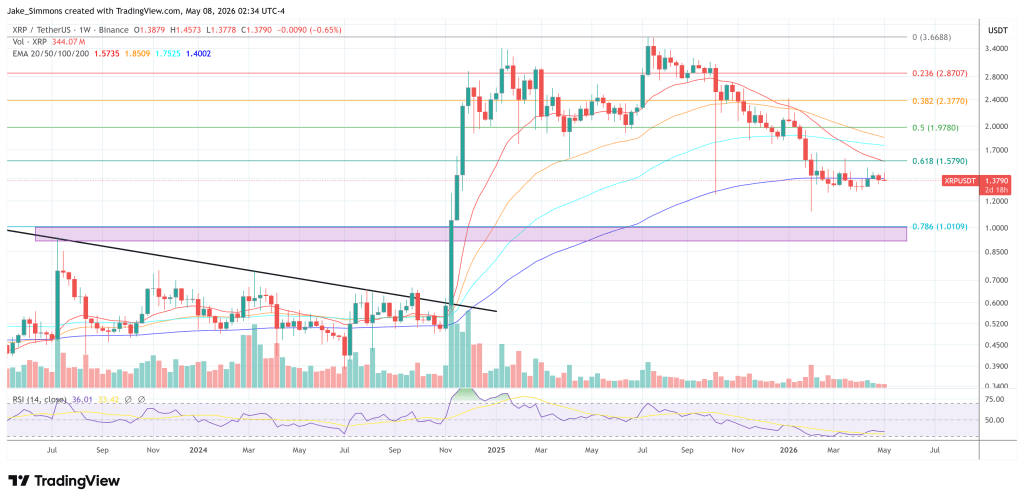
XRP trades around the 200-week EMA again, 1-week chart | Source: XRPUSDT on TradingView.com

Связанные с этим вопросы

QWhat potential benefit did Ripple CEO Brad Garlinghouse suggest XRP holders might receive if the company goes public?

ABrad Garlinghouse suggested that XRP holders could potentially receive 'something special' if Ripple eventually conducts an IPO, though he emphasized this is not a current plan or commitment.

QAccording to Garlinghouse, what is Ripple's primary contribution to the XRP community currently?

AGarlinghouse stated that Ripple's primary contribution is indirect, focusing on building products, infrastructure, and partnerships that increase XRP's utility, liquidity, and trust.

QWhy is Ripple not currently prioritizing a public listing (IPO), as stated by its CEO?

ARipple is not prioritizing an IPO due to the poor performance of recent crypto IPOs (citing BitGo and Gemini as examples) and the benefits of remaining a private company, such as greater freedom in public statements.

QHow did Garlinghouse address concerns that Ripple's expansion into other areas could dilute XRP's role in its strategy?

AGarlinghouse rejected this concern, arguing that Ripple remains the largest holder of XRP and has the strongest economic incentive for its success. He stated that all corporate initiatives, even those not directly linked, are part of a broader strategy to make XRP the most useful, liquid, and trusted digital asset.

QWhat was the trading price of XRP mentioned at the end of the article?

AAt press time, XRP was trading at $1.379.

Похожее

In a Bull Market, Trade New Coins. Will the 'Hook' Concept Become the Sector That Opens the Bull Market?

In a recent surge of interest, the "Hook" concept on Uniswap v4 has captured significant attention from the retail crypto community, driven by projects like $upeg, $sato, and Slonks. Despite being introduced over a year ago, Hooks—customizable plugins for the Uniswap protocol—gained mainstream traction only recently. The article argues that earlier Uniswap efforts to promote Hooks focused too heavily on technical improvements and liquidity provider (LP) solutions, which failed to capture the imagination of everyday users. The breakthrough came with projects that introduced novel, engaging gameplay. $upeg combines trading with generative art, where each integer purchase creates a unique image, adding a layer of artistic creation and complexity to tokenomics. $sato leverages a bonding curve on Ethereum, appealing to the network's "diamond hands" culture with a decentralized, zero-intervention model that turns into a "belief game." Slonks uses an AI model to redraw CryptoPunks, creating a gamified ecosystem where users can burn or merge NFTs to earn $SLOP tokens based on how much the AI "deviated" from the original. These examples highlight Hooks' potential to transform Uniswap from a simple swap and LP platform into a vibrant ecosystem of innovative applications. While technically possible to build such projects independently, the synergy with Uniswap’s established user base and infrastructure provides mutual benefits. For "Hook" to become a true catalyst for a bull market, the author suggests that projects need compelling, original narratives, and Uniswap must further commit to positioning itself as Ethereum's premier application marketplace for creative on-chain experiences.

marsbit4 мин. назад

In a Bull Market, Trade New Coins. Will the 'Hook' Concept Become the Sector That Opens the Bull Market?

marsbit4 мин. назад

Saylor Softens Stance, STRC Weakens, Is BTC Facing a Do-or-Die Battle?

**Summary: Bitcoin (BTC) at a Critical Juncture? Saylor's Hint and STRC Softness Spark Concerns** This article examines two recent developments that could pressure Bitcoin's price: Saylor's hinted willingness to sell some of MicroStrategy's (MSTR) BTC holdings and a significant slowdown in the issuance of its Structured Token Receipt Capital (STRC) product. Previously, STR C was viewed as a powerful new source of ongoing demand for Bitcoin, as the funds raised were used to buy more BTC with leverage. However, MicroStrategy CEO Michael Saylor's recent acknowledgment that the company *might* sell BTC to pay dividends undermines the "never sell" narrative that underpins MSTR's valuation premium and the entire STRC-driven demand thesis. While mathematically sustainable if BTC appreciates, forced selling during a market downturn would severely damage the company's balance sheet and reverse much of its recent buying. Simultaneously, the STRC "flywheel" appears to be stalling. Unlike in previous cycles, the STRC price has failed to return to its $100 par value ahead of the May dividend date, indicating zero new BTC purchases via this channel for the current period. The author attributes this "softness" to a saturated market of arbitrage traders after huge inflows in March and April, whose selling pressure kept prices down, as well as higher opportunity costs in a surging stock market. The combination risks starting a "reverse flywheel": No STRC issuance means no new BTC buying, putting downward pressure on BTC's price. This weakens STRC's collateral backing, potentially raising its required yield and making it even less attractive, which further starves BTC of demand. Saylor's comments may be preemptively pricing in this scenario. The article concludes that the near-term direction of BTC hinges on whether STRC can regain its par value and resume meaningful issuance in the coming week. A small, recent STRC issuance and a brief return of positive Coinbase premiums are noted as faintly optimistic signals. However, failure of the STRC model could lead to a sharp BTC correction by removing a key perceived source of support.

marsbit10 мин. назад

Saylor Softens Stance, STRC Weakens, Is BTC Facing a Do-or-Die Battle?

marsbit10 мин. назад

Торговля

Спот
Фьючерсы

Популярные статьи

Что такое XRP 2.0

XRP 2.0: Новая грань в мире криптовалют Введение в XRP 2.0 В постоянно развивающейся сфере криптовалют появляются новые проекты, стремящиеся к вниманию и внедрению. Один из таких многообещающих проектов - это XRP 2.0, новая криптовалюта, созданная для использования передовых технологий блокчейна и надежных методов шифрования. Хотя название вызывает ассоциации с XRP от Ripple, важно отметить, что XRP 2.0 функционирует независимо, сосредоточив внимание на повышении безопасности сделок, конфиденциальности и масштабируемости. Поскольку цифровая финансовая среда все больше принимает децентрализованные решения, XRP 2.0 намерена внести значимый вклад в web3 и общее расширение криптопроектов. Что такое XRP 2.0? XRP 2.0 в своей основе - это проект криптовалюты, цель которого - создать безопасную и децентрализованную экосистему цифровой валюты. Его базовая технология интегрирует сложные принципы блокчейна с современными методами шифрования. Основная цель XRP 2.0 - утвердиться как надежная и эффективная платформа, позволяющая быстро осуществлять транзакции с приоритетом на улучшенную защиту конфиденциальности для своих пользователей. Проект рекламируется как решение многих недостатков, с которыми сталкиваются существующие криптовалюты, предлагая систему, способную обрабатывать более высокий объем транзакций с улучшенной скоростью и конфиденциальностью. Эта универсальность позиционирует XRP 2.0 как значимого конкурента на рынке, переполненном различными цифровыми валютами. Кто создатель XRP 2.0? Идентичность создателя XRP 2.0 была обозначена как «Уилбур». Однако исчерпывающие данные о Уилбуре или связанном с ним проекте остаются неясными. Анонимность многих создателей криптовалют не является редким явлением в этой отрасли и часто применяется для сохранения определенной степени конфиденциальности и безопасности. Кто инвесторы XRP 2.0? <pна данный момент конкретная информация о инвестиционных фондах или организациях, поддерживающих xrp 2.0, не доступна публично. в секторе криптовалют поддержка репутабельными инвесторами может существенно повлиять на кредитоспособность и успех проекта, однако прозрачность в отношении финансовых спонсоров 2.0 еще была установлена. Как работает XRP 2.0? XRP 2.0 выделяется использованием сочетания технологий блокчейна и продвинутых алгоритмов шифрования, что обеспечивает безопасные и децентрализованные транзакции. Его инновационная структура включает уникальные функции, разработанные для повышения вовлеченности пользователей и расширения функциональности за пределами традиционных транзакций с криптовалютами. Среди этих функций XRP 2.0 интегрирует возможности с искусственным интеллектом, такие как текст в изображение и текст в речь. Эти дополнения разработаны для улучшения интерактивной работы пользователей, способствуя более широкому применению в различных секторах. Соединяя технологические достижения с дизайном, ориентированным на пользователя, XRP 2.0 стремится привлечь внимание разнообразных индивидуумов и предприятий, стремящихся интегрировать решения с криптовалютой в свои бизнес-процессы. Хронология XRP 2.0 Для понимания XRP 2.0 необходимо рассмотреть ключевые события, которые определили его путь до сих пор: 23 июля 2023 года: XRP 2.0 представлен как новый проект криптовалюты, стремящийся революционизировать возможности безопасных и децентрализованных транзакций в области блокчейна. 8 сентября 2023 года: Запуск другого проекта, XRP20, который представляет собой токен ERC-20 на блокчейне Ethereum и не имеет отношения к XRP 2.0. 13 ноября 2023 года: XRP Ledger подвергается значительному обновлению с выпуском программного обеспечения серверов rippled версии 2.0.0. Важно отметить, что это развитие не связано с проектом криптовалюты XRP 2.0. Ключевые моменты о XRP 2.0 Чтобы выделить суть XRP 2.0, возникают несколько критически важных факторов: Уникальные особенности: Включение таких функций, как основанные на ИИ текст в изображение и текст в речь, дополнительно разнообразит потенциальные приложения XRP 2.0. Технология блокчейна: Структура использует современные механизмы блокчейна и протоколы шифрования, обеспечивая безопасную и децентрализованную среду для транзакций. Масштабируемость и конфиденциальность: XRP 2.0 придает приоритет повышенным мерам защиты конфиденциальности в процессах транзакций и масштабируемости, необходимой для привлечения растущей базы пользователей. Нет связи с Ripple: Важно отметить, что, несмотря на свое название, XRP 2.0 не имеет никаких отношений или сотрудничества с XRP от Ripple, что отличает его операционные рамки и цели в экосистеме криптовалют. Заключение XRP 2.0 представляет собой амбициозное начинание в сфере криптовалют, стремясь предложить сочетание безопасности, конфиденциальности и эффективности в цифровых транзакциях. Интегрируя сложные технологии и удобные функции, проект стремится расширить горизонты того, что может достичь криптовалюта в современной цифровой экономике. Хотя анонимность его создателя и отсутствие раскрытых инвесторов могут вызвать вопросы у некоторых, акцент XRP 2.0 на передовых функциональных возможностях и децентрализации увеличивает его привлекательность на фоне все более переполненного крипто-рынка. Поскольку мир криптовалют продолжает развиваться, XRP 2.0 может еще стать ключевым игроком в расширении безопасных и масштабируемых блокчейн-решений.

198 просмотров всегоОпубликовано 2024.04.05Обновлено 2024.12.03

Что такое XRP 2.0

Неделя обучения по популярным токенам 13: запуск основной сети HIP-4 ожидается в середине 2026 года на фоне смещения фокуса рынка к масштабируемому внедрению ключевых криптоактивов, включая XRP

HIP-4 представит децентрализованные рынки прогнозов без разрешений, бинарные (исходные) контракты и опционы 0DTE.

1.1k просмотров всегоОпубликовано 2026.04.22Обновлено 2026.04.22

Неделя обучения по популярным токенам 13: запуск основной сети HIP-4 ожидается в середине 2026 года на фоне смещения фокуса рынка к масштабируемому внедрению ключевых криптоактивов, включая XRP

Обсуждения

Добро пожаловать в Сообщество HTX. Здесь вы сможете быть в курсе последних новостей о развитии платформы и получить доступ к профессиональной аналитической информации о рынке. Мнения пользователей о цене на XRP (XRP) представлены ниже.

活动图片