Another Corporate Bitcoin Treasury Strategy Ends: From High-Profile Entry to Liquidation at a Massive Loss in 11 Months

marsbitОпубликовано 2026-06-01Обновлено 2026-06-01

Введение

French semiconductor company Sequans Communications has sold off its bitcoin holdings and terminated its corporate bitcoin treasury strategy less than a year after launching it, sustaining heavy losses. Facing delisting from the New York Stock Exchange in mid-2025 due to low market capitalization, Sequans announced a plan to hold over 3,000 bitcoin as a long-term reserve asset. The strategy was executed with Swan Bitcoin and backed by a $384 million private financing round. At its peak in October 2025, the company held 3,234 bitcoin with an average cost of approximately $116,643 per coin. However, the plan quickly unraveled. With bitcoin's price falling, Sequans sold 970 bitcoin in late 2025 to repay debt, contradicting the core "hold" philosophy of such corporate strategies. The company has now sold more bitcoin to fully repay its convertible notes and announced the termination of its bitcoin reserve strategy. It plans to liquidate its remaining 658 bitcoin. The venture resulted in significant financial damage. The company reported an unrealized loss of $67.4 million on its bitcoin holdings in 2025, contributing to a total net loss of $109.3 million for the year. Sequans' stock (SQNS) has plummeted over 80% since the strategy's launch and is down 77% year-to-date. CEO Georges Karam, who previously championed bitcoin's long-term value, now states the company will refocus entirely on its core IoT semiconductor business. The failed experiment highlights the risks for compan...

Original Author: Protos

Original Translation: Chopper, Foresight News

Eleven months ago, French semiconductor company Sequans Communications launched a corporate bitcoin reserve plan to combat the risk of delisting from the New York Stock Exchange. Today, this trial has come to a quiet end.

The chipmaker confirmed that it has fully repaid its convertible bonds by selling its bitcoin holdings and also plans to gradually liquidate its remaining 658 bitcoins. The company's bitcoin holdings once peaked at 3,234 coins.

Sequans had previously declared its intention to accumulate and hold over 3,000 bitcoins as a long-term reserve asset. Yet this so-called "long-term" ultimately lasted less than a year.

The company's stock (ticker SQNS) has fallen 77% year-to-date, with a staggering 97% cumulative decline over the past five years.

Sequans' bitcoin reserve plan was launched on June 23, 2025, a time when Swan Bitcoin and its CEO Cory Klippsten were actively promoting the project (Note: Swan Bitcoin was the exclusive operator and advisor for Sequans' bitcoin reserve strategy). This launch came just 18 days after the NYSE issued a delisting warning to Sequans, stating the company's market capitalization and shareholder equity had both fallen below the exchange's $50 million minimum threshold.

Sequans' latest announcement confirms full repayment of its convertible bonds.

Klippsten stated at the time, "Sequans has the potential to become a leader in the corporate bitcoin treasury space." Back then, SQNS stock was trading at $23.40; today it opened at just $3.98.

Bitcoin Reserve Strategy Fails Shortly After Launch

Following the market bubble burst in early summer 2025, the stock prices of many public companies with digital asset treasury strategies collectively weakened, dashing the bright prospects Sequans had painted.

Sequans CEO Georges Karam had earlier expressed strong confidence, firmly believing bitcoin was a superior asset with extremely high long-term investment value.

The company had selected Swan Bitcoin as its execution partner and Coinbase Prime as the custodian. Simultaneously, Northland Capital Markets and B. Riley Securities acted as joint lead underwriters, assisting the company in completing a $384 million private placement.

Of this capital, only $195 million came from the sale of American Depositary Receipts at $1.40 per share; the remaining $189 million was in the form of secured convertible bonds using bitcoin as collateral. This means that from day one, the bitcoin Sequans held in reserve was essentially pledged to creditors.

As of October 3, 2025, Sequans held a total of 3,234 bitcoins, with an average acquisition cost of approximately $116,643 per coin. As of this writing, the bitcoin price has fallen to $73,000.

Just one month later, the company gained notoriety for a piece of negative news: to repay a portion of its debt, it sold 970 bitcoins.

This action completely violated the core principle of the corporate bitcoin accumulation model. Michael Saylor, a pioneer of this approach, famously stated, "Even if you are desperate, do not sell your bitcoin." But Sequans ultimately chose to sell its coins to pay debt.
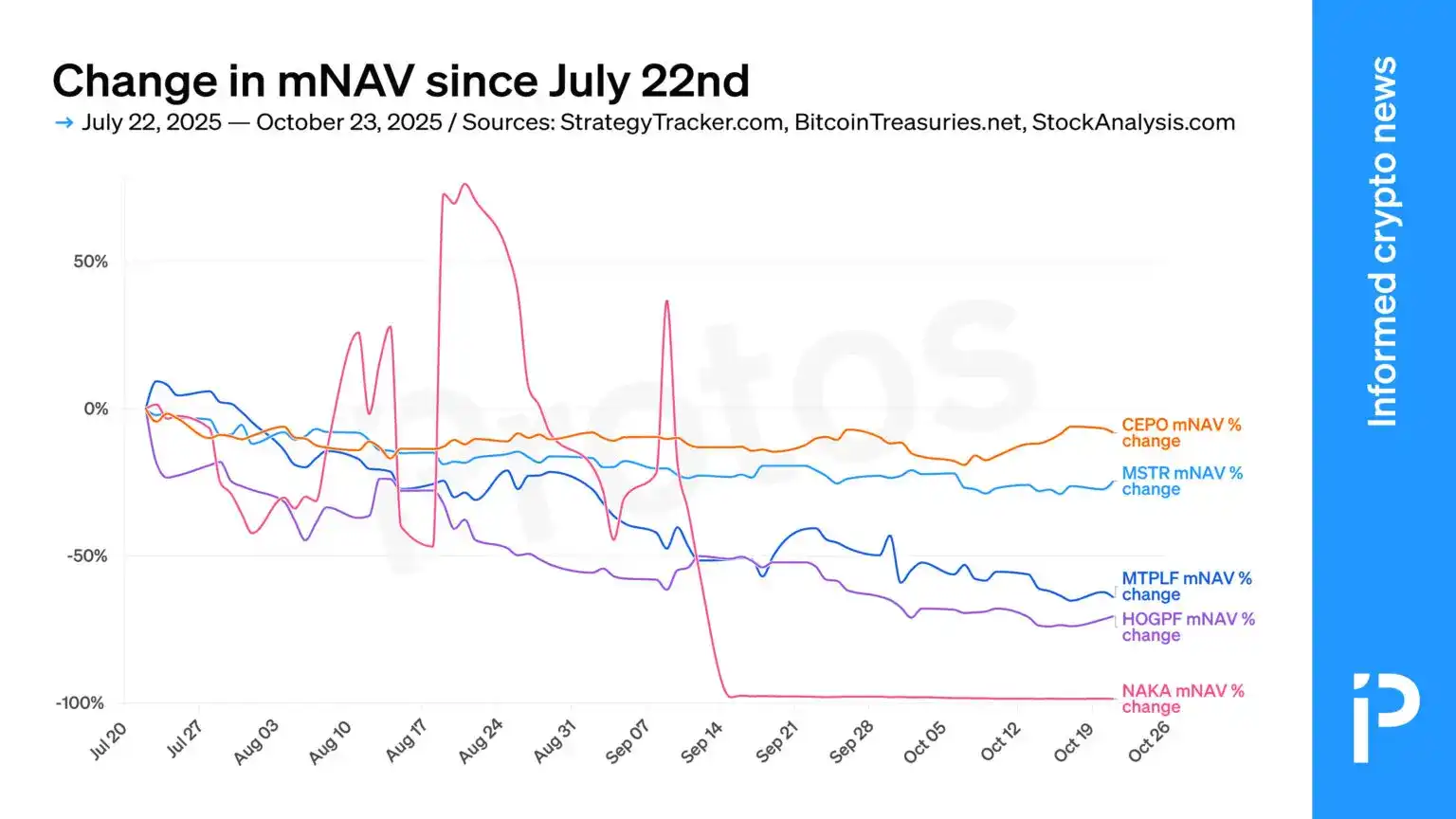
Percentage change in modified Net Asset Value per Share (mNAV) for several corporate bitcoin treasury companies since July 22, 2025.

"Bitcoin Reserve Strategy Officially Terminated"

Five more months passed, and Sequans completely halted the program. The company's announcement tersely stated: "The Bitcoin reserve strategy has been terminated."

Karam, the CEO who was once so bullish on bitcoin, now stated that this debt repayment is a significant turning point for the company, and Sequans will now fully focus on its core IoT semiconductor business to drive expansion.

All previous praise for bitcoin's value and promises to create long-term shareholder returns through crypto asset reserves have been abandoned. The current plan for the company is solely liquidation.

In fact, the exit signal was given three weeks earlier in the company's Q1 2026 earnings report. In the risk factors section, the company explicitly mentioned terminating its bitcoin reserve-related business. For that quarter, Sequans reported revenue of only $6.1 million and an operating loss of $50.5 million.

According to annual report data, Sequans posted a net loss of $109.3 million for the full year 2025. Within this, unrealized impairment losses on bitcoin assets alone amounted to $67.4 million, bringing the company's cumulative loss total to a staggering $145.1 million.

In summary, Sequans bought bitcoin high and sold low, ultimately generating tens of millions in losses.

The company had hoped to use its bitcoin reserves to strengthen its financial resilience and create long-term value for shareholders, but both goals have failed. Currently, SQNS stock is down over 80% from the day the bitcoin plan was launched and down 92% from its high over the past year.


Связанные с этим вопросы

QWhat was the main reason Sequans Communications started its corporate bitcoin reserve strategy?

ASequans Communications initiated its corporate bitcoin reserve strategy in June 2025 to counter the risk of delisting from the New York Stock Exchange after its market capitalization and shareholder equity fell below the exchange's minimum threshold.

QWho was the exclusive operator and advisor for Sequans' bitcoin reserve strategy?

ASwan Bitcoin, led by its CEO Cory Klippsten, was the exclusive operator and advisor for Sequans' bitcoin reserve strategy.

QHow many bitcoins did Sequans hold at its peak, and what was its average purchase cost per coin?

ASequans' bitcoin holdings peaked at 3,234 coins, with an average purchase cost of approximately $116,643 per bitcoin.

QWhat core tenet of the corporate bitcoin treasury strategy did Sequans violate when it sold part of its holdings?

ASequans violated the core tenet popularized by Michael Saylor: 'Don't sell your bitcoin, even if you're on the brink of disaster.' The company sold 970 bitcoins to repay part of its debt.

QWhat were the total net loss and the specific unrealized impairment loss related to bitcoin that Sequans reported for the year 2025?

AFor the year 2025, Sequans reported a total net loss of $109.3 million, which included an unrealized impairment loss on its bitcoin holdings of $67.4 million.

Похожее

The Midlife Crisis of Crypto GPs: No PMF, No Next Check from LPs

The article "The Midlife Crisis of Crypto GPs: No PMF, No Next LP Check" analyzes the shifting crypto fundraising landscape. It argues the era of selling grand visions to LPs is over; GPs must now offer products with clear Product-Market Fit (PMF). The author categorizes crypto fundraising products into three types: Primary (VC funds), Liquid (trading strategies), and CeFi/DeFi Native Yield. This summary focuses on the Primary market. Key points include: * **Market Shift:** LPs are impatient, demand immediate returns, and are skeptical of future promises. The "easy money" narrative has faded. * **GP Value Erosion:** LP learning curves have shortened (aided by AI), reducing the value of a GP's basic "crypto knowledge." Superior judgment is now rare. * **Weakened LP Motivations:** Traditional reasons for LPs to invest in crypto VC funds (capturing industry beta, gaining access, leveraging GP judgment) have weakened due to new products like ETFs and increased LP sophistication. * **Surviving in Primary:** The primary market will likely persist for: 1) large funds in endowment mandates treating it as a lottery ticket, 2) family offices/HNWIs using proprietary capital, 3) a few funds with proven recent outperformance, and 4) funds with strong ecosystem "deal-making" capabilities. * **Conclusion:** For most GPs, rebuilding trust requires starting over in a niche, demonstrating alpha-generating ability, or providing concrete value/services to LPs.

marsbit1 ч. назад

The Midlife Crisis of Crypto GPs: No PMF, No Next Check from LPs

marsbit1 ч. назад

Crypto GPs' Midlife Crisis: No PMF, No LP's Next Check

The article "The Midlife Crisis of Crypto GPs: No PMF, No LP's Next Check" analyzes the shifting crypto fundraising landscape. It argues that the era of LPs funding vague "vision" is over; GPs must now offer products with clear Product-Market Fit (PMF) to secure capital. The market has matured. LPs, disillusioned by the last cycle's failures and wary of long lock-up periods, now demand tangible, near-term returns rather than speculative narratives. The proliferation of accessible crypto ETFs and other liquid products has reduced the need for VC blind pools as an entry point. The author categorizes crypto fundraising products into three types: Primary (VC funds, with blind pools or clear pipelines), Liquid (alpha/beta, directional/market-neutral strategies), and CeFi/DeFi Native Yield (crypto-specific mechanisms like staking, farming). Focusing on the Primary market, the piece details why traditional LP rationales for investing in crypto VCs have weakened: easier beta access via ETFs, diminished "access" and "judgement" premiums as LPs build internal teams, and a widespread lack of proven superior returns from GPs. Ultimately, only specific players are likely to remain at the primary VC table: large funds with access to patient endowment capital, family offices/HNWIs investing proprietary capital, the few funds with demonstrable excess returns from the last cycle, and those with clear "deal-making" or ecosystem resource advantages. For others, the path forward is to rebuild trust by proving alpha-generation capability in a niche or providing concrete, valuable services.

链捕手1 ч. назад

Crypto GPs' Midlife Crisis: No PMF, No LP's Next Check

链捕手1 ч. назад

The Age of Decoupling Has Arrived: Bitcoin is No Longer the Sole Compass of Crypto

The era of the cryptocurrency market moving in lockstep with Bitcoin is ending, as the industry splits into two distinct asset categories: endogenous and exogenous. Endogenous assets, like Bitcoin, derive value purely from the crypto market's cycles. Their narratives swing between being "interstellar money" in bull markets and "digital collectibles" in bear markets. Exogenous assets, however, are nominally crypto but operate with independent value drivers. Examples include: * **Venice:** An AI inference service using tokens for payments; its consumer-AI business model is decoupled from crypto price swings. * **Figure:** A fintech lender using blockchain to speed up loan approvals; its core value is in credit, not crypto. * **Stablecoin firms like BVNK:** Acquired by traditional finance giants (Mastercard, Stripe), their growth is tied to payment infrastructure, not market cycles. Hybrid projects like **Hyperliquid** (a decentralized exchange) show a shift, with a growing share of non-crypto trading (e.g., prediction markets). This divergence is fundamental. Endogenous assets remain highly correlated to Bitcoin, similar to gold miners to gold. Exogenous assets are evolving to have their own fundamentals, like the weak correlation between gold and the S&P 500. This changes investment analysis. Evaluating exogenous assets requires traditional fundamental research—assessing user bases, unit economics, and moats—more akin to fintech investing than charting Bitcoin. Promising exogenous sectors include: on-chain exchanges/brokers, AI-crypto fusion, privacy-focused digital banks, lending (institutional/private credit), stablecoins/real-world asset tokenization, payment rails, and non-financial crypto-consumer products. Currently, investing via equity is often safer than via tokens, as token value accrual mechanisms need further regulatory and industry development (e.g., the CLARITY Act). Nonetheless, the core trend is clear: crypto market drivers are diversifying from a single factor (Bitcoin) to multiple fundamentals, ending the era of uniform market moves.

marsbit2 ч. назад

The Age of Decoupling Has Arrived: Bitcoin is No Longer the Sole Compass of Crypto

marsbit2 ч. назад

Торговля

Спот
Фьючерсы

Популярные статьи

Тест по Bitcoin Биткоина

HTX Learn: Изучите Bitcoin halving и Заработаете Токены USDT

3.0k просмотров всегоОпубликовано 2024.04.16Обновлено 2024.04.16

Тест по Bitcoin  Биткоина

Что такое $BITCOIN

ЦИФРОВОЕ ЗОЛОТО ($BITCOIN): Комплексный анализ Введение в ЦИФРОВОЕ ЗОЛОТО ($BITCOIN) ЦИФРОВОЕ ЗОЛОТО ($BITCOIN) — это проект на основе блокчейна, работающий в сети Solana, который стремится объединить характеристики традиционных драгоценных металлов с инновациями децентрализованных технологий. Хотя он носит имя Биткойн, часто называемого “цифровым золотом” из-за его восприятия как средства хранения ценности, ЦИФРОВОЕ ЗОЛОТО является отдельным токеном, предназначенным для создания уникальной экосистемы в ландшафте Web3. Его цель — позиционировать себя как жизнеспособный альтернативный цифровой актив, хотя детали его применения и функциональности все еще развиваются. Что такое ЦИФРОВОЕ ЗОЛОТО ($BITCOIN)? ЦИФРОВОЕ ЗОЛОТО ($BITCOIN) — это токен криптовалюты, специально разработанный для использования в блокчейне Solana. В отличие от Биткойна, который выполняет широко признанную роль хранения ценности, этот токен, похоже, сосредоточен на более широких приложениях и характеристиках. Примечательные аспекты включают: Инфраструктура блокчейна: Токен построен на блокчейне Solana, известном своей способностью обрабатывать высокоскоростные и недорогие транзакции. Динамика предложения: ЦИФРОВОЕ ЗОЛОТО имеет максимальное предложение, ограниченное 100 квадриллионами токенов (100P $BITCOIN), хотя детали о его обращающемся предложении в настоящее время не раскрыты. Утилита: Хотя точные функциональные возможности не описаны, есть указания на то, что токен может быть использован для различных приложений, потенциально связанных с децентрализованными приложениями (dApps) или стратегиями токенизации активов. Кто создатель ЦИФРОВОГО ЗОЛОТА ($BITCOIN)? На данный момент личность создателей и команды разработчиков, стоящих за ЦИФРОВЫМ ЗОЛОТОМ ($BITCOIN), остается неизвестной. Эта ситуация типична для многих инновационных проектов в области блокчейна, особенно тех, которые связаны с децентрализованными финансами и феноменом мем-криптовалют. Хотя такая анонимность может способствовать культуре, ориентированной на сообщество, она усиливает опасения по поводу управления и ответственности. Кто инвесторы ЦИФРОВОГО ЗОЛОТА ($BITCOIN)? Доступная информация указывает на то, что у ЦИФРОВОГО ЗОЛОТА ($BITCOIN) нет известных институциональных спонсоров или значительных венчурных капиталовложений. Проект, похоже, функционирует по модели пирингового взаимодействия, сосредоточенной на поддержке и принятии сообществом, а не на традиционных путях финансирования. Его активность и ликвидность в основном сосредоточены на децентрализованных биржах (DEX), таких как PumpSwap, а не на устоявшихся централизованных торговых платформах, что еще больше подчеркивает его подход, ориентированный на grassroots. Как работает ЦИФРОВОЕ ЗОЛОТО ($BITCOIN) Операционные механизмы ЦИФРОВОГО ЗОЛОТА ($BITCOIN) можно подробно описать на основе его дизайна блокчейна и характеристик сети: Механизм консенсуса: Используя уникальный механизм доказательства истории (PoH) Solana в сочетании с моделью доказательства доли (PoS), проект обеспечивает эффективную валидацию транзакций, что способствует высокой производительности сети. Токеномика: Хотя конкретные дефляционные механизмы не были подробно описаны, большое максимальное предложение токенов подразумевает, что оно может быть предназначено для микротранзакций или нишевых случаев использования, которые еще предстоит определить. Интероперабельность: Существует потенциал для интеграции с более широкой экосистемой Solana, включая различные платформы децентрализованных финансов (DeFi). Однако детали относительно конкретных интеграций остаются неуточненными. Хронология ключевых событий Вот хронология, которая подчеркивает значимые вехи, касающиеся ЦИФРОВОГО ЗОЛОТА ($BITCOIN): 2023: Первоначальное развертывание токена происходит в блокчейне Solana, отмеченное его адресом контракта. 2024: ЦИФРОВОЕ ЗОЛОТО приобретает видимость, когда оно становится доступным для торговли на децентрализованных биржах, таких как PumpSwap, позволяя пользователям обменивать его на SOL. 2025: Проект наблюдает спорадическую торговую активность и потенциальный интерес к инициативам, возглавляемым сообществом, хотя на данный момент не зафиксировано никаких значительных партнерств или технических достижений. Критический анализ Сильные стороны Масштабируемость: Основная инфраструктура Solana поддерживает высокие объемы транзакций, что может повысить полезность $BITCOIN в различных сценариях транзакций. Доступность: Потенциально низкая цена торговли за токен может привлечь розничных инвесторов, способствуя более широкому участию благодаря возможностям дробного владения. Риски Отсутствие прозрачности: Отсутствие публично известных спонсоров, разработчиков или процесса аудита может вызвать скептицизм относительно устойчивости и надежности проекта. Волатильность рынка: Торговая активность сильно зависит от спекулятивного поведения, что может привести к значительной волатильности цен и неопределенности для инвесторов. Заключение ЦИФРОВОЕ ЗОЛОТО ($BITCOIN) является интригующим, но неоднозначным проектом в быстро развивающейся экосистеме Solana. Хотя он пытается использовать нарратив “цифрового золота”, его отход от установленной роли Биткойна как средства хранения ценности подчеркивает необходимость более четкого различения его предполагаемой утилиты и структуры управления. Будущее принятие и усвоение, вероятно, будут зависеть от решения текущей непрозрачности и более четкого определения его операционных и экономических стратегий. Примечание: Этот отчет охватывает синтезированную информацию, доступную на октябрь 2023 года, и с тех пор могут произойти события.

99 просмотров всегоОпубликовано 2025.05.13Обновлено 2025.05.13

Что такое $BITCOIN

Fractal Bitcoin: масштабирование Биткоина с помощью рекурсивной системы

Fractal Bitcoin — масштабное Layer-1-решнение, созданное на базе кода Биткоина, позволяющего достигать бесконечного масштабирования с помощью рекурсивного подхода.

2.3k просмотров всегоОпубликовано 2025.06.30Обновлено 2025.06.30

Fractal Bitcoin: масштабирование Биткоина с помощью рекурсивной системы

Обсуждения

Добро пожаловать в Сообщество HTX. Здесь вы сможете быть в курсе последних новостей о развитии платформы и получить доступ к профессиональной аналитической информации о рынке. Мнения пользователей о цене на BTC (BTC) представлены ниже.

活动图片