Crypto Market First Major Outflow In 5 Weeks – Here’s How Bitcoin And Ethereum Performed

bitcoinistОпубликовано 2026-03-31Обновлено 2026-03-31

Введение

After five consecutive weeks of inflows, the cryptocurrency market experienced its first major capital outflow, with over $414 million withdrawn last week. This shift in investor sentiment was largely driven by rising rate expectations and geopolitical tensions involving Iran. The United States led the selling activity with $445 million in outflows, while regions like Germany and Canada saw inflows. Ethereum bore the brunt of the sell-off, recording approximately $222 million in outflows. In contrast, Bitcoin maintained a net inflow of over $964 million year-to-date despite the negative weekly performance. Analysts suggest this single week of outflows may not indicate a full trend reversal, but it has reduced market momentum. If macro conditions stabilize, inflows could resume in the coming weeks.

Despite waning price performance from Bitcoin and Ethereum, the broader cryptocurrency market still recorded notable inflows for weeks. However, all of these changed as investors’ sentiment shifted, and the crypto market ended up seeing massive capital outflows once again.

Bitcoin And Ethereum Are In Major Crypto Outflow

After several weeks of steady inflows, the cryptocurrency market has finally recorded a day of outflows as investors pull funds. Such a development is typically seen as a potential shift in investors’ sentiment across the highly volatile market.

As outlined in Milk Road’s report, this marks the first significant capital outflow in 5 weeks, raising questions about the market’s direction. Funds that had continuously invested in digital assets, especially well-known cryptocurrencies like Bitcoin and Ethereum, are now starting to turn around.

A single week of outflows doesn’t always indicate a larger trend, but it frequently indicates that investors are becoming more cautious. However, this could shift investors’ focus toward the sustainability of crypto’s recent momentum.

Milk Road highlighted that over $414 million left the sector last week, putting an end to a stream that had bulls feeling more excited about the market. Underneath the surface, the United States led the selling activity with $445 million in outflows. Meanwhile, other regions such as Germany and Canada moved in the opposite direction to the US, buying the dip while American investors were heading for the exit.
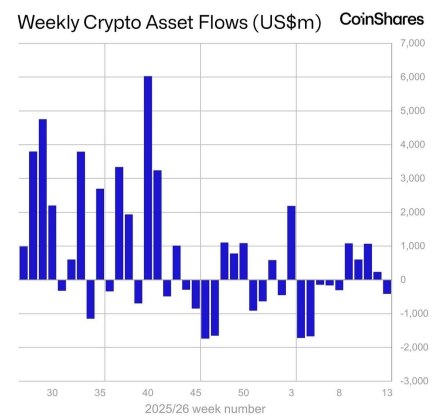
Source: Chart from Milk Road on X

In this bloodbath, Ethereum led the selling activity, recording approximately $222 million in outflows. According to Milk Road, this figure represents more than half of the total weekly rain emerging from a single asset.

Bitcoin, on the other hand, is telling a different story compared to Ethereum. Even though the week was rough, Bitcoin still managed to attract over $964 million in net inflows year-to-date (YTD). However, investors panicked as the asset reacted strongly negatively to economic and macro events.

Taking a look at the market, this cautious investor sentiment can be traced back to two major catalysts, which include rising rate expectations and Iran war fears. When both negative events meet, it often leads to institutions pulling away from risk assets like Bitcoin and Ethereum very fast.

What Bulls And Bears Are Calling For

As the event intensified, the crypto market was the first thing to get trimmed, prompting bears to call this the beginning of a trend reversal. For bulls, they will point to the BTC YTD figure and declare that one bad week does not mean anything significant. Milk Road noted that both ideas make a point.

One week of outflows does not mean the multi-week trend will not continue, but it does reduce momentum and make sellers more alert. In the meantime, the next test is whether the next two weeks produce more of the same or whether this was just institutions getting spooked by speculative headlines that carry no real significance.

If Iran tensions ease and rates stay put, the inflow streak will probably resume and continue in the following weeks. Sustained inflows will likely recover momentum for digital assets, with Bitcoin and Ethereum transitioning into the upward direction again.

BTC trading at $67,394 on the 1D chart | Source: BTCUSDT on Tradingview.com

Связанные с этим вопросы

QWhat was the overall trend in the cryptocurrency market after five weeks of inflows, and what was the total outflow amount?

AThe cryptocurrency market recorded its first major outflow in 5 weeks, with a total of over $414 million leaving the sector.

QWhich two major cryptocurrencies were highlighted in the report, and how did their outflow performances differ?

AEthereum led the selling activity with approximately $222 million in outflows, while Bitcoin still maintained a net inflow of over $964 million year-to-date (YTD).

QAccording to the report, which country was the selling activity led by, and how did other regions like Germany and Canada react?

AThe United States led the selling activity with $445 million in outflows, while other regions such as Germany and Canada moved in the opposite direction by buying the dip.

QWhat were the two major catalysts identified as causing the shift to cautious investor sentiment?

AThe two major catalysts were rising rate expectations and fears of war with Iran, which led institutions to pull away from risk assets like Bitcoin and Ethereum.

QWhat do bulls and bears respectively argue about this single week of outflows, according to Milk Road?

ABears call it the beginning of a trend reversal, while bulls point to Bitcoin's strong YTD inflows and argue that one bad week is not significant.

Похожее

$700 Billion Poured into AI, Americans Taste the Bitter Fruit of Inflation First

A Federal Reserve analysis from the St. Louis Fed argues that AI optimism itself is a driver of inflation. The "news shock" of AI's revolutionary potential causes households and businesses to increase spending and investment in anticipation of future gains, pushing demand beyond current supply and creating inflationary pressure. This is supported by a Deutsche Bank experiment where AI models (dbLumina, Claude, ChatGPT-5.2) assessed a 20-40% probability that AI would raise inflation in the next year, citing surging demand for data centers, semiconductors, and electricity. They saw only a 5% chance of AI significantly reducing inflation. Massive capital expenditure underscores this demand. Amazon, Microsoft, Google, and Meta are projected to spend a combined ~$663B in 2026, a fourfold increase in four years. A significant portion funds power-hungry data centers. For example, OpenAI's "Stargate" project plans a 10-gigawatt capacity, equivalent to the entire electricity load of 16 Vermont states. U.S. data center electricity consumption is forecast to triple by 2030. While AI could eventually boost productivity and be disinflationary long-term, current data shows no such productivity jump. The U.S. economy now faces a cycle: massive AI investment fuels inflation, delays interest rate cuts, raises financing costs—yet the investment continues to accelerate. The outcome hinges on whether these AI models will ultimately make the economy more efficient, a question that remains unanswered.

marsbit41 мин. назад

$700 Billion Poured into AI, Americans Taste the Bitter Fruit of Inflation First

marsbit41 мин. назад

What Kind of DeFi Does Wall Street Want?

Wall Street's vision for DeFi has shifted from simple asset tokenization to building a programmable, restructurable fixed-income infrastructure that enables yield financialization. The key driver is no longer retail speculation but institutional capital and Real-World Assets (RWA), with DeFi TVL surging from ~$115B to over $237B in 2025, while active wallets declined—indicating large, infrequent institutional inflows. RWA, now valued at $27.5B (up 2.4x YoY), is used as collateral in protocols like Aave Horizon, Maple Finance, and Centrifuge, creating an on-chain repo and rehypothecation flywheel. These structures function like institutional money-market funds, offering 4–6% yields from tokenized treasuries and stablecoin pools. Crucially, institutions are moving beyond holding assets to actively managing yield and risk. Protocols like Pendle Finance allow yield tokenization—splitting assets into Principal Tokens (PT) and Yield Tokens (YT)—enabling fixed-rate exposure, speculation, and on-chain interest rate hedging using mechanisms like yield AMMs. However, major barriers remain: public blockchain transparency exposes positions and liquidation levels, creating adversarial risks, and compliance (KYC, sanctions screening, audit trails) must be natively embedded into protocols—not added externally. Zero-knowledge proofs could offer a solution by enabling regulatory verification without leaking sensitive data. In summary, Wall Street wants a DeFi that integrates with global compliance infrastructure, replicates traditional fixed-income modularity for risk and return, and embeds programmable privacy and regulation—not to replace traditional finance, but to create a parallel system for more flexible capital and risk restructuring.

marsbit1 ч. назад

What Kind of DeFi Does Wall Street Want?

marsbit1 ч. назад

Торговля

Спот
Фьючерсы

Популярные статьи

Тест по Bitcoin Биткоина

HTX Learn: Изучите Bitcoin halving и Заработаете Токены USDT

2.9k просмотров всегоОпубликовано 2024.04.16Обновлено 2024.04.16

Тест по Bitcoin  Биткоина

Что такое $BITCOIN

ЦИФРОВОЕ ЗОЛОТО ($BITCOIN): Комплексный анализ Введение в ЦИФРОВОЕ ЗОЛОТО ($BITCOIN) ЦИФРОВОЕ ЗОЛОТО ($BITCOIN) — это проект на основе блокчейна, работающий в сети Solana, который стремится объединить характеристики традиционных драгоценных металлов с инновациями децентрализованных технологий. Хотя он носит имя Биткойн, часто называемого “цифровым золотом” из-за его восприятия как средства хранения ценности, ЦИФРОВОЕ ЗОЛОТО является отдельным токеном, предназначенным для создания уникальной экосистемы в ландшафте Web3. Его цель — позиционировать себя как жизнеспособный альтернативный цифровой актив, хотя детали его применения и функциональности все еще развиваются. Что такое ЦИФРОВОЕ ЗОЛОТО ($BITCOIN)? ЦИФРОВОЕ ЗОЛОТО ($BITCOIN) — это токен криптовалюты, специально разработанный для использования в блокчейне Solana. В отличие от Биткойна, который выполняет широко признанную роль хранения ценности, этот токен, похоже, сосредоточен на более широких приложениях и характеристиках. Примечательные аспекты включают: Инфраструктура блокчейна: Токен построен на блокчейне Solana, известном своей способностью обрабатывать высокоскоростные и недорогие транзакции. Динамика предложения: ЦИФРОВОЕ ЗОЛОТО имеет максимальное предложение, ограниченное 100 квадриллионами токенов (100P $BITCOIN), хотя детали о его обращающемся предложении в настоящее время не раскрыты. Утилита: Хотя точные функциональные возможности не описаны, есть указания на то, что токен может быть использован для различных приложений, потенциально связанных с децентрализованными приложениями (dApps) или стратегиями токенизации активов. Кто создатель ЦИФРОВОГО ЗОЛОТА ($BITCOIN)? На данный момент личность создателей и команды разработчиков, стоящих за ЦИФРОВЫМ ЗОЛОТОМ ($BITCOIN), остается неизвестной. Эта ситуация типична для многих инновационных проектов в области блокчейна, особенно тех, которые связаны с децентрализованными финансами и феноменом мем-криптовалют. Хотя такая анонимность может способствовать культуре, ориентированной на сообщество, она усиливает опасения по поводу управления и ответственности. Кто инвесторы ЦИФРОВОГО ЗОЛОТА ($BITCOIN)? Доступная информация указывает на то, что у ЦИФРОВОГО ЗОЛОТА ($BITCOIN) нет известных институциональных спонсоров или значительных венчурных капиталовложений. Проект, похоже, функционирует по модели пирингового взаимодействия, сосредоточенной на поддержке и принятии сообществом, а не на традиционных путях финансирования. Его активность и ликвидность в основном сосредоточены на децентрализованных биржах (DEX), таких как PumpSwap, а не на устоявшихся централизованных торговых платформах, что еще больше подчеркивает его подход, ориентированный на grassroots. Как работает ЦИФРОВОЕ ЗОЛОТО ($BITCOIN) Операционные механизмы ЦИФРОВОГО ЗОЛОТА ($BITCOIN) можно подробно описать на основе его дизайна блокчейна и характеристик сети: Механизм консенсуса: Используя уникальный механизм доказательства истории (PoH) Solana в сочетании с моделью доказательства доли (PoS), проект обеспечивает эффективную валидацию транзакций, что способствует высокой производительности сети. Токеномика: Хотя конкретные дефляционные механизмы не были подробно описаны, большое максимальное предложение токенов подразумевает, что оно может быть предназначено для микротранзакций или нишевых случаев использования, которые еще предстоит определить. Интероперабельность: Существует потенциал для интеграции с более широкой экосистемой Solana, включая различные платформы децентрализованных финансов (DeFi). Однако детали относительно конкретных интеграций остаются неуточненными. Хронология ключевых событий Вот хронология, которая подчеркивает значимые вехи, касающиеся ЦИФРОВОГО ЗОЛОТА ($BITCOIN): 2023: Первоначальное развертывание токена происходит в блокчейне Solana, отмеченное его адресом контракта. 2024: ЦИФРОВОЕ ЗОЛОТО приобретает видимость, когда оно становится доступным для торговли на децентрализованных биржах, таких как PumpSwap, позволяя пользователям обменивать его на SOL. 2025: Проект наблюдает спорадическую торговую активность и потенциальный интерес к инициативам, возглавляемым сообществом, хотя на данный момент не зафиксировано никаких значительных партнерств или технических достижений. Критический анализ Сильные стороны Масштабируемость: Основная инфраструктура Solana поддерживает высокие объемы транзакций, что может повысить полезность $BITCOIN в различных сценариях транзакций. Доступность: Потенциально низкая цена торговли за токен может привлечь розничных инвесторов, способствуя более широкому участию благодаря возможностям дробного владения. Риски Отсутствие прозрачности: Отсутствие публично известных спонсоров, разработчиков или процесса аудита может вызвать скептицизм относительно устойчивости и надежности проекта. Волатильность рынка: Торговая активность сильно зависит от спекулятивного поведения, что может привести к значительной волатильности цен и неопределенности для инвесторов. Заключение ЦИФРОВОЕ ЗОЛОТО ($BITCOIN) является интригующим, но неоднозначным проектом в быстро развивающейся экосистеме Solana. Хотя он пытается использовать нарратив “цифрового золота”, его отход от установленной роли Биткойна как средства хранения ценности подчеркивает необходимость более четкого различения его предполагаемой утилиты и структуры управления. Будущее принятие и усвоение, вероятно, будут зависеть от решения текущей непрозрачности и более четкого определения его операционных и экономических стратегий. Примечание: Этот отчет охватывает синтезированную информацию, доступную на октябрь 2023 года, и с тех пор могут произойти события.

99 просмотров всегоОпубликовано 2025.05.13Обновлено 2025.05.13

Что такое $BITCOIN

Fractal Bitcoin: масштабирование Биткоина с помощью рекурсивной системы

Fractal Bitcoin — масштабное Layer-1-решнение, созданное на базе кода Биткоина, позволяющего достигать бесконечного масштабирования с помощью рекурсивного подхода.

2.2k просмотров всегоОпубликовано 2025.06.30Обновлено 2025.06.30

Fractal Bitcoin: масштабирование Биткоина с помощью рекурсивной системы

Обсуждения

Добро пожаловать в Сообщество HTX. Здесь вы сможете быть в курсе последних новостей о развитии платформы и получить доступ к профессиональной аналитической информации о рынке. Мнения пользователей о цене на BTC (BTC) представлены ниже.

活动图片