Glassnode: Crypto Market in 'Late Bear Market Bottoming Phase', Three Core Signals Absent, Bitcoin Reversal Still Requires Time

marsbitОпубликовано 2026-07-10Обновлено 2026-07-10

Введение

According to a Glassnode analysis, the cryptocurrency market is currently in the late stages of a bear market bottom formation. Bitcoin's price has remained below key realized price and short-term holder cost benchmarks for five months, indicating deep undervaluation. A major source of sell-side pressure is from long-term holders realizing losses, with their daily loss-taking recently peaking at $280 million, the highest level since December 2022. While spot Bitcoin ETF outflows have moderated, they remain in a state of monthly net negative flows, and trading volumes are approximately 80% below their 2025 peak, signaling a lack of robust institutional demand. In derivatives markets, positioning has shifted to a cautiously bullish stance. However, options volatility surfaces still price in downside risk, and the spot price sits below the "Max Pain" strike level. The report concludes that the necessary conditions for a market bottom are in place, but a confirmed reversal requires three core signals: a sustained decline in long-term holder loss realization, a stabilization in ETF fund flows, and a sustained price recovery above the Realized Price. Until these signals emerge, a full transition to a bull market is unlikely to occur imminently.

Authors:CryptoVizArt, Frederik Theissen, Glassnode

Compiled by:Luffy, Foresight News

Bitcoin price has been below the true market average and the cost basis of short-term holders for five consecutive months, residing in a deeply undervalued zone.

The proportion of losses realized by long-term holders relative to total on-chain realized losses has now risen to 43%, with the daily peak of loss realization reaching $280 million, the highest level since December 2022. The outflow of spot ETF funds has moderated but still maintains a state of monthly net outflows; ETF daily average trading volume remains in the range of $650 million to $950 million, shrinking approximately 80% from the peak in October 2025, indicating institutional buying demand has not yet stabilized.

Derivatives positioning has shifted to cautiously bullish, with the put/call ratio dropping to its lowest level in 2026; however, the options volatility skew still maintains a defensive premium, and the spot price remains significantly below the max pain price. The market has entered the late stage of bottoming, and the continuous narrowing of selling pressure from long-term holders is an important precondition for a market reversal and recovery.

Macro Perspective

Oil Surges, Risk Assets Under Collective Pressure

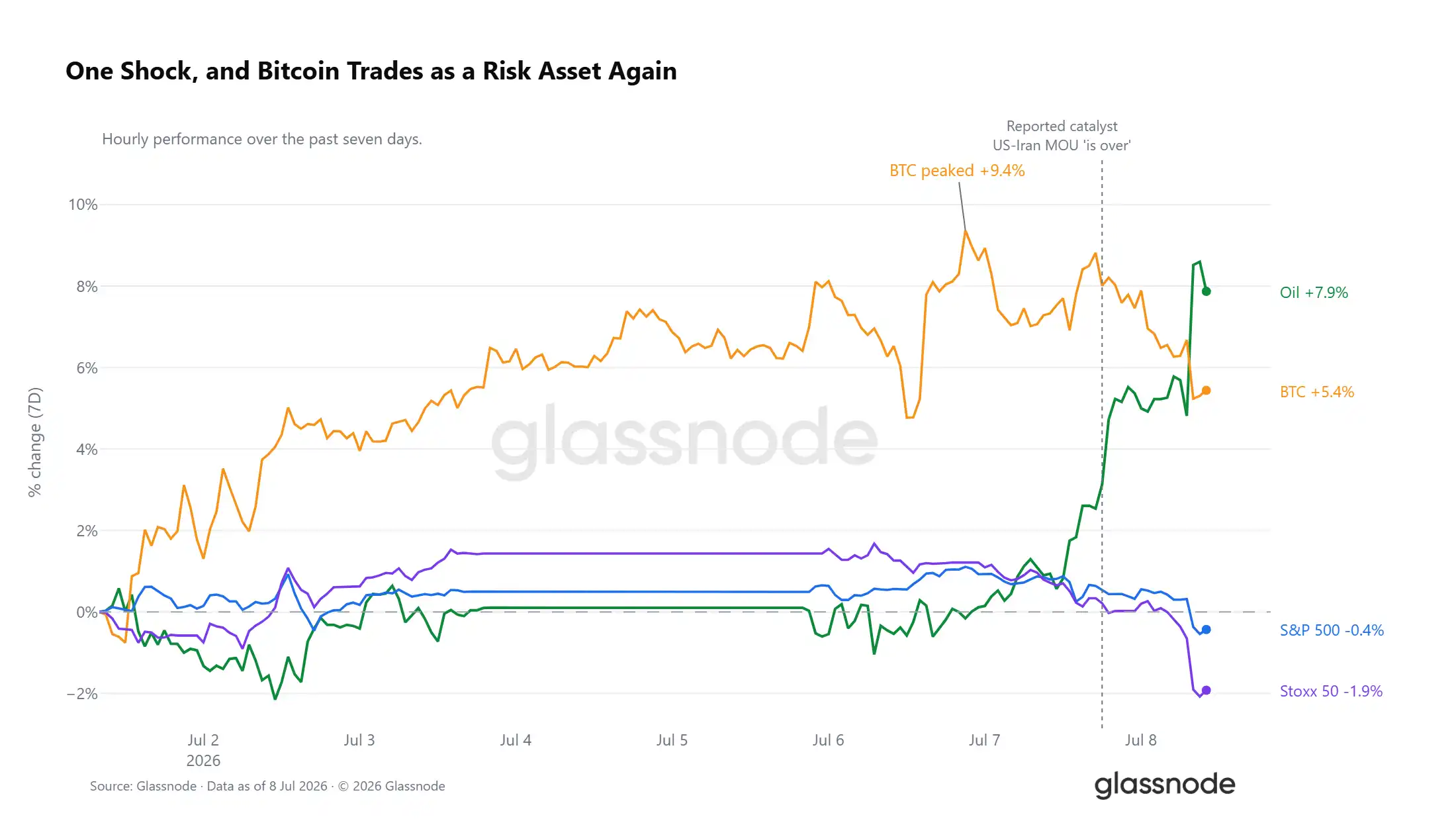
Over the past 7 trading days, WTI crude oil has cumulatively risen by 7.9%, with the majority of gains concentrated in recent sessions. News emerged that the US-Iran Memorandum of Understanding has expired, an impact that has rippled across all asset markets. Bitcoin's weekly gain peaked at 9.4% but has now retreated to a 5% weekly gain; the S&P 500 and Euro Stoxx indices have all turned negative, with European stocks leading the decline among global risk assets. Currently, Bitcoin's movement is highly synchronized with risk assets.
Liquidity Environment: Long-Short Contradictions Intensify

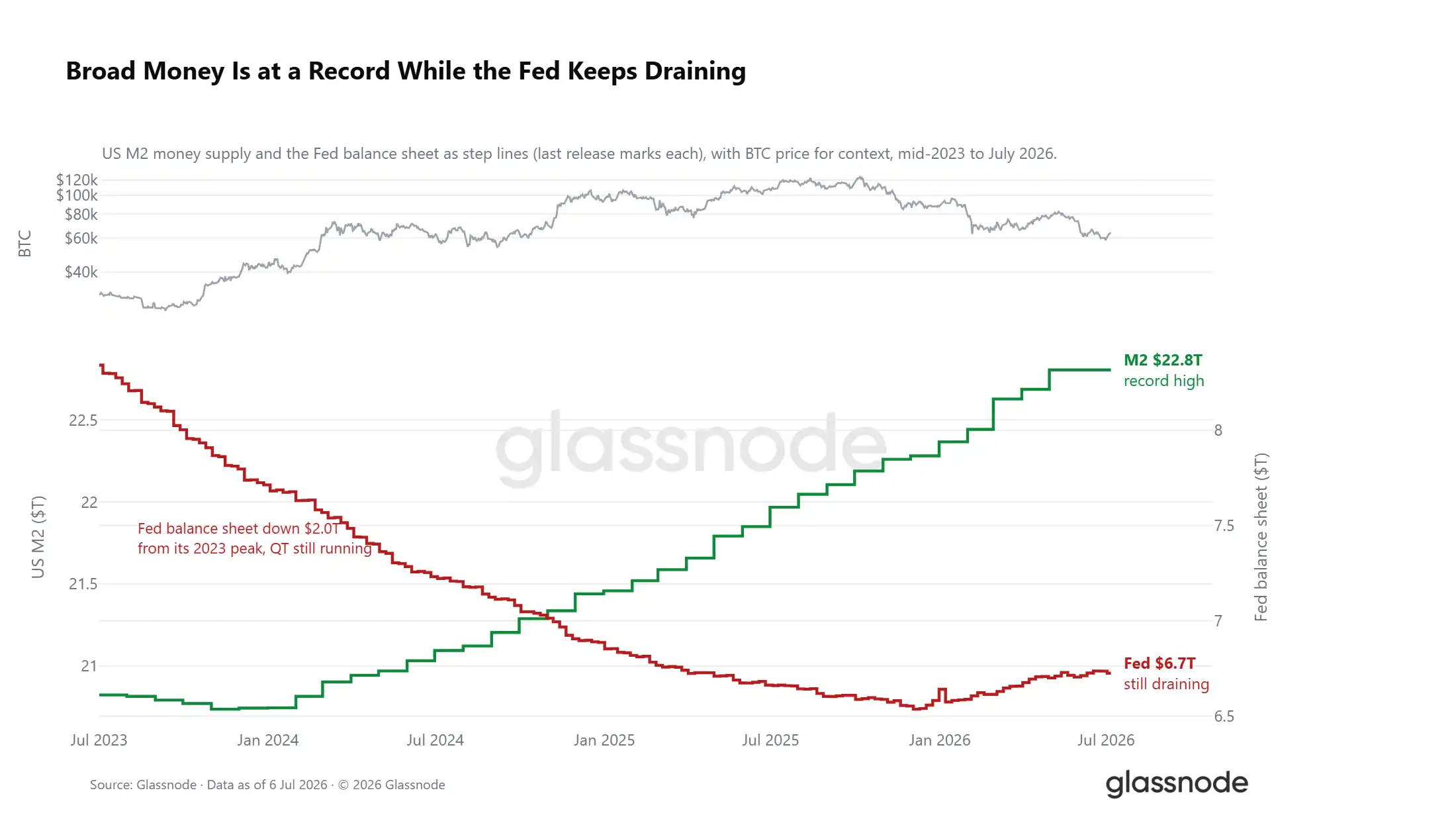
Amid external shocks from oil, the market's liquidity environment presents a contradictory picture. The total U.S. broad money supply (M2) has climbed to a new historical high of $22.8 trillion. Historically, broad money expansion cycles tend to boost market risk appetite; however, the Federal Reserve's balance sheet continues to shrink, with its current size down by $2 trillion from the 2023 peak. These two liquidity signals create a strong counterforce: the total broad money supply continues to rise while the quantitative tightening process persists, with real interest rates hovering near 1%, keeping the opportunity cost of holding non-yielding digital assets high. The macro-level favorable window is not completely closed but has not formed clear accommodative support either.
On-Chain Data

A Deeply Undervalued Zone Spanning Five Months

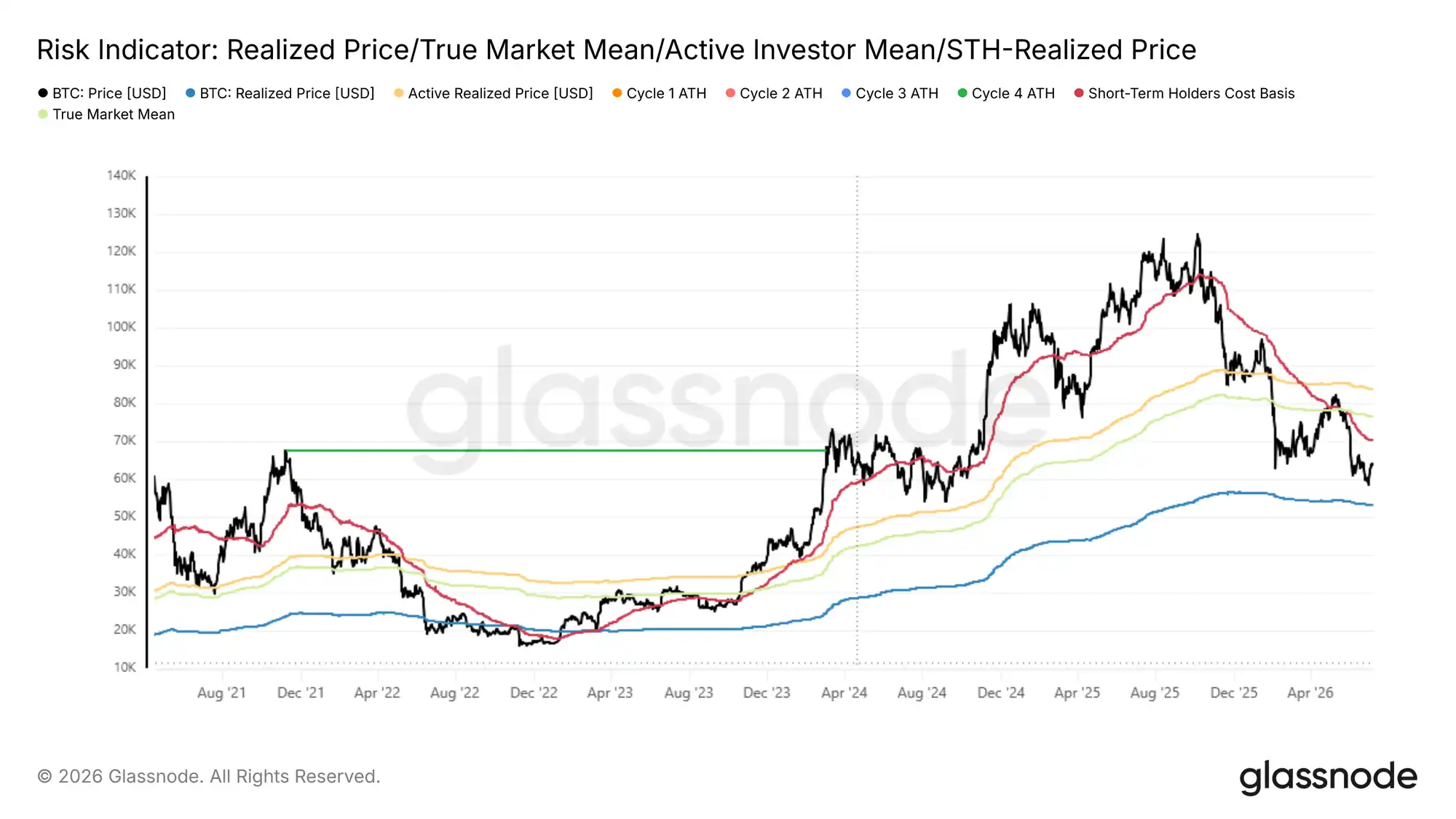
Over the past week, Bitcoin rebounded from $58,300 to $64,400, showing a short-term recovery, but the price remains significantly below the true market average of $76,600 and the short-term holder cost basis of $72,200. Only when the price reclaims these two key levels can the market exit the deeply undervalued zone; otherwise, the price action remains susceptible to declines catalyzed by external negative news.

The duration of this discount phase is noteworthy. Since early February 2026, the price has persistently traded below the cost basis of active investors and the break-even line for recent entrants, lasting nearly five months, which qualifies as a relatively long-lasting deep discount cycle in Bitcoin's history.

Continued high-volume coin distribution within a prolonged discount zone, with fresh capital consistently accumulating below the cost basis of earlier buyers and the entire market's active holdings, has historically formed the foundation for major cycle bottoms, offering long-term allocation appeal for value investors. Various metrics indicate the bottoming process has entered its later stages, but the possibility of a retest to $53,000 cannot be entirely ruled out.
Concentrated Stop-Loss Selling by Long-Term Holders with High-Cost Basis

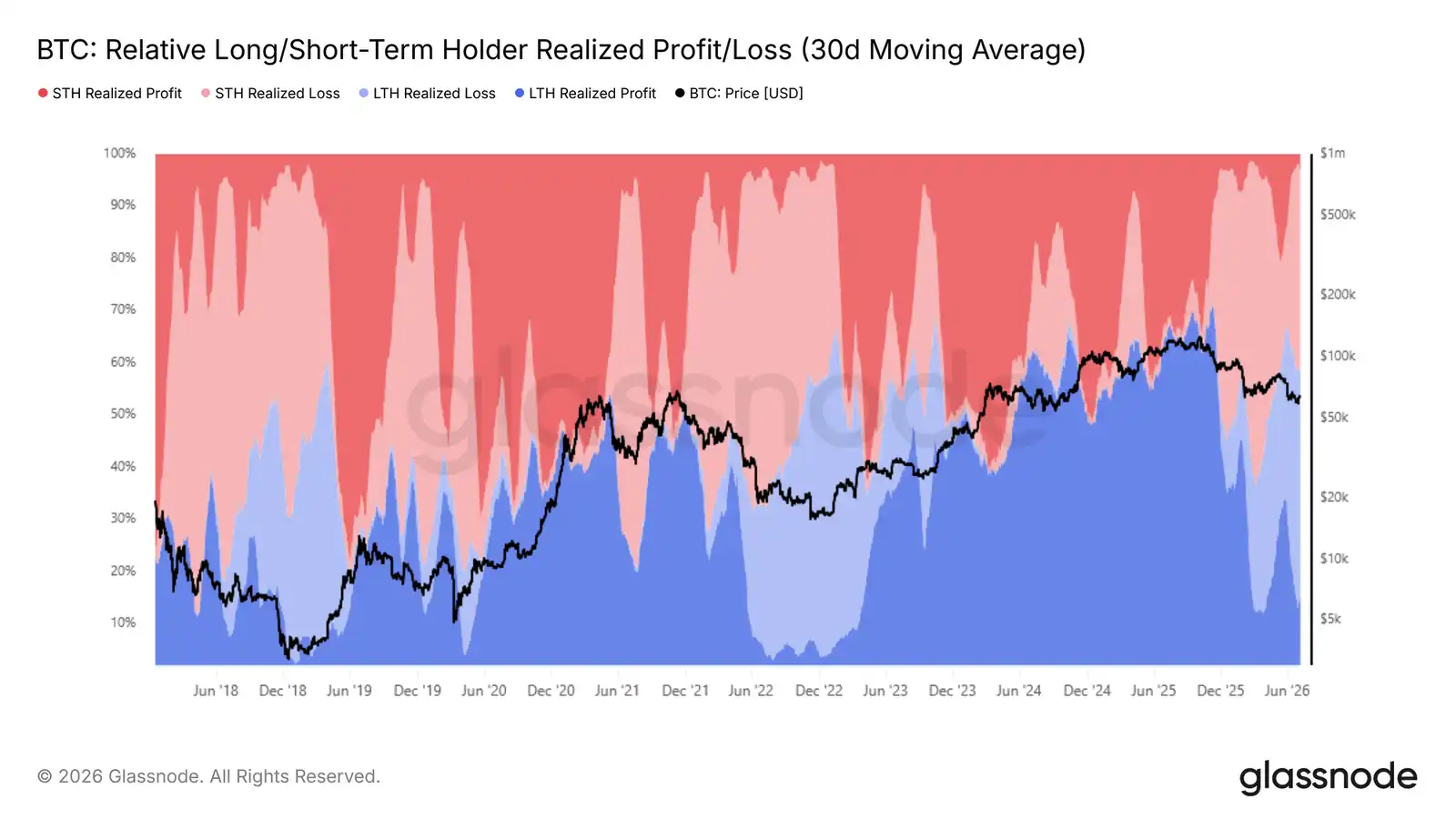
The market is constructing a cyclical bottom. The core question now is identifying the primary source of selling pressure. The relative indicator of profit/loss realization by long/short-term holders analyzes the distribution proportion of the entire market's on-chain realized profit/loss between these two holding groups, directly reflecting the scale share of each group's profit/loss realization.

After the price fell below the true market average, the 30-day moving average share of loss realization by long-term holders has climbed from around 15% in early February 2026 to the current 43%. Loss-driven selling pressure from this group has become the most dominant bearish force suppressing the price.

These investors mostly entered near the cycle highs. After enduring months of deep drawdowns, their confidence is gradually depleted, leading to concentrated exits. This coin structure directly explains why every recovery rally faces concentrated selling from deeply entrenched positions, preventing the price from solidifying above the upper bound of the current range.
Stop-Loss Selling Pressure Yet to Show Signs of Abating

Long-term holder loss realization has become the market's primary downward pressure. The next key observation is whether this selling pressure begins to subside.

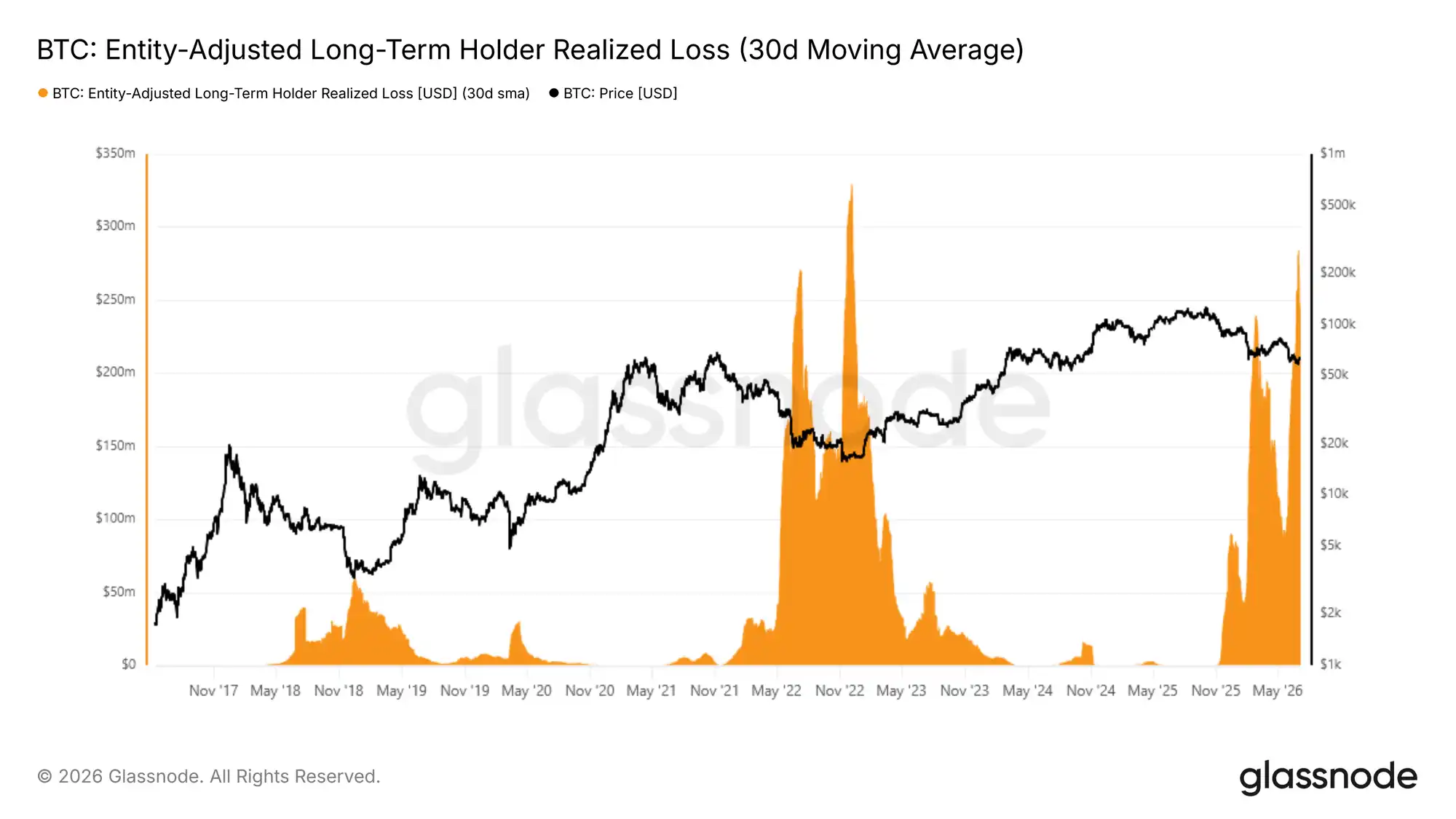
The entity-adjusted long-term holder realized loss indicator (30-day smoothed average) tracks the loss amount from sales by users holding coins for over 155 days, excluding internal address transfers, accurately reflecting genuine stop-loss exit behavior. This indicator recently hit a new daily peak, with daily loss realization volume around $280 million, the highest since December 2022, marking the second major wave of long-term holder stop-loss selling in this bear market.

The key difference is that after the first peak, selling pressure showed a temporary decline, whereas the current wave has yet to show a contraction in scale. Only when this indicator shows a clear downward trend will the market possess the foundational conditions for a shift towards a bull market. Its trajectory in the coming weeks to months will be the core signal for judging whether the market has truly completed selling pressure capitulation.
Off-Chain Markets

ETF Outflows Slow, But Outflow Trend Not Reversed

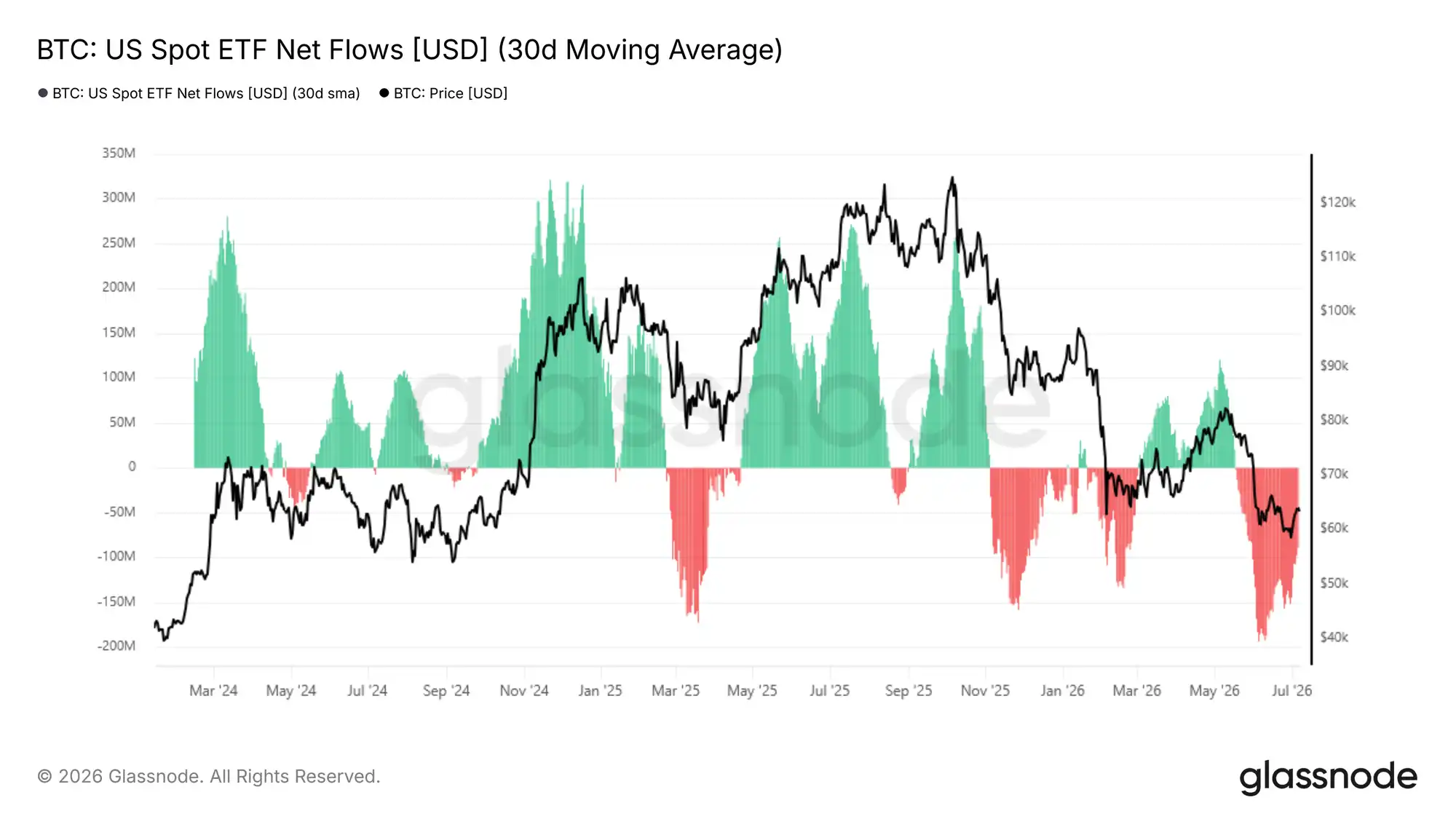
Shifting from on-chain to off-chain markets, spot ETF fund flows directly reflect institutional capital behavior. The 30-day moving average of ETF net flows indicates the daily net capital inflow/outflow from U.S. spot Bitcoin ETFs, smoothing out daily volatility to reveal underlying trends in institutional holdings.

Since mid-May 2026, this indicator entered a zone of monthly net outflows, with a daily outflow peak reaching $193 million in early June, now receded to a daily net outflow of $88.9 million. The moderation in outflow scale is a faint positive, but the market continues to see monthly capital outflows, and institutional buying demand has not stabilized. Only when the fund flow trend narrows consistently towards a balanced range can one reasonably anticipate a short-term expansionary rally.
Institutional Trading Volume Remains Sluggish

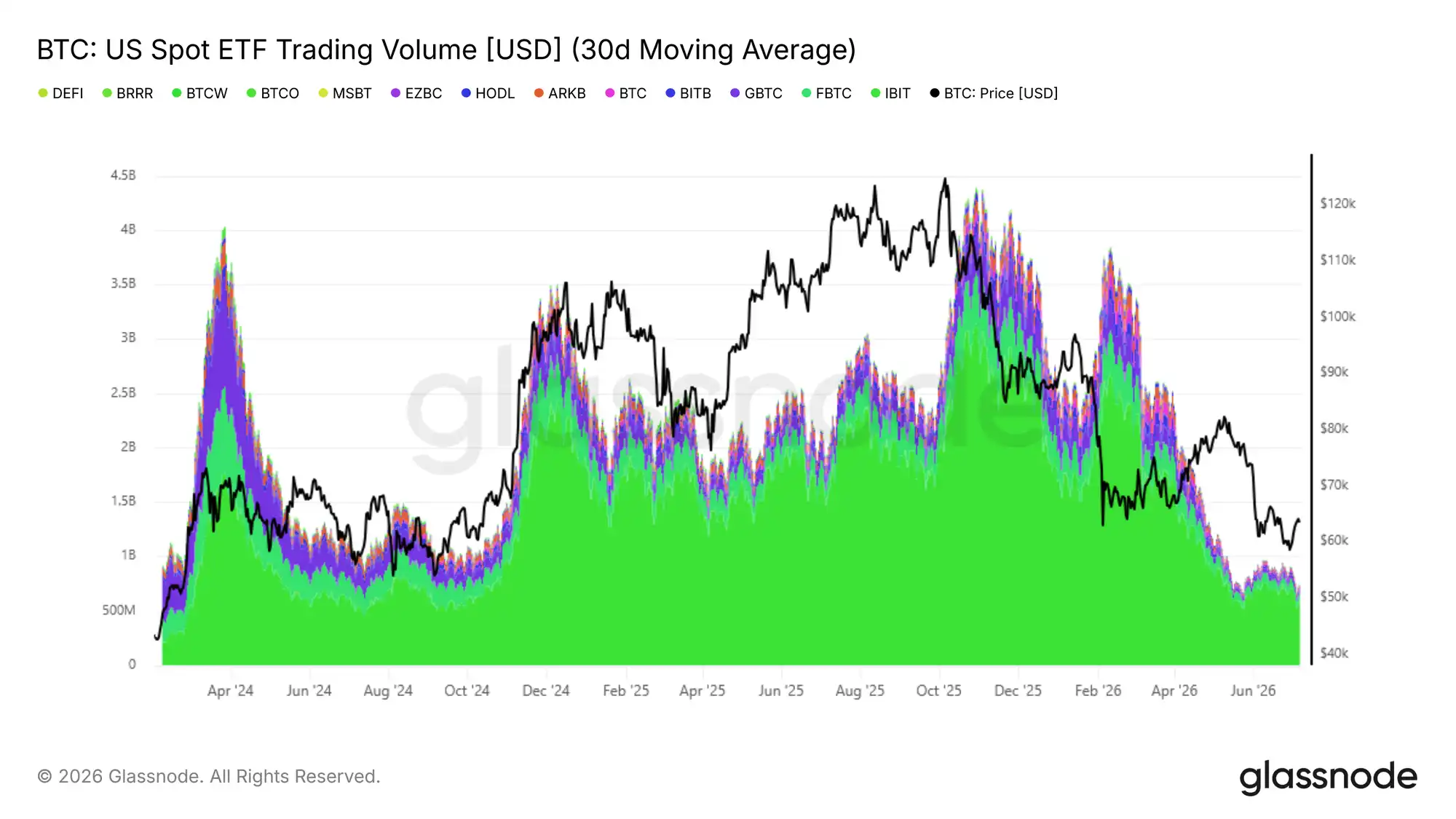
In addition to net flow data, U.S. spot ETF trading volume helps gauge the degree of institutional confidence recovery. The 30-day moving average of ETF daily trading volume currently fluctuates between $650 million and $950 million, a level comparable to Q4 2024, but also about 80% lower than the daily peak of $4.4 billion set in October 2025.

Current trading volume only represents basic institutional participation, remaining extremely low compared to bull market peaks, indicating that medium-to-long-term bullish confidence among ETF investors has not materially returned. Only when daily average trading volume shows sustained expansion *and* net outflow scale continuously narrows, with both signals appearing simultaneously, can institutional demand recovery be confirmed. Until both metrics improve in tandem, off-chain data aligns with on-chain indicators, suggesting the overall market remains in a bear market-dominated regime.
Derivatives Market

Short Covering, Positioning Shifts to Cautiously Bullish

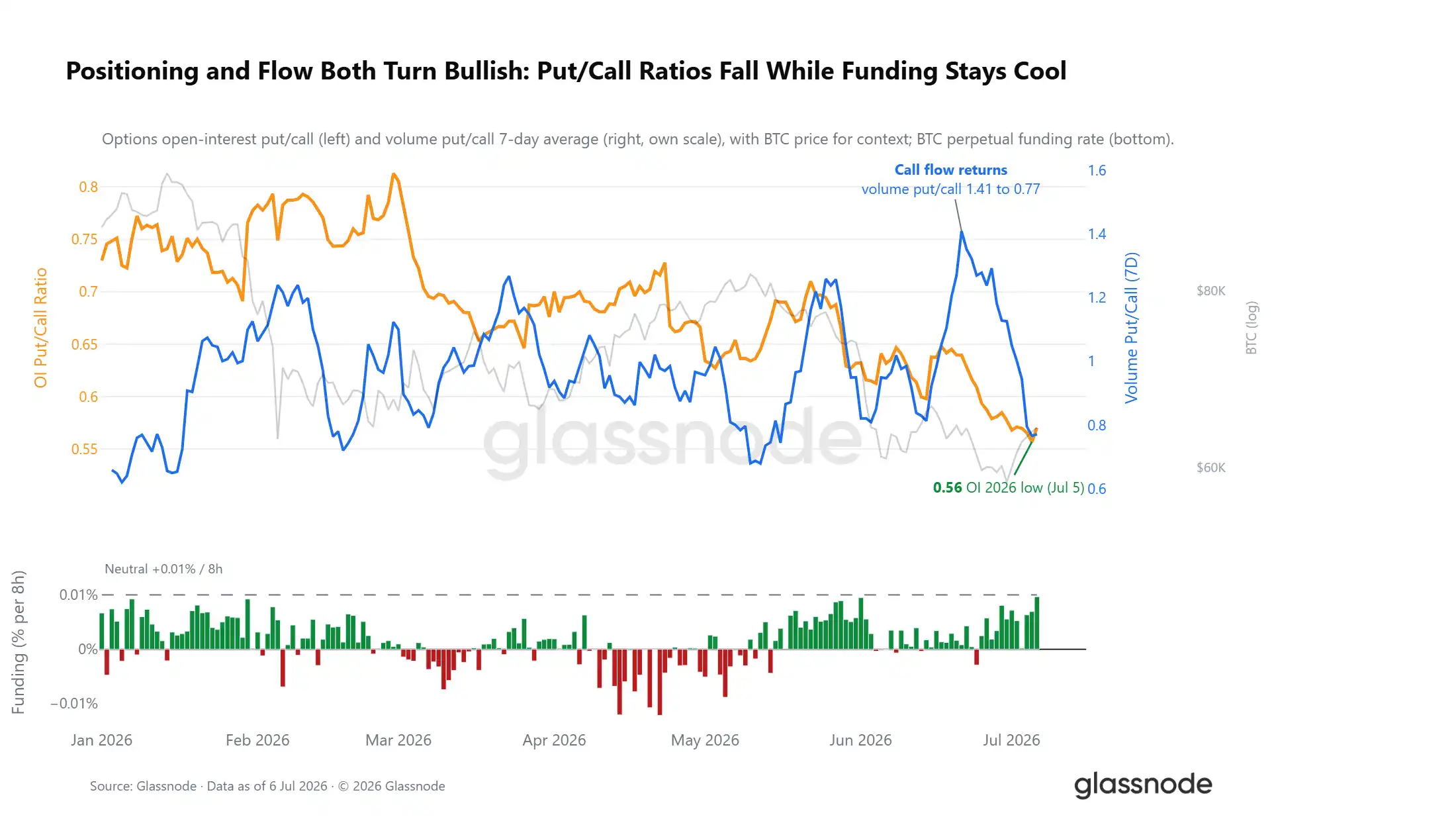
Despite the price action reflecting weak risk sentiment, derivatives positioning structure has already shown a reverse shift. The put/call open interest ratio has dropped to 0.56, the lowest level in 2026, meaning the market currently has one put contract for every two call contracts. Options trading flow corroborates this trend: two weeks ago during Bitcoin's second retest of lows, the market frantically bought puts for hedging, causing the put/call trading ratio to surge sharply; as call buying steadily returned, this ratio quickly declined, even though the spot price has only partially recovered its losses.

Perpetual swap funding rates also support the positioning shift. The average perpetual swap funding rate has long been below the 0.01% long-short equilibrium line, far from levels seen in crowded long trades. The derivatives market has completed its short risk clearance and has turned cautiously bullish overall amid external negative shocks, a stark contrast to the crowded short positioning structure before the previous major decline.
Options Skew Still Prices in Downside Risk

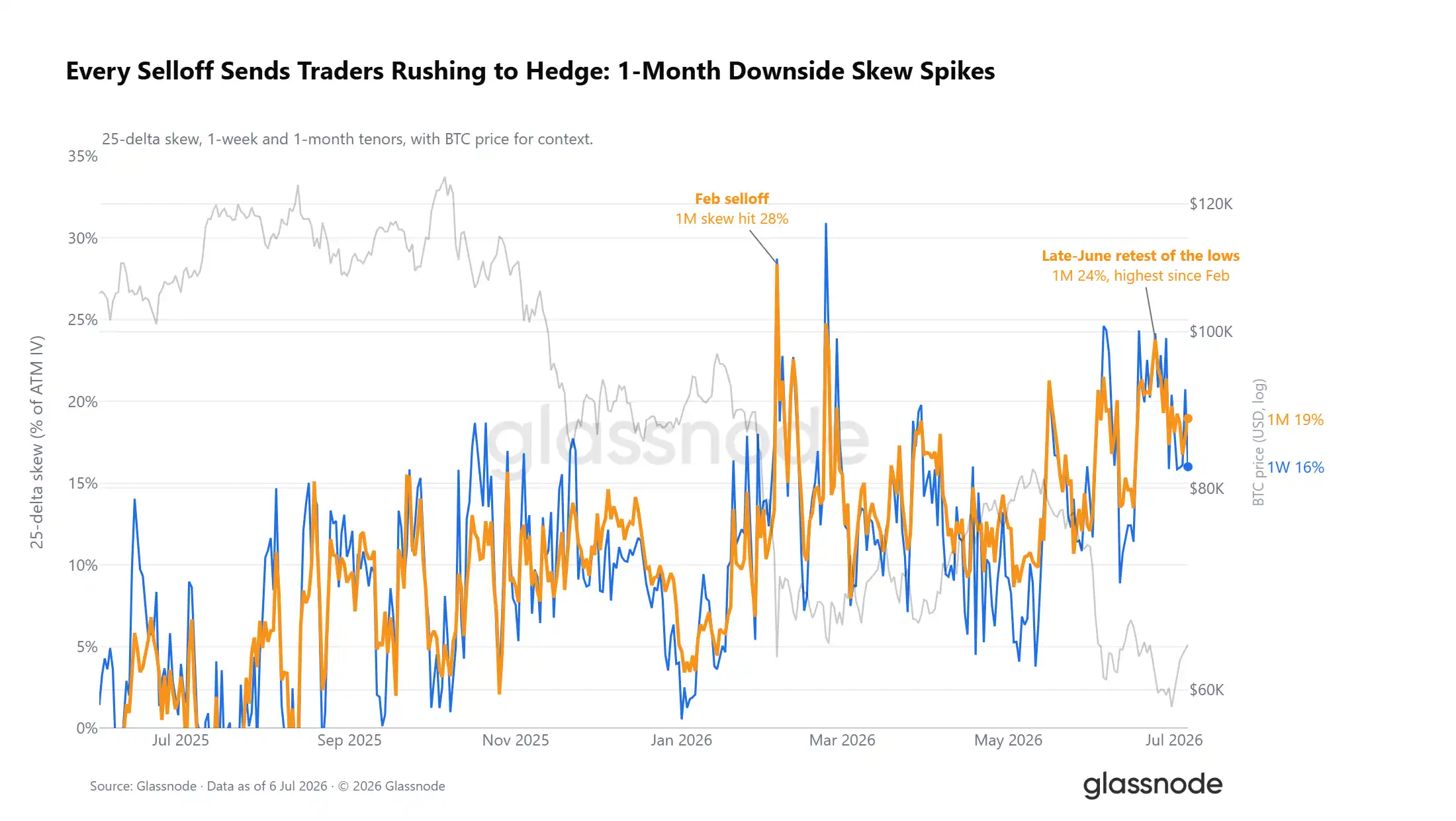
While overall positioning leans bullish, the options volatility skew sends an opposite signal. The 25-delta volatility skew indicator (premium for downside protection relative to upside gain) maintains a premium across all expiration dates. Every sell-off this year has pushed this premium higher, and at the end of June it surged to 24%, marking the strongest defensive sentiment for near-month contracts since the February crash. Even with the market leaning long, traders are still willing to pay a premium to buy downside hedging instruments.
Spot Price Deviates from Max Pain Price

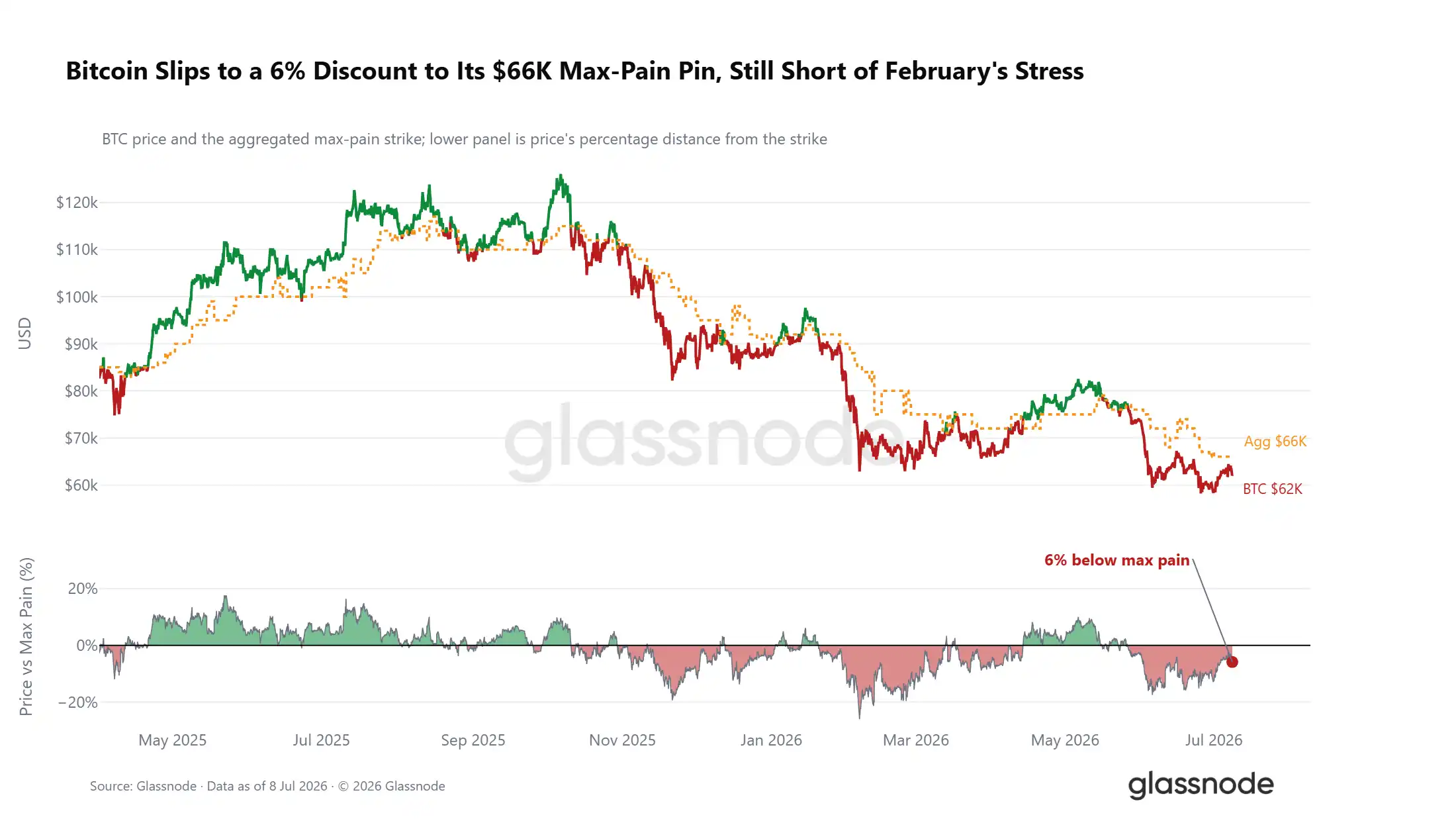
Beyond positioning and volatility skew, the relative position of the spot price to options market structure offers further clues. The current Bitcoin spot price is about 6% below the aggregate market max pain price of $66,000. The max pain price is the strike price at which the most open contracts expire worthless at expiration, and price action tends to gravitate towards this level before expiry.

This week's decline further widened the spread between spot and max pain, but the deviation is far from the extremes of the February crash, only residing in the middle of the 2026 price action range. Throughout the year, the max pain price has consistently acted as a gravitational center for price action, with the spot price oscillating around it, rarely deviating significantly for extended periods. If the price consistently holds above $66,000, short-term market signals would turn optimistic; if the spread widens further, it would reinforce the overall defensive trading sentiment in the options landscape.
Cost of Crash Hedging Continues to Decline

While signals from volatility skew and positioning diverge, the trend in absolute cost of hedging downside risk is clear. With the market's slight rebound, the pricing on the put side of the one-month volatility curve has shifted lower overall, with implied volatility for puts 5% below spot dropping significantly; the lowest pricing points on the volatility curve are concentrated in far out-of-the-money call options.
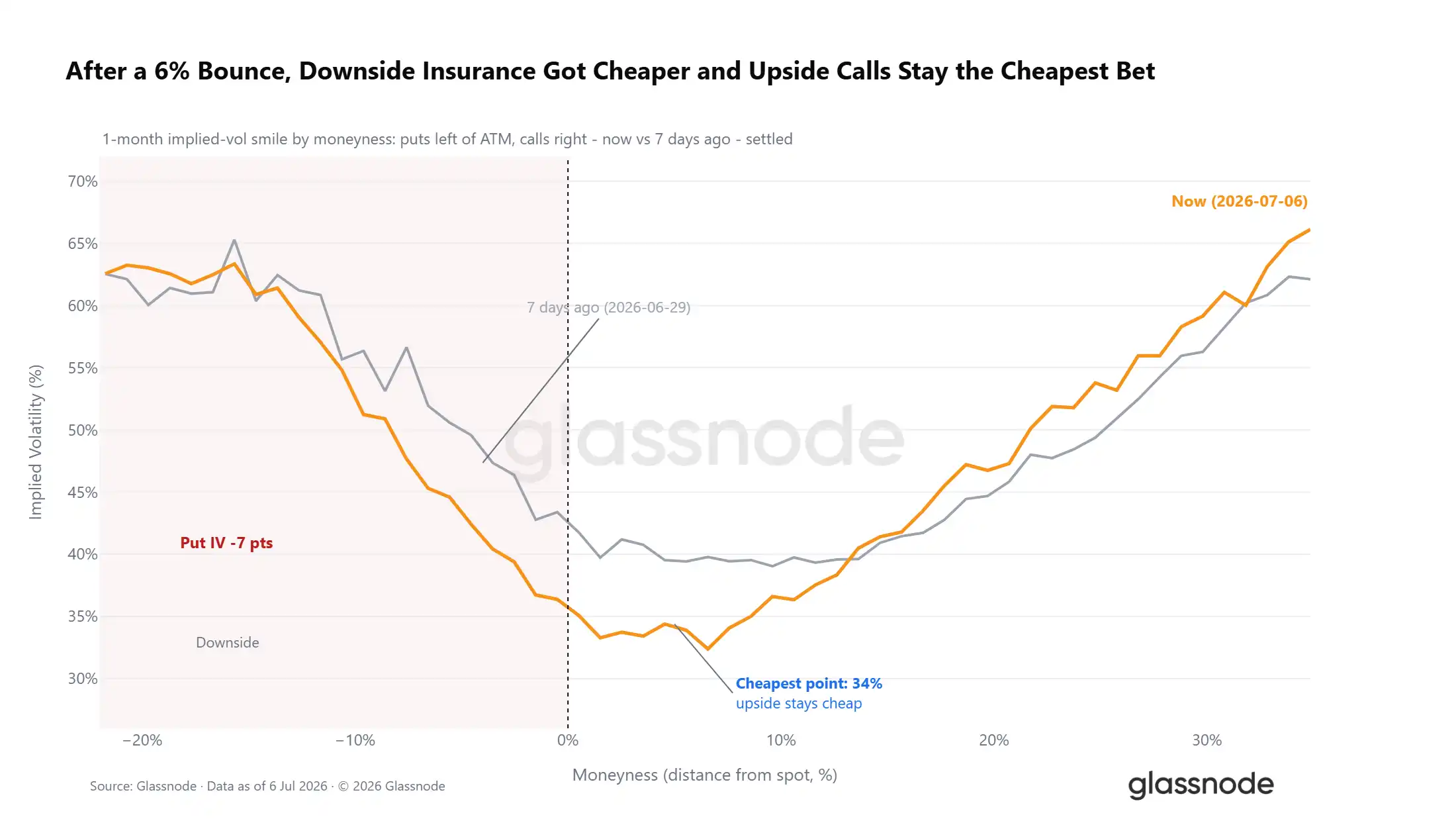
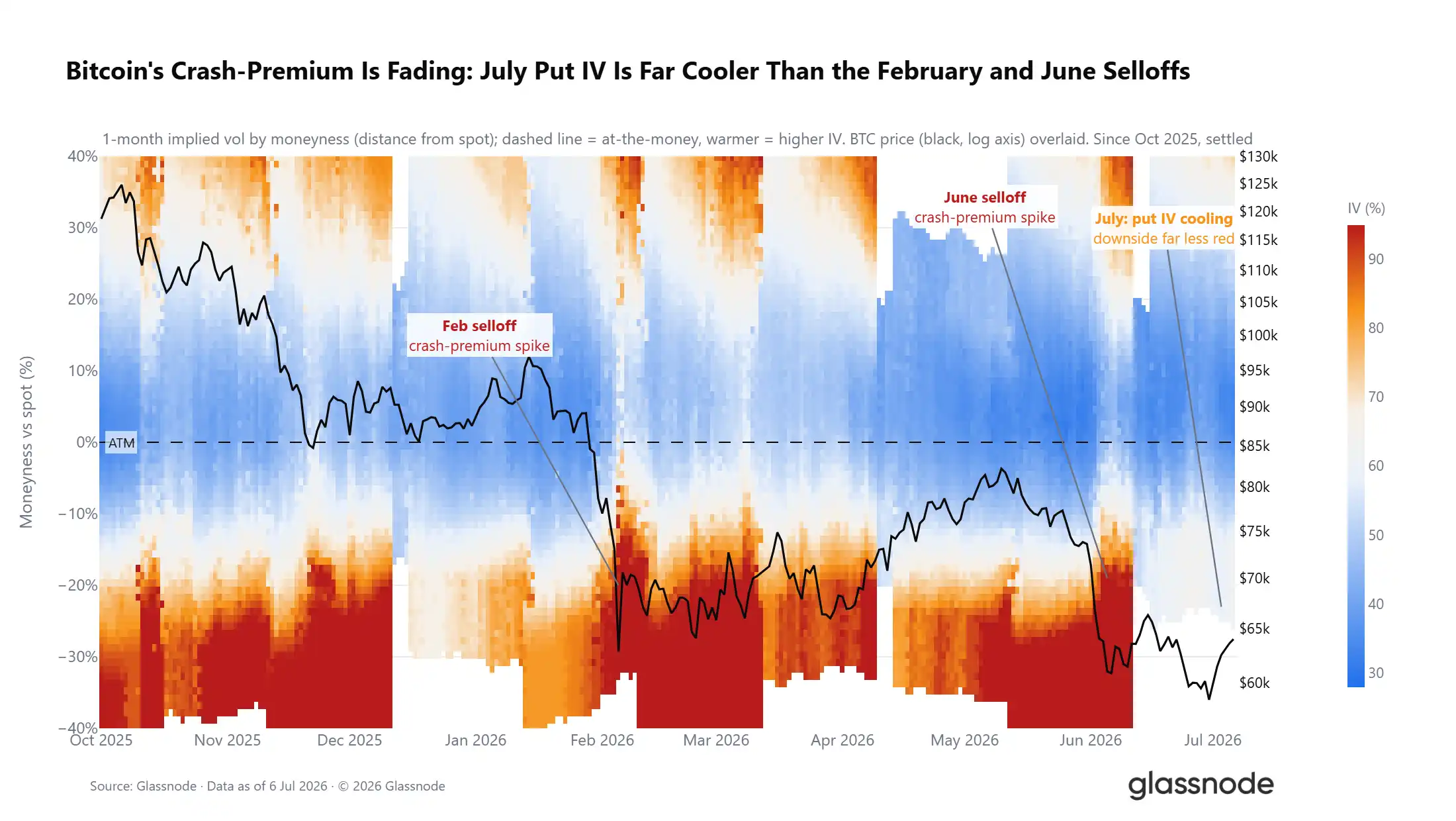
Overall defensive market sentiment persists, but the absolute cost traders pay to hedge against declines has noticeably decreased. Extending the time horizon makes this trend clearer: the volatility premium driven by extreme put hedging demand during the February and June crashes has gradually subsided entering July. The DVOL volatility index has fallen to a 12-month low, as the market enters a low-volatility regime. While cautious sentiment still dominates price action, hedging demand is gradually fading.
Summary

Integrating data from on-chain, off-chain, and derivatives dimensions, the market clearly exhibits late-stage bear market characteristics.

On-chain data shows a prolonged deep undervaluation cycle lasting five months continues, with long-term holder daily stop-loss realization volume rising to $280 million, indicating large-scale coin distribution is underway; however, a sustained decline in this stop-loss indicator is a necessary prerequisite for an effective market reversal.

Regarding off-chain data, ETF outflow scale has narrowed from its June peak but monthly net outflows persist; daily average trading volume is down 80% from the October 2025 peak, reflecting low institutional bullish confidence.

From a derivatives perspective, market positioning has shifted to cautiously bullish, with the put/call ratio hitting a yearly low; however, the volatility skew and options surface continue to price in downside risk.

Synthesizing all indicators, the foundational conditions required for market bottoming are all in place, but the core signals confirming a bottom have not yet appeared. Subsequent price action needs to meet three conditions: continuous cooling of long-term holder stop-loss selling pressure, stabilization of institutional fund flows, and price effectively holding above the true market average. Only on this basis will the probability of a shift into a bull market cycle significantly increase.


Трендовые криптовалюты

Связанные с этим вопросы

QAccording to the Glassnode article, what are the three key signals that have not yet appeared, which are necessary to confirm a sustained Bitcoin market reversal?

AThe article states that for a sustained reversal, three key signals must appear: 1) A continued cooling-off of long-term holder sell-side pressure (realized losses). 2) A stabilization of institutional capital flows (ETF net flows turning positive or neutral). 3) The price effectively stabilizing above the Realized Price (true market mean).

QWhat does the 'long-term holder realized loss' metric indicate about the current market, and why is its trend crucial for a potential bullish turn?

AThe 'long-term holder realized loss' metric indicates that investors who bought near the cycle peak are capitulating and selling at a loss. This is currently the dominant source of selling pressure. Its trend is crucial because only when this metric shows a clear and sustained decline, signaling that this capitulation is exhausting, will the market have a foundation for a transition to a bullish cycle.

QHow does the performance of US spot Bitcoin ETFs reflect the current institutional sentiment, based on the data presented in the article?

AThe data shows institutional sentiment remains weak. While ETF daily net outflows have moderated from their June peak, they persist on a monthly basis. Furthermore, the average daily trading volume of ETFs has shrunk by approximately 80% compared to the October 2025 peak, indicating a lack of strong institutional buying conviction and participation.

QDespite a shift to a 'cautiously net long' positioning in derivatives, what signal from the options market suggests traders are still defensive?

AThe 25-delta volatility skew remains in positive territory across all maturities, meaning traders are willing to pay a premium for downside protection (put options) relative to upside potential (call options). This indicates that even with a net long bias, the market is still actively hedging against potential price declines.

QWhat is the significance of Bitcoin's price trading below both the Realized Price and the Short-Term Holder Cost Basis for an extended period, as mentioned in the article?

ABitcoin trading below both the Realized Price (the average price at which all coins last moved) and the Short-Term Holder Cost Basis for nearly five months signifies a period of deep undervaluation. Historically, such prolonged periods of accumulation below key on-chain cost bases have formed the foundation for major cycle bottoms, presenting long-term value opportunities.

Похожее

Свадебное дело Чхве Тхэвона закрыто: раскрывая скрытые линии наследования за триллионной империей SK Hynix

Дело о разводе главы SK Group Чхве Тхэвона завершилось, раскрывая сложные сценарии наследования в конгломерате, стоящем за SK Hynix, чья капитализация превысила 1000 трлн вон. В отличие от традиционных сценариев наследования в чеблях, где ключевую роль играют первенец, доли, брачные связи и отцовское признание, трое детей Чхве Тхэвона от бывшей жены Но Соён — дочь Чхве Юнджон (1989 г.р.), дочь Чхве Минджон (1991 г.р.) и сын Чхве Ингын (1995 г.р.) — следуют разными путями. Чхве Юнджон, названная СМИ «наиболее очевидным кандидатом», занимает руководящую должность в SK Inc. и работает над стратегией развития в области биотехнологий и точной медицины, сочетая научную подготовку с бизнес-опытом. Её брак с основателем ИИ-стартапа символизирует новый тип элитных союзов. Чхве Минджон, добровольно служившая в ВМС Республики Корея и работавшая в сфере международной политики в SK Hynix в США, сейчас является основателем ИИ-стартапа в сфере здравоохранения. Её брак с бывшим офицером морской пехоты США подчёркивает связь с геополитическим контекстом, в котором теперь существует полупроводниковый гигант. Чхве Ингын, единственный сын и, казалось бы, естественный наследник по старой логике, сохраняет молчание. Имея образование в области физики, он покинул SK E&S, чтобы присоединиться к McKinsey, что рассматривается как стандартная внешняя стажировка, но без явных сигналов о наследовании. Громкое судебное разбирательство по разводу родителей, связанное с разделом активов на триллионы вон, стало фоном для их путей. По мере того как SK Hynix становится глобальным геополитическим активом в эпоху ИИ, наследование в SK перестаёт быть семейным делом, превращаясь в публичный экзамен на легитимность в новой, сложной реальности. Наследникам предстоит найти свои собственные ответы на вызовы эпохи.

marsbit2 дня назад 09:08

Свадебное дело Чхве Тхэвона закрыто: раскрывая скрытые линии наследования за триллионной империей SK Hynix

marsbit2 дня назад 09:08

Банки выступают против компромисса по доходности стейблкоинов – Найдёт ли закон CLARITY 60 голосов?

Американский Банковский институт политики выступил против нового проекта закона CLARITY Act, указав на пробелы в регулировании доходности стейблкоинов и мерах по борьбе с незаконными финансами. Банковский сектор добивается полного запрета любых форм вознаграждений по стейблкоинам и лоббирует сенаторов, что снижает поддержку со стороны республиканцев. Из-за смерти сенатора Грэма и болезни Макконнелла у республиканцев стало 51 голос. Если сенаторы Кёртис и Корнин откажут в поддержке, эта цифра упадет до 49, а для принятия закона потребуется 60 голосов. Необходимость заручиться поддержкой 11 демократов осложняется тем, что некоторые про-крипто демократы также выступают против законопроекта. Сроки ограничены: до августовских каникул Сената осталось две недели. Лидер большинства Джон Тюн сомневается в успехе до перерыва. Советник Белого дома по криптовалютам Патрик Уитт призывает провести голосование, утверждая, что новые этические нормы устраняют возражения демократов. Вероятность принятия закона в 2026 году, по рыночным оценкам, упала до 32%.

ambcrypto2 дня назад 09:03

Банки выступают против компромисса по доходности стейблкоинов – Найдёт ли закон CLARITY 60 голосов?

ambcrypto2 дня назад 09:03

За 2 месяца оценка выросла с 8,8 до 68 млрд юаней! Крупнейший AI-хаб OpenRouter может быть куплен

Stripe ведет переговоры о приобретении стартапа OpenRouter, агрегатора API крупных языковых моделей, за сумму около 100 миллиардов долларов. Это представляет собой семикратный рост по сравнению с оценкой OpenRouter в 13 миллиардов долларов двумя месяцами ранее. OpenRouter выступает в качестве «маршрутизатора» или агрегатора для более чем 400 AI-моделей (таких как GPT, Claude и множество открытых), позволяя разработчикам через единый API выбирать наиболее подходящую модель для каждой задачи на основе стоимости, скорости и сложности. Это помогает приложениям снижать расходы, автоматически направляя простые запросы к более дешевым моделям. Компания, основанная соучредителем OpenSea Алексом Аталлой, демонстрирует быстрый рост: ее ежегодный доход достиг 50 миллионов долларов, увеличившись в пять раз за полгода. Для Stripe, крупнейшего процессора онлайн-платежей, это вторая крупная сделка в сфере AI-инфраструктуры после приобретения платформы биллинга Metronome в 2025 году. Стратегия Stripe заключается в создании комплексного предложения для AI-экономики: OpenRouter будет «выбирать модель», Metronome — «подсчитывать потребление», а существующие платежные сервисы Stripe — «обрабатывать оплату». Таким образом, Stripe стремится контролировать ключевой уровень инфраструктуры, который определяет распределение трафика между моделями и формирует счета для конечных предприятий. Сделка подчеркивает растущую важность промежуточного слоя, который управляет стоимостью и выбором моделей для миллионов пользователей AI-приложений.

链捕手2 дня назад 09:00

За 2 месяца оценка выросла с 8,8 до 68 млрд юаней! Крупнейший AI-хаб OpenRouter может быть куплен

链捕手2 дня назад 09:00

От OpenSea до OpenRouter: Алекс Аталлах повторяет сценарий «ухода на пике»?

Автор: Нэнси, PANews Алекс Аталла, соучредитель NFT-платформы OpenSea, покинул компанию на пике пузыря NFT четыре года назад. Сейчас он снова оказывается в центре внимания на волне бума ИИ, готовясь продать созданную им агрегирующую платформу AI-моделей OpenRouter по высокой цене. По данным The Wall Street Journal от 23 июля, платежный гигант Stripe ведет переговоры о приобретении OpenRouter, при этом потенциальная оценка сделки может приблизиться к 100 миллиардам долларов. Если сделка состоится, это станет еще одним успехом Аталлы в создании компании на уровне ста миллиардов долларов после OpenSea. Ранее в этом месяце появились сообщения о том, что OpenRouter получил предложения о покупке от нескольких крупных технологических компаний. Потенциальная сделка со Stripe рассматривается как важный шаг для инфраструктурного гиганта в сфере платежей по расширению своего присутствия в области инфраструктуры ИИ. По данным информированных источников, если сделка будет заключена, оценка OpenRouter может приблизиться к 100 миллиардам долларов, что значительно превышает его предыдущие оценки при финансировании. Всего за три года компания добилась быстрого роста благодаря буму больших моделей. Это не первая компания Аталлы стоимостью в сто миллиардов. Ранее он был соучредителем OpenSea, ведущей мировой платформы для торговли NFT, пиковая оценка которой превысила 130 миллиардов долларов. Его уход с OpenSea до серьезного спада на рынке NFT рассматривался как знаковый сигнал. OpenRouter стала крупнейшим хабом в эпоху ИИ, подключившись к более чем 400 AI-моделям, имея около 10 миллионов пользователей и обрабатывая более 200 триллионов токенов в месяц. Однако, несмотря на быстрый рост, это бизнес с большими объемами, но ограниченной рентабельностью. Его основная бизнес-модель заключается в взимании комиссии за платформу (около 5-5,5%) при вызове разработчиками AI-моделей. Конкуренция на рынке агрегации AI-моделей также обостряется. Высокая оценка OpenRouter, возможно, больше отражает его будущий потенциал, чем текущую прибыльность. Для потенциальных покупателей наиболее ценным активом могут быть не текущие доходы, а накопленные реальные данные об использовании ИИ, которые трудно быстро воспроизвести. От NFT к ИИ Алекс Аталла дважды поймал волну технологического бума. Если продажа OpenRouter состоится с оценкой в 100 миллиардов долларов, это может означать либо переоценку стоимости инфраструктуры ИИ, либо сигнал о новом пике цикла. Ответ на этот вопрос даст только время.

链捕手2 дня назад 08:44

От OpenSea до OpenRouter: Алекс Аталлах повторяет сценарий «ухода на пике»?

链捕手2 дня назад 08:44

Приближается ли Биткойн к очередной зоне накопления? ЭТОТ сигнал говорит «да»

Аналитики отмечают, что Bitcoin (BTC) переживает один из самых длительных медвежьих периодов, охватывающий три квартала и два календарных года, при этом его динамика отклонилась от рынка акций. Однако сохраняется корреляция с акциями Apple (AAPL). График соотношения BTC/AAPL с 2017 года движется в восходящем канале, где его нижняя граница традиционно сигнализирует о зоне недооценки (накопления) для Bitcoin, а верхняя — о перекупленности. В настоящее время соотношение приближается к линии поддержки, что, по историческим данным, может предшествовать новой фазе роста BTC. При этом в 2025 году нарушилась многолетняя корреляция годовой доходности Bitcoin с индексами S&P 500 и Nasdaq 100, что объясняется его более резкой реакцией на макроэкономические потрясения. В качестве подтверждающего сигнала для разворота рассматриваются поступления стейблкоинов на криптобиржи, которые указывают на готовность капитала к реинвестированию. За последние семь дней чистый приток составил $1,42 млрд, что значительно меньше оттока в $10 млрд за предыдущие 30 дней и пока недостаточно для уверенного старта ралли. Таким образом, соотношение BTC/AAPL указывает на возможное приближение к зоне накопления, но для подтверждения тренда необходимы более значительные притоки стейблкоинов.

ambcrypto2 дня назад 08:24

Приближается ли Биткойн к очередной зоне накопления? ЭТОТ сигнал говорит «да»

ambcrypto2 дня назад 08:24

Торговля

Спот

Популярные статьи

Тест по Bitcoin Биткоина

HTX Learn: Изучите Bitcoin halving и Заработаете Токены USDT

3.2k просмотров всегоОпубликовано 2024.04.16Обновлено 2024.04.16

Тест по Bitcoin  Биткоина

Что такое $BITCOIN

ЦИФРОВОЕ ЗОЛОТО ($BITCOIN): Комплексный анализ Введение в ЦИФРОВОЕ ЗОЛОТО ($BITCOIN) ЦИФРОВОЕ ЗОЛОТО ($BITCOIN) — это проект на основе блокчейна, работающий в сети Solana, который стремится объединить характеристики традиционных драгоценных металлов с инновациями децентрализованных технологий. Хотя он носит имя Биткойн, часто называемого “цифровым золотом” из-за его восприятия как средства хранения ценности, ЦИФРОВОЕ ЗОЛОТО является отдельным токеном, предназначенным для создания уникальной экосистемы в ландшафте Web3. Его цель — позиционировать себя как жизнеспособный альтернативный цифровой актив, хотя детали его применения и функциональности все еще развиваются. Что такое ЦИФРОВОЕ ЗОЛОТО ($BITCOIN)? ЦИФРОВОЕ ЗОЛОТО ($BITCOIN) — это токен криптовалюты, специально разработанный для использования в блокчейне Solana. В отличие от Биткойна, который выполняет широко признанную роль хранения ценности, этот токен, похоже, сосредоточен на более широких приложениях и характеристиках. Примечательные аспекты включают: Инфраструктура блокчейна: Токен построен на блокчейне Solana, известном своей способностью обрабатывать высокоскоростные и недорогие транзакции. Динамика предложения: ЦИФРОВОЕ ЗОЛОТО имеет максимальное предложение, ограниченное 100 квадриллионами токенов (100P $BITCOIN), хотя детали о его обращающемся предложении в настоящее время не раскрыты. Утилита: Хотя точные функциональные возможности не описаны, есть указания на то, что токен может быть использован для различных приложений, потенциально связанных с децентрализованными приложениями (dApps) или стратегиями токенизации активов. Кто создатель ЦИФРОВОГО ЗОЛОТА ($BITCOIN)? На данный момент личность создателей и команды разработчиков, стоящих за ЦИФРОВЫМ ЗОЛОТОМ ($BITCOIN), остается неизвестной. Эта ситуация типична для многих инновационных проектов в области блокчейна, особенно тех, которые связаны с децентрализованными финансами и феноменом мем-криптовалют. Хотя такая анонимность может способствовать культуре, ориентированной на сообщество, она усиливает опасения по поводу управления и ответственности. Кто инвесторы ЦИФРОВОГО ЗОЛОТА ($BITCOIN)? Доступная информация указывает на то, что у ЦИФРОВОГО ЗОЛОТА ($BITCOIN) нет известных институциональных спонсоров или значительных венчурных капиталовложений. Проект, похоже, функционирует по модели пирингового взаимодействия, сосредоточенной на поддержке и принятии сообществом, а не на традиционных путях финансирования. Его активность и ликвидность в основном сосредоточены на децентрализованных биржах (DEX), таких как PumpSwap, а не на устоявшихся централизованных торговых платформах, что еще больше подчеркивает его подход, ориентированный на grassroots. Как работает ЦИФРОВОЕ ЗОЛОТО ($BITCOIN) Операционные механизмы ЦИФРОВОГО ЗОЛОТА ($BITCOIN) можно подробно описать на основе его дизайна блокчейна и характеристик сети: Механизм консенсуса: Используя уникальный механизм доказательства истории (PoH) Solana в сочетании с моделью доказательства доли (PoS), проект обеспечивает эффективную валидацию транзакций, что способствует высокой производительности сети. Токеномика: Хотя конкретные дефляционные механизмы не были подробно описаны, большое максимальное предложение токенов подразумевает, что оно может быть предназначено для микротранзакций или нишевых случаев использования, которые еще предстоит определить. Интероперабельность: Существует потенциал для интеграции с более широкой экосистемой Solana, включая различные платформы децентрализованных финансов (DeFi). Однако детали относительно конкретных интеграций остаются неуточненными. Хронология ключевых событий Вот хронология, которая подчеркивает значимые вехи, касающиеся ЦИФРОВОГО ЗОЛОТА ($BITCOIN): 2023: Первоначальное развертывание токена происходит в блокчейне Solana, отмеченное его адресом контракта. 2024: ЦИФРОВОЕ ЗОЛОТО приобретает видимость, когда оно становится доступным для торговли на децентрализованных биржах, таких как PumpSwap, позволяя пользователям обменивать его на SOL. 2025: Проект наблюдает спорадическую торговую активность и потенциальный интерес к инициативам, возглавляемым сообществом, хотя на данный момент не зафиксировано никаких значительных партнерств или технических достижений. Критический анализ Сильные стороны Масштабируемость: Основная инфраструктура Solana поддерживает высокие объемы транзакций, что может повысить полезность $BITCOIN в различных сценариях транзакций. Доступность: Потенциально низкая цена торговли за токен может привлечь розничных инвесторов, способствуя более широкому участию благодаря возможностям дробного владения. Риски Отсутствие прозрачности: Отсутствие публично известных спонсоров, разработчиков или процесса аудита может вызвать скептицизм относительно устойчивости и надежности проекта. Волатильность рынка: Торговая активность сильно зависит от спекулятивного поведения, что может привести к значительной волатильности цен и неопределенности для инвесторов. Заключение ЦИФРОВОЕ ЗОЛОТО ($BITCOIN) является интригующим, но неоднозначным проектом в быстро развивающейся экосистеме Solana. Хотя он пытается использовать нарратив “цифрового золота”, его отход от установленной роли Биткойна как средства хранения ценности подчеркивает необходимость более четкого различения его предполагаемой утилиты и структуры управления. Будущее принятие и усвоение, вероятно, будут зависеть от решения текущей непрозрачности и более четкого определения его операционных и экономических стратегий. Примечание: Этот отчет охватывает синтезированную информацию, доступную на октябрь 2023 года, и с тех пор могут произойти события.

213 просмотров всегоОпубликовано 2025.05.13Обновлено 2025.05.13

Что такое $BITCOIN

Fractal Bitcoin: масштабирование Биткоина с помощью рекурсивной системы

Fractal Bitcoin — масштабное Layer-1-решнение, созданное на базе кода Биткоина, позволяющего достигать бесконечного масштабирования с помощью рекурсивного подхода.

2.4k просмотров всегоОпубликовано 2025.06.30Обновлено 2025.06.30

Fractal Bitcoin: масштабирование Биткоина с помощью рекурсивной системы

Обсуждения

Добро пожаловать в Сообщество HTX. Здесь вы сможете быть в курсе последних новостей о развитии платформы и получить доступ к профессиональной аналитической информации о рынке. Мнения пользователей о цене на BTC (BTC) представлены ниже.

活动图片