Which Companies Has NVIDIA's "Three-Track Investment Architecture" Invested In?

marsbitОпубликовано 2026-06-04Обновлено 2026-06-04

Введение

NVIDIA's investment strategy operates through a "three-track architecture," not just its NVentures venture arm. Corporate Development handles massive strategic bets (e.g., $30B in OpenAI, $10B in Anthropic, $20B in Synopsys). NVentures, a small team, focuses on early-stage, financial investments across sectors like quantum computing (Alice & Bob, PsiQuantum), AI infrastructure (OpenRouter, Tensormesh), and biotech. The NVIDIA Inception accelerator provides non-monetary support. This system allows NVIDIA to nurture startups and lock in strategic partners, creating a vast AI ecosystem. This aggressive capital deployment has drawn scrutiny. Critics like Michael Burry and EU regulators question potential "circular financing," where NVIDIA's equity investments in companies (e.g., CoreWeave, OpenAI) facilitate those companies' purchases of NVIDIA hardware, potentially inflating revenue. Supporters view it as a necessary "virtuous cycle" to secure supply and demand in a compute-scarce market. While NVentures' smaller deals appear like traditional VC, its role within the larger, controversial investment framework remains a point of debate.

Author: Ada, Deep Tide TechFlow

Recently, NVentures, NVIDIA's venture capital arm, made a new investment in the French quantum computing company Alice & Bob, focusing on fault-tolerant quantum computing.

It is a common misconception to attribute all of NVIDIA's external investments under the name NVentures. In fact, the collective scale of this venture division's approximately 30 annual investments, established in 2021, pales in comparison to a single investment made casually by the Corporate Development team. The latter's $2 billion equity investment in Synopsys at the end of 2025 alone is several times larger than NVentures' cumulative investment amount over nearly three years.

To understand how NVIDIA uses capital to weave the AI ecosystem, one must start with the "Three-Track Architecture" of its investment system. The Corporate Development team handles strategic large-scale investments and mergers & acquisitions ranging from billions to hundreds of billions of dollars. NVentures is responsible for early-stage, broadly scoped financial investments across industries. NVIDIA Inception is a startup accelerator that provides resource connections without direct capital investment. These three parts work in synergy, forming the largest and fastest-paced capital deployment machine in Silicon Valley's history, and also becoming the core target of "circular financing" allegations in the eyes of short-sellers.

The True Face of NVentures: 2-Person Team, 79 Companies, 20 Unicorns

Although bearing NVIDIA's brand, NVentures' internal size is surprisingly small. According to private equity data firm Tracxn, as of May 2026, the entire team consists of only 2 people, having cumulatively invested in 79 companies, fostering 20 unicorns, including AI video generation platform Synthesia, clinical AI company Abridge, quantum computing company PsiQuantum, and others. In the past 12 months, the team completed 43 new investments, with 20 deals in the first five months of 2026 alone, indicating a significantly accelerated pace.

Leading NVentures is Mohamed "Sid" Siddeek, corporate vice president and head of NVentures. Siddeek's resume itself reflects NVIDIA's positioning for this division. He worked at Morgan Stanley in the late 1990s, accompanying Jensen Huang during NVIDIA's IPO roadshow; then served for nearly a decade as head of TMT & Telecom investments at the UAE sovereign wealth fund Mubadala; later managed enterprise software and healthcare investments at SoftBank's Vision Fund; and finally returned to NVIDIA in 2021 to establish NVentures.

Siddeek's own description of the investment scope is: "The real screening criteria are only two layers: the first is anywhere NVIDIA can reach, the second is which areas are investable." In an interview with Global Corporate Venturing, he revealed this means horizontal coverage across almost all industries AI can transform—healthcare, manufacturing, robotics, autonomous driving, quantum, etc.—and vertical coverage from underlying tools to the application layer, all within NVentures' investment scope.

Three-Track Architecture: Corp Dev for Strategy, NVentures for Early-Stage, Inception for Ecosystem

NVIDIA's external investment system consists of three distinct parts with clear division of labor.
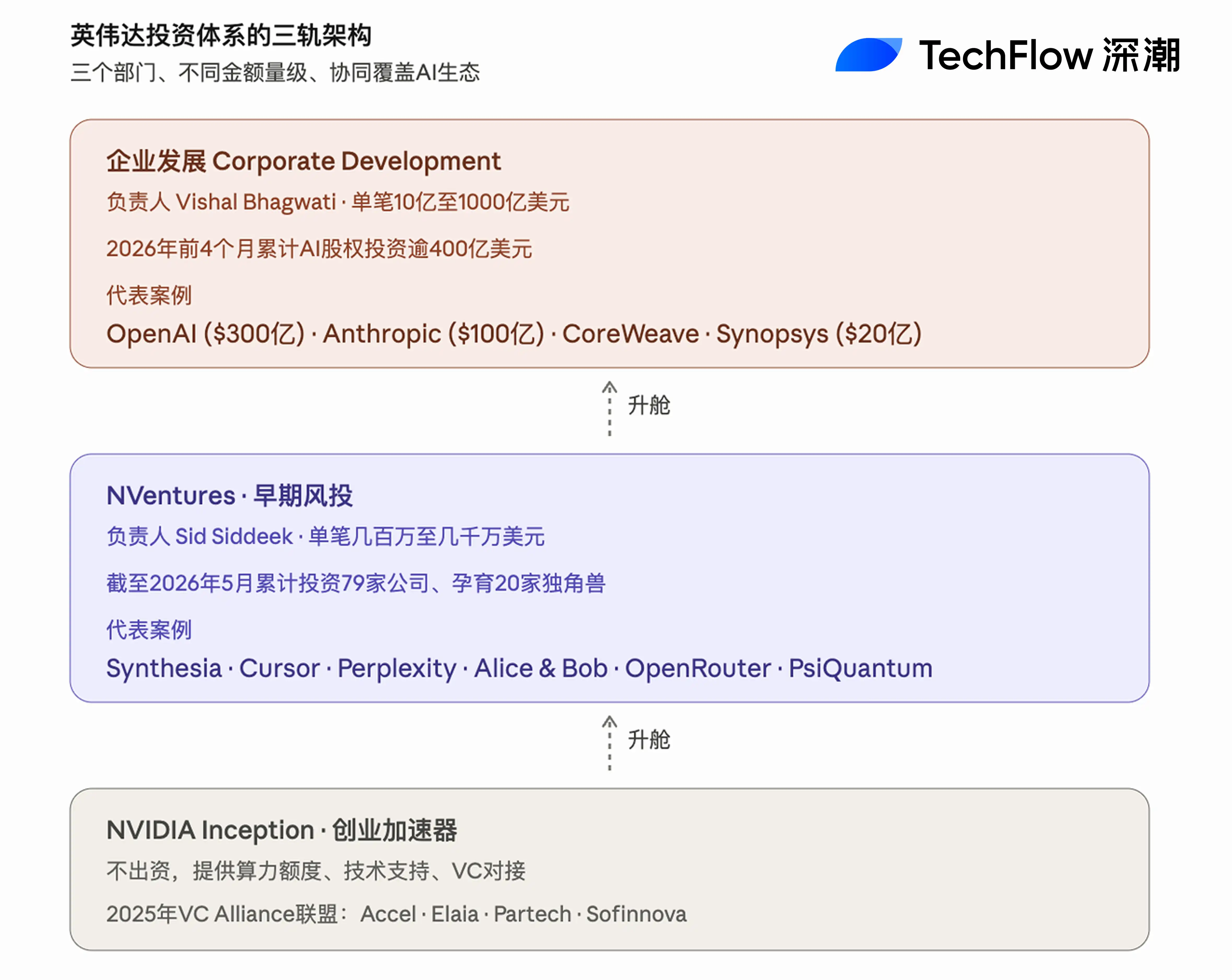
The first layer is the Corporate Development team, led by Vishal Bhagwati, responsible for all strategic-level large-scale investments, joint ventures, and M&A. The magnitude of deals on this track is completely different from NVentures. Representative moves from the second half of 2025 to the first half of 2026 include leading a $30 billion investment in OpenAI in February 2026 (as part of a roughly $110 billion funding round), with a commitment to potentially increase to $100 billion in the future; a $10 billion commitment to Anthropic in November 2025; a $2 billion injection into Synopsys at the end of 2025; a $2 billion follow-on investment in CoreWeave in early 2026, accompanied by a $6.3 billion cloud capacity purchase agreement; a $2 billion investment in Nebius in March 2026; and an equity commitment of up to $2 billion in xAI.

According to CNBC, in just the first four months of 2026, AI-related equity investments led by the Corporate Development team exceeded $40 billion. NVIDIA invested a total of $17.5 billion in private companies and infrastructure funds during fiscal year 2025.

The second layer is NVentures, led by Sid Siddeek, positioned as a traditional venture capital firm pursuing financial returns. Individual deal sizes range from a few million to tens of millions of dollars, primarily investing at Seed to Series B stages. Siddeek explicitly told Global Venturing that NVentures "primarily focuses on early-stage investments, while the Corporate Development team handles larger, more directly strategic investments." Behaviorally, NVentures predominantly participates as a co-investor, leading only about one-eighth of its investments, more often joining rounds led by top VCs like Accel, a16z, and Sequoia, leveraging the NVIDIA endorsement.

The third layer is NVIDIA Inception, essentially a startup accelerator program that does not directly invest capital but provides startups with NVIDIA hardware credits, technical support, market promotion, and VC connection channels. NVIDIA's upgraded "VC Alliance" launched in 2025, partnering with institutions like Accel, Elaia, Partech, and Sofinnova, distributes NVIDIA DGX Cloud Lepton compute credits to their portfolio companies, representing an extension of Inception in Europe.

There is a clear "funnel" relationship among the three. Inception discovers early-stage projects and integrates them into the NVIDIA ecosystem. Those with investment potential come into NVentures' view and may receive early-stage checks from a few million to tens of millions of dollars. When a company grows to a size significant enough to impact NVIDIA's strategic landscape (becoming a major customer, key supplier, or potential acquisition target), it "upgrades" to the Corporate Development team, entering cooperation frameworks worth billions or even hundreds of billions of dollars.

NVentures' Recent Moves: Quantum, Inference Routing, AI Security

NVentures' activity in May 2026 was notable. Just within the recent month, there have been four publicly disclosed deals. On May 22, French quantum computing company Alice & Bob announced NVentures participated in the extension of its €100 million Series B round. Alice & Bob's core technology is a fault-tolerant quantum computing architecture based on "cat qubits," deeply collaborating with NVIDIA's hybrid quantum-classical computing stack like CUDA-Q, cuQuantum, Dynamiqs, and NVQLink. On May 26, AI model routing platform OpenRouter completed a $113 million Series B round, with NVentures co-investing alongside Google CapitalG, Snowflake, and others. OpenRouter's business provides developers a unified interface to access APIs from dozens of different model providers globally. On May 28, AI inference infrastructure startup Tensormesh completed a $20 million seed extension round, with NVentures co-investing alongside CoreWeave, AMD, and others. On May 6, AI cybersecurity company Xbow completed a $35 million Series C extension, with NVentures participating.

Judging by the investment targets, NVentures' recent tilt clearly leans toward three directions: quantum computing (Alice & Bob, Quantinuum, PsiQuantum), AI biopharma (Relation Therapeutics, Genesis Therapeutics), and AI Agent & inference layer (OpenRouter, Tensormesh, etc.). This aligns with Siddeek's statement "anywhere NVIDIA can reach" and also corresponds precisely to the directions NVIDIA is investing in for its next-generation software stacks like CUDA-Q, CUDA-X, and Triton.

Geographically, NVentures' European deployment has notably accelerated. It completed 14 European investments in 2025, double the 7 investments in 2024.

Panoramic View of the Three-Tier Investment Portfolio

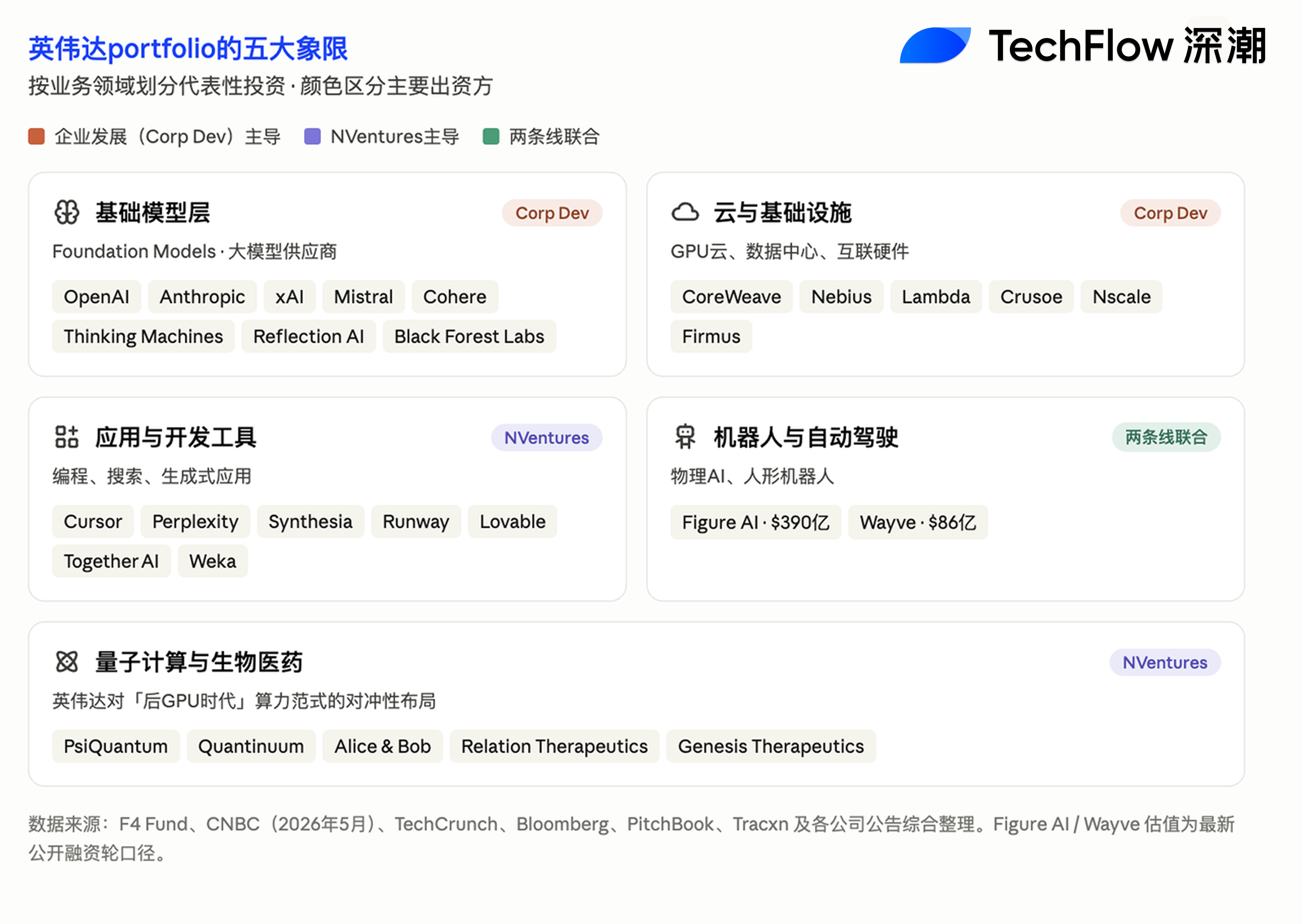
If we overlay the portfolios of the three investment tiers on the same map, NVIDIA's "capital radiation" on the AI ecosystem can be summarized into five main quadrants.

The foundation model layer includes OpenAI, Anthropic, xAI, Mistral, Cohere, Thinking Machines Lab, Reflection AI, Black Forest Labs. This layer is primarily funded by the Corporate Development team, with NVentures participating in smaller shares.

The cloud & infrastructure layer includes CoreWeave, Nebius, Lambda, Crusoe, Nscale, Firmus Technologies. This layer is also dominated by the Corporate Development team, with individual investments often reaching billions of dollars, accompanied by long-term compute purchase contracts.

The application & developer tools layer includes Cursor, Perplexity, Synthesia, Runway, Lovable, Together AI, Weka. NVentures has higher participation in this layer, with relatively smaller amounts.

The robotics & autonomous driving layer includes Figure AI (latest valuation $39 billion) and Wayve (valuation $8.6 billion). This involves combined efforts from both Corporate Development and NVentures.

The quantum computing & biopharma layer includes PsiQuantum, Quantinuum, Alice & Bob, Relation Therapeutics. This consists mainly of early-stage investments led by NVentures, serving as NVIDIA's hedging bets on post-GPU-era computing paradigms.

According to venture capital research firm F4 Fund, from 2025 to early 2026, in the investment rounds participated in by NVIDIA (Corporate Development + NVentures), at least 10 companies crossed the $1 billion valuation threshold, including OpenAI, Anthropic, xAI, Mistral, Figure AI, Cursor, Perplexity, Scale AI, Wayve, and others.
Controversy: Burry's Shorts and the Question of "Circular Financing"

However, NVIDIA's massive external investment landscape is attracting increasing scrutiny. The most representative criticism comes from hedge fund manager Michael Burry, famous from the movie "The Big Short."

According to Scion Asset Management's Q3 2025 13F filing, Burry established short positions against NVIDIA and Palantir before September 30, 2025, including put options for approximately 1 million NVIDIA shares, representing a nominal exposure of about $187 million based on the stock price at the time; and 50,000 put option contracts (each for 100 shares) on Palantir, with actual premium payments of about $9.2 million. Burry posted on his X account "Cassandra Unchained" with a screenshot from "The Big Short," captioning "Sometimes, we can see bubbles," and later retweeted a Bloomberg chart about NVIDIA's circular financing, directly pointing the finger at NVIDIA's capital deployment model.

Burry's specific accusations are technical. He estimated in a Substack post that between 2026 and 2028, cloud providers including Microsoft, Google, Oracle, and Meta would cumulatively understate depreciation by about $176 billion by extending the accounting depreciation period for NVIDIA GPUs, thereby inflating profits during that period. This accounting adjustment resonates with NVIDIA's equity investments in customers. The former gives buyers higher "paper profits" to absorb larger capital expenditures, while the latter directly provides buyers with funds to purchase NVIDIA hardware.

At the institutional level, similar suspicions are accumulating. The EU competition regulator explicitly included the "risk of circular spending" within NVIDIA's investment system in its review scope in March 2026. Seaport Research estimates that for every $1 of equity NVIDIA invests, it corresponds to about $3.5 in downstream chip purchase revenue. Bloomberg's March 2026 feature on "AI Circular Trades" mapped the dense web of fund flows among NVIDIA, CoreWeave, OpenAI, Oracle, and Anthropic. NVIDIA holds about a 7% stake in CoreWeave, CoreWeave uses NVIDIA GPUs as collateral for financing, in turn uses cash to purchase more GPUs from NVIDIA, and NVIDIA then signs a $6.3 billion cloud capacity purchase agreement, committing to absorb CoreWeave's excess capacity through 2032. NVIDIA committed up to $100 billion in investment to OpenAI, OpenAI commits to purchasing NVIDIA hardware and building a $300 billion data center via Oracle, and Oracle then purchases GPUs from NVIDIA. NVIDIA invests $10 billion in Anthropic, Anthropic commits to deploying Claude on Microsoft Azure, and Azure purchases NVIDIA Grace Blackwell and Vera Rubin systems.

Counterarguments from supporters also exist. Asset manager Janus Henderson characterized this model as a "virtuous cycle," arguing that in an era of extreme compute scarcity, binding supply and demand through "equity + long-term purchase contracts" is a reasonable commercial arrangement. Morningstar's analysis pointed out that NVIDIA's arrangement with CoreWeave to "commit to purchasing excess capacity" actually makes NVIDIA bear CoreWeave's inventory risk, thus constituting a constraint on the impulse to push hardware sales in the short term.

In this controversy, NVentures' position is rather delicate. Its early-stage, small-scale, co-investment-focused, and industry-dispersed investment style forms a stark contrast to the "circular trade" model of the Corporate Development team. Companies like Alice & Bob, Tensormesh, and OpenRouter, which NVentures invests in, are not large enough to form the "both NVIDIA customer and NVIDIA investee" cycle; their investment behavior is closer to the financial investment logic of a traditional CVC. However, from the perspective of NVIDIA's overall investment system, whether NVentures, to some extent, acts as the "compliant venture capital facade" in external disclosures, making it easier for outsiders to interpret NVIDIA's investment activities as normal venture capital behavior rather than systematic seller financing, is the unspoken but implied question from Burry and EU regulators.

NVIDIA's consistent official stance is that all investments are based on independent business judgment and are not linked to hardware sales. But market observers are increasingly quoting a phrase: in an era of compute shortage, whether to believe "the entanglement of equity and purchase contracts is coincidental" is itself a question of trust.


Трендовые криптовалюты

Связанные с этим вопросы

QWhat are the three parts of NVIDIA's investment system as described in the article?

AThe three-part system consists of: 1) The Corporate Development team, which handles strategic, large-scale investments and acquisitions worth billions to hundreds of billions of dollars. 2) NVentures, the venture capital arm that makes early-stage, financially-focused investments ranging from millions to tens of millions of dollars. 3) NVIDIA Inception, a startup accelerator program that provides resources and connections but does not make direct investments.

QWho leads the NVentures team and what is its typical investment role?

ANVentures is led by Mohamed 'Sid' Siddeek. Its typical investment role is that of a traditional VC seeking financial returns, primarily participating in early-stage rounds (Seed to Series B). It mostly acts as a co-investor in rounds led by top VCs like Accel or Sequoia, with only about one-eighth of its investments being lead roles.

QWhat are some recent investment areas for NVentures as of May 2026?

AAs of May 2026, NVentures's recent investments show a clear tilt towards three areas: Quantum Computing (e.g., Alice & Bob, Quantinuum, PsiQuantum), AI Biopharma (e.g., Relation Therapeutics, Genesis Therapeutics), and AI Agent & Inference Layer (e.g., OpenRouter, Tensormesh).

QWhat is the core criticism from Michael Burry regarding NVIDIA's investment activities?

AMichael Burry's core criticism revolves around the concept of 'circular financing.' He alleges that NVIDIA's equity investments in its customers (like AI companies and cloud providers) effectively provide them with funds to purchase NVIDIA hardware. This, combined with accounting practices that extend GPU depreciation periods for buyers, creates a loop that inflates reported profits and sustains demand for NVIDIA's products.

QAccording to the article, what is the "funnel" relationship between the three parts of NVIDIA's investment system?

AThere is a clear 'funnel' relationship: NVIDIA Inception discovers early-stage projects and brings them into the NVIDIA ecosystem. Promising companies from this pool may then attract NVentures for an early-stage investment. Finally, if a company grows to a size significant enough to impact NVIDIA's strategic landscape (as a key customer, supplier, or potential acquisition target), it 'graduates' to the Corporate Development team for multi-billion dollar strategic partnerships or investments.

Похожее

Когда рынок начинает сомневаться в капитальных затратах на ИИ: полный анализ квартальных отчетов пяти технологических гигантов

В конце июля 2026 года ведущие технологические гиганты — Alphabet (Google), Intel, Microsoft, Meta и Apple — представили квартальные отчёты. Все компании показали рост выручки и прибыли, превысив ожидания рынка, однако реакция инвесторов сильно различалась из-за расхождений в подходах к капитальным затратам (CAPEX) на ИИ и ожиданиях относительно свободного денежного потока. **Alphabet** продемонстрировал рекордный 12-й квартал двузначного роста выручки, а облачный бизнес вырос на 82%. Однако акции упали более чем на 7% после новостей о рекордных квартальных CAPEX в $44,9 млрд и первом в истории отрицательном свободном денежном потоке. Компания также повысила годовой прогноз по CAPEX. **Intel** сообщил о самом сильном росте выручки за 15 лет (25%), во многом благодаря бизнесу центров обработки данных и ИИ. Несмотря на это, акции испытали волатильность после увеличения годового прогноза CAPEX с $18 млрд до более чем $20 млрд, что усилило опасения по поводу денежного потока. **Microsoft** стала фаворитом рынка: выручка Azure впервые превысила $100 млрд в годовом исчислении. Ключевым положительным сигналом стало *снижение* прогноза по CAPEX на 2026 год с $190 млрд до $175 млрд и обещание положительного свободного денежного потока в 2027 финансовом году. Акции выросли, показав лучший однодневный результат за 18 лет. **Meta**, несмотря на рост выручки на 28%, столкнулась с самым резким падением акций (почти 10%). Причина — рост расходов на 55%, резкое сокращение свободного денежного потока на 90% и повышение годового прогноза по CAPEX. Это уже второй квартал подряд, когда Meta наказывают за рост затрат. **Apple** отчиталась о рекордной выручке и прибыли за июньский квартал, но её акции упали более чем на 8%, а рыночная капитализация сократилась на $300 млрд. Это произошло из-за консервативного прогноза на следующий квартал, который оказался ниже ожиданий Уолл-стрит, и опасений по поводу ограничений в цепочке поставок. **Общий вывод:** Рынок смещает фокус с абсолютных показателей выручки и прибыли на **доходность капитальных вложений**. Компании, демонстрирующие контроль над расходами и путь к положительному свободному денежному потоку (как Microsoft), вознаграждаются. Те, кто агрессивно наращивает CAPEX без четких краткосрочных перспектив возврата денежных средств (как Google и Meta), сталкиваются с продажами. В следующем отчётном сезоне объяснение стратегии CAPEX и его окупаемости будет критически важным для котировок акций.

Odaily星球日报10 мин. назад

Когда рынок начинает сомневаться в капитальных затратах на ИИ: полный анализ квартальных отчетов пяти технологических гигантов

Odaily星球日报10 мин. назад

a16z: От компании к DAO, DUNA может стать следующей организационной формой

Автор: a16z crypto Компиляция: Deep Tide TechFlow Основная задача бизнеса на протяжении веков остаётся неизменной: как организовать сотрудничество незнакомых людей с разными ролями, асимметричной информацией и интересами для достижения общей цели? История бизнеса — это история поиска новых организационных форм. Компания стала великим прорывом для индустриальной эпохи, но цифровые технологии и интернет-протоколы снижают потребность в традиционных иерархических структурах. Существующее законодательство не предназначено для нового мира децентрализованных сетей. DAO (децентрализованные автономные организации), хотя и являются перспективной формой, сталкиваются с правовыми проблемами: отсутствием юридического признания, что подвергает участников неограниченной ответственности, и неопределённостью в регулировании, особенно в свете теста Хоуи в США. В качестве решения предлагается DUNA (Децентрализованная Некорпоративная Некоммерческая Ассоциация) — новая правовая форма, уже принятая в нескольких штатах США. DUNA предоставляет группе людей юридическое лицо и ограниченную ответственность, позволяя децентрализованным сообществам легально владеть активами, заключать контракты и вести деятельность, не полагаясь на централизованное управление. Она заполняет правовой вакуум для интернет-нативных организаций, не решая всех проблем управления, но давая им законный статус. Эволюция организационных форм — от семейных предприятий и компаний до LLC и DUNA — расширяет инструменты для координации людей. DUNA представляет собой следующий шаг, позволяющий анонимным, географически разбросанным участникам блокчейн-сетей сотрудничать как единое юридическое лицо, минимизируя личные риски и открывая новую главу в организации коллективных действий.

marsbit55 мин. назад

a16z: От компании к DAO, DUNA может стать следующей организационной формой

marsbit55 мин. назад

Отчет о токенизированных активах реального мира (RWA) за середину 2026 года: рыночная капитализация токенизированных акций удвоилась за год, но 90% прав – пустышка

**Отчет о RWA на блокчейне за середину 2026 года: капитализация токенизированных акций удвоилась за год, но 90% прав — пустышка** В июле 2026 года стоимость распределенных токенизированных акций достигла $1,89 млрд, почти удвоившись с марта. Однако рост сконцентрирован вокруг немногих инструментов (SECZ, FGRS, STRCx дали ~49% прироста) и платформ (Ondo, xStocks, Securitize контролируют 85% рынка). Рынок расколот: офшорные продукты (Ondo, xStocks) обеспечивают ликвидность и доступность в DeFi, но предлагают слабые юридические права на базовый актив. Регулируемая инфраструктура США (например, через Nasdaq) обеспечивает юридическую определенность, но страдает от низкой ликвидности и ограниченного распределения. Ни один продукт не сочетает полноценные права собственности, широкое распределение, ликвидность и независимое ценовое образование. Общие данные по RWA ($36,8 млрд распределенных активов) требуют осторожной интерпретации из-за изменений в методологии учета. Рынок токенизированных акций расширяется технически, но остается фрагментированным в правовом поле, где разные токены, отслеживающие одну акцию, представляют собой отдельные юридические обязательства.

marsbit1 ч. назад

Отчет о токенизированных активах реального мира (RWA) за середину 2026 года: рыночная капитализация токенизированных акций удвоилась за год, но 90% прав – пустышка

marsbit1 ч. назад

Внимание, пользователи биткоина! Сегодняшний взлом может быть масштабнее, чем вы думали. Вот что нужно делать

Компания Coinkite, производитель аппаратных биткоин-кошельков Coldcard, обнаружила критическую уязвимость в процессе генерации сид-фраз на устройствах Coldcard Mk3 с прошивкой версий 4.0.1–5.0.3. Все биткоин-адреса, созданные из этих сид-фраз, потенциально скомпрометированы. Компания настоятельно рекомендует пользователям немедленно перевести средства на новый, безопасный кошелёк, создав новую сид-фразу. Просто сменить устройство недостаточно — старую сид-фразу использовать нельзя. Это предупреждение следует на фоне масштабной атаки 30 июля, в ходе которой автоматизированный инструмент за 41 минуту опустошил 1196 кошельков, похитив около 1082 BTC (на тот момент ~$70,2 млн). Исследователи связывают эту атаку с обнаруженной уязвимостью, так как она произошла за 30 часов до публичного раскрытия проблемы Coinkite. Украденные средства пока остаются на четырёх адресах без движения.

cryptonews.ru3 ч. назад

Внимание, пользователи биткоина! Сегодняшний взлом может быть масштабнее, чем вы думали. Вот что нужно делать

cryptonews.ru3 ч. назад

Биткоин в августе: эксперты ждут проверки диапазона, а не быстрого разворота

Биткоин в августе, по мнению аналитиков, скорее всего, останется в состоянии проверки ключевых ценовых уровней, а не совершит резкий разворот к росту. Несмотря на восстановление в июле, сохраняется риск снижения ниже $60 тыс. Основными факторами давления остаются сложная макроэкономическая обстановка: высокие ставки в США, устойчивая инфляция и сильный доллар, что ограничивает аппетит к рисковым активам, включая криптовалюты. Эксперты отмечают, что август исторически слаб для крипторынка. Институциональный спрос остается вялым, о чем свидетельствуют чистые оттоки из биткоин-ETF. Рынок продолжает торговаться в узком диапазоне, преимущественно между $60 и $65 тыс. Прогнозы на месяц в основном сдержанные. Базовый сценарий (вероятность 50%) предполагает движение в коридоре $58–68 тыс. Негативный (30%) — снижение к $50–55 тыс. Позитивный (20%) — рост к $71–75 тыс. Ключевыми уровнями являются поддержка в районе $60–61 тыс. и сопротивление около $67 тыс., преодоление которого могло бы изменить текущий нисходящий тренд. Эксперты советуют инвесторам рассматривать текущие уровни как возможность для постепенного долгосрочного накопления, но быть готовыми к повышенной волатильности. Более существенные движения рынка ожидаются не раньше четвёртого квартала. Внимание рекомендуется уделять не только цене биткоина, но и динамике ставок, инфляции, потокам в ETF и общему настроению на рынке рисковых активов.

cryptonews.ru4 ч. назад

Биткоин в августе: эксперты ждут проверки диапазона, а не быстрого разворота

cryptonews.ru4 ч. назад

Торговля

Спот

Популярные статьи

Как купить AR

Добро пожаловать на HTX.com! Мы сделали приобретение Arweave (AR) простым и удобным. Следуйте нашему пошаговому руководству и отправляйтесь в свое крипто-путешествие.Шаг 1: Создайте аккаунт на HTXИспользуйте свой адрес электронной почты или номер телефона, чтобы зарегистрироваться и бесплатно создать аккаунт на HTX. Пройдите удобную регистрацию и откройте для себя весь функционал.Создать аккаунтШаг 2: Перейдите в Купить криптовалюту и выберите свой способ оплатыКредитная/Дебетовая Карта: Используйте свою карту Visa или Mastercard для мгновенной покупки Arweave (AR).Баланс: Используйте средства с баланса вашего аккаунта HTX для простой торговли.Третьи Лица: Мы добавили популярные способы оплаты, такие как Google Pay и Apple Pay, для повышения удобства.P2P: Торгуйте напрямую с другими пользователями на HTX.Внебиржевая Торговля (OTC): Мы предлагаем индивидуальные услуги и конкурентоспособные обменные курсы для трейдеров.Шаг 3: Хранение Arweave (AR)После приобретения вами Arweave (AR) храните их в своем аккаунте на HTX. В качестве альтернативы вы можете отправить их куда-либо с помощью перевода в блокчейне или использовать для торговли с другими криптовалютами.Шаг 4: Торговля Arweave (AR)С легкостью торгуйте Arweave (AR) на спотовом рынке HTX. Просто зайдите в свой аккаунт, выберите торговую пару, совершайте сделки и следите за ними в режиме реального времени. Мы предлагаем удобный интерфейс как для начинающих, так и для опытных трейдеров.

998 просмотров всегоОпубликовано 2024.03.29Обновлено 2026.06.02

Как купить AR

Обсуждения

Добро пожаловать в Сообщество HTX. Здесь вы сможете быть в курсе последних новостей о развитии платформы и получить доступ к профессиональной аналитической информации о рынке. Мнения пользователей о цене на AR (AR) представлены ниже.

活动图片












