Ripple Just Embedded XRP Into The World’s Treasury Plumbing, Experts Explain

bitcoinistОпубликовано 2025-10-17Обновлено 2025-10-17

Введение

Ripple’s agreement to acquire GTreasury has triggered a sharp, technically informed reaction on X, where several long-time market observers argue...

Trusted Editorial content, reviewed by leading industry experts and seasoned editors. Ad Disclosure

Ripple’s agreement to acquire GTreasury has triggered a sharp, technically informed reaction on X, where several long-time market observers argue the deal quietly routes XRP and Ripple’s stablecoin ambitions into the center of corporate finance. Their case rests on where GTreasury sits in the value chain, what it already connects to, and how Ripple can insert settlement choices—XRP or RLUSD—without forcing enterprises to change screens, ERPs, or bank relationships.

Why The GTreasury Deal Is Massive For Ripple And XRP

“I am pretty sure no one in crypto Twitter even understands what this is,” wrote developer Vincent Van Code (@vincent_vancode), before laying out why the plumbing matters. “GTreasury provides software that enables mainly large, multinational corporations [to] handle payments, liquidity, cash flow etc. The software links into banking and payment systems such as SWIFT, and is ISO20022 compliant.”

In other words, GTreasury is not a speculative bet on future rails; it is an orchestration layer that already standardizes and routes cash, messages, and risk data between a corporate’s bank portals, payment networks, and ERP.

Van Code’s key implication is distribution, not hype: “So this acquisition along with Hidden Roads and Standard Custody and Trust, allows Ripple to introduce digital assets into the $100T Treasury market. Ripple doesn’t need to ‘sell’ XRP to the big corporates, that is just part of the plumbing. The SaaS and UI doesn’t change, it just means Ripple progressively rolls out faster, more efficient rails. That’s the game.”

That line of thinking is echoed by Ray Fuentes (@RayFuentesIO), who argues the strategic shortcut is not merely technical but also legal and compliance-oriented. “Once this deal clears with GTreasury, Ripple will own a treasury platform already live in the SWIFT-interoperability lane. Translation: no building SWIFT integrations from scratch—there’s a legal, technical, and compliant path in place. HUGE win for enterprise adoption. #XRP.”

The point is less about a headline-grabbing re-architecture and more about a low-friction insertion into flows that already pass audit, security, and regulatory muster. If the bank and ERP adapters are in place, new settlement options can be exposed as toggles rather than rebuilds.

What Ripple Gets From The Acquisition

Wrathof Kahneman (@WKahneman) expands the distribution map and the product surface area by situating GTreasury in its historical and technical context. “They have ~40 years integrating w/ 800+ banks worldwide. They integrate directly with major ERP systems like SAP, Oracle, & NetSuite, and connects to leading banks like JPMorgan, Goldman Sachs, Bank of America, Wells Fargo, and PNC.”

That list matters because corporate treasurers don’t buy ledgers or tokens; they buy time-tested connectivity that won’t break cash positioning, FX hedging, pooling, and reconciliation. The argument is that once Ripple owns the connectivity fabric and the user interface, it can surface settlement paths—on-ledger via XRP, on-chain via RLUSD, or status quo—behind an unchanged workflow.

This is also why @WKahneman frames the deal as “Direct access to the corporate global money movement. With this Ripple can bring #RLUSD & #XRP settlement options into existing treasury workflows. A co could move funds across subsidiaries, currencies, or counterparties instantly, w/ changing software or banks. It’s the last mile for corporate finance.”

The operative phrase is “existing treasury workflows.” Treasurers remain inside SAP, Oracle, or NetSuite, while GTreasury orchestrates bank messages and payments. If Ripple can slot XRPL or RLUSD as routable options under that orchestration, the adoption barrier becomes a policy decision, not a systems project.

The Long-Term Plan

The purchasing pattern that led here is not incidental. @WKahneman tallies the stack: “Metaco – $250 million (2023) / Hidden Road – $1.25 billion / Rail – $200 million / GTreasury – $1 billion. Ripple has spent ~$3b building a complete corporate finance stack. They can offer every layer between a corporate CFO’s dashboard and on-chain settlement.”

Framed this way, Metaco covers custody and tokenization controls; Hidden Road adds institutional execution and collateral plumbing across venues; Rail supplies stablecoin payment orchestration; GTreasury becomes the corporate command console with bank and ERP integrations.

This in turn raises the question most readers leap to: how, exactly, does this touch XRP? @WKahneman does not over-promise but draws the strategic circle: “I know, I know,… ‘but what about XRP?’ I will leave it to you to consider what the implications are for a company that was built around the XRPL becoming embedded in corporate finance while holding 40% of the XRP supply. It’s important market penetration.”

The assertion is not that XRP becomes mandatory; it is that XRP becomes native—present at the point of decision inside treasury workflows where speed, pre-funding, and FX paths are calculated. If the “bridge asset” case is ever to be tested at scale, it will not be via retail speculation but via the quiet default settings of treasury middleware.

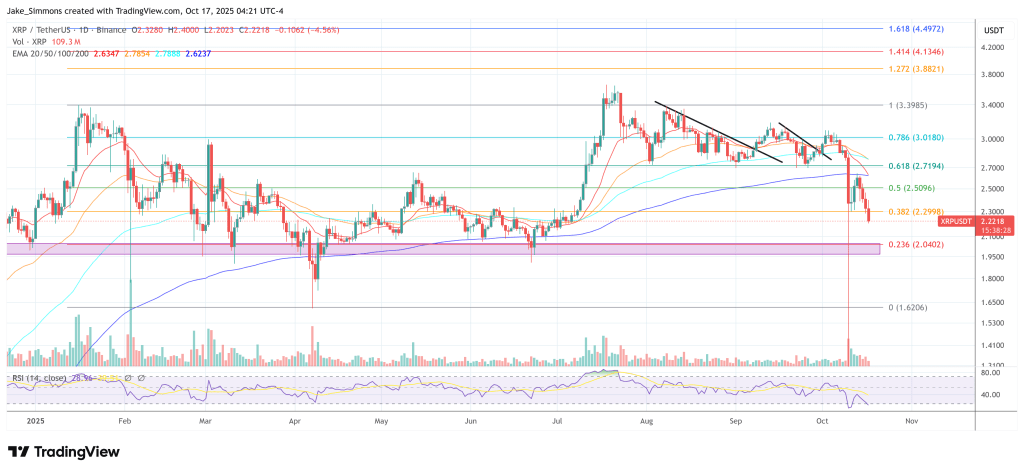
At press time, XRP traded at $2.22.
XRP price
XRP drops below the 0.382 Fib, 1-day chart | Source: XRPUSDT on TradingView.com
Featured image created with DALL.E, chart from TradingView.com
Editorial Process for bitcoinist is centered on delivering thoroughly researched, accurate, and unbiased content. We uphold strict sourcing standards, and each page undergoes diligent review by our team of top technology experts and seasoned editors. This process ensures the integrity, relevance, and value of our content for our readers.

Jake Simmons has been a Bitcoin enthusiast since 2016. Ever since he heard about Bitcoin, he has been studying the topic every day and trying to share his knowledge with others. His goal is to contribute to Bitcoin's financial revolution, which will replace the fiat money system. Besides BTC and crypto, Jake studied Business Informatics at a university. After graduation in 2017, he has been working in the blockchain and crypto sector. You can follow Jake on Twitter at @realJakeSimmons.

Похожее

Top Audit Guru Alerts: All DeFi is Unsafe, Withdraw Now!

Leading DeFi security auditor and OpenZeppelin founder Manuel Aráoz has issued a stark warning, declaring all DeFi protocols unsafe and advising the withdrawal of funds, even from established platforms like Aave and MakerDAO. This warning stems from the rapidly growing threat posed by AI-powered hacking tools. Aráoz highlights that AI agents can now identify and exploit smart contract vulnerabilities in minutes, a task that previously took expert teams weeks. This creates a critical asymmetry: defenders must patch every flaw, while attackers need only find one. Recent months have seen a surge in high-profile exploits, with billions lost in April and May alone across protocols like Drift Protocol, Kelp DAO, and THORChain. The acceleration is attributed to AI's ability to perform rapid code scanning, generate automated attack scripts, and even orchestrate social engineering and infrastructure attacks faster than human defenders can respond. The article cites Anthropic's powerful new AI model, Mythos, which demonstrated such proficiency in finding zero-day vulnerabilities that its public release was delayed over security concerns. This evolution fundamentally disrupts DeFi's risk-reward calculus. With yields on reliable protocols falling to single digits, users now face the potential of 100% capital loss for minimal returns. Aráoz's conclusion is that for most users, withdrawing funds to secure wallets is the most rational risk-management choice in the current landscape.

Odaily星球日报5 мин. назад

Top Audit Guru Alerts: All DeFi is Unsafe, Withdraw Now!

Odaily星球日报5 мин. назад

Behind Changxin Technology, Stands a Group of A-Share Companies

Changxin Technology, a leading Chinese DRAM (Dynamic Random Access Memory) manufacturer, has passed the review by the STAR Market listing committee, moving closer to an IPO. The company, seeking to raise 29.5 billion yuan, is the first to utilize the new "pre-review mechanism" on the STAR Market, expediting its approval process within five months. As China's largest and most technologically advanced integrated DRAM company, Changxin has achieved mass production of mainstream DDR5 and LPDDR5X products. It holds the fourth-largest global market share and ranks first in China, though it still trails behind industry leaders Samsung, SK Hynix, and Micron in areas like HBM technology. The company reported its first annual profit in 2025, with net profit surging to 24.762 billion yuan in Q1 2026, driven by booming AI-related demand. The IPO has drawn significant market attention due to Changxin's extensive and prestigious shareholder base. This includes state-backed funds like the National Integrated Circuit Industry Investment Fund II, industrial partner GigaDevice, internet giants (Xiaomi, Alibaba, Tencent), and several securities firms and A-share listed companies such as InfoMotion, Shangfeng Cement, and Hefei Urban Construction, which stand to benefit from the listing. The company's founder, Zhu Yiming, a pivotal figure in China's semiconductor industry who also founded GigaDevice, has committed to an unprecedented long-term lock-up of his shares and a massive personal equity incentive plan worth an estimated over 20 billion yuan for employees, excluding himself, upon listing.

marsbit37 мин. назад

Behind Changxin Technology, Stands a Group of A-Share Companies

marsbit37 мин. назад

When Vitalik Stops Blogging to Write Sci-Fi

Vitalik Buterin, founder of Ethereum, has announced a pause in his long-form technical blogging to instead write a science fiction novel exploring decentralized governance. The story, set in a fictional nation called Veridia, follows a member of a governance body that uses complex systems like quadratic voting, privacy-preserving audits, and AI-assisted decision-making to guide society through incentive structures rather than outright bans. This creative shift comes at a pivotal moment for the Ethereum ecosystem. The Ethereum Foundation has seen significant internal upheaval in 2026, with at least nine core contributors, including key protocol leaders, departing. Just days before his announcement, Vitalik published a statement addressing this turbulence, framing the Foundation as a "smaller ship" that will now focus on core principles like censorship resistance and security, while moving from a growth-oriented to a sustainability-focused organization. The novel's themes directly mirror Vitalik's long-standing technical interests in governance mechanisms. Community reactions are mixed: some see it as a thoughtful exploration of ideas through narrative, while others view the timing—amidst core team departures and a significant drop in ETH's price—as pointedly symbolic. The move is also interpreted as a personal transition, signaling Vitalik's evolving role from a central executive figure to one of many decentralized thought leaders within the Ethereum ecosystem.

marsbit1 ч. назад

When Vitalik Stops Blogging to Write Sci-Fi

marsbit1 ч. назад

Judgment from a Crypto VC: The Final Stop is Here, All Passengers Please Disembark

A crypto VC firm declares the end of the line: the era driven by retail speculation and crypto-native ideology is over. The future belongs to the large-scale, institutional adoption of blockchain technology, stripped of its decentralized ethos. While retail became distracted by memecoins, major institutions—banks, payment giants—entered en masse, recognizing blockchain's unparalleled efficiency for value transfer. Their goal isn't to embrace decentralization but to build proprietary, controlled networks, adopting the technology while discarding its foundational philosophy. This marks the transition from a "crypto industry" to a "digital asset economy"—a foundational layer powering mainstream finance, not a separate rebellion. Trillions in assets are poised for tokenization, but largely through traditional, regulated channels. For builders and investors, the old playbook of launching low-float, high-FDV tokens for retail speculation is dead. The new imperative is to build robust infrastructure that serves institutional needs: compliance, security, and seamless integration into existing financial systems. The real opportunity lies not in fighting this shift but in enabling it, as institutions become the primary conduit for onboarding the next billion users and tokenizing the next hundred trillion dollars in assets. The game has fundamentally changed.

marsbit1 ч. назад

Judgment from a Crypto VC: The Final Stop is Here, All Passengers Please Disembark

marsbit1 ч. назад

Торговля

Спот
Фьючерсы

Популярные статьи

Что такое XRP 2.0

XRP 2.0: Новая грань в мире криптовалют Введение в XRP 2.0 В постоянно развивающейся сфере криптовалют появляются новые проекты, стремящиеся к вниманию и внедрению. Один из таких многообещающих проектов - это XRP 2.0, новая криптовалюта, созданная для использования передовых технологий блокчейна и надежных методов шифрования. Хотя название вызывает ассоциации с XRP от Ripple, важно отметить, что XRP 2.0 функционирует независимо, сосредоточив внимание на повышении безопасности сделок, конфиденциальности и масштабируемости. Поскольку цифровая финансовая среда все больше принимает децентрализованные решения, XRP 2.0 намерена внести значимый вклад в web3 и общее расширение криптопроектов. Что такое XRP 2.0? XRP 2.0 в своей основе - это проект криптовалюты, цель которого - создать безопасную и децентрализованную экосистему цифровой валюты. Его базовая технология интегрирует сложные принципы блокчейна с современными методами шифрования. Основная цель XRP 2.0 - утвердиться как надежная и эффективная платформа, позволяющая быстро осуществлять транзакции с приоритетом на улучшенную защиту конфиденциальности для своих пользователей. Проект рекламируется как решение многих недостатков, с которыми сталкиваются существующие криптовалюты, предлагая систему, способную обрабатывать более высокий объем транзакций с улучшенной скоростью и конфиденциальностью. Эта универсальность позиционирует XRP 2.0 как значимого конкурента на рынке, переполненном различными цифровыми валютами. Кто создатель XRP 2.0? Идентичность создателя XRP 2.0 была обозначена как «Уилбур». Однако исчерпывающие данные о Уилбуре или связанном с ним проекте остаются неясными. Анонимность многих создателей криптовалют не является редким явлением в этой отрасли и часто применяется для сохранения определенной степени конфиденциальности и безопасности. Кто инвесторы XRP 2.0? <pна данный момент конкретная информация о инвестиционных фондах или организациях, поддерживающих xrp 2.0, не доступна публично. в секторе криптовалют поддержка репутабельными инвесторами может существенно повлиять на кредитоспособность и успех проекта, однако прозрачность в отношении финансовых спонсоров 2.0 еще была установлена. Как работает XRP 2.0? XRP 2.0 выделяется использованием сочетания технологий блокчейна и продвинутых алгоритмов шифрования, что обеспечивает безопасные и децентрализованные транзакции. Его инновационная структура включает уникальные функции, разработанные для повышения вовлеченности пользователей и расширения функциональности за пределами традиционных транзакций с криптовалютами. Среди этих функций XRP 2.0 интегрирует возможности с искусственным интеллектом, такие как текст в изображение и текст в речь. Эти дополнения разработаны для улучшения интерактивной работы пользователей, способствуя более широкому применению в различных секторах. Соединяя технологические достижения с дизайном, ориентированным на пользователя, XRP 2.0 стремится привлечь внимание разнообразных индивидуумов и предприятий, стремящихся интегрировать решения с криптовалютой в свои бизнес-процессы. Хронология XRP 2.0 Для понимания XRP 2.0 необходимо рассмотреть ключевые события, которые определили его путь до сих пор: 23 июля 2023 года: XRP 2.0 представлен как новый проект криптовалюты, стремящийся революционизировать возможности безопасных и децентрализованных транзакций в области блокчейна. 8 сентября 2023 года: Запуск другого проекта, XRP20, который представляет собой токен ERC-20 на блокчейне Ethereum и не имеет отношения к XRP 2.0. 13 ноября 2023 года: XRP Ledger подвергается значительному обновлению с выпуском программного обеспечения серверов rippled версии 2.0.0. Важно отметить, что это развитие не связано с проектом криптовалюты XRP 2.0. Ключевые моменты о XRP 2.0 Чтобы выделить суть XRP 2.0, возникают несколько критически важных факторов: Уникальные особенности: Включение таких функций, как основанные на ИИ текст в изображение и текст в речь, дополнительно разнообразит потенциальные приложения XRP 2.0. Технология блокчейна: Структура использует современные механизмы блокчейна и протоколы шифрования, обеспечивая безопасную и децентрализованную среду для транзакций. Масштабируемость и конфиденциальность: XRP 2.0 придает приоритет повышенным мерам защиты конфиденциальности в процессах транзакций и масштабируемости, необходимой для привлечения растущей базы пользователей. Нет связи с Ripple: Важно отметить, что, несмотря на свое название, XRP 2.0 не имеет никаких отношений или сотрудничества с XRP от Ripple, что отличает его операционные рамки и цели в экосистеме криптовалют. Заключение XRP 2.0 представляет собой амбициозное начинание в сфере криптовалют, стремясь предложить сочетание безопасности, конфиденциальности и эффективности в цифровых транзакциях. Интегрируя сложные технологии и удобные функции, проект стремится расширить горизонты того, что может достичь криптовалюта в современной цифровой экономике. Хотя анонимность его создателя и отсутствие раскрытых инвесторов могут вызвать вопросы у некоторых, акцент XRP 2.0 на передовых функциональных возможностях и децентрализации увеличивает его привлекательность на фоне все более переполненного крипто-рынка. Поскольку мир криптовалют продолжает развиваться, XRP 2.0 может еще стать ключевым игроком в расширении безопасных и масштабируемых блокчейн-решений.

198 просмотров всегоОпубликовано 2024.04.05Обновлено 2024.12.03

Что такое XRP 2.0

Неделя обучения по популярным токенам 13: запуск основной сети HIP-4 ожидается в середине 2026 года на фоне смещения фокуса рынка к масштабируемому внедрению ключевых криптоактивов, включая XRP

HIP-4 представит децентрализованные рынки прогнозов без разрешений, бинарные (исходные) контракты и опционы 0DTE.

1.2k просмотров всегоОпубликовано 2026.04.22Обновлено 2026.04.22

Неделя обучения по популярным токенам 13: запуск основной сети HIP-4 ожидается в середине 2026 года на фоне смещения фокуса рынка к масштабируемому внедрению ключевых криптоактивов, включая XRP

Обсуждения

Добро пожаловать в Сообщество HTX. Здесь вы сможете быть в курсе последних новостей о развитии платформы и получить доступ к профессиональной аналитической информации о рынке. Мнения пользователей о цене на XRP (XRP) представлены ниже.

活动图片