Greatest Bitcoin Threat? Charles Edwards Predicts Quantum Break In 2–8 Years

bitcoinistОпубликовано 2025-10-15Обновлено 2025-10-15

Введение

At TOKEN2049 Singapore, Capriole Investments founder Charles Edwards set aside his well-known Bitcoin bullishness to deliver an unambiguous warning: a...

Trusted Editorial content, reviewed by leading industry experts and seasoned editors. Ad Disclosure

At TOKEN2049 Singapore, Capriole Investments founder Charles Edwards set aside his well-known Bitcoin bullishness to deliver an unambiguous warning: a quantum “Q-Day” could arrive far sooner than most of the industry expects, with potentially existential consequences if Bitcoin’s core cryptography is not upgraded in time. “Within two to eight years, a quantum machine will break Bitcoin’s current encryption,” he told the audience, urging developers, companies and holders to treat the issue as urgent engineering, not distant theory.

Edwards framed Q-Day as the moment a sufficiently powerful quantum computer can break widely-used classical cryptography such as RSA—and, by extension, the elliptic-curve cryptography (ECC) underpinning Bitcoin’s public-private key model. “Q-day is the day in which a quantum machine will break classic encryption,” he said, adding that once that threshold is crossed, anything protected by those primitives—from financial networks to “sensitive data” and “of course Bitcoin”—is at risk. He asserted that Bitcoin’s ECC would likely fall sooner than RSA when the industry approaches that breakpoint.

Quantum Computing Could Break Bitcoin Within 8 Years

Pushing back on the common refrain that practical quantum attacks are decades away, Edwards argued the timeline has materially compressed, citing both rapid technical progress and a collective incentive among states and large firms to accelerate. “Even quantum years away. If you ask ChatGPT or Grok, it’ll tell you 10, 20, 30 years away. It’s rubbish,” he said. He pointed to quantum computer access already available via major cloud providers—AWS, Google and Azure—and its use cases in “drug discovery, defense, [and] optimizing bond yields,” presenting these as markers of real-world traction rather than laboratory demos.

Edwards anchored his 2–8 year forecast to a convergence of views he described as independent and sober. He referenced security specialist Jameson Lopp as assigning “50% risk in four to nine years,” a “math PhD doctor specializing in quantum” at “2 to six years for Bitcoin,” and McKinsey’s estimate for RSA-level Q-Day in “2 to 10 years,” reiterating his belief that “Bitcoin breaks years earlier than that.”

He also drew attention to a 2017 “Bitcoin quantum paper” that, in his reading, suggests “you only need 2,300 qubits—logical qubits—to break Bitcoin’s ECC,” noting its authorship by researchers affiliated with Microsoft, IonQ and Meta. While those numbers and affiliations were presented as evidence, his central message was less about any single study and more about the overall direction of travel: a multilateral “quantum arms race” that he said has already attracted “$55 billion” in commitments, with China “spending double the US.”

In Edwards’ telling, technological trendlines are compounding that investment wave. He described qubit growth as “basically a straight line in a log chart,” claiming it is “progressing faster than Moore’s law,” and likened today’s skepticism to the disbelief many held about AI adoption in 2021—right before chatbots went mainstream.

“Imagine 2021 and thinking about AI… You thought it was years away. So ChatGPT happened. I think we’re in a similar moment with quantum. It’s ignored today, but it’s coming.” He also highlighted a perceived shift in sentiment from Nvidia’s Jensen Huang, saying that after downplaying quantum timelines early in the year, Huang later called quantum at “an inflection point” and has been “spending billions buying quantum companies.” For Edwards, the takeaway is simple: “As always, follow the money.”

The operational risks Edwards outlined for Bitcoin were concrete and immediate. If adversaries can derive private keys from public keys exposed on-chain, coins sitting at addresses that have previously revealed public keys become vulnerable to theft. That set includes long-dormant “lost” coins and, potentially, some portion of Satoshi-era holdings.

“Satoshi’s coins will probably be market dumped,” he said starkly, not because their owner would necessarily act, but because the associated keys could be computed and the UTXOs swept once Q-Day arrives.

He contrasted dormant addresses with actively maintained wallets, arguing that modern key management and timely migration would reduce exposure: “We want to keep active wallets… it’s good to maintain security upgrades and relevancy of the tech through time.” He referenced Michael Saylor’s recent remark about doing “something ethically proper and burn[ing] his coins,” using it to underscore an inversion in perceived safety: “Actually burnt—the lost coins—the highest risk because no one has maintained that infrastructure.”

Beyond the cryptographic break itself, Edwards emphasized the logistical constraints of any industry-wide upgrade. Bitcoin can only process so many transactions per day, meaning a migration to quantum-safe addresses cannot be done overnight. “We have long lead times to upgrade Bitcoin,” he said.

“For Bitcoin itself it takes at least a month if you ignore all other transactions on the network to simply move everyone across to new wallets… so we’re looking at at least basically 6 to 12 months to fix this.” On that basis, he argued work on a concrete migration path cannot wait: “We need to be solving this really next year—2026—in order to get a solution before 2027.”

Edwards pointed to ongoing technical efforts as a starting point rather than a finished plan. “There’s solutions to protect crypto… There’s a few BIPs for example like this one… by Jameson Lopp. So there are solutions. We can solve this but there is an urgency to it.”

He called on developers to evaluate proposals for quantum-resistant schemes and on the broader community to “get talking to [the] community, your social media, get involved in the Bitcoin improvement proposals. Review them, give feedback, just get talking.” The subtext was that governance friction—social consensus, client implementation, wallet support, exchange coordination—becomes the gating factor once a candidate scheme is chosen, and that delay is itself a security risk if adversaries are on a clock of their own.

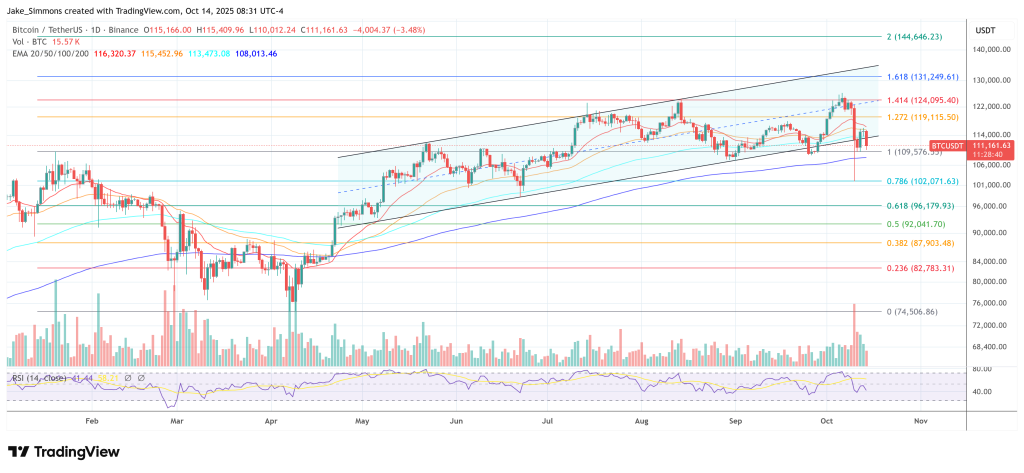
At press time, Bitcoin traded at $111,161.
Bitcoin price
Bitcoin drops below the channel again, 1-day chart | Source: BTCUSDT on TradingView.com
Featured image created with DALL.E, chart from TradingView.com
Editorial Process for bitcoinist is centered on delivering thoroughly researched, accurate, and unbiased content. We uphold strict sourcing standards, and each page undergoes diligent review by our team of top technology experts and seasoned editors. This process ensures the integrity, relevance, and value of our content for our readers.

Jake Simmons has been a Bitcoin enthusiast since 2016. Ever since he heard about Bitcoin, he has been studying the topic every day and trying to share his knowledge with others. His goal is to contribute to Bitcoin's financial revolution, which will replace the fiat money system. Besides BTC and crypto, Jake studied Business Informatics at a university. After graduation in 2017, he has been working in the blockchain and crypto sector. You can follow Jake on Twitter at @realJakeSimmons.

Похожее

Apple Re-invented Image Compression with AI: Same Quality, One-Third the File Size

Apple’s PICO: An AI-Powered Image Codec That Cuts File Size by Two-Thirds at Equal Perceived Quality In 2025, JPEG AI became the first international standard for learned image compression. However, it, like most codecs, still prioritizes mathematical metrics like PSNR over true perceptual quality—what the human eye finds pleasing. Apple researchers have introduced PICO (Perceptual Image Codec), a neural codec designed to optimize for human perception. It tackles key practical challenges: 1) Speed: A novel "one-shot context model" accelerates entropy encoding without sacrificing compression efficiency. 2) Artifacts: A dedicated TextFidelity loss preserves text clarity, and a TilingArtifact loss eliminates color seams between image tiles processed in parallel. 3) Control: It avoids the "hallucinations" common in GAN-based perceptual models. In a large-scale human evaluation (74,925 comparisons), PICO achieved the same perceived quality as standards like AV1, VVC, and JPEG AI while using only 30-43% of the bitrate. It also outperforms other learned perceptual codecs by 20-40%. Remarkably, it runs in 230ms (encode) and 150ms (decode) on an iPhone 17 Pro Max. While less efficient on synthetic graphics, PICO represents a significant shift from optimizing mathematical scores to directly targeting human visual experience, making high-quality perceptual compression practical for consumer devices. The work builds on expertise from WaveOne, whose team joined Apple and previously advanced neural video compression.

marsbit1 мин. назад

Apple Re-invented Image Compression with AI: Same Quality, One-Third the File Size

marsbit1 мин. назад

Shanghai's Leading Large Model Company Initiates A-Share Listing

Shanghai-based AI large language model leader MiniMax has initiated the process for an A-share listing in China, having filed a pre-IPO tutoring report with the Shanghai Securities Regulatory Bureau on May 29. This move positions it to compete with Zhipu AI for the title of the first major domestic LLM company to list on the A-share market. Having already completed an IPO in Hong Kong in January 2026, MiniMax's stock price has surged approximately 409% since its debut, with its market capitalization reaching around HK$263.45 billion (approximately RMB 227.55 billion) as of May 29. The company's rapid growth is supported by strong business performance. Its Annual Recurring Revenue (ARR) has grown over 100% in the past two months and now exceeds $300 million. It serves over one million global enterprise and developer clients and has around 300 million users worldwide. For the full year 2025, MiniMax reported revenue of $79.038 million, with a gross margin of 25.4%. While it reported an adjusted net loss of $250 million, the loss rate has narrowed significantly year-over-year. On the product front, MiniMax has released several flagship models this year, including MiniMax-M2.5, M2.6, and M2.7, with the first and last being open-sourced. Its models gained significant traction earlier in the year, briefly becoming the top model provider by usage share on the OpenRouter platform in February. The company has also upgraded its AI agent product, now named Mavis, and is preparing to launch its next-generation MiniMax-M3 model. Technical previews indicate M3 will feature a novel "MiniMax Sparse Attention" mechanism, promising substantial improvements in inference speed. MiniMax's push for an A-share listing reflects a broader trend among China's leading AI firms, including Zhipu AI, Moonshot AI, StepFun, and 01.AI, to seek public listings. This strategy aims to secure broader financing channels to support the immense computational costs and ongoing commercialization efforts inherent in developing advanced large language models.

marsbit3 мин. назад

Shanghai's Leading Large Model Company Initiates A-Share Listing

marsbit3 мин. назад

Торговля

Спот
Фьючерсы

Популярные статьи

Тест по Bitcoin Биткоина

HTX Learn: Изучите Bitcoin halving и Заработаете Токены USDT

3.0k просмотров всегоОпубликовано 2024.04.16Обновлено 2024.04.16

Тест по Bitcoin  Биткоина

Что такое $BITCOIN

ЦИФРОВОЕ ЗОЛОТО ($BITCOIN): Комплексный анализ Введение в ЦИФРОВОЕ ЗОЛОТО ($BITCOIN) ЦИФРОВОЕ ЗОЛОТО ($BITCOIN) — это проект на основе блокчейна, работающий в сети Solana, который стремится объединить характеристики традиционных драгоценных металлов с инновациями децентрализованных технологий. Хотя он носит имя Биткойн, часто называемого “цифровым золотом” из-за его восприятия как средства хранения ценности, ЦИФРОВОЕ ЗОЛОТО является отдельным токеном, предназначенным для создания уникальной экосистемы в ландшафте Web3. Его цель — позиционировать себя как жизнеспособный альтернативный цифровой актив, хотя детали его применения и функциональности все еще развиваются. Что такое ЦИФРОВОЕ ЗОЛОТО ($BITCOIN)? ЦИФРОВОЕ ЗОЛОТО ($BITCOIN) — это токен криптовалюты, специально разработанный для использования в блокчейне Solana. В отличие от Биткойна, который выполняет широко признанную роль хранения ценности, этот токен, похоже, сосредоточен на более широких приложениях и характеристиках. Примечательные аспекты включают: Инфраструктура блокчейна: Токен построен на блокчейне Solana, известном своей способностью обрабатывать высокоскоростные и недорогие транзакции. Динамика предложения: ЦИФРОВОЕ ЗОЛОТО имеет максимальное предложение, ограниченное 100 квадриллионами токенов (100P $BITCOIN), хотя детали о его обращающемся предложении в настоящее время не раскрыты. Утилита: Хотя точные функциональные возможности не описаны, есть указания на то, что токен может быть использован для различных приложений, потенциально связанных с децентрализованными приложениями (dApps) или стратегиями токенизации активов. Кто создатель ЦИФРОВОГО ЗОЛОТА ($BITCOIN)? На данный момент личность создателей и команды разработчиков, стоящих за ЦИФРОВЫМ ЗОЛОТОМ ($BITCOIN), остается неизвестной. Эта ситуация типична для многих инновационных проектов в области блокчейна, особенно тех, которые связаны с децентрализованными финансами и феноменом мем-криптовалют. Хотя такая анонимность может способствовать культуре, ориентированной на сообщество, она усиливает опасения по поводу управления и ответственности. Кто инвесторы ЦИФРОВОГО ЗОЛОТА ($BITCOIN)? Доступная информация указывает на то, что у ЦИФРОВОГО ЗОЛОТА ($BITCOIN) нет известных институциональных спонсоров или значительных венчурных капиталовложений. Проект, похоже, функционирует по модели пирингового взаимодействия, сосредоточенной на поддержке и принятии сообществом, а не на традиционных путях финансирования. Его активность и ликвидность в основном сосредоточены на децентрализованных биржах (DEX), таких как PumpSwap, а не на устоявшихся централизованных торговых платформах, что еще больше подчеркивает его подход, ориентированный на grassroots. Как работает ЦИФРОВОЕ ЗОЛОТО ($BITCOIN) Операционные механизмы ЦИФРОВОГО ЗОЛОТА ($BITCOIN) можно подробно описать на основе его дизайна блокчейна и характеристик сети: Механизм консенсуса: Используя уникальный механизм доказательства истории (PoH) Solana в сочетании с моделью доказательства доли (PoS), проект обеспечивает эффективную валидацию транзакций, что способствует высокой производительности сети. Токеномика: Хотя конкретные дефляционные механизмы не были подробно описаны, большое максимальное предложение токенов подразумевает, что оно может быть предназначено для микротранзакций или нишевых случаев использования, которые еще предстоит определить. Интероперабельность: Существует потенциал для интеграции с более широкой экосистемой Solana, включая различные платформы децентрализованных финансов (DeFi). Однако детали относительно конкретных интеграций остаются неуточненными. Хронология ключевых событий Вот хронология, которая подчеркивает значимые вехи, касающиеся ЦИФРОВОГО ЗОЛОТА ($BITCOIN): 2023: Первоначальное развертывание токена происходит в блокчейне Solana, отмеченное его адресом контракта. 2024: ЦИФРОВОЕ ЗОЛОТО приобретает видимость, когда оно становится доступным для торговли на децентрализованных биржах, таких как PumpSwap, позволяя пользователям обменивать его на SOL. 2025: Проект наблюдает спорадическую торговую активность и потенциальный интерес к инициативам, возглавляемым сообществом, хотя на данный момент не зафиксировано никаких значительных партнерств или технических достижений. Критический анализ Сильные стороны Масштабируемость: Основная инфраструктура Solana поддерживает высокие объемы транзакций, что может повысить полезность $BITCOIN в различных сценариях транзакций. Доступность: Потенциально низкая цена торговли за токен может привлечь розничных инвесторов, способствуя более широкому участию благодаря возможностям дробного владения. Риски Отсутствие прозрачности: Отсутствие публично известных спонсоров, разработчиков или процесса аудита может вызвать скептицизм относительно устойчивости и надежности проекта. Волатильность рынка: Торговая активность сильно зависит от спекулятивного поведения, что может привести к значительной волатильности цен и неопределенности для инвесторов. Заключение ЦИФРОВОЕ ЗОЛОТО ($BITCOIN) является интригующим, но неоднозначным проектом в быстро развивающейся экосистеме Solana. Хотя он пытается использовать нарратив “цифрового золота”, его отход от установленной роли Биткойна как средства хранения ценности подчеркивает необходимость более четкого различения его предполагаемой утилиты и структуры управления. Будущее принятие и усвоение, вероятно, будут зависеть от решения текущей непрозрачности и более четкого определения его операционных и экономических стратегий. Примечание: Этот отчет охватывает синтезированную информацию, доступную на октябрь 2023 года, и с тех пор могут произойти события.

99 просмотров всегоОпубликовано 2025.05.13Обновлено 2025.05.13

Что такое $BITCOIN

Fractal Bitcoin: масштабирование Биткоина с помощью рекурсивной системы

Fractal Bitcoin — масштабное Layer-1-решнение, созданное на базе кода Биткоина, позволяющего достигать бесконечного масштабирования с помощью рекурсивного подхода.

2.3k просмотров всегоОпубликовано 2025.06.30Обновлено 2025.06.30

Fractal Bitcoin: масштабирование Биткоина с помощью рекурсивной системы

Обсуждения

Добро пожаловать в Сообщество HTX. Здесь вы сможете быть в курсе последних новостей о развитии платформы и получить доступ к профессиональной аналитической информации о рынке. Мнения пользователей о цене на BTC (BTC) представлены ниже.

活动图片