Here’s How Much Bitcoin, Ethereum, And XRP Institutions Bought Last Week

bitcoinistОпубликовано 2025-10-14Обновлено 2025-10-14

Введение

Institutional investors bought more Bitcoin, Ethereum, and XRP last week, with crypto funds recording another week of net inflows. This...

Trusted Editorial content, reviewed by leading industry experts and seasoned editors. Ad Disclosure

Institutional investors bought more Bitcoin, Ethereum, and XRP last week, with crypto funds recording another week of net inflows. This provides a bullish outlook for these crypto assets, especially as they look to bounce from last week’s crash.

Institutional Investors Accumulate Bitcoin, Ethereum, and XRP

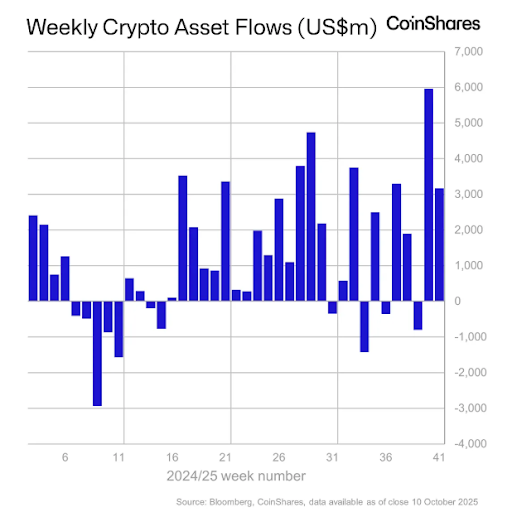
CoinShares’ report revealed that Bitcoin, Ethereum, and XRP saw net inflows of $2.67 billion, $338 million, and $61.6 million, respectively. This came as crypto funds recorded $3.17 billion in inflows last week, bringing their year-to-date (YTD) inflows to $48.7 billion. Specifically, BTC, ETH, and XRP now have YTD inflows of $30.2 billion, $13.9 billion, and $1.8 billion, respectively. 

Meanwhile, the increased inflows into Bitcoin and Ethereum over XRP last week mark a turnaround, as these institutions at some point accumulated more XRP than the top two cryptos by market cap. This was the case two weeks ago when XRP saw a net inflow of $93.1 million while BTC and ETH recorded outflows of $719 million and $409.4 million, respectively. 
Bitcoin
Source: Chart from CoinShares

The net inflows into Bitcoin, Ethereum, and XRP last week came despite the crypto market crash triggered by Donald Trump’s announcement of 100% tariffs on China. CoinShares revealed that there was little reaction to the development, as crypto funds saw about $159 million in outflows on Friday when Trump announced it. 

CoinShares also noted that, despite the hype around upcoming XRP ETF launches, inflows into XRP funds have slowed, as institutional investors pay more attention to Bitcoin and Ethereum. Notably, BTC and ETH have seen more inflows since the U.S. government shutdown began. Institutional investors are believed to be moving into Bitcoin, especially as a safety net amid macro uncertainty, a trade which has been described as the ‘debasement trade.’ 

The increased inflows into the Bitcoin funds were one of the factors that contributed to a rally to a new all-time high (ATH) above $126,000 earlier this month. However, BTC has since lost all these gains thanks to the tariff announcement last week. 

BTC and ETH Start This Week With Outflows

SoSoValue data shows that the Bitcoin and Ethereum ETFs have started this week with outflows, possibly stemming from last week’s tariff announcement. The BTC ETFs recorded $326.52 million in daily net outflows on October 13. BlackRock was the only fund issuer that recorded inflows on the day, taking in $60.36 million. 

Meanwhile, the ETH ETFs recorded daily net outflows of $428.52 million. BlackRock’s ETH fund recorded the largest outflows, with $310.13 million flowing out of the fund. Other funds also recorded outflows or zero flows. If the trend sustains, it could present a setback for these crypto assets as they look to bounce from last week’s market crash.

Bitcoin
BTC trading at $111,700 on the 1D chart | Source: BTCUSDT on Tradingview.com
Featured image from iStock, chart from Tradingview.com
Editorial Process for bitcoinist is centered on delivering thoroughly researched, accurate, and unbiased content. We uphold strict sourcing standards, and each page undergoes diligent review by our team of top technology experts and seasoned editors. This process ensures the integrity, relevance, and value of our content for our readers.

Scott Matherson is a leading crypto writer at Bitcoinist, who possesses a sharp analytical mind and a deep understanding of the digital currency landscape. Scott has earned a reputation for delivering thought-provoking and well-researched articles that resonate with both newcomers and seasoned crypto enthusiasts. Outside of his writing, Scott is passionate about promoting crypto literacy and often works to educate the public on the potential of blockchain.

Похожее

Investment Philosophy of Gavin Baker, an Early Nvidia Investor: Long AI Infrastructure Bottlenecks, Short Overall Market Risk

Gavin Baker, an early investor in Nvidia and founder of Atreides Management, outlines his investment philosophy: going long on AI infrastructure bottlenecks while hedging against broader market risk. He argues AI is not a bubble but a supercycle driven by constraints in power, wafers (semiconductors), and compute efficiency (tokens per watt). True alpha, he believes, lies not in application-layer companies like OpenAI but in "picks and shovels" providers—companies solving physical bottlenecks in GPU connectivity (e.g., Astera Labs), memory (Micron), inference chips (Cerebras, Positron), advanced manufacturing (TSMC, ASML), and energy supply. His portfolio reflects this barbell strategy: concentrated bets on key infrastructure players alongside a significant put position on the QQQ ETF to hedge overall market downside. Baker contends this cycle differs from the dot-com bubble because demand is fueled by the strong balance sheets of hyperscalers (Google, Meta, Amazon, Microsoft), not debt, and physical supply constraints (e.g., chip manufacturing capacity) prevent runaway overinvestment. He highlights the growing importance of inference (vs. pre-training), vertical/small language models, sovereign infrastructure deployment speed, and the convergence of energy and space (e.g., orbital compute). His long-term view is that performance-per-watt and token cost reduction will dictate winners as AI scaling hits fundamental physical limits.

marsbit24 мин. назад

Investment Philosophy of Gavin Baker, an Early Nvidia Investor: Long AI Infrastructure Bottlenecks, Short Overall Market Risk

marsbit24 мин. назад

Apple Re-invented Image Compression with AI: Same Quality, One-Third the File Size

Apple’s PICO: An AI-Powered Image Codec That Cuts File Size by Two-Thirds at Equal Perceived Quality In 2025, JPEG AI became the first international standard for learned image compression. However, it, like most codecs, still prioritizes mathematical metrics like PSNR over true perceptual quality—what the human eye finds pleasing. Apple researchers have introduced PICO (Perceptual Image Codec), a neural codec designed to optimize for human perception. It tackles key practical challenges: 1) Speed: A novel "one-shot context model" accelerates entropy encoding without sacrificing compression efficiency. 2) Artifacts: A dedicated TextFidelity loss preserves text clarity, and a TilingArtifact loss eliminates color seams between image tiles processed in parallel. 3) Control: It avoids the "hallucinations" common in GAN-based perceptual models. In a large-scale human evaluation (74,925 comparisons), PICO achieved the same perceived quality as standards like AV1, VVC, and JPEG AI while using only 30-43% of the bitrate. It also outperforms other learned perceptual codecs by 20-40%. Remarkably, it runs in 230ms (encode) and 150ms (decode) on an iPhone 17 Pro Max. While less efficient on synthetic graphics, PICO represents a significant shift from optimizing mathematical scores to directly targeting human visual experience, making high-quality perceptual compression practical for consumer devices. The work builds on expertise from WaveOne, whose team joined Apple and previously advanced neural video compression.

marsbit59 мин. назад

Apple Re-invented Image Compression with AI: Same Quality, One-Third the File Size

marsbit59 мин. назад

Shanghai's Leading Large Model Company Initiates A-Share Listing

Shanghai-based AI large language model leader MiniMax has initiated the process for an A-share listing in China, having filed a pre-IPO tutoring report with the Shanghai Securities Regulatory Bureau on May 29. This move positions it to compete with Zhipu AI for the title of the first major domestic LLM company to list on the A-share market. Having already completed an IPO in Hong Kong in January 2026, MiniMax's stock price has surged approximately 409% since its debut, with its market capitalization reaching around HK$263.45 billion (approximately RMB 227.55 billion) as of May 29. The company's rapid growth is supported by strong business performance. Its Annual Recurring Revenue (ARR) has grown over 100% in the past two months and now exceeds $300 million. It serves over one million global enterprise and developer clients and has around 300 million users worldwide. For the full year 2025, MiniMax reported revenue of $79.038 million, with a gross margin of 25.4%. While it reported an adjusted net loss of $250 million, the loss rate has narrowed significantly year-over-year. On the product front, MiniMax has released several flagship models this year, including MiniMax-M2.5, M2.6, and M2.7, with the first and last being open-sourced. Its models gained significant traction earlier in the year, briefly becoming the top model provider by usage share on the OpenRouter platform in February. The company has also upgraded its AI agent product, now named Mavis, and is preparing to launch its next-generation MiniMax-M3 model. Technical previews indicate M3 will feature a novel "MiniMax Sparse Attention" mechanism, promising substantial improvements in inference speed. MiniMax's push for an A-share listing reflects a broader trend among China's leading AI firms, including Zhipu AI, Moonshot AI, StepFun, and 01.AI, to seek public listings. This strategy aims to secure broader financing channels to support the immense computational costs and ongoing commercialization efforts inherent in developing advanced large language models.

marsbit1 ч. назад

Shanghai's Leading Large Model Company Initiates A-Share Listing

marsbit1 ч. назад

Торговля

Спот
Фьючерсы

Популярные статьи

Тест по Bitcoin Биткоина

HTX Learn: Изучите Bitcoin halving и Заработаете Токены USDT

3.0k просмотров всегоОпубликовано 2024.04.16Обновлено 2024.04.16

Тест по Bitcoin  Биткоина

Что такое $BITCOIN

ЦИФРОВОЕ ЗОЛОТО ($BITCOIN): Комплексный анализ Введение в ЦИФРОВОЕ ЗОЛОТО ($BITCOIN) ЦИФРОВОЕ ЗОЛОТО ($BITCOIN) — это проект на основе блокчейна, работающий в сети Solana, который стремится объединить характеристики традиционных драгоценных металлов с инновациями децентрализованных технологий. Хотя он носит имя Биткойн, часто называемого “цифровым золотом” из-за его восприятия как средства хранения ценности, ЦИФРОВОЕ ЗОЛОТО является отдельным токеном, предназначенным для создания уникальной экосистемы в ландшафте Web3. Его цель — позиционировать себя как жизнеспособный альтернативный цифровой актив, хотя детали его применения и функциональности все еще развиваются. Что такое ЦИФРОВОЕ ЗОЛОТО ($BITCOIN)? ЦИФРОВОЕ ЗОЛОТО ($BITCOIN) — это токен криптовалюты, специально разработанный для использования в блокчейне Solana. В отличие от Биткойна, который выполняет широко признанную роль хранения ценности, этот токен, похоже, сосредоточен на более широких приложениях и характеристиках. Примечательные аспекты включают: Инфраструктура блокчейна: Токен построен на блокчейне Solana, известном своей способностью обрабатывать высокоскоростные и недорогие транзакции. Динамика предложения: ЦИФРОВОЕ ЗОЛОТО имеет максимальное предложение, ограниченное 100 квадриллионами токенов (100P $BITCOIN), хотя детали о его обращающемся предложении в настоящее время не раскрыты. Утилита: Хотя точные функциональные возможности не описаны, есть указания на то, что токен может быть использован для различных приложений, потенциально связанных с децентрализованными приложениями (dApps) или стратегиями токенизации активов. Кто создатель ЦИФРОВОГО ЗОЛОТА ($BITCOIN)? На данный момент личность создателей и команды разработчиков, стоящих за ЦИФРОВЫМ ЗОЛОТОМ ($BITCOIN), остается неизвестной. Эта ситуация типична для многих инновационных проектов в области блокчейна, особенно тех, которые связаны с децентрализованными финансами и феноменом мем-криптовалют. Хотя такая анонимность может способствовать культуре, ориентированной на сообщество, она усиливает опасения по поводу управления и ответственности. Кто инвесторы ЦИФРОВОГО ЗОЛОТА ($BITCOIN)? Доступная информация указывает на то, что у ЦИФРОВОГО ЗОЛОТА ($BITCOIN) нет известных институциональных спонсоров или значительных венчурных капиталовложений. Проект, похоже, функционирует по модели пирингового взаимодействия, сосредоточенной на поддержке и принятии сообществом, а не на традиционных путях финансирования. Его активность и ликвидность в основном сосредоточены на децентрализованных биржах (DEX), таких как PumpSwap, а не на устоявшихся централизованных торговых платформах, что еще больше подчеркивает его подход, ориентированный на grassroots. Как работает ЦИФРОВОЕ ЗОЛОТО ($BITCOIN) Операционные механизмы ЦИФРОВОГО ЗОЛОТА ($BITCOIN) можно подробно описать на основе его дизайна блокчейна и характеристик сети: Механизм консенсуса: Используя уникальный механизм доказательства истории (PoH) Solana в сочетании с моделью доказательства доли (PoS), проект обеспечивает эффективную валидацию транзакций, что способствует высокой производительности сети. Токеномика: Хотя конкретные дефляционные механизмы не были подробно описаны, большое максимальное предложение токенов подразумевает, что оно может быть предназначено для микротранзакций или нишевых случаев использования, которые еще предстоит определить. Интероперабельность: Существует потенциал для интеграции с более широкой экосистемой Solana, включая различные платформы децентрализованных финансов (DeFi). Однако детали относительно конкретных интеграций остаются неуточненными. Хронология ключевых событий Вот хронология, которая подчеркивает значимые вехи, касающиеся ЦИФРОВОГО ЗОЛОТА ($BITCOIN): 2023: Первоначальное развертывание токена происходит в блокчейне Solana, отмеченное его адресом контракта. 2024: ЦИФРОВОЕ ЗОЛОТО приобретает видимость, когда оно становится доступным для торговли на децентрализованных биржах, таких как PumpSwap, позволяя пользователям обменивать его на SOL. 2025: Проект наблюдает спорадическую торговую активность и потенциальный интерес к инициативам, возглавляемым сообществом, хотя на данный момент не зафиксировано никаких значительных партнерств или технических достижений. Критический анализ Сильные стороны Масштабируемость: Основная инфраструктура Solana поддерживает высокие объемы транзакций, что может повысить полезность $BITCOIN в различных сценариях транзакций. Доступность: Потенциально низкая цена торговли за токен может привлечь розничных инвесторов, способствуя более широкому участию благодаря возможностям дробного владения. Риски Отсутствие прозрачности: Отсутствие публично известных спонсоров, разработчиков или процесса аудита может вызвать скептицизм относительно устойчивости и надежности проекта. Волатильность рынка: Торговая активность сильно зависит от спекулятивного поведения, что может привести к значительной волатильности цен и неопределенности для инвесторов. Заключение ЦИФРОВОЕ ЗОЛОТО ($BITCOIN) является интригующим, но неоднозначным проектом в быстро развивающейся экосистеме Solana. Хотя он пытается использовать нарратив “цифрового золота”, его отход от установленной роли Биткойна как средства хранения ценности подчеркивает необходимость более четкого различения его предполагаемой утилиты и структуры управления. Будущее принятие и усвоение, вероятно, будут зависеть от решения текущей непрозрачности и более четкого определения его операционных и экономических стратегий. Примечание: Этот отчет охватывает синтезированную информацию, доступную на октябрь 2023 года, и с тех пор могут произойти события.

99 просмотров всегоОпубликовано 2025.05.13Обновлено 2025.05.13

Что такое $BITCOIN

Fractal Bitcoin: масштабирование Биткоина с помощью рекурсивной системы

Fractal Bitcoin — масштабное Layer-1-решнение, созданное на базе кода Биткоина, позволяющего достигать бесконечного масштабирования с помощью рекурсивного подхода.

2.3k просмотров всегоОпубликовано 2025.06.30Обновлено 2025.06.30

Fractal Bitcoin: масштабирование Биткоина с помощью рекурсивной системы

Обсуждения

Добро пожаловать в Сообщество HTX. Здесь вы сможете быть в курсе последних новостей о развитии платформы и получить доступ к профессиональной аналитической информации о рынке. Мнения пользователей о цене на BTC (BTC) представлены ниже.

活动图片