SIREN sings a warning even as bulls defend local support: What’s next?

ambcryptoPublished on 2026-03-30Last updated on 2026-03-30

Abstract

AI-powered memecoin SIREN has exhibited significant volatility and bullish momentum since February, though it recently entered a corrective phase. The 3-day chart remains in a bullish trend, but the RSI is retreating from overbought levels, and trading volume has notably declined. A descending triangle pattern suggests a potential breakdown below the critical $0.78-$0.80 local support zone. If breached, this could trigger a deeper correction toward $0.70. For a sustained upward move, a high-volume breakout above $2 is necessary, but current low demand makes this unlikely. Traders are advised to wait for clearer signals, as a false breakout or further decline appears probable in the short term.

AI-powered memecoin Siren [SIREN] has been making waves among crypto traders and investors with its bullish performances recently. It has seen extreme volatility over the past week after making steady gains since February.

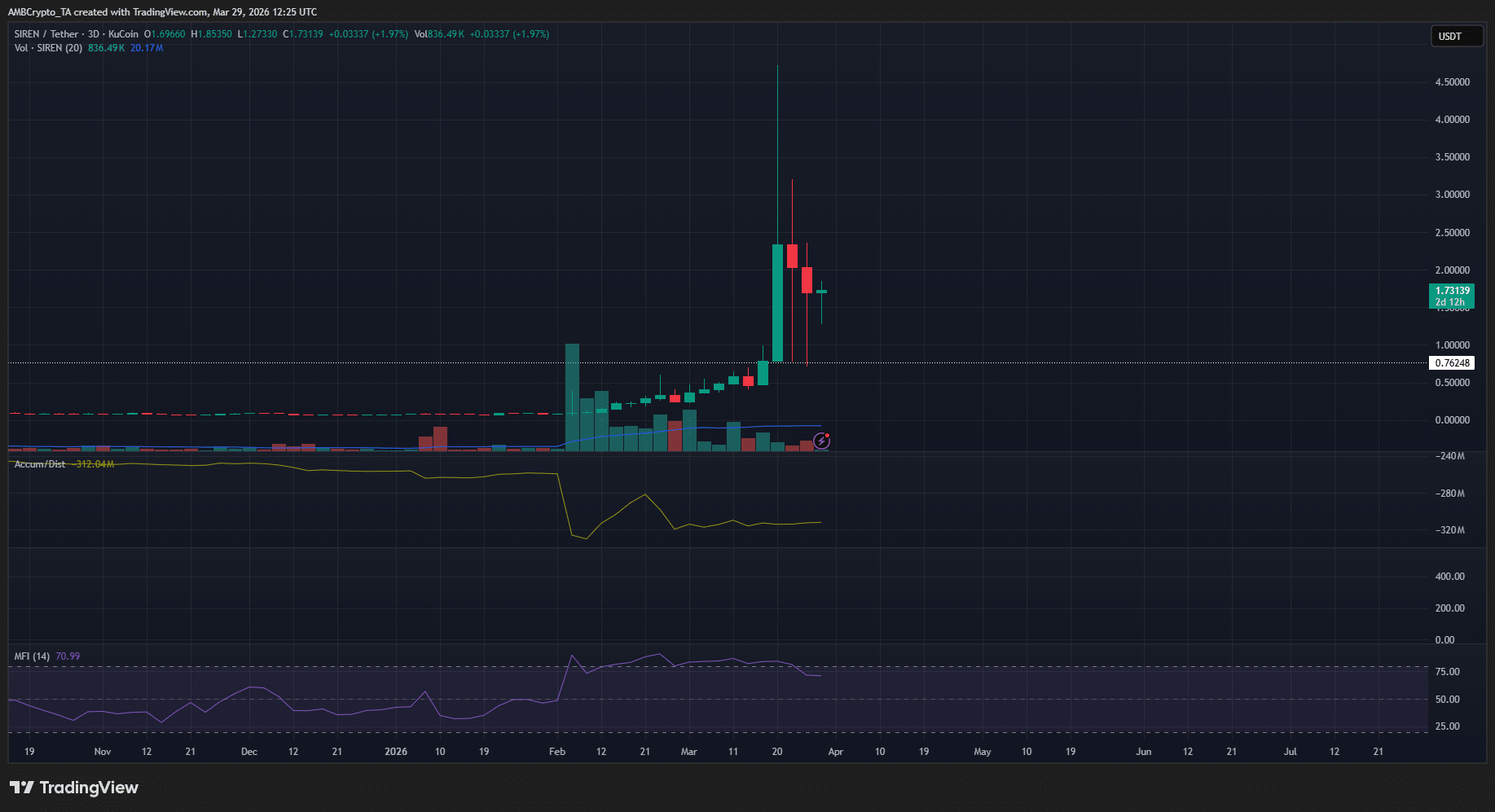
Source: SIREN/USDT on TradingView

The 3-day chart’s trend remained firmly bullish. The RSI was correcting from overbought levels, explaining the drawdown of the past few days. At the same time, the large upside candle wicks during some 3-day sessions have dragged the A/D indicator lower.

The drop-off in trading volume compared to February was striking, even more so because March saw SIREN make more gains. Any recovery would need a massive influx of trading volume and demand to sustain the next move higher.

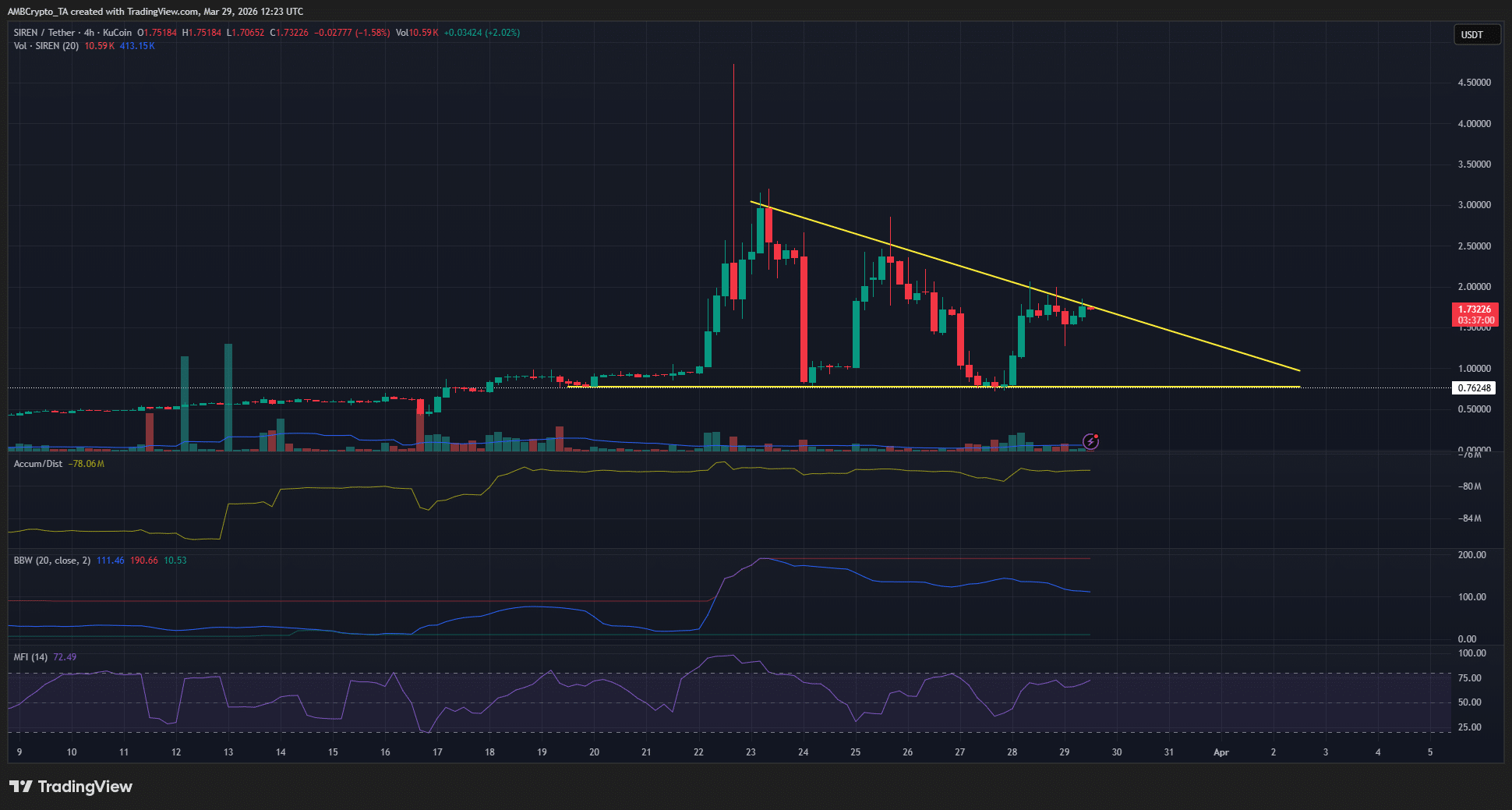
In the short term, a deeper price drop appeared likely. The coin has tested the $0.78 local support and bounced higher but has yet to end the contraction it entered over the past week. Its descending triangle chart pattern will soon see a resolution.

SIREN to test the local support once again

Source: SIREN/USDT on TradingView

The falling triangle pattern was a concern for the bulls. The $0.8 support zone has been tested multiple times in recent days. Meanwhile, each subsequent price bounce is shallower.

In other words, seller conviction remained high, and buyers were holding on. High volatility and low demand could see the $0.8 support zone breached, sending SIREN into a deeper correction.

A breakout beyond $2 is needed to convince swing traders to go long en masse.

Traders’ call to action – Wait

Source: CoinGlass

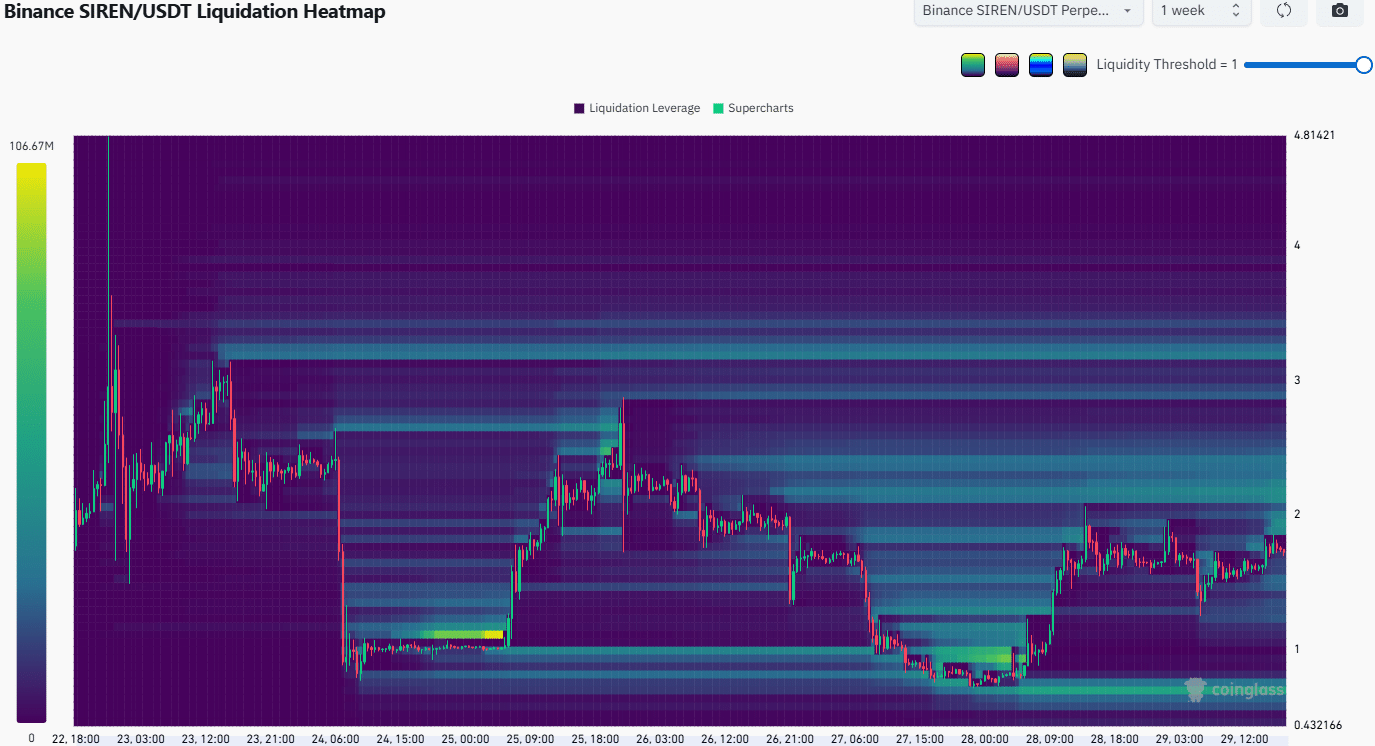
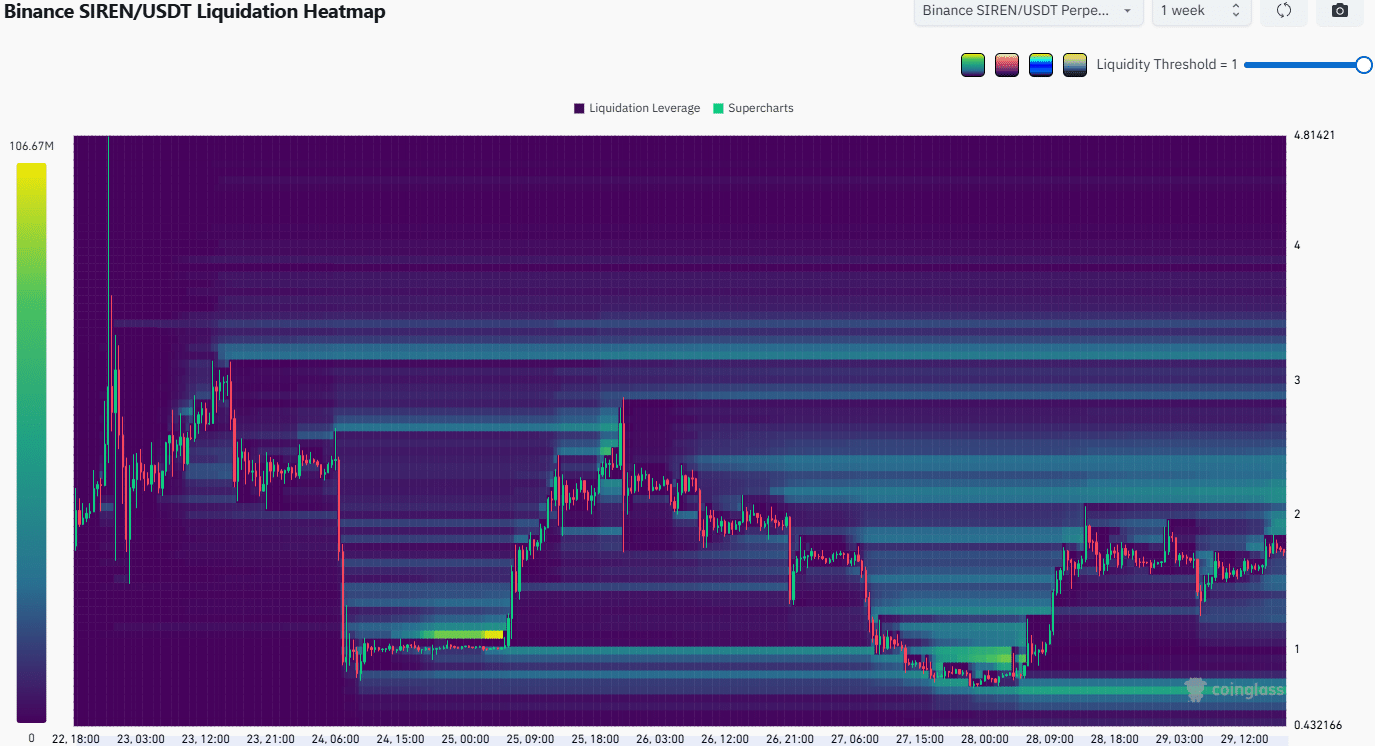
The liquidation heatmap warned of a potential liquidity sweep into the $2 area. This might look like a breakout, but it has a threat of reversing, especially if low demand conditions persist.

In this scenario, a drop to the $0.7 magnetic zone to hunt down long liquidations might commence in the coming days. Combined with the triangle pattern, a deeper price drop appears likely.

A true breakout and retest of $2, on high volume, is unlikely as things stand.


Final Summary

  • SIREN was one of the only memecoins showing bullish strength in recent weeks.
  • The descending triangle pattern was a warning to the bulls of a drop below the $0.8 local support.

Related Questions

QWhat is the current technical pattern observed in SIREN's price chart and what does it suggest?

AThe current technical pattern is a descending triangle, which suggests a potential drop below the local support level of $0.8, indicating a bearish signal for the price.

QWhat key level does SIREN need to break to convince swing traders to go long?

ASIREN needs to break out beyond the $2 level to convince swing traders to go long en masse.

QWhy is a massive influx of trading volume and demand crucial for SIREN's recovery?

AA massive influx of trading volume and demand is crucial to sustain the next move higher, as the current drop-off in volume compared to February is striking, and low demand conditions could lead to a deeper price correction.

QWhat is the potential downside target if the $0.8 support zone is breached?

AIf the $0.8 support zone is breached, SIREN could drop to the $0.7 magnetic zone to hunt down long liquidations, leading to a deeper correction.

QWhat does the liquidation heatmap warn about a potential move to the $2 area?

AThe liquidation heatmap warns that a move to the $2 area might look like a breakout but has a threat of reversing, especially if low demand conditions persist, making it a potential liquidity sweep rather than a sustainable rally.

Related Reads

Huawei Cloud Rejects Token Price War, Zhou Yuefeng Seeks a New Winning Formula for AI Cloud

At the 2026 Huawei Cloud INSPIRE Creator Conference, CEO Zhou Yuefeng outlined Huawei Cloud's distinct strategy in the competitive AI cloud market. Instead of engaging in price wars based on token volume or Maas revenue—a common focus for rivals like Alibaba Cloud and ByteDance's Volcano Engine—Huawei Cloud is shifting the competition towards real-world productivity gains. Zhou highlighted three core differentiators: a fully domestic computing stack (Ascend, Kunpeng), a focus on government and enterprise clients rather than consumer internet, and a deep commitment to open-source ecosystems. To this end, Huawei Cloud launched a suite of new products under the "Agentic Infra" paradigm, including the AICS Lingqu computing cluster, AMS memory storage, and the ModelArts Next platform. These aim to solve enterprise challenges in deploying AI agents, such as latency, memory, scheduling, and security. The strategy further involves creating specialized industry zones ("AI Dream Factories") for sectors like healthcare and embodied intelligence. For example, a smart medical zone developed with Shanghai Ruijin Hospital aims to democratize expert-level diagnostic capabilities. In essence, Huawei Cloud is positioning itself not as a commodity token provider, but as the foundational infrastructure for industrial AI, leveraging its domestic supply chain and hybrid cloud solutions to serve sectors where productivity, not just scale, is the ultimate measure of value.

marsbit59m ago

Huawei Cloud Rejects Token Price War, Zhou Yuefeng Seeks a New Winning Formula for AI Cloud

marsbit59m ago

70% of the Public Opposes AI, Americans Hope the U.S. Loses the AI War

70% of Americans believe AI development is moving too fast, with growing public resistance evolving from online criticism to real-world protests and violence. This widespread anti-AI sentiment stems from fears of job losses, rising utility costs, environmental damage, threats to democracy, and financial instability. Key incidents illustrate the backlash: Google's former CEO Eric Schmidt was loudly booed at a graduation for promoting AI; AI company ads are vandalized; protests and even violent attacks target AI firms and data centers. Polls show deep public pessimism and strong local opposition to data center construction, often surpassing resistance to nuclear power plants. The core grievances are economic and practical: AI is seen as automating jobs, concentrating wealth, and increasing household electricity and water bills due to massive data center resource demands. Environmentalists also oppose AI's high energy use and carbon emissions. This opposition has turned AI into a major political issue in the US. While the Trump administration prioritizes AI innovation for global competition, bipartisan pushback is growing. Democrats and factions within the MAGA movement are forming temporary alliances to support stricter regulations and local bans on new data centers, pressuring the administration to choose between its tech industry backers and its voter base. The situation highlights a profound national divide over AI's future.

marsbit1h ago

70% of the Public Opposes AI, Americans Hope the U.S. Loses the AI War

marsbit1h ago

Trading

Spot
Futures

Hot Articles

Discussions

Welcome to the HTX Community. Here, you can stay informed about the latest platform developments and gain access to professional market insights. Users' opinions on the price of S (S) are presented below.

活动图片