With cross-border payments, on-chain transactions, and the entry of mainstream financial institutions, stablecoins are rapidly moving from a "minority" to the mainstream payment system. The rise of AI Agents, meanwhile, is bringing machine-autonomous consumption into the real world for the first time. In the past, crypto-finance, global payments, and corporate treasury management have long been fragmented: on-chain assets struggled to support real-world consumption scenarios, corporate cross-border cash flows were complex and inefficient, and AI Agents lacked controllable, secure payment capabilities.
As a world-leading stablecoin infrastructure platform, Interlace is enabling stablecoins to truly transition from "on-chain assets" to "everyday payments," allowing digital assets to "move seamlessly" within the traditional financial world and enhancing the efficiency and dimensionality of corporate capital flow. By integrating stablecoin payments, corporate digital banking, corporate asset management, virtual card issuance, and AI payment capabilities into a unified infrastructure, Interlace has built a global capital network connecting traditional finance and crypto-finance.
In 2026, Interlace further expanded AI payment and stablecoin consumption scenarios by launching its Agent Card and Scan to Pay products. In the future, Interlace will continue to focus on Agentic Payment and stablecoin infrastructure, enhancing enterprise-grade financial infrastructure capabilities to effectively respond to the new landscape of global competition.
1. A New Generation Payment Network
With the rapid development of AI Agents and stablecoin payments, payment systems are evolving from traditional bank card networks into new payment networks covering intelligent agents, on-chain funds, and global real-time settlement.
On one hand, an increasing number of AI companies are beginning to experiment with allowing Agents to autonomously call APIs, procure cloud resources, and manage automated workflows; on the other hand, stablecoins are gradually moving from on-chain assets into real-world consumption scenarios.
Interlace is building payment infrastructure better suited for the next generation of business models, centered around Agentic Payment and stablecoin payments.
Agent Card: Payment Card Designed for AI Agents
Assign Dedicated Virtual Cards: Can assign independent virtual cards for each AI Agent, supporting Visa / Mastercard networks, covering payment scenarios like cloud service subscriptions, ad spending, API calls, travel, and procurement.
Spending Limits & Risk Control: Supports setting granular spending limits by time, amount, and merchant category, with instant fund provisioning, ensuring the Agent operates within preset rules and effectively avoids payment risks.
Developer Friendly: Through Interlace Agent Card Skills, enabling payment capabilities for Claude, ChatGPT, or self-developed Agent frameworks no longer requires writing complex integration code or building payment processes.
Adapts to AI-Native Workflows: Supports AI Agents automatically completing SaaS renewals, cloud resource procurement, service calls, and task execution, extending the payment system from serving users to serving Agents.

Scan to Pay: Stablecoin Scan-to-Pay
Currently, stablecoins are gradually moving from being a medium of exchange into real-world consumption systems. Especially in cross-border tourism, digital service consumption, and global merchant scenarios, stablecoins are shifting from held assets to everyday payment tools.
The Scan to Pay launched by Interlace provides local scan-to-pay capabilities to exchanges, wallets, OTC desks, and other financial institutions, helping them quickly access emerging market consumption scenes and offline payment networks in regions like Southeast Asia, Latin America, and Africa, truly bringing on-chain assets into daily commercial scenarios.
Stablecoin Scan-to-Pay: Supports users using USDT, USDC to scan local QR codes for consumption. Merchants receive payment in local fiat currency, with Interlace automatically handling currency conversion and settlement.
Supports a Wide Range of Payment Scenarios: Covers both offline low-frequency, high-frequency scenarios like retail, dining, and transportation, and adapts to complex needs like online e-commerce, cross-border trade, and B2B large-value payments.
Seamless Payment Experience:Interlace encapsulates backend conversion and settlement processes. Users can complete payments without understanding complex on-chain operations, achieving a payment experience closer to Web2.
Connects Multiple Payment Networks:Leveraging Interlace's CaaS (Card as a Service) infrastructure, it connects wallets, merchants, and card payment networks, enabling smooth cross-border payment interoperability.
Enterprise-Grade Compliance Capabilities:Integrates AML, KYC, and KYB compliance systems, and supports enterprise-grade payment risk control and transaction monitoring.
2. Stablecoin Payment & Card Issuance Capabilities
As corporate globalization accelerates, payments are no longer just a simple tool for transferring funds but are increasingly becoming a vital component of operational efficiency and global treasury management.
Interlace builds an integrated card payment system around corporate spending management and global payment scenarios, covering corporate card issuance, employee expenses, brand payments, and API-enabled capabilities.
Infinity Card: Enterprise Spending Management
Infinity Card combines global payment capabilities with corporate spending management, helping businesses manage global operational expenses more efficiently.
Rapid Card Issuance:Supports businesses to quickly issue virtual or physical cards, with flexible configuration of card permissions and limits based on different teams, employees, or business scenarios.
Multiple Funding Methods:Direct connection to corporate bank accounts for easier fund transfers; supports fiat and stablecoin funding, offering Web3 users more flexible ways to use the card.
Real-Time Expense Management:Businesses can view account transactions, team spending, and card usage in real-time. Employees no longer need to manually submit reimbursement requests, improving financial transparency and fund management efficiency.
Flexible Budgeting & Risk Control:Supports limit controls, merchant restrictions, spending rule configurations, and multi-dimensional risk management, enabling more granular expenditure control.
Global Payment Experience:Supports binding with Apple Pay and Google Wallet, and leverages Visa / Mastercard networks to cover global payment scenarios; physical cards support ATM withdrawals.
Covers Global Consumption Scenarios:Supports online and offline payment scenarios like ad spending, SaaS subscriptions, cloud services, travel, logistics, and e-commerce procurement, meeting the daily operational needs of globalized enterprises.
CaaS (Card as a Service): Flexible, Embeddable Card Issuance Capability
Interlace CaaS helps businesses quickly build global card issuance capabilities, embedding card payment features directly into their own products and service systems.
Fast Integration Card Issuance API:Businesses and platforms can rapidly issue virtual and physical cards via API, supporting bulk issuance, covering corporate payments, employee expenses, cross-border business, and other scenarios.
Branded Card Issuance Capability: Supports customization of brand logos, exclusive card designs, and card systems, and provides 30+ card BINs to meet demands across different regions, consumption scenarios, and card types.
Global Payment Network:Based on Visa / Mastercard networks, supports online/offline consumption, multi-currency payments, ATM withdrawals, and can be linked to Apple Pay and Google Wallet.
Supports Cryptocurrency Spending:Supports funding with fiat or cryptocurrency, which can be directly used for daily spending, helping Web3 platforms more naturally connect digital assets with real-world payment scenarios.
Developer Friendly:Provides standardized APIs, detailed technical documentation, and full-link technical support, enabling integration and launch in as fast as 14 days.
Infinity Launch: Enterprise-Grade White-Label Financial System
For wallets, trading platforms, cross-border businesses, and global enterprises, financial capability is no longer just a payment tool but is increasingly becoming part of the product experience and user growth.
Interlace's Infinity Launch enables businesses to quickly set up their own branded financial systems without complex technical development, integrating accounts, card issuance, crypto wallets, and payment capabilities into their platforms.
Rapid Launch of Branded Financial Capabilities:Supports businesses in quickly configuring brand logos, visual styles, and functional modules. No complex API development needed; a dedicated financial platform can be launched in as fast as 3 days.
Modular Financial Combinations:Supports on-demand combination of Business Account, Infinity Card, Crypto Wallet, On/Off Ramp, and API capabilities.
Branded Financial Experience:Businesses can create exclusive branded accounts, payment cards, and treasury management systems, providing users with a more unified financial service experience.
No Need to Build Complex Financial Systems In-House:Interlace provides underlying financial infrastructure support, helping businesses reduce technical and compliance barriers and accelerating the implementation of global business.
3. Corporate Accounts & Banking Capabilities: Efficient Global Capital Flow
With the growth of corporate globalization and cross-border operations, enterprise needs for accounts, payments, and treasury management are evolving from single bank accounts to global capital systems covering multiple currencies, markets, and entities.
Interlace focuses on API-ifying corporate account and banking capabilities, helping global teams and Web3 project teams efficiently manage multi-currency, multi-market, and multi-entity global cash flows.
Business Account: Corporate Multi-Currency Account
Unified Account Management:Supports quick online opening of multi-currency corporate accounts (USD, EUR, GBP, HKD, etc.) and allows companies from multiple countries and regions to open accounts under the same legal entity name, unifying global cash flow management.
Global Payment Collection & Disbursement Capabilities:Supports fiat currency in/out flows across180+ countries and regions for 40+ currencies, and supports global fund distribution, channel agent commissions, logistics/advertising fee payments, etc.
Enterprise-Grade Treasury Management Experience:Allows businesses to view accounts, cash flows, payment records, and settlement status on a single platform, reducing the need to switch between multiple platforms and simplifying complex reconciliation processes.
For cross-border enterprises, global teams, and Web3 project teams, treasury management is gradually shifting from piecing together multiple tools towards unified platform management.
BaaS (Banking as a Service): Embedded Banking Capabilities
Interlace API-ifies global account, payment, and fund transfer capabilities, enabling businesses to quickly gain cross-border banking capabilities without building complex financial systems themselves.
Global Multi-Currency Accounts:Supports rapid opening of multi-currency corporate accounts via API, covering mainstream currencies like USD, EUR, GBP, HKD, etc., to meet global payment collection and disbursement needs.
Global Payment Network Access: Integrates SWIFT, ACH, and local instant payment networks, supporting international remittances, local transfers, and global fund distribution capabilities, covering corporate cross-border settlements, supplier payments, commission distribution, and operational expenditures.
Local Payment Capabilities:Can access local banking networks in different countries and regions, helping businesses reduce cross-border payment costs and improve fund arrival efficiency.
Embedded Banking Capabilities:Businesses and platforms can directly embed account, payment, and treasury management capabilities into their own products, building a more complete financial service experience.
Enterprise-Grade Compliance System: Integrates KYC, KYB, AML, and transaction monitoring capabilities, and supports flexible identity verification processes to meet compliance needs for global business.
For cross-border e-commerce, global SaaS, platform-based businesses, and Web3 enterprises, banking services are gradually evolving from traditional financial institutions into foundational capabilities that can be quickly called and flexibly combined.
4. Crypto-Finance Infrastructure & Compliance Assurance
A core business of Interlace is building seamless bridges between traditional finance and crypto assets. For businesses, the real difficulty is not owning crypto assets, but how to enter the global financial system safely and compliantly.
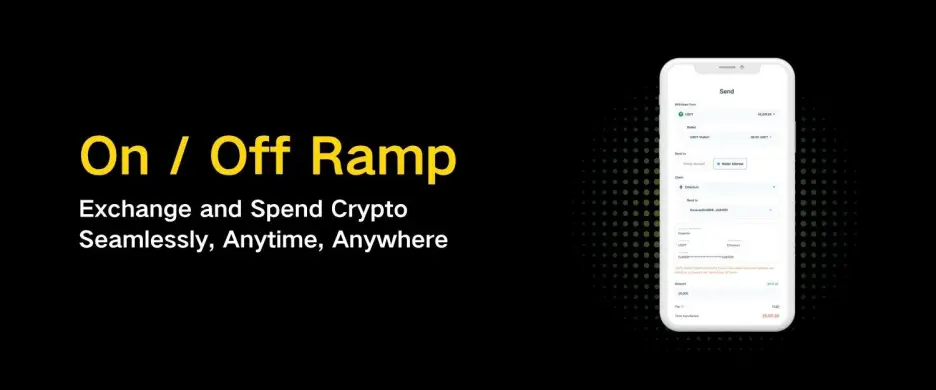
On / Off Ramp: Cryptocurrency On/Off Ramp
Fiat & Crypto Asset Exchange:Supports exchange between fiat currencies like USD, EUR, GBP, etc., and mainstream cryptocurrencies like BTC, ETH, USDT, USDC, helping businesses more conveniently convert funds between on-chain and off-chain.
On-Chain/Off-Chain Fund Flow:Supports unified management of digital assets and fiat funds for businesses, simplifying cross-border payments, stablecoin settlements, and global fund allocation processes.
Direct Cryptocurrency Spending:Can connect directly to Interlace Infinity Card, supporting the use of cryptocurrency for online/offline payments and daily consumption, further bridging on-chain assets with real-world payment scenarios.
Enterprise-Grade Crypto Account Capabilities:Provides crypto account and treasury management capabilities for enterprises, supporting Web3 companies, global teams, and cross-border businesses in daily collections/disbursements and asset management.
Security & Compliance System
As stablecoins gradually enter mainstream commercial scenarios, security and compliance capabilities are becoming core to infrastructure competition.
Highest Security Standards:Interlace complies with PCI DSS Level-1 security certification and employs MPC wallet technology, fully ensuring the security of digital assets.
Automated Risk Control System:Integrates KYT (Know Your Transaction) automated risk management, comprehensive KYC (Know Your Customer) systems, AML anti-money laundering, and real-time transaction monitoring systems.
Global Compliance Footprint:Holds financial licenses in countries and regions including the US, Canada, Hong Kong China, and continues to advance global license acquisition.
5. Treasury Management & Integrated Financial Ecosystem
As the global capital network becomes increasingly on-chain, enterprise demand for financial infrastructure is evolving from single payment tools to an integrated system covering fund storage, consumption, flow, and yield management. Previously fragmented bank accounts, payment systems, stablecoin wallets, and card issuance capabilities are gradually being unified into the same global capital network.
Interlace is building financial infrastructure better suited for global enterprises and the next generation of internet business models, focusing on corporate treasury management and an integrated financial ecosystem.
Yield Treasury: Flexible Corporate Fund Appreciation & Allocation
As corporate funds become increasingly globalized and on-chain, capital is beginning to take on multiple roles beyond just sitting in accounts or wallets: flow, consumption, and yield management. Interlace, focusing on corporate capital efficiency, launched the Yield Treasury product to help businesses build more flexible treasury management capabilities.
Idle Fund Appreciation:Supports idle funds in corporate accounts participating in treasury management, with yields up to 4%, helping businesses improve capital utilization efficiency.
Unified Treasury Management:Businesses can manage fiat, stablecoin, and treasury accounts on the same platform, reducing the complexity of cross-platform fund allocation.
Real-Time Fund Allocation:Supports businesses in flexibly allocating funds based on payment, procurement, and operational needs, enabling concurrent fund usage and yield management.
More and more global enterprises are simultaneously managing on-chain and off-chain assets. Treasury management is also evolving from static accounts to a dynamic capital network.Interlace Yield Treasury allows every unit of capital to continuously create value while in motion.
Integrated Financial Ecosystem
In the past, businesses often needed to simultaneously engage with banks, payment institutions, exchanges, wallets, and card issuance platforms, resulting in complex and fragmented capital flows. Interlace connects different capital scenarios in global operations through unified financial infrastructure.
Unified Accounts & Simplified Reconciliation:Deeply integrates global corporate accounts, multi-currency payments/receipts, stablecoin flows, and card issuance capabilities, eliminating the need to switch between multiple platforms and minimizing reconciliation financial costs.
All-Scenario API-ified Capabilities:Provides a full set of standardized APIs around acquiring, card issuance, wallets, and treasury management. Businesses and platforms can quickly integrate without building complex underlying financial systems.
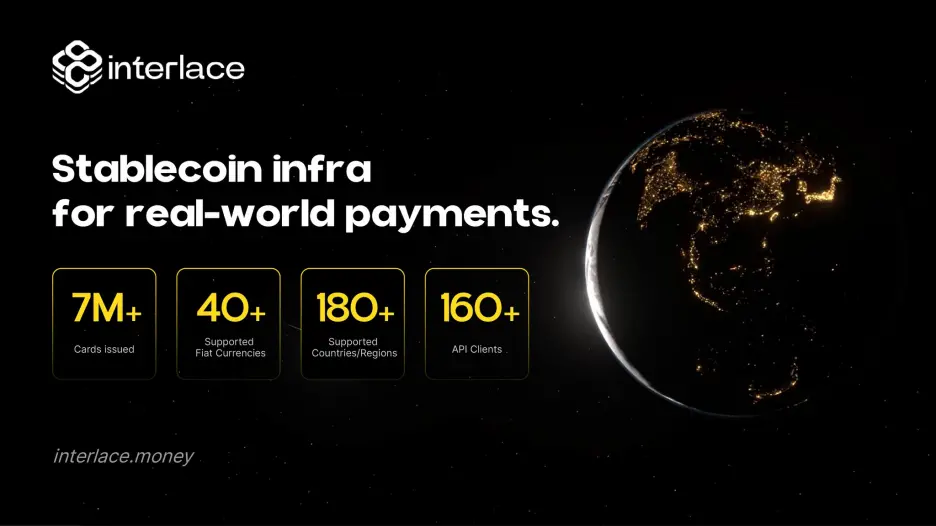
Mature Global Services:Relying on this infrastructure, Interlace's business now covers over 180 countries and regions, with cumulative card issuance exceeding 7 million cards, serving over 12,000 businesses, and having over 160 active API customers, comprehensively empowering AI companies, Web3 teams, global SaaS, and cross-border e-commerce.
AI & Stablecoins Are Reshaping Global Financial Infrastructure
With the rapid development of AI Agents and stablecoin payments, more and more transactions in the future will occur between AI Agents and services, between on-chain and off-chain, and within global real-time capital networks.
Payment systems are also evolving from traditional bank card networks into new financial infrastructure covering stablecoins, intelligent agents, global settlement, and programmable fund flows.
For AI companies, Web3 teams, and global enterprises, the focus is no longer just on payment itself, but on:
Whether AI Agents can spend safely
Whether stablecoins can enter real commercial scenarios
Whether businesses can unify the management of on-chain and off-chain funds
However, the long-awaited mass adoption in the crypto industry will not necessarily arrive in a more complex form. Instead, it is more likely to gradually integrate into the global commercial network in a more natural, seamless, even invisible way.
From Agent Card and Scan to Pay to global card issuance, stablecoin on/off ramps, and API-ified financial capabilities, Interlace is connecting bank accounts, payment systems, and on-chain capital networks, building the infrastructure layer behind this new financial system.
About Interlace
Interlace is a world-leading stablecoin infrastructure platform, providing integrated capabilities such as accounts, card issuance, fund flow, and payment network connectivity for the Web3 ecosystem, trading platforms, cross-border businesses, AI projects, and more. Currently, Interlace's business covers over 180 countries and regions, with cumulative card issuance exceeding 7 million cards and transaction volume reaching $15 billion. It holds financial licenses in countries and regions including the United States, Hong Kong China, and Canada, as well as the payment industry's highest-level security certification, PCI DSS Level 1. It continues to build safe, compliant, and efficient payment infrastructure for cross-border, cross-currency, and cross-financial-system operations.
For more information, please visit:www.interlace.money.