Ethereum vs. Bitcoin: Is ETH’s 5% Q3 rally the start of a structural rotation?

ambcryptoPublished on 2026-07-12Last updated on 2026-07-12

Abstract

The article examines whether Ethereum's (ETH) recent 5% Q3 rally against Bitcoin (BTC) signals a lasting capital rotation or is merely another short-term move. Historically, ETH has struggled to sustain outperformance; a strong 2025 Q3 rally was largely reversed, suggesting temporary rotations as capital flowed back to Bitcoin. Currently, Bitcoin dominance is testing a key resistance level, hinting at a possible shift back toward BTC. However, on-chain and institutional data present a counter-narrative. Ethereum ETFs have attracted significant net inflows this month, outperforming Bitcoin ETFs. A key catalyst is Robinhood's new Layer 2 network, which uses ETH for gas and settlement. Data shows a nearly 10x weekly surge in ETH bridged to this chain, indicating growing ecosystem activity and ETH demand. While it's premature to confirm a structural shift, the rally appears increasingly supported by fundamentals—including institutional inflows, rising Layer 2 adoption, and stronger on-chain metrics—rather than just market rotation. If these trends persist, the current ETH/BTC breakout could signal the beginning of a broader capital move into Ethereum during Q3.

Ethereum [ETH] has historically struggled to sustain its outperformance against Bitcoin.

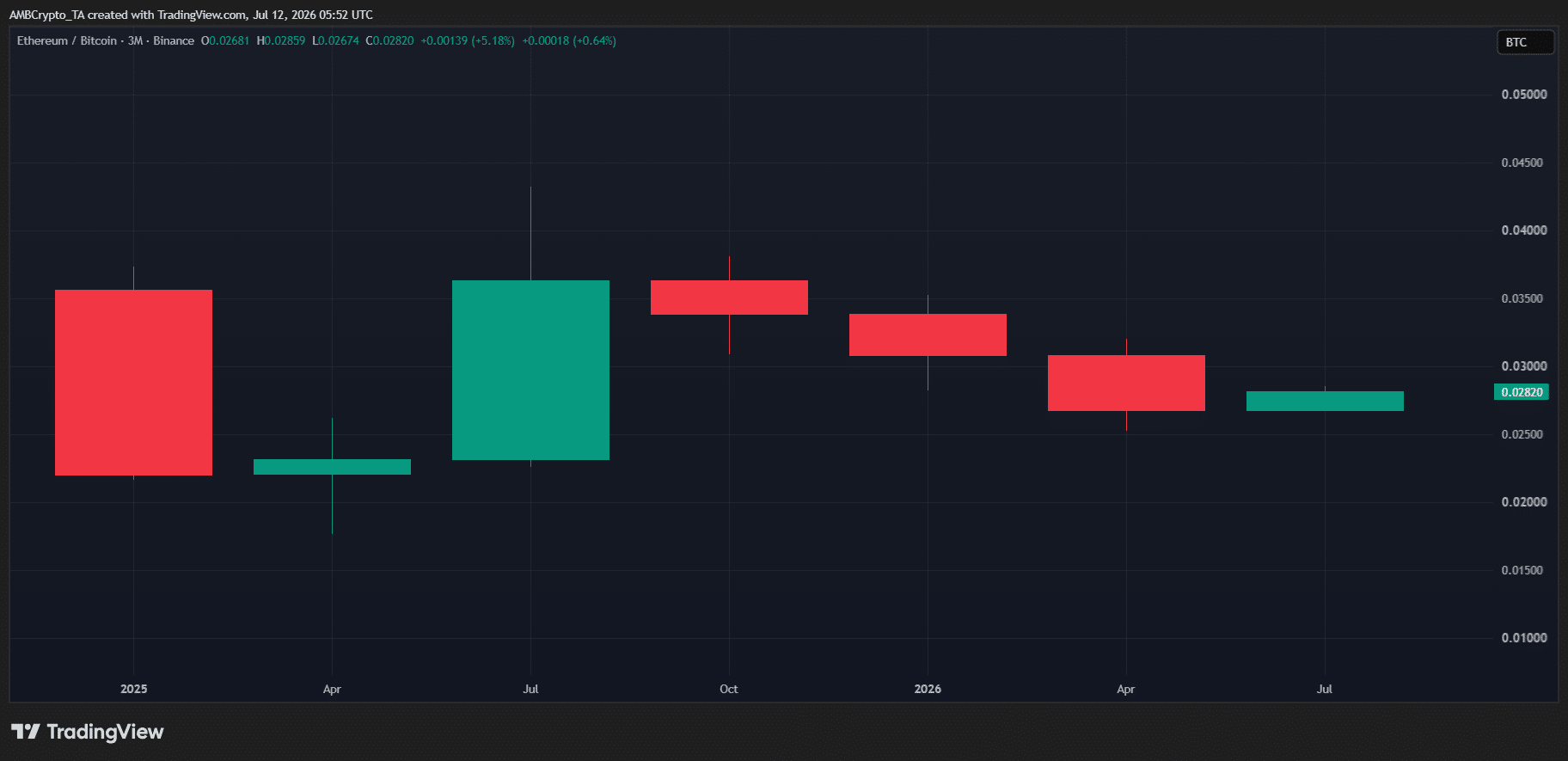
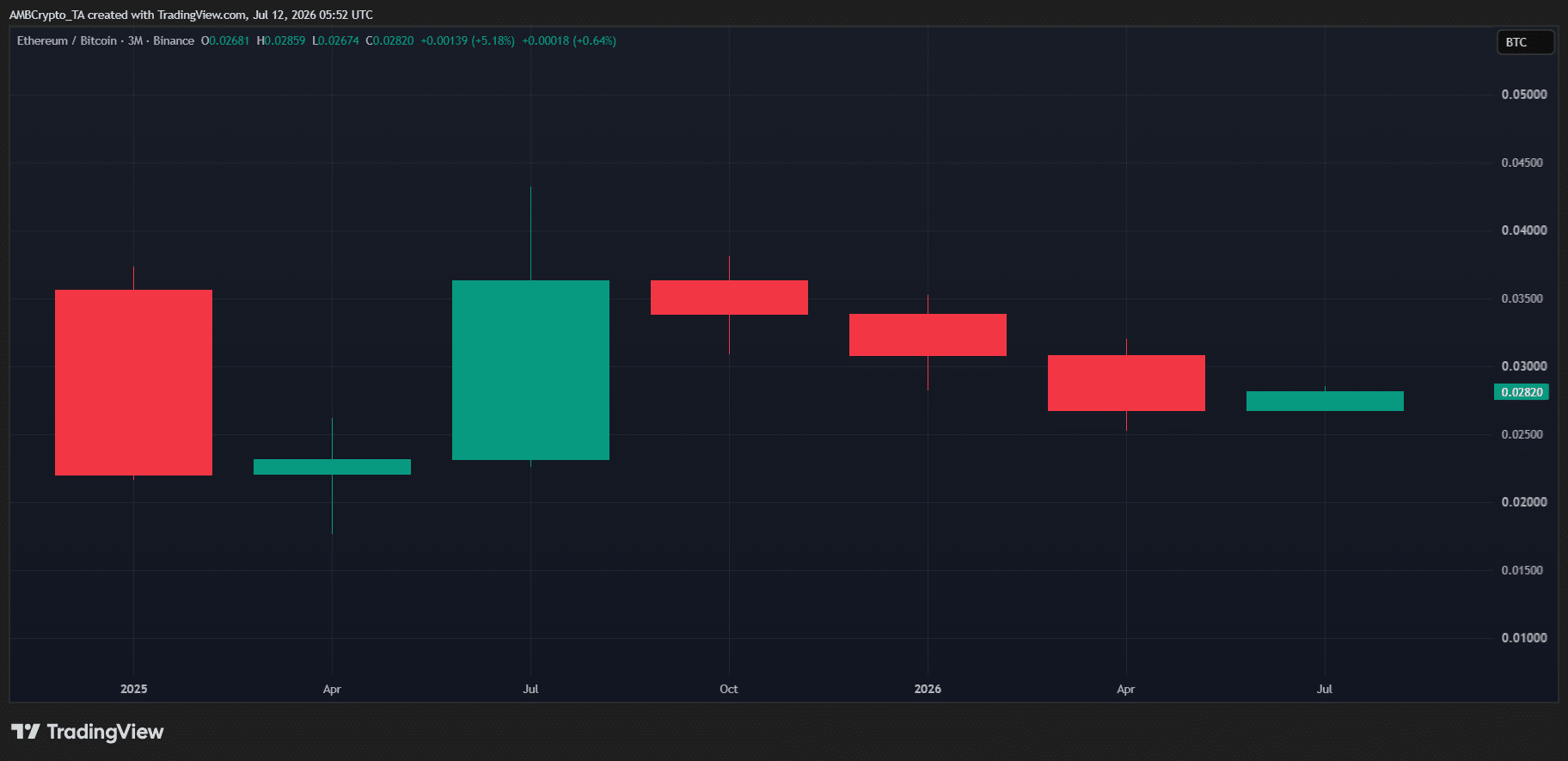
On the technical front, ETH/BTC last posted a strong quarterly rally in Q3 2025, surging 53%, marking its biggest quarterly gain since Q2 2021. However, sellers erased 50% of those gains as the rally lost momentum. This suggests the rotation was temporary, as capital continued to flow into Bitcoin.

Against this backdrop, the ratio’s 5% rally so far in Q3 appears too early to confirm a sustained rotation from Bitcoin into Ethereum. At the same time, Bitcoin dominance is once again pushing toward the key 60% resistance level, gaining 1.5% in July and signaling that capital may already be rotating back into Bitcoin.

Source: TradingView (ETH/BTC)

That said, Eric Trump’s recent post on X points in the opposite direction, supporting Ethereum’s rally.

Meanwhile, the on-chain data tells a similar story. Ethereum’s outperformance against Bitcoin [BTC] isn’t happening in isolation. Institutional positioning continues to back the move, with Ethereum ETFs attracting over $128 million in net inflows so far this month, outperforming Bitcoin. Meanwhile, Ethereum’s DATs are recovering, adding further support to Ethereum’s recent strength.

With that said, it may be too early to write off the current ETH/BTC uptrend as just another short-term rotation. The bigger question is whether smart money is positioning ahead of a structural shift that the broader market has yet to price in.

Ethereum’s latest catalyst puts the ETH/BTC ratio in the spotlight

A key catalyst may be reinforcing the institutional rotation into Ethereum.

Tom Lee pointed to Robinhood’s recently unveiled Layer 2 chain as a major differentiator, calling it a breakout product that has already generated more volume than many established DEXs. More importantly, the network uses ETH as its native gas token, and settles on Ethereum Layer 1. As activity on the chain grows, each transaction feeds back into Ethereum’s ecosystem, strengthening the long-term demand case for ETH.

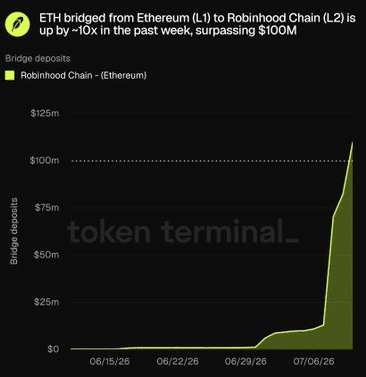
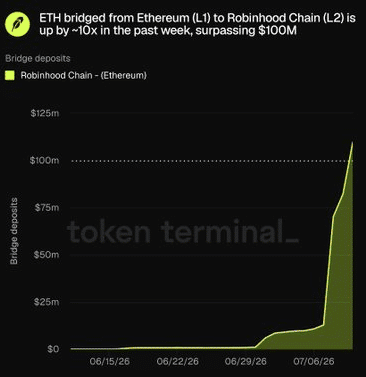
The on-chain data backs this up. As the chart below shows, the amount of ETH bridged from Ethereum Layer 1 to the Robinhood Chain has jumped nearly 10x over the past week, surpassing $100 million. That suggests users are actively moving liquidity into Robinhood’s Layer 2 ecosystem, with ETH emerging as the network’s core asset for gas, settlement, and on-chain activity.

Source: Token Terminal

In this context, Ethereum’s outperformance against Bitcoin may be more than just another rotation.

Instead, the move looks increasingly driven by improving fundamentals, as institutional inflows, growing Layer 2 activity, and rising on-chain demand continue to strengthen Ethereum’s long-term investment case. If that trend holds, the ETH/BTC breakout could be the first sign of a broader capital rotation into Ethereum through Q3.


Final Summary

  • Ethereum’s rally against Bitcoin is backed by ETF inflows, stronger on-chain activity, and Robinhood’s Layer 2 ecosystem.
  • If these trends continue, the ETH/BTC breakout could signal a broader shift of capital into Ethereum in Q3.

Trending Cryptos

Related Questions

QBased on the article, what evidence suggests that Ethereum's recent outperformance against Bitcoin might be more than just a short-term rotation?

AThe evidence includes substantial institutional support with Ethereum ETFs attracting over $128 million in net inflows, strong growth in on-chain activity and fundamentals like the recovery of DATs, and a key catalyst in Robinhood's Layer 2 chain, which uses ETH as its native gas token and has seen a 10x increase in bridged ETH value. These factors point to improving fundamentals driving the move.

QWhat technical pattern in the ETH/BTC ratio from Q3 2025 does the article use as a cautionary example for the current rally?

AThe article notes that in Q3 2025, the ETH/BTC ratio surged 53%, its biggest quarterly gain since Q2 2021, but sellers later erased 50% of those gains as momentum faded. This historical example suggests such strong rallies can be temporary if capital flows back into Bitcoin.

QAccording to the on-chain data mentioned, what significant change occurred regarding ETH on the Robinhood Chain recently?

AThe amount of ETH bridged from Ethereum Layer 1 to the Robinhood Chain jumped nearly 10 times over the past week, surpassing $100 million. This indicates users are actively moving liquidity into Robinhood's Layer 2 ecosystem, establishing ETH as the core asset for gas, settlement, and activity on that network.

QWhat conflicting signal does the article present that might challenge the idea of a sustained capital rotation from Bitcoin to Ethereum?

AThe article points out that Bitcoin dominance is pushing toward the key 60% resistance level, having gained 1.5% in July. This signals that capital may already be rotating back into Bitcoin, which contradicts the narrative of a sustained shift towards Ethereum.

QWhat does Tom Lee, cited in the article, identify as a major differentiator and catalyst for Ethereum?

ATom Lee identifies Robinhood's recently unveiled Layer 2 chain as a major differentiator, calling it a breakout product that has already generated more volume than many established DEXs. Crucially, it uses ETH as its native gas token and settles on Ethereum Layer 1, strengthening ETH's long-term demand case as activity grows.

Related Reads

Mining Firms Flock to AI, but Wall Street Cools Valuation Enthusiasm. The Earnings Season Reveals Who's 'Swimming Naked'?

Bitcoin mining companies are increasingly pivoting to AI and HPC (high-performance computing) infrastructure, but Wall Street is growing skeptical, demanding proof of a viable business model over mere announcements. An analysis shows that while early AI-related announcements triggered significant stock price movements (average absolute change of 24.1%), recent similar news has had a much smaller market impact (average ~10.2%), despite the underlying business value of AI/HPC hosting contracts improving. A review of Q2 2024 earnings from five major mining firms reveals a mixed picture: * **Marathon Digital (MARA):** Reported declining revenue ($175M, down 27%) and a large net loss ($610M+). Its AI/HPC transformation remains in the building phase, contributing negligible revenue so far. * **Core Scientific:** Successfully shifted its business model, with AI/HPC hosting now dominating revenue (83% of total $164.2M). However, this came with high capital expenditure and negative shareholder equity. * **TeraWulf:** Showed early results from its pivot, with HPC leasing generating 71% of its total revenue ($44.77M). It secured major long-term contracts but also reported a significant net loss. * **Hut 8:** Achieved substantial revenue growth ($74.9M, up 81.4%) driven by computing operations and completed commercialization of its first major AI data center campus. It remains unprofitable on a net income basis. * **CleanSpark:** Revenue still relies entirely on Bitcoin mining ($138M, down 30.5%). Its main AI highlight was signing a $6.6 billion, 20-year data center lease, but revenue from it is not expected until late 2027. The key takeaway is that the market's focus has shifted from the "AI story" to tangible execution, project delivery capabilities, customer quality, and the ability to generate future cash flow.

marsbit1h ago

Mining Firms Flock to AI, but Wall Street Cools Valuation Enthusiasm. The Earnings Season Reveals Who's 'Swimming Naked'?

marsbit1h ago

All Metrics Smashing Records, Yet Stock Prices Plunge Across the Board

Memory giants like Western Digital (WDC) and SanDisk (SNDK) reported blockbuster earnings in the summer of 2026, featuring毛利率 exceeding 80%, massive customer prepayments, and long-term supply agreements. Despite this seemingly perfect performance, their stocks plummeted post-earnings (WDC down 13%, SNDK down 7%), along with peers like Micron. The collapse highlights a core market rule: "good" isn't enough; results must beat already sky-high expectations. With valuations at peak "perfect asset" levels, even slightly conservative forward guidance triggered a sell-off. The market saw "peak performance" as a signal to exit. Beneath the stellar numbers, four反常 trends emerged: 1. **Financialized Pricing:** Customers provide百亿级 in upfront "interest-free deposits" to secure future capacity. 2. **Reversed Cost Curve:** Advanced DRAM (HBM4, DDR6) costs are rising per bit due to complex packaging, breaking Moore's Law. 3. **AI vs. Consumer Split:** Data center storage demand soars (+103% for SanDisk), while consumer electronics demand weakens under high costs. 4. **HDD Revival:** Hard drives, now used for AI agent context caching, see毛利率 near 55-57%. Underlying隐忧 persist. Soaring capital expenditure (CapEx) by SK Hynix and Micron risks future oversupply. Revenue growth is increasingly driven by price hikes, not surging shipment volumes (bit growth), making profits vulnerable to any price correction. In conclusion, while AI has created a long-term growth narrative, transforming storage into "strategic infrastructure," the market's violent reaction signals that peak valuations and expectations have left no safety margin. The周期 hasn't disappeared; it's merely wearing an AI disguise.

marsbit1h ago

All Metrics Smashing Records, Yet Stock Prices Plunge Across the Board

marsbit1h ago

Building the Next-Generation Financial Information Terminal with BlockBeats

BlockBeats is building a next-generation personal financial information portal, integrating real-time global market data, news, professional research, and AI-powered analysis. We are actively hiring for multiple roles across our teams in Beijing, with strictly remote opportunities available. We are seeking passionate individuals to join our Hot News Team as Global Market Information Editors, responsible for real-time tracking and analysis of global tech, financial markets, and industry trends. Our In-Depth Reporting & Research Team is looking for Tech Finance Researchers to conduct deep analysis on AI, capital markets, digital assets, and emerging industries. Our Operations Team needs Social Media Specialists to drive user growth and community engagement on platforms like Twitter and Telegram. The Business Team has openings for Business Executives to manage client partnerships and Overseas Business Development specialists to expand our global footprint. Technical roles include Frontend and Backend Developers to help build our products. We are also forming a Prediction Markets Team, seeking Researchers/Content Writers to analyze market events, on-chain data, and provide actionable insights. Ideal candidates are curious about future tech, sensitive to financial markets, adept at extracting value from information, and eager to build new products. Both full-time positions and internships are available.

marsbit1h ago

Building the Next-Generation Financial Information Terminal with BlockBeats

marsbit1h ago

Trading

Spot

Hot Articles

What is $BITCOIN

DIGITAL GOLD ($BITCOIN): A Comprehensive Analysis Introduction to DIGITAL GOLD ($BITCOIN) DIGITAL GOLD ($BITCOIN) is a blockchain-based project operating on the Solana network, which aims to combine the characteristics of traditional precious metals with the innovation of decentralized technologies. While it shares a name with Bitcoin, often referred to as “digital gold” due to its perception as a store of value, DIGITAL GOLD is a separate token designed to create a unique ecosystem within the Web3 landscape. Its goal is to position itself as a viable alternative digital asset, although specifics regarding its applications and functionalities are still developing. What is DIGITAL GOLD ($BITCOIN)? DIGITAL GOLD ($BITCOIN) is a cryptocurrency token explicitly designed for use on the Solana blockchain. In contrast to Bitcoin, which provides a widely recognized value storage role, this token appears to focus on broader applications and characteristics. Notable aspects include: Blockchain Infrastructure: The token is built on the Solana blockchain, known for its capacity to handle high-speed and low-cost transactions. Supply Dynamics: DIGITAL GOLD has a maximum supply capped at 100 quadrillion tokens (100P $BITCOIN), although details regarding its circulating supply are currently undisclosed. Utility: While precise functionalities are not explicitly outlined, there are indications that the token could be utilized for various applications, potentially involving decentralized applications (dApps) or asset tokenization strategies. Who is the Creator of DIGITAL GOLD ($BITCOIN)? At present, the identity of the creators and development team behind DIGITAL GOLD ($BITCOIN) remains unknown. This situation is typical among many innovative projects within the blockchain space, particularly those aligning with decentralized finance and meme coin phenomena. While such anonymity may foster a community-driven culture, it intensifies concerns about governance and accountability. Who are the Investors of DIGITAL GOLD ($BITCOIN)? The available information indicates that DIGITAL GOLD ($BITCOIN) does not have any known institutional backers or prominent venture capital investments. The project seems to operate on a peer-to-peer model focused on community support and adoption rather than traditional funding routes. Its activity and liquidity are primarily situated on decentralized exchanges (DEXs), such as PumpSwap, rather than established centralized trading platforms, further highlighting its grassroots approach. How DIGITAL GOLD ($BITCOIN) Works The operational mechanics of DIGITAL GOLD ($BITCOIN) can be elaborated on based on its blockchain design and network attributes: Consensus Mechanism: By leveraging Solana’s unique proof-of-history (PoH) combined with a proof-of-stake (PoS) model, the project ensures efficient transaction validation contributing to the network's high performance. Tokenomics: While specific deflationary mechanisms have not been extensively detailed, the vast maximum token supply implies that it may cater to microtransactions or niche use cases that are still to be defined. Interoperability: There exists the potential for integration with Solana’s broader ecosystem, including various decentralized finance (DeFi) platforms. However, the details regarding specific integrations remain unspecified. Timeline of Key Events Here is a timeline that highlights significant milestones concerning DIGITAL GOLD ($BITCOIN): 2023: The initial deployment of the token occurs on the Solana blockchain, marked by its contract address. 2024: DIGITAL GOLD gains visibility as it becomes available for trading on decentralized exchanges like PumpSwap, allowing users to trade it against SOL. 2025: The project witnesses sporadic trading activity and potential interest in community-led engagements, although no noteworthy partnerships or technical advancements have been documented as of yet. Critical Analysis Strengths Scalability: The underlying Solana infrastructure supports high transaction volumes, which could enhance the utility of $BITCOIN in various transaction scenarios. Accessibility: The potential low trading price per token could attract retail investors, facilitating wider participation due to fractional ownership opportunities. Risks Lack of Transparency: The absence of publicly known backers, developers, or an audit process may yield skepticism regarding the project's sustainability and trustworthiness. Market Volatility: The trading activity is heavily reliant on speculative behavior, which can result in significant price volatility and uncertainty for investors. Conclusion DIGITAL GOLD ($BITCOIN) emerges as an intriguing yet ambiguous project within the rapidly evolving Solana ecosystem. While it attempts to leverage the “digital gold” narrative, its departure from Bitcoin's established role as a store of value underscores the need for a clearer differentiation of its intended utility and governance structure. Future acceptance and adoption will likely depend on addressing the current opacity and defining its operational and economic strategies more explicitly. Note: This report encompasses synthesised information available as of October 2023, and developments may have transpired beyond the research period.

1.6k Total ViewsPublished 2025.05.13Updated 2025.05.13

What is $BITCOIN

Discussions

Welcome to the HTX Community. Here, you can stay informed about the latest platform developments and gain access to professional market insights. Users' opinions on the price of BTC (BTC) are presented below.

活动图片