Autor: Claude, Shenchao TechFlow
Guía de Shenchao: La nueva política de privacidad de Anthropic entrará en vigor el 8 de julio. En las redes sociales chinas se interpreta ampliamente como un cambio significativo hacia la "verificación de identidad y facial" y la "apertura de datos a las autoridades policiales". Sin embargo, al comparar meticulosamente el texto original, la mayoría de las conclusiones sensacionalistas no se sostienen: la verificación de identidad es un mecanismo antiguo que se implementó en abril, y el supuesto "bajar el umbral de divulgación a las fuerzas del orden" no encuentra respaldo en los términos de las versiones antigua y nueva. El verdadero cambio sustancial es que, por primera vez, se incluye en la política el flujo de datos en las tareas de los Agentes.

Anthropic anunció una actualización de su política de privacidad el 8 de junio. La nueva versión entrará en vigor para los usuarios individuales gratuitos, Pro y Max de Claude a partir del 8 de julio. Tras el anuncio, se difundió rápidamente en los círculos tecnológicos y comunitarios chinos, centrándose la narrativa principal en dos puntos:
- Claude introducirá la verificación de identidad y facial.
- Las nuevas reglas reducen el umbral para revelar datos de usuarios a las fuerzas del orden, marcando el "fin de la era del anonimato en los modelos grandes".
Al comparar meticulosamente el texto de la nueva política, la versión antigua (del 28 de septiembre de 2025) y el resumen oficial de actualización de Anthropic, encontramos que la mayoría de las conclusiones de esta narrativa no coinciden con el texto original de la política.
Error 1: La verificación de identidad y facial es un mecanismo antiguo de abril, no una nueva política de julio
Tomar la verificación de identidad como una "nueva política repentina" del 8 de julio es el error más común en la cadena de difusión actual.
La realidad es que Anthropic ya implementó un mecanismo de verificación de identidad en la plataforma Claude el 14 de abril de 2026. Al día siguiente, la página de política "Identity verification" se publicó oficialmente en el centro de ayuda del sitio web.
Según informes de la época de V2EX, East Money y 36Kr, los usuarios que activaban la verificación debían enviar, a través del proveedor de servicios de cumplimiento Persona, un documento de identidad oficial emitido por el gobierno (pasaporte, licencia de conducir o DNI) y completar una verificación de detección de vida en tiempo real con una selfie de la cámara. En ese momento, la cuenta "Cai Fu Hao" de East Money registró que los usuarios afectados eran principalmente aquellos suscritos al plan de pago más alto Max, usuarios frecuentes o cuentas consideradas sospechosas por el sistema de control de riesgos. También se registró que algunos desarrolladores tuvieron sus cuentas suspendidas debido a errores de la IA.
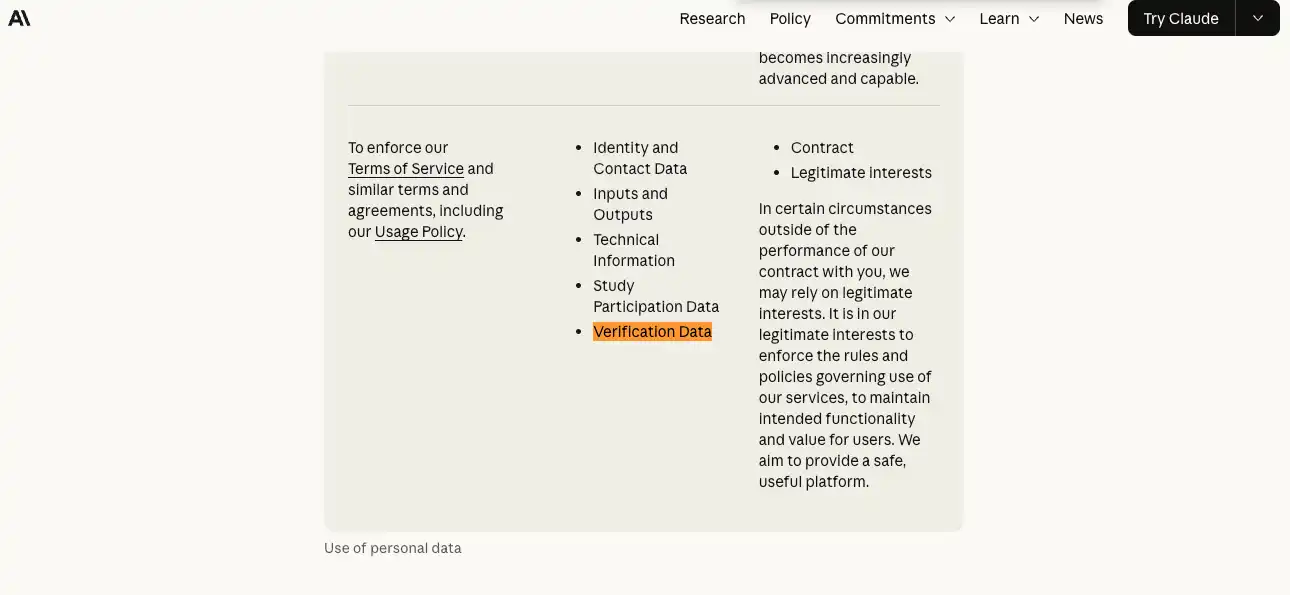
En otras palabras, el asunto de "si hay que entregar el DNI" ya ocurrió hace dos meses y provocó una reacción de los desarrolladores en su momento. La actualización de la política de privacidad del 8 de julio no añade esta acción, sino que simplemente formaliza en el texto de la política de privacidad la recopilación de datos correspondiente al mecanismo de verificación ya en funcionamiento. La nueva sección "Datos de verificación" (Verification Data) enumera claramente lo que se recopilará:
Imágenes de documentos de identidad gubernamentales con su número, fecha de nacimiento, retratos en forma de foto o video, plantillas geométricas faciales (clasificadas como datos biométricos en algunas jurisdicciones) y el resultado de la verificación en sí.
Interpretar la "inclusión del texto en la política" como una "implementación repentina del mecanismo" confunde completamente la línea de tiempo.
Error 2: "Abrir los datos a las fuerzas del orden" no se sostiene; la comparación palabra por palabra entre cláusulas antiguas y nuevas no muestra restricciones sustanciales
La afirmación más impactante en la cadena de difusión, y la que más debe corregirse, es que "las nuevas reglas reducen el umbral para revelar datos de usuarios a las fuerzas del orden". Algunas versiones chinas afirman que la versión antigua solo divulgaba datos cuando existía un "requisito legal obligatorio", mientras que la nueva se amplía para permitir la divulgación siempre que Anthropic tenga una "creencia de buena fe".
Este marco de comparación no encontramos su origen en el texto original, ni usando Claude.
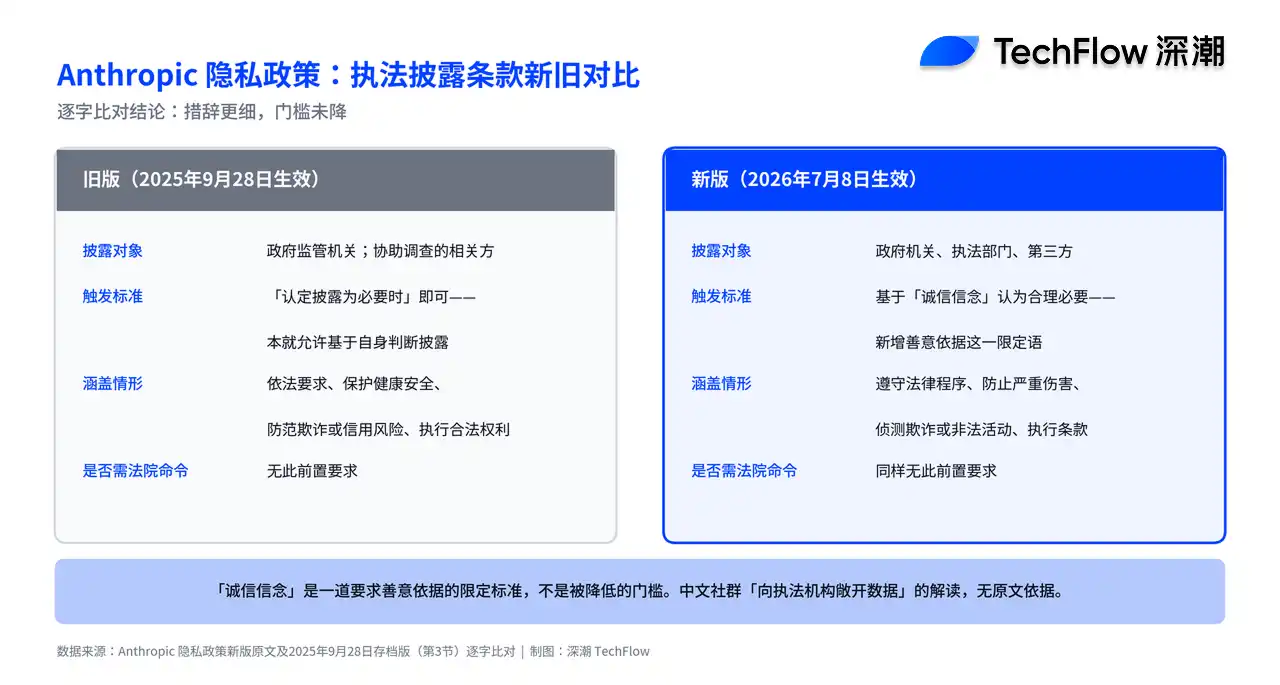
La Sección 3 de la nueva versión establece: Basándose en la información existente y teniendo una "creencia de buena fe" (good-faith belief) de que la divulgación es razonablemente necesaria, Anthropic puede compartir datos con agencias gubernamentales, fuerzas del orden o terceros, en cuatro tipos de situaciones:
Cumplir con leyes, regulaciones o procesos legales (incluyendo responder a solicitudes gubernamentales ejecutables), prevenir daños graves a personas o propiedades, detectar/prevenir fraudes o actividades ilegales, y hacer cumplir los términos o proteger los derechos, seguridad, de Anthropic, sus usuarios y otras personas.
La clave está en cómo se redacta la versión antigua (del 28 de septiembre). La Sección 3 de la versión antigua también permitía divulgar datos cuando "se considera necesario para proteger su salud y seguridad o la de otros, prevenir fraudes o riesgos crediticios, hacer valer derechos legítimos, etc.", y también incluía "divulgar legalmente a autoridades gubernamentales de supervisión... o ayudar en investigaciones". Es decir, la versión antigua nunca fue "divulgar solo cuando la ley lo exige obligatoriamente"; ya otorgaba a Anthropic el margen para divulgar basándose en su propio criterio.
La conclusión de la comparación palabra por palabra es:
La nueva versión reescribe este punto de manera más estructurada, menciona explícitamente a las "fuerzas del orden", añade la cláusula limitante "creencia de buena fe", y enumera claramente las cuatro situaciones. Desde una perspectiva legal sustantiva, "creencia de buena fe" es un estándar limitante que requiere una base justificada de buena voluntad, no un umbral que se haya reducido. Una redacción más detallada no equivale a un umbral más bajo. La calificación de Anthropic en su resumen oficial de actualización para esta parte es simplemente "explicar con mayor claridad cuándo podemos compartir datos con terceros".
Un hecho en la dirección opuesta puede ayudar a calibrar esta mala interpretación.
En agosto de 2025, el Tribunal Federal del Distrito Norte de California, en el caso de derechos de autor Universal Music Group et al. contra Anthropic, dictaminó que Anthropic no tenía que proporcionar información personal de los usuarios a los editores. Según Intellectual Property Finance citando a Bloomberg, el juez consideró que vincular el contenido de las conversaciones con usuarios específicos "carecía de base suficiente y perjudicaba el peso de la privacidad de terceros". En ese caso, Anthropic se posicionó del lado de negarse a entregar los datos de los usuarios. Esto muestra que la aplicación en la práctica de estándares como la "creencia de buena fe" es mucho más compleja que lo descrito por "abrir los datos a las fuerzas del orden".
En cuanto a la afirmación específica de que "los datos biométricos no se almacenan en los servidores de Anthropic, sino que los procesa Persona", proviene de algunas versiones chinas de medios de comunicación. El texto original de la nueva política no contiene una declaración correspondiente, por lo que no se puede verificar a partir de fuentes primarias. Se recomienda tratarla como no confirmada.
Lo que realmente cambió la política: El flujo de datos en las tareas de los Agentes se incluyó por primera vez en el texto
Eliminando las partes exageradas, el verdadero cambio sustancial de la nueva política es que establece explícitamente las reglas sobre el flujo de datos cuando Claude ejecuta tareas de múltiples pasos o se conecta a aplicaciones de terceros. Precisamente, esta era una parte que la versión antigua apenas cubría.
El contenido añadido en las Secciones 1 y 3 de la nueva versión establece: Cuando un usuario conecta un servicio de terceros o instruye a Claude para que ejecute tareas en su nombre (leer archivos, enviar mensajes, recuperar información), Claude enviará las entradas, salidas e instrucciones del usuario directamente al servicio de terceros, quien procesará estos datos según su propia política de privacidad; Claude también recuperará contenido de los servicios de terceros, y este contenido pasa a formar parte de la entrada del usuario. Algunas integraciones mantendrán acceso hasta que el usuario las desconecte activamente.
Esta es la base de cumplimiento añadida para la forma de producto Agent. Cuando se redactó la política de privacidad antigua, Claude era principalmente una herramienta de diálogo de pregunta-respuesta; la nueva versión debe responder a una nueva pregunta: cuando la IA ejecuta operaciones a través de múltiples aplicaciones externas en tu nombre, ¿cómo fluyen los datos entre tú, Anthropic y los terceros? La nueva versión también señala que, a medida que las tareas de los Agentes se vuelven más complejas, los escenarios de verificación podrían ampliarse en el futuro. Para los usuarios que dependen en gran medida de conectores y flujos de trabajo como Claude Code, este punto merece más atención que "si hay que entregar el DNI": tu rastro de datos se expandirá junto con la capacidad de agencia de Claude.
Además del flujo de datos de los Agentes y los datos de verificación, la nueva versión también añade una sección sobre "Datos de participación en investigación" (datos recopilados cuando los usuarios participan en estudios o entrevistas de Anthropic) y especifica las bases legales para las recomendaciones de marketing y el procesamiento de datos. Anthropic reitera en el resumen de actualización tres compromisos inalterados: no vender datos de usuarios, mantener a Claude sin anuncios, y permitir a los usuarios controlar si sus conversaciones se usan para entrenar el modelo.
Enmarcando esta actualización: se parece más a una ordenación de cumplimiento para "que el texto de la política alcance las formas de producto existentes", que a una restricción activa de la privacidad del usuario.
El alto interés en las comunidades chinas proviene en parte de leer mezcladas noticias antiguas de abril, cláusulas estándar de la industria y los elementos realmente nuevos. Para el usuario promedio, el verdadero riesgo de cierre de cuenta proviene de violar las políticas de uso o ser considerado anómalo por el sistema de control de riesgos, algo que ya existía desde abril y que no se ha agravado con esta actualización. En cuanto a la preocupación de que "el historial de chat se entregue arbitrariamente a la policía", tanto el texto original como la sentencia de California muestran que ha sido claramente exagerada.
Nota: Este artículo fue escrito por el propio Claude, por lo que tiene más peso que las versiones de los medios de comunicación.
Enlaces de referencia:
Nueva política de privacidad de Anthropic:
https://www.anthropic.com/legal/privacy




















