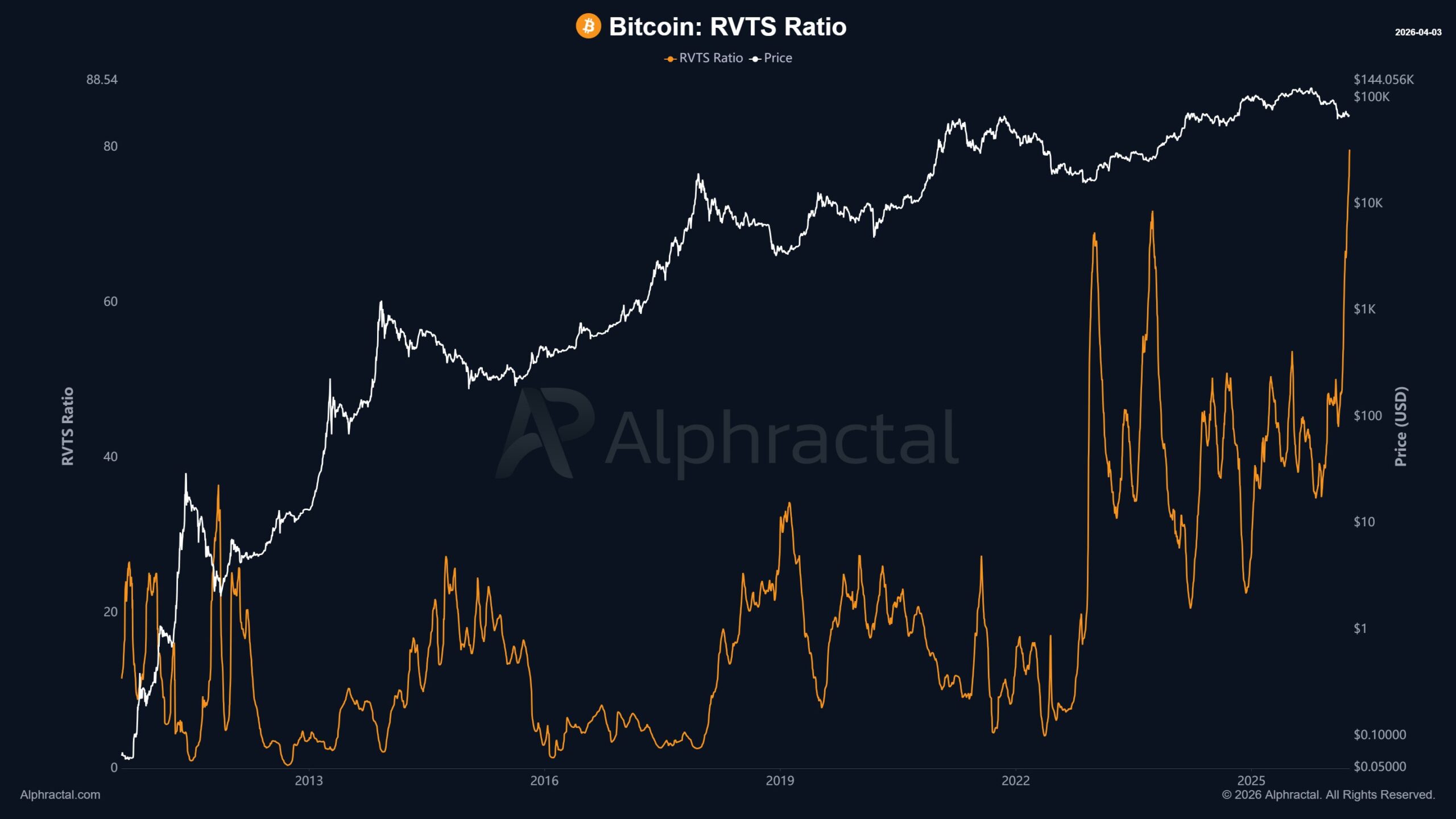
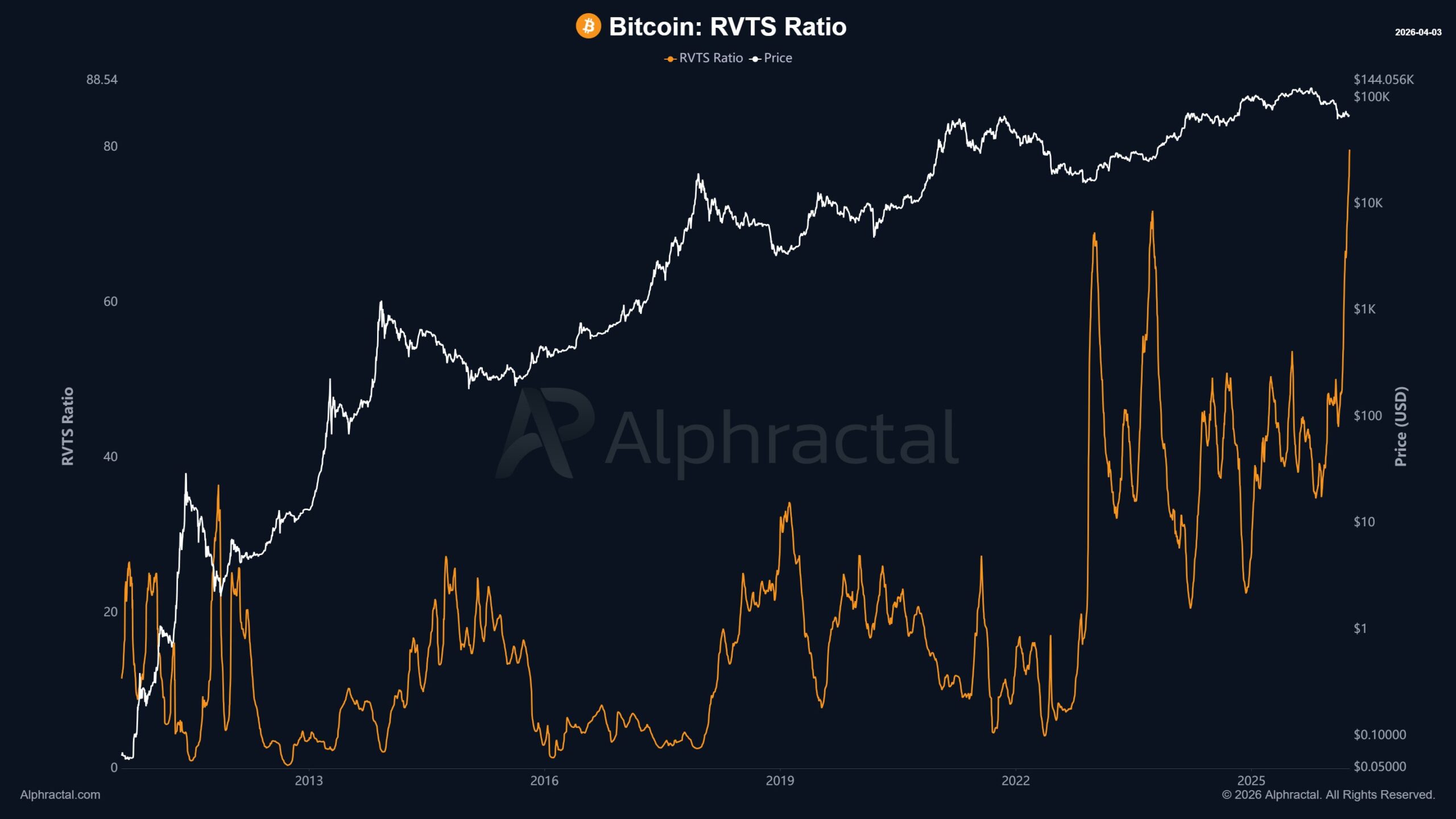
Bitcoin is exhibiting a state of market imbalance, with its price holding firm near $66,940 despite a significant decline in on-chain network usage. This divergence is highlighted by the Realized Value Transaction Volume (RVTS) Ratio reaching a record high of 85, indicating that adjusted on-chain volume is shrinking relative to valuation. The current phase suggests that price discovery is being driven more by derivatives and liquidity flows rather than spot market activity, as capital circulates off-chain.
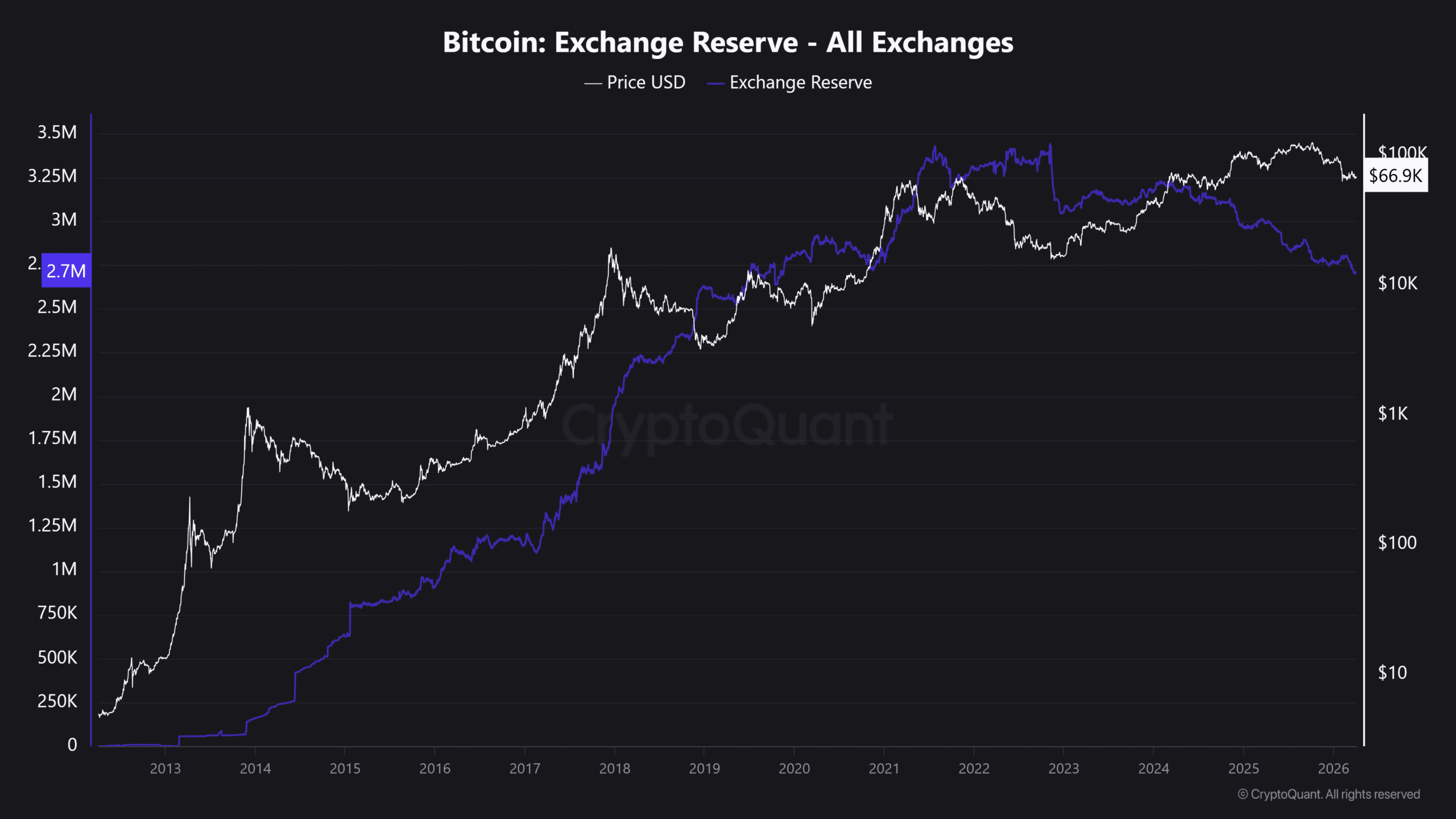
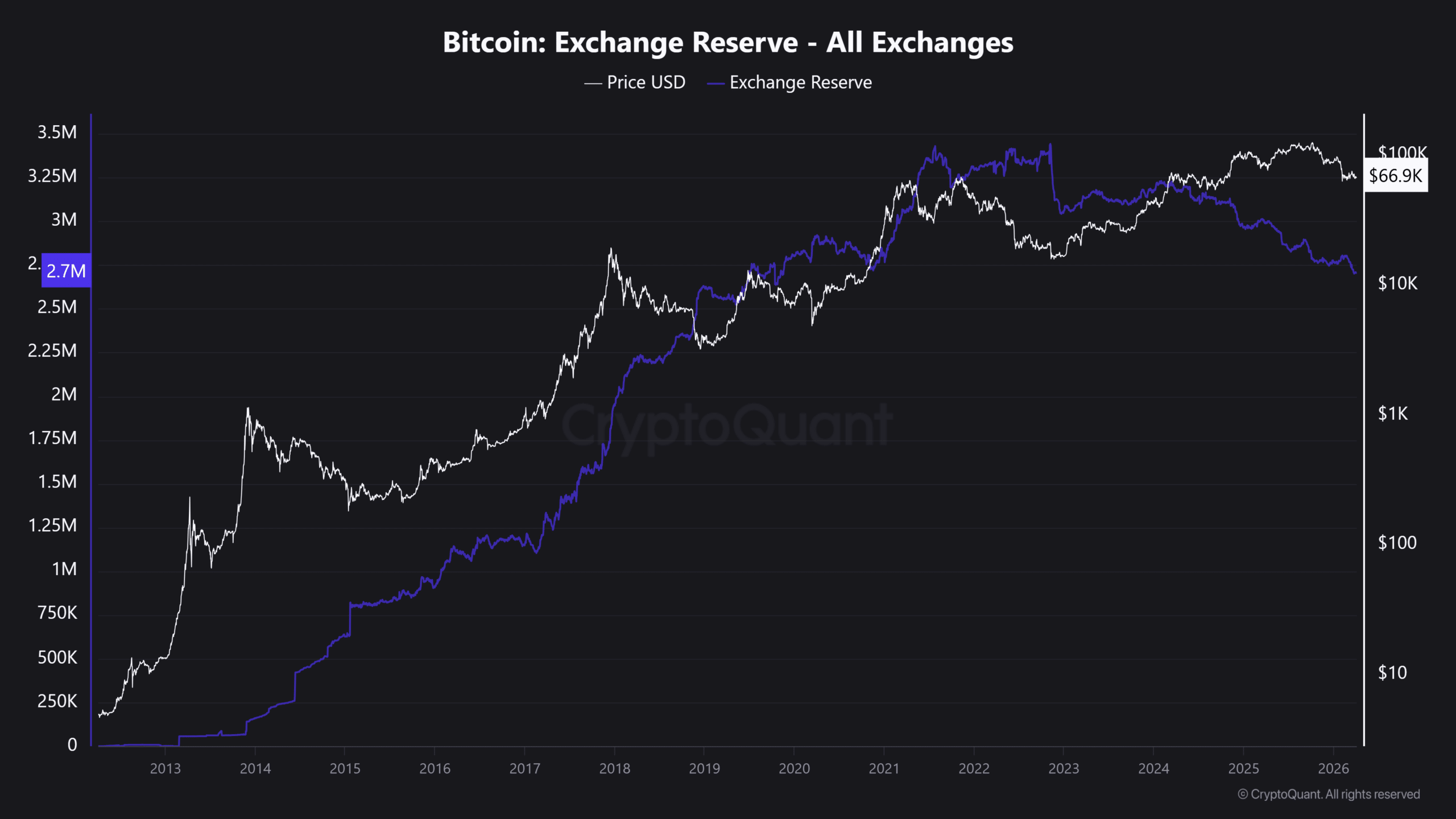
Historically, such high RVTS levels have occurred during low-participation phases, often near cycle bottoms. However, the current reading exceeds previous spikes, pointing to deeper structural apathy. Despite this, the compression often precedes accumulation, as weaker hands exit and stronger, long-term holders absorb supply. Long-Term Holder supply has increased to 14.90 million BTC, while exchange reserves remain near multi-year lows at around 2.7 million BTC, reducing sell pressure.
Although the market shows resilience and a tightening supply structure, a meaningful price upside still depends on the return of stronger demand and participation. For now, Bitcoin's stability appears sustained by positioning rather than organic network activity.
Bitcoin’s market has been slipping into a quiet imbalance, one where price strength no longer reflects underlying network activity. Understandably, this raises some questions about what is really driving value.
At the time of writing, the RVTS (Realized Value Transaction Volume) Ratio had climbed towards 85 – Its highest level ever. When this ratio rises, it means that adjusted on-chain volume is shrinking, meaning fewer coins may be moving relative to valuation.
In effect, it implied that the price might be holding firm, even as network usage fades.
Source: X
This may be happening because market structure has shifted. Liquidity and derivatives now dominate price discovery, while spot-driven activity has weakened. As a result, capital circulates off-chain, reducing the need for on-chain settlement.
Historically, similar spikes above 60 in 2022 appeared during low-participation phases, often near cycle bottoms. However, the press time move seemed to exceed those levels – Evidence of deeper structural apathy.
Still, such a compression often precedes accumulation. As weaker hands exit and activity rebuilds, the imbalance can be expected to resolve itself. Until then, Bitcoin [BTC] is likely to reflect a market sustained by positioning, not participation.
Bitcoin, at press time, was trading in a quiet zone where price stability was contrary to muted participation, creating uncertainty around what this phase represents. It was valued at close to $66,940, well above $65,800 – A sign that the support level remains intact.
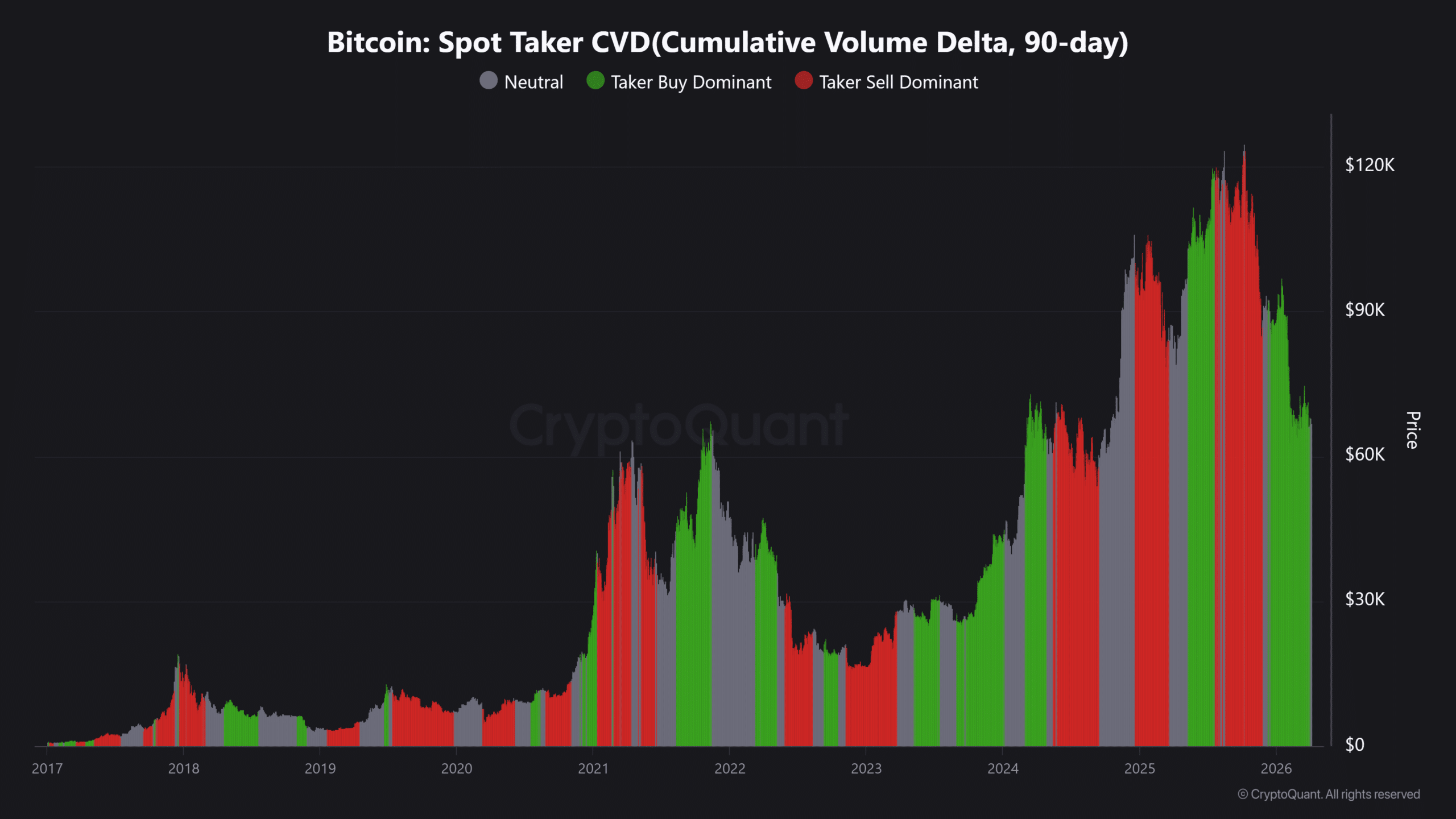
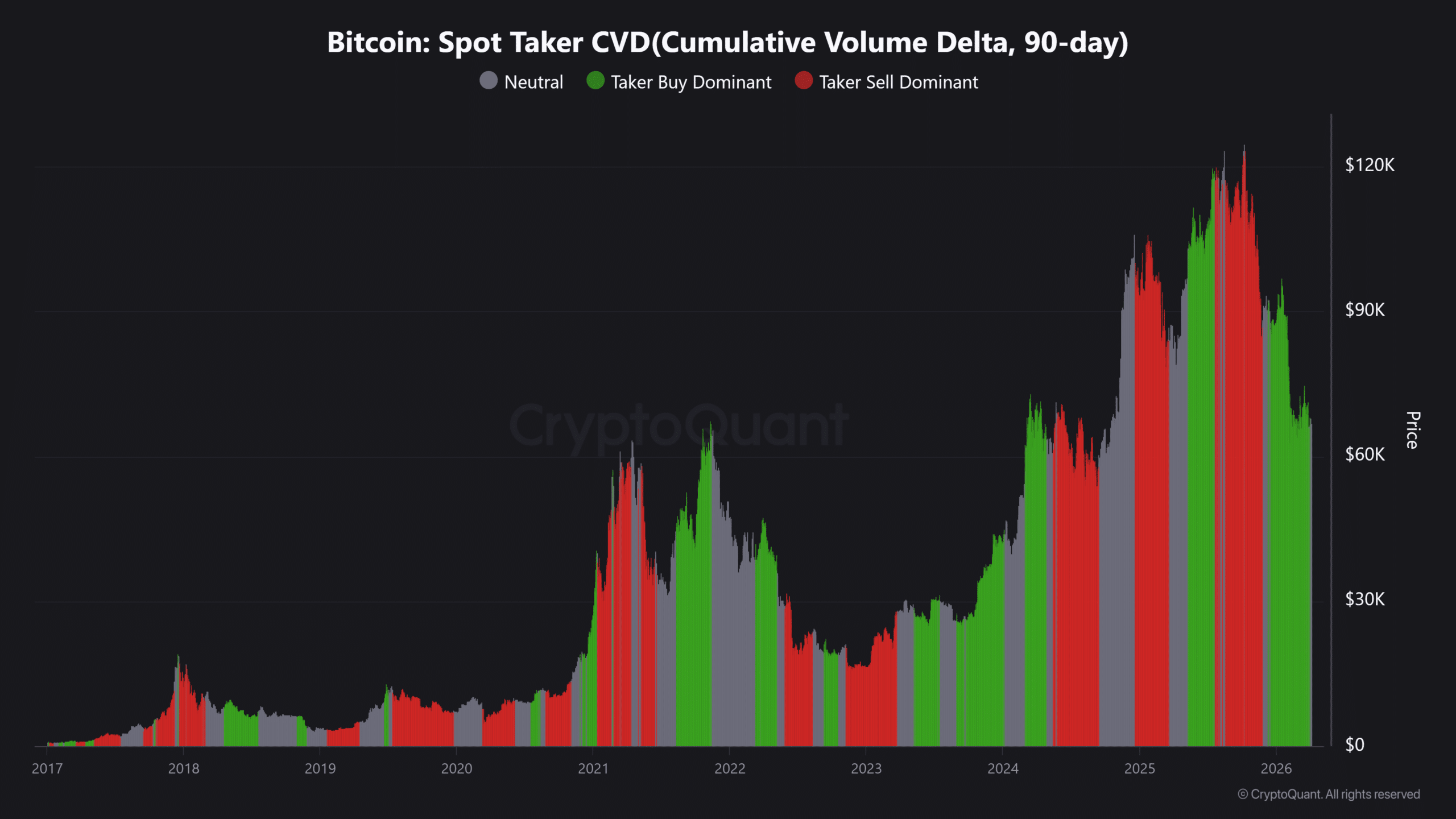
At the same time, while the narrow $66,569–$67,200 range hinted at consolidation, it also alluded to limited conviction. This happens when activity stays compressed, even though the Spot Taker CVD has continued to rise and point to underlying buy pressure.
Source: CryptoQuant
However, when the RVTS remains elevated yet the market cannot defend its floor, the low-activity reading shifts from potential accumulation to a demand vacuum.
Thus, resilience holds the structure together. And yet, without stronger participation, the same setup risks shifting from accumulation into a slow demand vacuum.
Strong hands absorb supply as market activity stays muted
In this context, the quiet market begins to reveal a shift under the surface, one where ownership changes even as activity stays low. For instance – The Long-Term Holder supply climbed to 14.90 million BTC. This hike suggested that experienced holders may be absorbing the supply, rather than distributing it.
Meanwhile, Exchange Reserves were near 2.7 million BTC, close to multi-year lows, reducing available supply on the market.
However, activity has stayed subdued, raising doubts about immediate demand strength. This happens because selling pressure fades as stronger hands take control.
Source: CryptoQuant
The result is a tightening supply structure, one where downside risk weakens, but a meaningful upside still depends on demand returning.
Final Summary
Bitcoin [BTC] held firm as its RVTS hit record highs, showing price strength driven by derivatives despite weak on-chain activity.
Bitcoin’s supply has tightened as long-term holders accumulated and Exchange Reserves fell, reducing sell pressure.
Связанные с этим вопросы
QWhat does the RVTS (Realized Value Transaction Volume) Ratio reaching 85 indicate about Bitcoin's market?
AThe RVTS Ratio reaching 85, its highest level ever, indicates that adjusted on-chain volume is shrinking, meaning fewer coins are moving relative to valuation. This suggests that the price might be holding firm even as network usage fades, driven more by derivatives and liquidity rather than spot-driven activity.
QHow has the market structure shift affected Bitcoin's price discovery?
AThe market structure has shifted with liquidity and derivatives now dominating price discovery, while spot-driven activity has weakened. This results in capital circulating off-chain, reducing the need for on-chain settlement and creating a scenario where price is sustained by positioning rather than participation.
QWhat historical pattern is mentioned regarding the RVTS Ratio spikes?
AHistorically, similar spikes in the RVTS Ratio above 60 occurred in 2022 during low-participation phases, often near cycle bottoms. However, the current move exceeds those levels, indicating deeper structural apathy in the market.
QWhat does the increase in Long-Term Holder supply and decrease in Exchange Reserves suggest?
AThe increase in Long-Term Holder supply to 14.90 million BTC and the decrease in Exchange Reserves to near 2.7 million BTC (multi-year lows) suggest that experienced holders are absorbing supply rather than distributing it. This reduces available supply on the market and weakens selling pressure, indicating a tightening supply structure.
QWhat is the potential outcome of the current market imbalance according to the article?
AThe current market imbalance, characterized by low activity and high RVTS, often precedes accumulation. As weaker hands exit and activity rebuilds, the imbalance is expected to resolve itself. However, without stronger participation, the setup risks shifting from accumulation into a slow demand vacuum, though downside risk weakens due to supply tightening.
ЦИФРОВОЕ ЗОЛОТО ($BITCOIN): Комплексный анализ Введение в ЦИФРОВОЕ ЗОЛОТО ($BITCOIN) ЦИФРОВОЕ ЗОЛОТО ($BITCOIN) — это проект на основе блокчейна, работающий в сети Solana, который стремится объединить характеристики традиционных драгоценных металлов с инновациями децентрализованных технологий. Хотя он носит имя Биткойн, часто называемого “цифровым золотом” из-за его восприятия как средства хранения ценности, ЦИФРОВОЕ ЗОЛОТО является отдельным токеном, предназначенным для создания уникальной экосистемы в ландшафте Web3. Его цель — позиционировать себя как жизнеспособный альтернативный цифровой актив, хотя детали его применения и функциональности все еще развиваются. Что такое ЦИФРОВОЕ ЗОЛОТО ($BITCOIN)? ЦИФРОВОЕ ЗОЛОТО ($BITCOIN) — это токен криптовалюты, специально разработанный для использования в блокчейне Solana. В отличие от Биткойна, который выполняет широко признанную роль хранения ценности, этот токен, похоже, сосредоточен на более широких приложениях и характеристиках. Примечательные аспекты включают: Инфраструктура блокчейна: Токен построен на блокчейне Solana, известном своей способностью обрабатывать высокоскоростные и недорогие транзакции. Динамика предложения: ЦИФРОВОЕ ЗОЛОТО имеет максимальное предложение, ограниченное 100 квадриллионами токенов (100P $BITCOIN), хотя детали о его обращающемся предложении в настоящее время не раскрыты. Утилита: Хотя точные функциональные возможности не описаны, есть указания на то, что токен может быть использован для различных приложений, потенциально связанных с децентрализованными приложениями (dApps) или стратегиями токенизации активов. Кто создатель ЦИФРОВОГО ЗОЛОТА ($BITCOIN)? На данный момент личность создателей и команды разработчиков, стоящих за ЦИФРОВЫМ ЗОЛОТОМ ($BITCOIN), остается неизвестной. Эта ситуация типична для многих инновационных проектов в области блокчейна, особенно тех, которые связаны с децентрализованными финансами и феноменом мем-криптовалют. Хотя такая анонимность может способствовать культуре, ориентированной на сообщество, она усиливает опасения по поводу управления и ответственности. Кто инвесторы ЦИФРОВОГО ЗОЛОТА ($BITCOIN)? Доступная информация указывает на то, что у ЦИФРОВОГО ЗОЛОТА ($BITCOIN) нет известных институциональных спонсоров или значительных венчурных капиталовложений. Проект, похоже, функционирует по модели пирингового взаимодействия, сосредоточенной на поддержке и принятии сообществом, а не на традиционных путях финансирования. Его активность и ликвидность в основном сосредоточены на децентрализованных биржах (DEX), таких как PumpSwap, а не на устоявшихся централизованных торговых платформах, что еще больше подчеркивает его подход, ориентированный на grassroots. Как работает ЦИФРОВОЕ ЗОЛОТО ($BITCOIN) Операционные механизмы ЦИФРОВОГО ЗОЛОТА ($BITCOIN) можно подробно описать на основе его дизайна блокчейна и характеристик сети: Механизм консенсуса: Используя уникальный механизм доказательства истории (PoH) Solana в сочетании с моделью доказательства доли (PoS), проект обеспечивает эффективную валидацию транзакций, что способствует высокой производительности сети. Токеномика: Хотя конкретные дефляционные механизмы не были подробно описаны, большое максимальное предложение токенов подразумевает, что оно может быть предназначено для микротранзакций или нишевых случаев использования, которые еще предстоит определить. Интероперабельность: Существует потенциал для интеграции с более широкой экосистемой Solana, включая различные платформы децентрализованных финансов (DeFi). Однако детали относительно конкретных интеграций остаются неуточненными. Хронология ключевых событий Вот хронология, которая подчеркивает значимые вехи, касающиеся ЦИФРОВОГО ЗОЛОТА ($BITCOIN): 2023: Первоначальное развертывание токена происходит в блокчейне Solana, отмеченное его адресом контракта. 2024: ЦИФРОВОЕ ЗОЛОТО приобретает видимость, когда оно становится доступным для торговли на децентрализованных биржах, таких как PumpSwap, позволяя пользователям обменивать его на SOL. 2025: Проект наблюдает спорадическую торговую активность и потенциальный интерес к инициативам, возглавляемым сообществом, хотя на данный момент не зафиксировано никаких значительных партнерств или технических достижений. Критический анализ Сильные стороны Масштабируемость: Основная инфраструктура Solana поддерживает высокие объемы транзакций, что может повысить полезность $BITCOIN в различных сценариях транзакций. Доступность: Потенциально низкая цена торговли за токен может привлечь розничных инвесторов, способствуя более широкому участию благодаря возможностям дробного владения. Риски Отсутствие прозрачности: Отсутствие публично известных спонсоров, разработчиков или процесса аудита может вызвать скептицизм относительно устойчивости и надежности проекта. Волатильность рынка: Торговая активность сильно зависит от спекулятивного поведения, что может привести к значительной волатильности цен и неопределенности для инвесторов. Заключение ЦИФРОВОЕ ЗОЛОТО ($BITCOIN) является интригующим, но неоднозначным проектом в быстро развивающейся экосистеме Solana. Хотя он пытается использовать нарратив “цифрового золота”, его отход от установленной роли Биткойна как средства хранения ценности подчеркивает необходимость более четкого различения его предполагаемой утилиты и структуры управления. Будущее принятие и усвоение, вероятно, будут зависеть от решения текущей непрозрачности и более четкого определения его операционных и экономических стратегий. Примечание: Этот отчет охватывает синтезированную информацию, доступную на октябрь 2023 года, и с тех пор могут произойти события.
Fractal Bitcoin — масштабное Layer-1-решнение, созданное на базе кода Биткоина, позволяющего достигать бесконечного масштабирования с помощью рекурсивного подхода.
Добро пожаловать в Сообщество HTX. Здесь вы сможете быть в курсе последних новостей о развитии платформы и получить доступ к профессиональной аналитической информации о рынке. Мнения пользователей о цене на BTC (BTC) представлены ниже.