By The Numbers: How Much Bitcoin Supply Is Exposed To Quantum Risk?

bitcoinistPublished on 2026-05-21Last updated on 2026-05-21

Abstract

Glassnode estimates that 6.04 million BTC, representing over 30% of the circulating supply, is potentially exposed to quantum computing risk. The risk arises when a wallet's public key is visible on the blockchain, which quantum computers could theoretically use to break cryptographic security. This exposed supply is divided into two categories: structurally unsafe coins (1.92 million BTC, 9.6%) due to older wallet designs, and operationally unsafe coins (4.12 million BTC, 20.6%) where practices like address reuse have revealed public keys. While structurally unsafe supply has decreased over time, operationally unsafe supply has grown. The remaining 13.99 million BTC are considered safe. Concurrently, Bitcoin's price is near $77,000, down over 3% weekly.

Analytics firm Glassnode has broken down how much of the Bitcoin supply is at risk due to Quantum Computing and what its composition looks like.

6.04 Million Bitcoin Is Estimated To Be Exposed To Quantum Risk

In a new X article, Glassnode has talked about the part of the Bitcoin supply in circulation that’s exposed to the risk posed by Quantum Computing. “Quantum Computing” refers to an emerging class of computers that can, in theory, be powerful enough to break advanced cryptographic systems. Bitcoin and other cryptocurrencies could be examples of such systems.

While Quantum Computing is something that has been “upcoming” for years now, the technology has made some advancements recently that has made many in the digital asset industry talk about its possible consequences for the sector.

For Bitcoin, the main threat from Quantum Computing involves the supply that’s sitting in vulnerable wallets. “The relevant threshold is whether the public key needed to spend a coin is already visible on-chain,” noted Glassnode.

Based on this criteria, the analytics firm has estimated 6.04 million tokens to be vulnerable to potential Quantum Computing attacks. In terms of the supply percentage, these coins make up for more than 30% of all BTC in existence today.

The supply at risk to the Quantum Computing threat can be further divided into two categories. As Glassnode explained:

The first is structural exposure: outputs whose script type reveals the public key by design. The second is operational exposure: coins that may have been protected initially, but where address reuse, partial spending, or custody behaviour has already made the public key visible while BTC remains tied to it.

Below is a chart that shows how the composition of the Bitcoin supply has changed in terms of these two categories over the years.
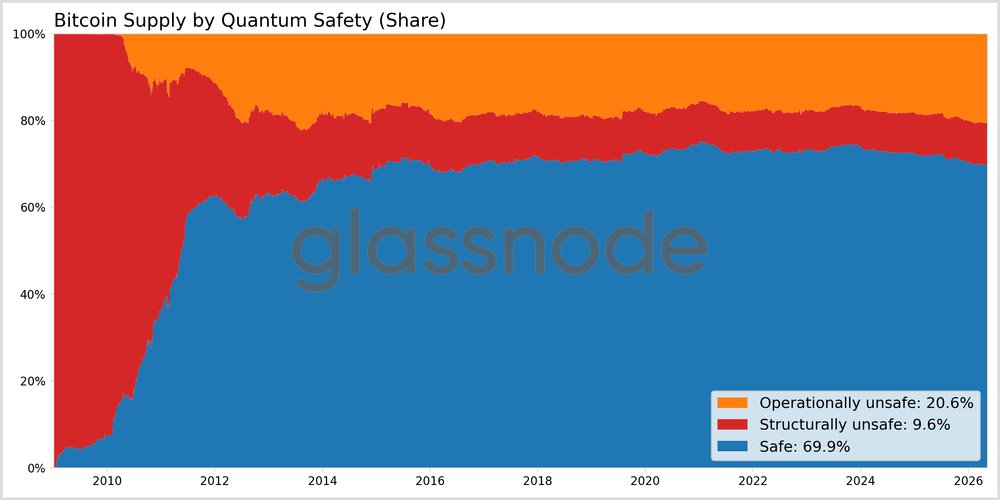
Looks like the operationally unsafe supply has grown in size | Source: Glassnode on X

As is visible in the graph, a major part of the Bitcoin supply was structurally unsafe during the cryptocurrency’s early years. This is naturally due to the fact that early wallets weren’t as secure as those in use today.

As the years have gone by and investors have adopted better wallet standards, the structurally unsafe supply has shrunken to just 9.6%. A notable 20.6% of the supply, however, is still inside the operationally unsafe category. This part of the supply has actually seen some growth in recent years.

In pure numbers, the operationally unsafe supply includes about 4.12 million BTC right now, as the below chart shows.
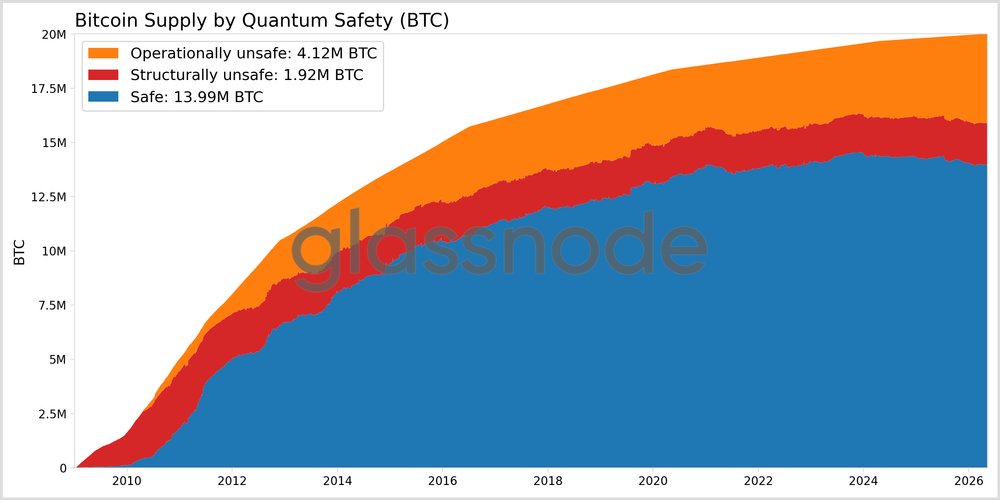
The breakdown of the BTC supply by quantum safety | Source: Glassnode on X

Meanwhile, the structurally unsafe supply is made up of 1.92 million BTC, while the safe one includes 13.99 million BTC.

BTC Price

At the time of writing, Bitcoin is floating around $77,000, down more than 3% in the last seven days.

The price of the coin seems to have declined recently | Source: BTCUSDT on TradingView


Related Questions

QAccording to Glassnode, how many Bitcoin are estimated to be exposed to quantum risk, and what percentage of the total supply does this represent?

AGlassnode estimates that 6.04 million Bitcoin are exposed to quantum risk, which represents more than 30% of the total Bitcoin supply in existence today.

QWhat are the two categories into which the Bitcoin supply at risk from Quantum Computing is divided, and what are the current figures for each in terms of supply percentage?

AThe two categories are 'structural exposure' and 'operational exposure'. Currently, structurally unsafe supply makes up 9.6% of the total supply, while operationally unsafe supply makes up 20.6%.

QWhat specific condition, according to the article, determines if a Bitcoin holding is vulnerable to a potential Quantum Computing attack?

AThe relevant condition is whether the public key needed to spend a coin is already visible on the blockchain. If it is, that Bitcoin is considered vulnerable to a potential Quantum Computing attack.

QHow has the 'structurally unsafe' Bitcoin supply changed from the cryptocurrency's early years to the present?

ADuring Bitcoin's early years, a major part of the supply was structurally unsafe due to less secure wallet standards. Over time, as better wallet standards were adopted, this portion has shrunk to just 9.6%.

QBased on the data provided in the article's final charts, how many Bitcoin are currently in the 'safe' category regarding quantum risk, and what was the price of Bitcoin at the time of writing?

AThere are 13.99 million Bitcoin in the 'safe' category. At the time of writing, Bitcoin was floating around $77,000.

Related Reads

Detained for 37 Days: The First Wave of People Who Got Rich from 'AI Gateways' Are Starting to Go to Jail

A prominent AI proxy service operator was reportedly detained for 37 days and is now on bail pending trial, highlighting the legal risks in China's booming but unregulated AI intermediary market. These services act as "AI scalpers," providing domestic users with access to restricted overseas models (like OpenAI, Claude) by bundling APIs, handling payments, and bypassing network blocks, all for a fee. Their controversial profitability stems from practices like bulk-registering accounts to resell free credits, exploiting refund policies, overcharging for tokens, substituting cheaper models, and illegally selling user conversation data. Major figures, including cryptocurrency entrepreneurs, are now entering this space. Legally, these operations face severe risks. Their core model often involves unauthorized API access and operating without required telecom licenses, potentially constituting illegal business operations. They fail to meet data security obligations for the vast amounts of user data they process, risking charges for failing to fulfill network security duties. Crucially, the unauthorized collection and sale of user data, which can include personal and commercial secrets, easily meets the threshold for the crime of infringing on personal information. The case underscores a critical juncture for the AI industry. While proxies lower access barriers, they expose user data to unsecured middlemen and undermine the business models of AI developers, forcing them to divert resources to security and distorting market value perceptions. The article argues that the industry's sustainable future depends on building trust, protecting data, and fostering compliant competition, moving away from its current "wild growth" phase.

marsbit2h ago

Detained for 37 Days: The First Wave of People Who Got Rich from 'AI Gateways' Are Starting to Go to Jail

marsbit2h ago

Trading

Spot
Futures

Hot Articles

What is $BITCOIN

DIGITAL GOLD ($BITCOIN): A Comprehensive Analysis Introduction to DIGITAL GOLD ($BITCOIN) DIGITAL GOLD ($BITCOIN) is a blockchain-based project operating on the Solana network, which aims to combine the characteristics of traditional precious metals with the innovation of decentralized technologies. While it shares a name with Bitcoin, often referred to as “digital gold” due to its perception as a store of value, DIGITAL GOLD is a separate token designed to create a unique ecosystem within the Web3 landscape. Its goal is to position itself as a viable alternative digital asset, although specifics regarding its applications and functionalities are still developing. What is DIGITAL GOLD ($BITCOIN)? DIGITAL GOLD ($BITCOIN) is a cryptocurrency token explicitly designed for use on the Solana blockchain. In contrast to Bitcoin, which provides a widely recognized value storage role, this token appears to focus on broader applications and characteristics. Notable aspects include: Blockchain Infrastructure: The token is built on the Solana blockchain, known for its capacity to handle high-speed and low-cost transactions. Supply Dynamics: DIGITAL GOLD has a maximum supply capped at 100 quadrillion tokens (100P $BITCOIN), although details regarding its circulating supply are currently undisclosed. Utility: While precise functionalities are not explicitly outlined, there are indications that the token could be utilized for various applications, potentially involving decentralized applications (dApps) or asset tokenization strategies. Who is the Creator of DIGITAL GOLD ($BITCOIN)? At present, the identity of the creators and development team behind DIGITAL GOLD ($BITCOIN) remains unknown. This situation is typical among many innovative projects within the blockchain space, particularly those aligning with decentralized finance and meme coin phenomena. While such anonymity may foster a community-driven culture, it intensifies concerns about governance and accountability. Who are the Investors of DIGITAL GOLD ($BITCOIN)? The available information indicates that DIGITAL GOLD ($BITCOIN) does not have any known institutional backers or prominent venture capital investments. The project seems to operate on a peer-to-peer model focused on community support and adoption rather than traditional funding routes. Its activity and liquidity are primarily situated on decentralized exchanges (DEXs), such as PumpSwap, rather than established centralized trading platforms, further highlighting its grassroots approach. How DIGITAL GOLD ($BITCOIN) Works The operational mechanics of DIGITAL GOLD ($BITCOIN) can be elaborated on based on its blockchain design and network attributes: Consensus Mechanism: By leveraging Solana’s unique proof-of-history (PoH) combined with a proof-of-stake (PoS) model, the project ensures efficient transaction validation contributing to the network's high performance. Tokenomics: While specific deflationary mechanisms have not been extensively detailed, the vast maximum token supply implies that it may cater to microtransactions or niche use cases that are still to be defined. Interoperability: There exists the potential for integration with Solana’s broader ecosystem, including various decentralized finance (DeFi) platforms. However, the details regarding specific integrations remain unspecified. Timeline of Key Events Here is a timeline that highlights significant milestones concerning DIGITAL GOLD ($BITCOIN): 2023: The initial deployment of the token occurs on the Solana blockchain, marked by its contract address. 2024: DIGITAL GOLD gains visibility as it becomes available for trading on decentralized exchanges like PumpSwap, allowing users to trade it against SOL. 2025: The project witnesses sporadic trading activity and potential interest in community-led engagements, although no noteworthy partnerships or technical advancements have been documented as of yet. Critical Analysis Strengths Scalability: The underlying Solana infrastructure supports high transaction volumes, which could enhance the utility of $BITCOIN in various transaction scenarios. Accessibility: The potential low trading price per token could attract retail investors, facilitating wider participation due to fractional ownership opportunities. Risks Lack of Transparency: The absence of publicly known backers, developers, or an audit process may yield skepticism regarding the project's sustainability and trustworthiness. Market Volatility: The trading activity is heavily reliant on speculative behavior, which can result in significant price volatility and uncertainty for investors. Conclusion DIGITAL GOLD ($BITCOIN) emerges as an intriguing yet ambiguous project within the rapidly evolving Solana ecosystem. While it attempts to leverage the “digital gold” narrative, its departure from Bitcoin's established role as a store of value underscores the need for a clearer differentiation of its intended utility and governance structure. Future acceptance and adoption will likely depend on addressing the current opacity and defining its operational and economic strategies more explicitly. Note: This report encompasses synthesised information available as of October 2023, and developments may have transpired beyond the research period.

363 Total ViewsPublished 2025.05.13Updated 2025.05.13

What is $BITCOIN

Discussions

Welcome to the HTX Community. Here, you can stay informed about the latest platform developments and gain access to professional market insights. Users' opinions on the price of BTC (BTC) are presented below.

活动图片