Bitcoin Supply In Profit Drops Sharply, Echoing Previous Bear Market Levels, Downtrend To Continue?

bitcoinistPublished on 2026-04-11Last updated on 2026-04-11

Abstract

Bitcoin's price has failed to recover significantly since its all-time high, reinforcing bearish sentiment. The supply of BTC in profit has sharply declined to around 59%, nearing levels last seen during the previous bear market. This indicates that nearly half of all Bitcoin is held at a loss, well below the historical average of 75%. Analysts suggest that if the profit supply drops to 50%, it could signal a market bottom, though current conditions point to a potential accumulation phase rather than mass selling. Additionally, the MVRV Z-Score has not yet entered the bottoming zone, suggesting the bear market may continue for another six months, with another major price drop likely.

Since falling from its all-time high in 2025, the Bitcoin price has failed to initiate another major upward move, reinforcing the bear market narrative. After this sharp downward action over the past few months, the amount of BTC supply in loss is spiking hard, reaching levels not seen in years.

Profit Supply On Bitcoin Contracts To Multi-Year Lows

Bitcoin’s price may have witnessed a brief upswing, reclaiming the $72,000 mark, but the underlying structure remains highly bearish. The prolonged negative price performance has started to influence BTC’s market dynamics, with supply in the loss territory rising at a fast rate.

With the price of Bitcoin falling sharply, Darkfost, a market expert and CryptoQuant’s verified author, revealed that profit supply has collapsed, nearing levels last seen in the last bear market phase. This decline, which reflects the strain of recent market activity, indicates that an increasing percentage of holders are either at breakeven or sitting on unrealized losses.

Darkfost stated that nearly 1 BTC out of 2 is held at a loss as of Thursday. To be precise, the share of Bitcoin supply still in profit is estimated at around 59%, a level that almost aligns with what was observed during the last bear market. According to historical data, the average level sits closer to about 75% of supply in profit. Therefore, the current market cycle is now below typical levels.
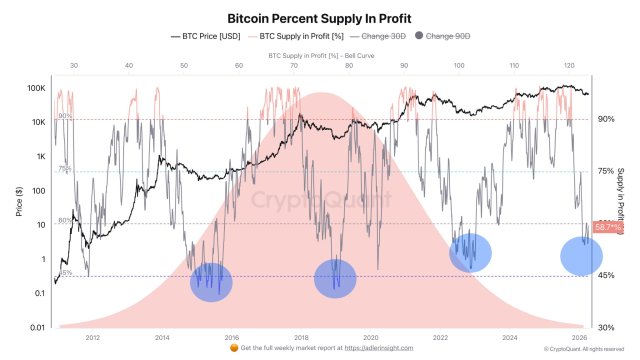
BTC supply in profit shrinks | Source: Chart from Darkfost on X

These levels can trigger periods of capitulation or consolidation, but they also frequently indicate a decline in market confidence and a diminished motivation to sell. While it may seem counterintuitive to some crypto players, the expert claims that the market clearly needs investors to make profits in order to maintain a positive momentum.

However, the key level to watch out for is 50%, which could completely flip the market structure, as bear markets have often bottomed around this area. Given the market state, this metric should be closely watched since it helps assess when losses or profits become significant across the market, allowing for a relatively straightforward strategy.

Specifically, this strategy involves accumulating when losses hit extreme levels, putting some investors ahead of a majority of players. It also helps to manage exposure when profits approach 100%. As profit margins shrink across the network, the current environment seems more of an accumulation phase than selling at this stage.

BTC Bear Market Is Still Active

As the debate regarding a bear market bottom heats up, a crypto analyst has offered insights on the matter, noting that Bitcoin has yet to hit a bottom. The expert’s analysis is backed by signals from the BTC Market Value to Realized Value (MVRV) Z-Score. While some considered the $60,000 level as the bear market bottom for BTC, the expert has dismissed this narrative.

According to the expert, the MVRV has not yet fallen into the green bottoming zone, which means the bear market is still active. In terms of timing, the analyst has predicted an additional 6 months into the bear market. As a result, another major drop for BTC is inevitable.

BTC trading at $71,599 on the 1D chart | Source: BTCUSDT on Tradingview.com

Trending Cryptos

Related Questions

QWhat percentage of Bitcoin supply is currently in profit, and how does this compare to historical levels?

ACurrently, around 59% of Bitcoin supply is in profit. This is significantly below the historical average of approximately 75% and is near levels last seen during the previous bear market.

QAccording to the expert Darkfost, what is the key level for the profit supply metric that could completely flip the market structure?

AThe key level to watch is 50%. Bear markets have often bottomed around this area, and falling to or below this level could signal a major shift in market structure.

QWhat does the analysis of the BTC Market Value to Realized Value (MVRV) Z-Score indicate about the current market state?

AThe analysis indicates that the MVRV Z-Score has not yet fallen into the green bottoming zone, which suggests that the bear market is still active and a true bottom has not been reached.

QHow long does the analyst predict the current bear market could last based on the MVRV signal?

AThe analyst predicts the bear market could last for an additional 6 months, implying that another major price drop for Bitcoin is inevitable.

QDoes the current environment with shrinking profit margins suggest an accumulation or a selling phase for investors?

AThe current environment, characterized by shrinking profit margins, is described as being more of an accumulation phase rather than a selling phase at this stage.

Related Reads

WeChat AI Card Hands-On Guide: Has the AI Shopping Era Arrived?

**"WeChat AI Card" Practical Test Guide: Has the Era of AI Shopping Arrived?** WeChat has officially launched the "AI Exclusive Card," a feature integrated into its Workbuddy AI assistant. This card is designed to handle payments for AI-initiated purchases. Our hands-on test reveals it's not yet a tool for fully autonomous AI shopping, but rather a controlled payment layer for AI agents. The AI Card functions as an isolated sub-wallet within WeChat Pay. Users must bind the card and transfer funds into it from their main wallet. Crucially, every transaction requires explicit user confirmation via smartphone scan; AI cannot spend autonomously. Currently accessible through the Workbuddy agent, the card targets specific digital consumption scenarios: purchasing paid content (reports, data), calling paid APIs/tools, and subscribing to services. Its design prioritizes security and control by separating funds and mandating approval for each payment. We tested a real-world scenario: ordering bubble tea via Workbuddy using a "Meituan Life Assistant" skill. The process encountered multiple hurdles: high "skill" usage costs (exceeding daily free credits), and most importantly, while a payment was successfully initiated, the AI purchased an incorrect product (a mismatched group-buy coupon instead of the desired drink). This highlights the current limitation: the **AI Card only solves the payment step**. The broader challenge lies in the **AI agent's execution chain**—accurately understanding intent, navigating third-party platforms, selecting the right product, and ensuring proper fulfillment. The payment succeeded, but the purchase failed to meet the user's need. In conclusion, the WeChat AI Exclusive Card is a cautious, early-step experiment in AI commerce. It provides a secure, user-controlled payment method for agent interactions but is not yet capable of reliable, end-to-end complex purchases. For now, it's best used for low-value, low-risk digital services with careful user verification at each step. The vision of AI handling complete shopping tasks remains a work in progress.

marsbit2h ago

WeChat AI Card Hands-On Guide: Has the AI Shopping Era Arrived?

marsbit2h ago

Deconstructing Notion's Growth: From a Note-taking Tool to 100 Million Users—How Notion Built a Triple Growth Flywheel Through Product, Templates, and Community

Notion's growth from a niche note-taking tool to a platform with 100 million users is powered by three interconnected flywheels: Product-Led Growth (PLG), a Template Economy, and Community-Driven Growth. First, Notion's PLG strategy relies on a highly flexible, "plastic" product that users can adapt to countless personal and team workflows. Its freemium model lowers the barrier to entry, while features like page sharing and collaboration drive organic, usage-based viral growth as users naturally invite others. Second, the Template Economy solves the "blank page" problem. Templates, created by both Notion and its community, transform abstract product capabilities into concrete, copyable solutions for specific scenarios (e.g., project management, content calendars). This dramatically lowers activation costs for new users and fuels SEO-driven discovery. Third, a vibrant Community acts as a distributed growth engine. Users and official Ambassadors create tutorials, share use cases, and host local events. This community not only educates users but also fosters a sense of identity around pursuing "better ways of working," strengthening loyalty and enabling global, low-cost expansion. Together, these flywheels create a self-reinforcing ecosystem: a great product attracts users who create templates and community content, which in turn attracts more users and deepens engagement. This system allowed Notion to scale from individuals to teams and enterprises through a bottom-up adoption path. Looking ahead, AI integration promises to accelerate these flywheels further by making templates smarter and the platform a potential AI-native work operating system. Ultimately, Notion's defensible advantage is not just its features, but this deeply entrenched network of user assets, creators, and community trust.

marsbit2h ago

Deconstructing Notion's Growth: From a Note-taking Tool to 100 Million Users—How Notion Built a Triple Growth Flywheel Through Product, Templates, and Community

marsbit2h ago

$10 Billion, Qualcomm to Acquire Chip Legend Jim Keller's Company

Global mobile chip giant Qualcomm is in advanced talks to acquire AI chip startup Tenstorrent in a deal valued between $8-10 billion, according to media reports. This potential acquisition would be one of the largest in the AI chip sector in recent years. Tenstorrent, led by legendary chip architect Jim Keller, has gained prominence for its RISC-V architecture and AI accelerator designs. The move highlights Qualcomm's strategic push to diversify beyond its core smartphone chip business. As the smartphone market matures, Qualcomm is aggressively targeting growth in automotive, data center, and cloud AI. Acquiring Tenstorrent would allow Qualcomm to rapidly enter the high-end AI computing market, bypassing lengthy in-house development cycles. Tenstorrent's cost-effective system architecture, which avoids expensive HBM memory and relies on standard Ethernet for clustering, offers a potential alternative to Nvidia's costly solutions. Furthermore, Tenstorrent's high-performance RISC-V CPU technology and its focus on the automotive and edge computing segments align with Qualcomm's strategic goals, including its "Snapdragon Digital Chassis" platform. Despite the strategic rationale, the high valuation has sparked some investor caution. The successful integration of Tenstorrent's open-source culture and independent team into Qualcomm's organization, along with the commercialization of its technology, remains a key challenge.

marsbit2h ago

$10 Billion, Qualcomm to Acquire Chip Legend Jim Keller's Company

marsbit2h ago

Trading

Spot
Futures

Hot Articles

What is $BITCOIN

DIGITAL GOLD ($BITCOIN): A Comprehensive Analysis Introduction to DIGITAL GOLD ($BITCOIN) DIGITAL GOLD ($BITCOIN) is a blockchain-based project operating on the Solana network, which aims to combine the characteristics of traditional precious metals with the innovation of decentralized technologies. While it shares a name with Bitcoin, often referred to as “digital gold” due to its perception as a store of value, DIGITAL GOLD is a separate token designed to create a unique ecosystem within the Web3 landscape. Its goal is to position itself as a viable alternative digital asset, although specifics regarding its applications and functionalities are still developing. What is DIGITAL GOLD ($BITCOIN)? DIGITAL GOLD ($BITCOIN) is a cryptocurrency token explicitly designed for use on the Solana blockchain. In contrast to Bitcoin, which provides a widely recognized value storage role, this token appears to focus on broader applications and characteristics. Notable aspects include: Blockchain Infrastructure: The token is built on the Solana blockchain, known for its capacity to handle high-speed and low-cost transactions. Supply Dynamics: DIGITAL GOLD has a maximum supply capped at 100 quadrillion tokens (100P $BITCOIN), although details regarding its circulating supply are currently undisclosed. Utility: While precise functionalities are not explicitly outlined, there are indications that the token could be utilized for various applications, potentially involving decentralized applications (dApps) or asset tokenization strategies. Who is the Creator of DIGITAL GOLD ($BITCOIN)? At present, the identity of the creators and development team behind DIGITAL GOLD ($BITCOIN) remains unknown. This situation is typical among many innovative projects within the blockchain space, particularly those aligning with decentralized finance and meme coin phenomena. While such anonymity may foster a community-driven culture, it intensifies concerns about governance and accountability. Who are the Investors of DIGITAL GOLD ($BITCOIN)? The available information indicates that DIGITAL GOLD ($BITCOIN) does not have any known institutional backers or prominent venture capital investments. The project seems to operate on a peer-to-peer model focused on community support and adoption rather than traditional funding routes. Its activity and liquidity are primarily situated on decentralized exchanges (DEXs), such as PumpSwap, rather than established centralized trading platforms, further highlighting its grassroots approach. How DIGITAL GOLD ($BITCOIN) Works The operational mechanics of DIGITAL GOLD ($BITCOIN) can be elaborated on based on its blockchain design and network attributes: Consensus Mechanism: By leveraging Solana’s unique proof-of-history (PoH) combined with a proof-of-stake (PoS) model, the project ensures efficient transaction validation contributing to the network's high performance. Tokenomics: While specific deflationary mechanisms have not been extensively detailed, the vast maximum token supply implies that it may cater to microtransactions or niche use cases that are still to be defined. Interoperability: There exists the potential for integration with Solana’s broader ecosystem, including various decentralized finance (DeFi) platforms. However, the details regarding specific integrations remain unspecified. Timeline of Key Events Here is a timeline that highlights significant milestones concerning DIGITAL GOLD ($BITCOIN): 2023: The initial deployment of the token occurs on the Solana blockchain, marked by its contract address. 2024: DIGITAL GOLD gains visibility as it becomes available for trading on decentralized exchanges like PumpSwap, allowing users to trade it against SOL. 2025: The project witnesses sporadic trading activity and potential interest in community-led engagements, although no noteworthy partnerships or technical advancements have been documented as of yet. Critical Analysis Strengths Scalability: The underlying Solana infrastructure supports high transaction volumes, which could enhance the utility of $BITCOIN in various transaction scenarios. Accessibility: The potential low trading price per token could attract retail investors, facilitating wider participation due to fractional ownership opportunities. Risks Lack of Transparency: The absence of publicly known backers, developers, or an audit process may yield skepticism regarding the project's sustainability and trustworthiness. Market Volatility: The trading activity is heavily reliant on speculative behavior, which can result in significant price volatility and uncertainty for investors. Conclusion DIGITAL GOLD ($BITCOIN) emerges as an intriguing yet ambiguous project within the rapidly evolving Solana ecosystem. While it attempts to leverage the “digital gold” narrative, its departure from Bitcoin's established role as a store of value underscores the need for a clearer differentiation of its intended utility and governance structure. Future acceptance and adoption will likely depend on addressing the current opacity and defining its operational and economic strategies more explicitly. Note: This report encompasses synthesised information available as of October 2023, and developments may have transpired beyond the research period.

391 Total ViewsPublished 2025.05.13Updated 2025.05.13

What is $BITCOIN

Discussions

Welcome to the HTX Community. Here, you can stay informed about the latest platform developments and gain access to professional market insights. Users' opinions on the price of BTC (BTC) are presented below.

活动图片














