Altcoin Season In Q1? Bitcoin, Ethereum Breakdown Maps Out Performance

bitcoinistPublished on 2026-01-07Last updated on 2026-01-07

Abstract

A crypto market expert predicts a strong altcoin season in Q1 2026, driven by Bitcoin's bearish consolidation and Ethereum's recovery. Analyst 'ChainHub' notes that Bitcoin's distribution phase ended earlier than expected, with a potential price top around $107,000–$108,000, well below its previous all-time high. While Bitcoin remains bearish, its declining dominance may allow altcoins to lead. Ethereum shows mixed signals but could reach new highs near $5,000–$5,500. The ETH/Silver ratio indicates a shift from precious metals to crypto. Altcoins like Dogecoin and SUI have already found bottoms, with Total3 and others expected to drive the rally, potentially exceeding previous highs from summer 2025.

A crypto market expert has predicted a strong altcoin season in the first quarter of 2026, pointing to recent price action for Bitcoin (BTC) and Ethereum (ETH) as key indicators. The analyst noted that Bitcoin’s steady consolidation and Ethereum’s recovery from price dips are laying the groundwork for a bullish shift in the altcoin market.

Bitcoin And Ethereum Trends Signal Altcoin Season In Q1 2026

A market analyst identified as ‘ChainHub’ on X has announced that the crypto market is showing signs of an altcoin season in Q1 2026. He shared a detailed breakdown of Bitcoin and Ethereum setups that indicate and support a strong altcoin performance in February and March this year.

Compared to 2021, which saw the last altcoin season, this cycle’s rally has been delayed by three months, pushing a potential altseason into Q1 after Bitcoin completed its distribution phase. ChainHub notes that BTC’s price bottom came a little earlier than expected. He highlighted that refined lower-time-frame cycles initially suggested a bottom would form between mid-January and early February in 2026. However, BTC bottomed out by late December 2025.

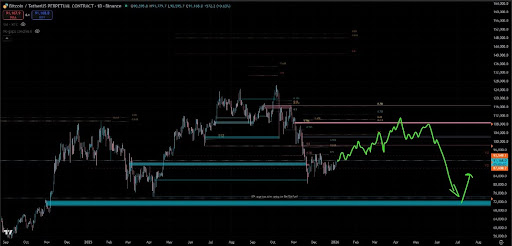
Notably, the analyst disclosed that while Bitcoin remains extremely bearish, this creates an ideal opportunity for altcoins to lead when BTC dominance weakens. Due to its ongoing bear market, ChainHub has predicted that BTC is unlikely to reach a new all-time high soon. He estimates that the cryptocurrency’s next price top could be around $107,000 to $108,000, representing a more than 15% decline from its ATH above $126,000.

Source: Chart from ChainHub on X

While BTC’s slow performance supports an altcoin season in 2026, Ethereum is showing mixed signals. ChainHub disclosed that on shorter timeframes, the ETH price is less bullish, but longer-term charts point to the potential for a new all-time high near $5,000-$5,500. He revealed that Ethereum bottoming around $2,600- $2,700 is not a reliable indicator of an upcoming altseason. However, its overall bullish nature supports long-term upward momentum.

The analyst also noted that the ETH/Silver ratio points to a rotation from precious metals into cryptocurrencies, signaling renewed investor interest in alts after October 2025’s missed rotation expectations. According to ChainHub, these developments suggest a strong altcoin season in Q1, especially as BTC’s dominance declines and demand for alts rises.

Analyst Sees Alt Rally As Market Strengthens

ChainHub has remained bullish and confident that an altseason will occur in Q1, after setups in Q4 2025, such as Dogecoin and SUI, successfully reversed and found their bottoms. He revealed that Total3 and others are the primary focus of the pump. Because of this, he is targeting filling gaps from October 10, though the altcoin sector’s strength could push prices beyond these levels.

According to ChainHub, some altcoins may even reach their extreme highs from summer 2025, with bullish continuation providing opportunities to buy during price dips. The analyst noted that, since Bitcoin and Ethereum are not performing as well as alts in the current market, he expects a pivot by mid-January. He says this pivot could act as a retest, which could be even more bullish for alts and provide additional fuel for upward moves.

Overall market cap excluding BTC at $1.3 trillion on the 1D chart | Source: TOTAL2 on Tradingview.com

Trending Cryptos

Related Questions

QAccording to the analyst ChainHub, when is a strong altcoin season predicted to occur?

AA strong altcoin season is predicted to occur in the first quarter (Q1) of 2026.

QWhat are the two key cryptocurrency indicators that the analyst points to for this prediction?

AThe analyst points to the recent price action of Bitcoin (BTC) and Ethereum (ETH) as the key indicators.

QWhat is the estimated price range for Bitcoin's next top, and how does it compare to its previous all-time high?

ABitcoin's next price top is estimated to be around $107,000 to $108,000, which is a more than 15% decline from its previous all-time high above $126,000.

QWhat potential new all-time high price range does the analyst suggest for Ethereum on longer-term charts?

AOn longer-term charts, the analyst suggests Ethereum has the potential for a new all-time high near $5,000 to $5,500.

QWhat does the ETH/Silver ratio indicate, according to the analysis?

AThe ETH/Silver ratio points to a rotation from precious metals into cryptocurrencies, signaling renewed investor interest in altcoins.

Related Reads

WEEX TradFi Trading Competition Kicks Off, 50,000 USDT Prize Pool First-Come, First-Served, Open a Position and Get 5 U

WEEX Exchange Launches "TradFi Trading Competition" with a 50,000 USDT Prize Pool Amidst a crypto market downturn, WEEX Exchange highlights the growth of tokenized traditional finance (TradFi) assets as a key trend, allowing users to trade stocks, ETFs, and commodities using crypto. The platform has launched a "TradFi Trading Competition" from July 9th to 23rd, featuring a 50,000 USDT prize pool. The campaign offers three reward tiers: 1. **New User Bonus (25,000 USDT pool):** New users depositing ≥100 USDT, completing a specified spot trade, and one TradFi contract trade (margin ≥10 USDT) receive 200 USDT. 2. **Volume-Based Rewards (20,000 USDT pool):** All users can earn tiered bonuses for achieving TradFi contract trading volumes of 5,000 USDT (3 USDT), 20,000 USDT (10 USDT), and 100,000 USDT (50 USDT). Rewards are stackable. 3. **Participation Reward:** Any user opening a TradFi contract trade during the event receives 5 USDT instantly. The article promotes WEEX's TradFi features, which include trading tokenized shares of companies like NVIDIA and Tesla using USDT, 24/7 trading, fractional share investing starting from $5, and high leverage up to 100x for hedging. It positions these features as solutions to traditional investing barriers like high fees, strict trading hours, and high share prices. The summary concludes by encouraging users to join the competition and leverage WEEX's platform to access global TradFi markets.

marsbit12m ago

WEEX TradFi Trading Competition Kicks Off, 50,000 USDT Prize Pool First-Come, First-Served, Open a Position and Get 5 U

marsbit12m ago

Switching Chains for Another Shot at Success: Can It Really 'Change One's Destiny'?

Recent months have witnessed a wave of established blockchain projects migrating to new public chains, notably Base and Arbitrum, coupled with strategic pivots in their business models—essentially "re-starting" elsewhere. Examples include Sophon (moving from ZKsync to Base to cut $3M+ annual costs and focus on consumer apps), Moonbeam (shifting from Polkadot to Base to pursue decentralized AI), and Secret Network (planning a move from Cosmos to Arbitrum to explore privacy-AI integrations, though its token price plunged 30% post-announcement). A common thread is that these migrating projects are primarily layer-1 or layer-2 chains now seeking relevance in AI and real-world consumer applications. This trend highlights the relative stagnation of ecosystems like Polkadot and Cosmos, which are seeing significant outflows. However, the community remains skeptical about whether such chain-hopping truly enables a turnaround. Historical cases like y00ts NFTs (which moved from Solana to Polygon and back to Ethereum) and Synthetix (which retreated from a multi-chain strategy) show that migration often fails to deliver expected benefits and can add complexity. In today's more rational market, devoid of easy narrative or airdrop红利, simply changing chains is unlikely to be a silver bullet. For both migrating projects and destination chains, the real challenge lies not in attracting projects but in developing actual use cases that retain users.

marsbit16m ago

Switching Chains for Another Shot at Success: Can It Really 'Change One's Destiny'?

marsbit16m ago

Does Switching Chains to Re-entrepreneur Really "Change One's Destiny"?

Amid a recent wave of blockchain migrations, several established projects, including Sophon, Moonbeam, and Secret Network, are moving to new ecosystems like Base and Arbitrum. Unlike past migrations driven by hype or security, these moves are often accompanied by strategic pivots, such as shifting focus to consumer applications, AI, or privacy-AI integration, effectively representing a "re-startup" attempt. However, the crypto community has reacted cautiously. Following Secret Network's announcement of its planned migration to Arbitrum, its token price plummeted over 30% in 24 hours. While migrating to more cost-efficient, higher-traffic, or technologically suitable chains can be a pragmatic choice, history shows that such moves rarely guarantee success. Examples like the y00ts NFT project, which moved from Solana to Polygon and then to Ethereum, or Synthetix’s retreat from a multi-chain strategy, illustrate the challenges and often underwhelming results. The current market environment, characterized by greater user rationality and the partial validation of past narratives, makes a successful "pivot via migration" even more difficult. Simultaneously, destination chains themselves face challenges in demonstrating sustainable user adoption beyond merely attracting migrating projects. Ultimately, the competition is shifting from which chain can onboard the most projects to which can genuinely foster real-world application and retain users.

链捕手21m ago

Does Switching Chains to Re-entrepreneur Really "Change One's Destiny"?

链捕手21m ago

June Transaction Volume Doubles: x402 Ecosystem Continues to Expand, Content Monetization Narrative Faces Crucial Test

X402, a protocol for AI and data services, experienced significant growth in June. Its transaction volume doubled compared to May, primarily driven by the AI inference routing service BlockRun. The ecosystem expanded with new integrations: Apify enabled data scraping services, Exa extended its AI search to Solana, and Seal launched 'Hacks', a marketplace for automated AI agents. The protocol itself received crucial upgrades, including 'Builder Codes' for tracking and affiliate systems and 'Batch Settlement' to enable practical micropayments for high-frequency AI tasks. Major external validation came from tech giants. Amazon Web Services (AWS) launched a solution for AI traffic metering at its edge nodes. More significantly, Cloudflare opened its waitlist for a Content Monetization Gateway. This gateway allows websites to charge AI bots and other automated agents for accessing content, using x402 for stablecoin payments. This addresses a core internet monetization problem and represents x402's most promising path to mass adoption, though Cloudflare's CEO noted current blockchain scalability remains a critical hurdle. Current leading use cases are AI inference routing and paid data feeds. However, the large-scale real-world test with Cloudflare's gateway will be decisive in determining if x402 can transition from a useful tool to a fundamental infrastructure component for a new web economy where AI agents pay for the content they consume.

Foresight News46m ago

June Transaction Volume Doubles: x402 Ecosystem Continues to Expand, Content Monetization Narrative Faces Crucial Test

Foresight News46m ago

Trading

Spot

Hot Articles

What is $BITCOIN

DIGITAL GOLD ($BITCOIN): A Comprehensive Analysis Introduction to DIGITAL GOLD ($BITCOIN) DIGITAL GOLD ($BITCOIN) is a blockchain-based project operating on the Solana network, which aims to combine the characteristics of traditional precious metals with the innovation of decentralized technologies. While it shares a name with Bitcoin, often referred to as “digital gold” due to its perception as a store of value, DIGITAL GOLD is a separate token designed to create a unique ecosystem within the Web3 landscape. Its goal is to position itself as a viable alternative digital asset, although specifics regarding its applications and functionalities are still developing. What is DIGITAL GOLD ($BITCOIN)? DIGITAL GOLD ($BITCOIN) is a cryptocurrency token explicitly designed for use on the Solana blockchain. In contrast to Bitcoin, which provides a widely recognized value storage role, this token appears to focus on broader applications and characteristics. Notable aspects include: Blockchain Infrastructure: The token is built on the Solana blockchain, known for its capacity to handle high-speed and low-cost transactions. Supply Dynamics: DIGITAL GOLD has a maximum supply capped at 100 quadrillion tokens (100P $BITCOIN), although details regarding its circulating supply are currently undisclosed. Utility: While precise functionalities are not explicitly outlined, there are indications that the token could be utilized for various applications, potentially involving decentralized applications (dApps) or asset tokenization strategies. Who is the Creator of DIGITAL GOLD ($BITCOIN)? At present, the identity of the creators and development team behind DIGITAL GOLD ($BITCOIN) remains unknown. This situation is typical among many innovative projects within the blockchain space, particularly those aligning with decentralized finance and meme coin phenomena. While such anonymity may foster a community-driven culture, it intensifies concerns about governance and accountability. Who are the Investors of DIGITAL GOLD ($BITCOIN)? The available information indicates that DIGITAL GOLD ($BITCOIN) does not have any known institutional backers or prominent venture capital investments. The project seems to operate on a peer-to-peer model focused on community support and adoption rather than traditional funding routes. Its activity and liquidity are primarily situated on decentralized exchanges (DEXs), such as PumpSwap, rather than established centralized trading platforms, further highlighting its grassroots approach. How DIGITAL GOLD ($BITCOIN) Works The operational mechanics of DIGITAL GOLD ($BITCOIN) can be elaborated on based on its blockchain design and network attributes: Consensus Mechanism: By leveraging Solana’s unique proof-of-history (PoH) combined with a proof-of-stake (PoS) model, the project ensures efficient transaction validation contributing to the network's high performance. Tokenomics: While specific deflationary mechanisms have not been extensively detailed, the vast maximum token supply implies that it may cater to microtransactions or niche use cases that are still to be defined. Interoperability: There exists the potential for integration with Solana’s broader ecosystem, including various decentralized finance (DeFi) platforms. However, the details regarding specific integrations remain unspecified. Timeline of Key Events Here is a timeline that highlights significant milestones concerning DIGITAL GOLD ($BITCOIN): 2023: The initial deployment of the token occurs on the Solana blockchain, marked by its contract address. 2024: DIGITAL GOLD gains visibility as it becomes available for trading on decentralized exchanges like PumpSwap, allowing users to trade it against SOL. 2025: The project witnesses sporadic trading activity and potential interest in community-led engagements, although no noteworthy partnerships or technical advancements have been documented as of yet. Critical Analysis Strengths Scalability: The underlying Solana infrastructure supports high transaction volumes, which could enhance the utility of $BITCOIN in various transaction scenarios. Accessibility: The potential low trading price per token could attract retail investors, facilitating wider participation due to fractional ownership opportunities. Risks Lack of Transparency: The absence of publicly known backers, developers, or an audit process may yield skepticism regarding the project's sustainability and trustworthiness. Market Volatility: The trading activity is heavily reliant on speculative behavior, which can result in significant price volatility and uncertainty for investors. Conclusion DIGITAL GOLD ($BITCOIN) emerges as an intriguing yet ambiguous project within the rapidly evolving Solana ecosystem. While it attempts to leverage the “digital gold” narrative, its departure from Bitcoin's established role as a store of value underscores the need for a clearer differentiation of its intended utility and governance structure. Future acceptance and adoption will likely depend on addressing the current opacity and defining its operational and economic strategies more explicitly. Note: This report encompasses synthesised information available as of October 2023, and developments may have transpired beyond the research period.

705 Total ViewsPublished 2025.05.13Updated 2025.05.13

What is $BITCOIN

Discussions

Welcome to the HTX Community. Here, you can stay informed about the latest platform developments and gain access to professional market insights. Users' opinions on the price of BTC (BTC) are presented below.

活动图片