Qualcomm and Arm Fall Together: The Bill for Memory Price Hikes Finally Arrives at Mobile Chip Companies

marsbitDipublikasikan tanggal 2026-07-30Terakhir diperbarui pada 2026-07-30

Abstrak

After posting Q2 FY2026 results, Qualcomm and Arm both saw their shares decline, reflecting the impact of memory price increases on the smartphone chip sector. Qualcomm's revenue of $9.95B slightly beat expectations, but EPS of $2.21 fell short. More concerning was its guidance for next quarter, with EPS projections below analyst estimates. The company directly attributed a >$1.50 per share annual EPS headwind to rising memory costs and supply constraints in Android phones, prompting planned price hikes. While automotive revenue grew 61% and is approaching one-third of phone revenue, the mobile segment declined 20%. Qualcomm also confirmed a significant reduction in its modem share for the upcoming iPhone and outlined a plan for data center revenue to replace all Apple-related income by FY2027. Arm's results surpassed expectations with revenue of $1.29B and EPS of $0.45, and its guidance was also strong. However, its stock fell. Key concerns included royalty revenue failing to set a new record and a downward revision to full-year royalty growth guidance from ~20% to the high-teens, citing weak smartphone demand and high memory prices. Despite robust growth in its data center business, Arm's premium valuation (over 100x forward P/E) means even beating expectations isn't enough to push the stock higher, as any sign of uncertainty is magnified. Ongoing global antitrust investigations add another risk factor. The situation highlights a broader shift. Memory price surges, which...

After the U.S. stock market closed on July 29th, Qualcomm and Arm released their earnings reports one after the other.

Starting with Qualcomm. Its revenue was $9.947 billion, exceeding the consensus estimate of $9.67 billion. However, non-GAAP earnings per share (EPS) were $2.21, missing the expected $2.23. More crucially, the guidance for the next fiscal quarter is revenue of $9.7 billion to $10.5 billion and EPS of $2.05 to $2.25. According to Reuters' statistics, the market consensus was $2.36 per share, meaning even the upper end of Qualcomm's guidance is below expectations. This isn't 'beating expectations'; it's revenue beating, profits slightly missing, and guidance significantly missing.

Now, Arm. Its shareholder letter was clean, with revenue of $1.289 billion and adjusted EPS of $0.45 both exceeding expectations, and next-quarter guidance also beating. Its stock price fell 8.11% that day, a drop that occurred during the regular trading session before the earnings release. After the report came out, the stock barely moved, but then fell another 7% to 8% in after-hours trading following the conference call. A Bloomberg news article URL still contained the phrase 'beat doesn't impress', while the displayed headline had been changed to 'Arm Drops as Smartphone Slowdown Outweighs Data Center Growth'.

What happened in between? Both companies mentioned the same word in their reports: memory.

Phone Shrinks, Cars Keep It Alive

A page in Qualcomm's official earnings presentation materials specifically addressed the Android phone business. It stated that due to memory price increases and supply constraints, Android phone revenue for the QCT segment in fiscal 2026 is expected to decline approximately 20% year-over-year, dragging down full-year EPS by more than $1.50. It also announced price increases for its products effective September 1st to pass on rising input costs.

This page is the most direct evidence in these two reports. The memory price surge translated to KRW 89.49 trillion in operating profit for Samsung, and here for Qualcomm, it's a bill itemized down to $1.50 per share.

It's also visible in gross margins. Qualcomm's GAAP gross margin this quarter was 53.1%, compared to 55.6% last year. According to a transcript of the call, management described QCT gross margins as 'slightly below our historical range', attributing it to rising memory and other input costs.
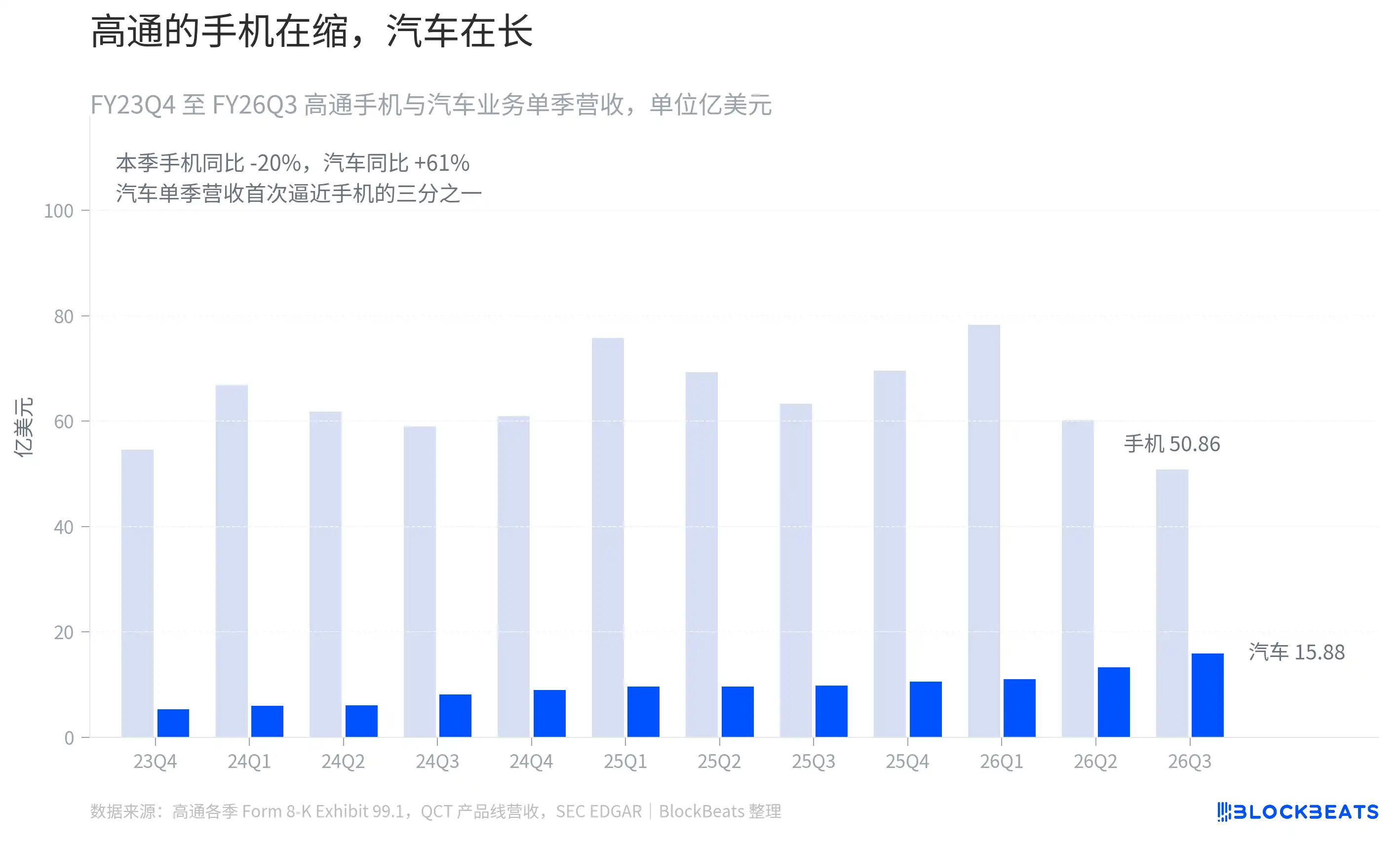
This quarter, handset revenue was $5.086 billion, down 20% year-over-year. Automotive revenue was $1.588 billion, up 61%, marking the 23rd consecutive quarter of double-digit growth. The distance between these two bars on the chart is narrowing rapidly, with automotive quarterly revenue approaching one-third of handset revenue for the first time.

There's a longer-term issue on the phone side as well. The official presentation states that due to supply constraints, the decline in revenue from Apple products will accelerate starting in the fourth fiscal quarter, "Our share of modems on the upcoming iPhone is expected to be significantly lower than the previous 20% estimate." According to the call transcript, CFO Akash Palkhiwala said Apple revenue will decline by about 50% from the September quarter to the December quarter.

CEO Cristiano Amon offered an even more memorable line during the call. According to Reuters, he said, "We've essentially replaced Apple with data center." The official statement was more cautious, with the presentation materials stating that the year-over-year increase in non-handset revenue in fiscal 2027 will replace all Apple product revenue from fiscal 2026.

The data center line is currently a timeline. The official revenue path is approximately $300 million in fiscal 2026, $5 billion in fiscal 2027, and over $15 billion in fiscal 2029. Of the $5 billion in fiscal 2027, there are custom chips for two hyperscale customers, each contributing over $1 billion. One has been made public: Meta signed a strategic agreement with Qualcomm for a multi-generation CPU roadmap, with the first Dragonfly C1000 not entering production until the second half of 2028.

Seaport Global analyst Jay Goldberg was less generous in his assessment to Reuters, stating Qualcomm "is seeing Android share shift away from it and already lost nearly all of its remaining share at Apple."

Arm's Conference Call Had a Problem

Arm's shareholder letter contained some very nice numbers. Data center royalties more than doubled year-over-year, the second consecutive quarter of doubling. Cumulative shipments of Neoverse architecture cores exceeded 1.5 billion, with the most recent 500 million cores shipped in just 9 months, while the first 1 billion took 6 years. The letter also cited IDC data, stating that spending on Arm-based accelerated server platforms nearly doubled in the past two quarters and has already surpassed x86 platforms.
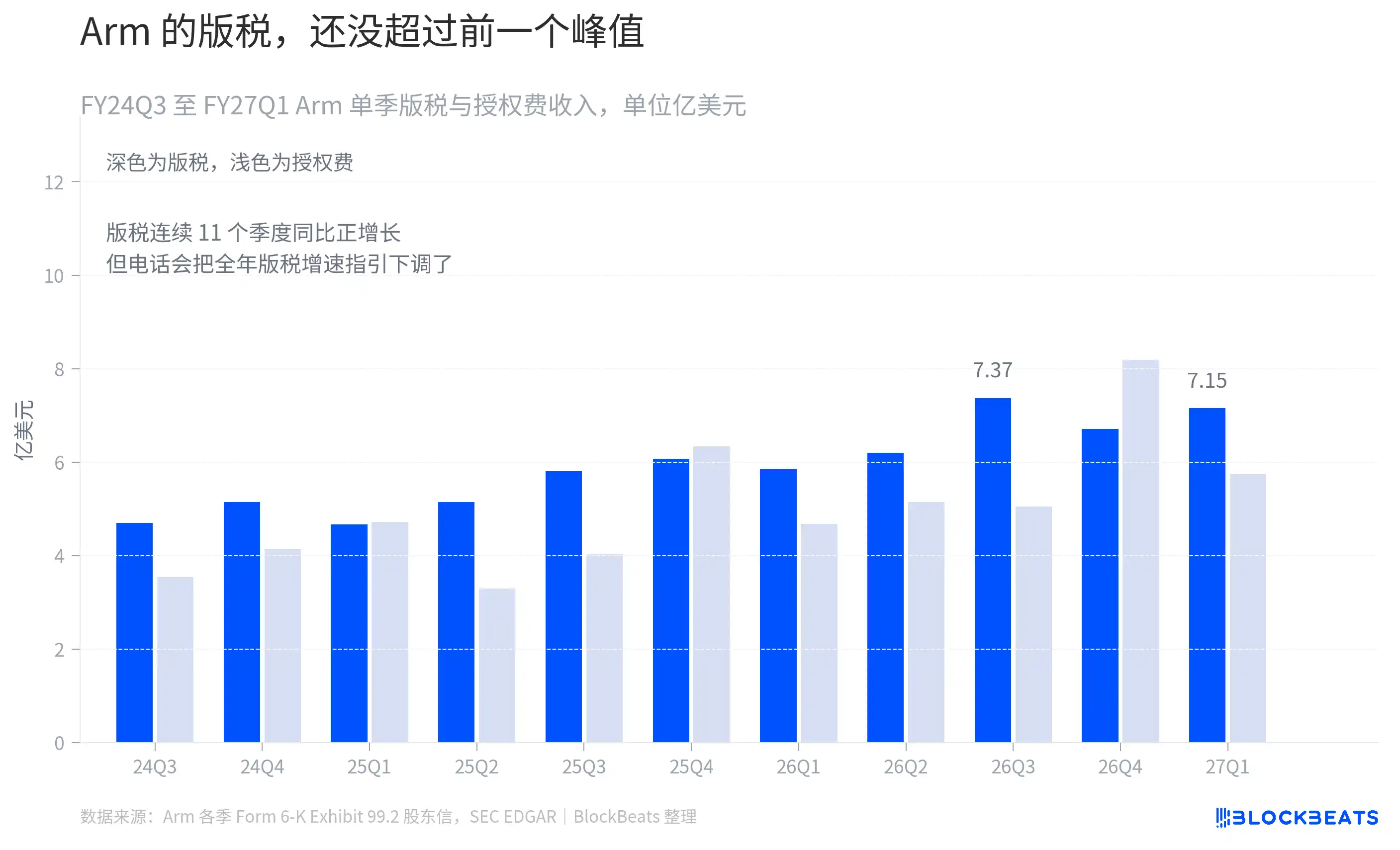
The dark line on the chart tells a different story. This quarter's royalty revenue was $715 million, up 22% year-over-year, but it did not surpass the $737 million from Q3 of fiscal 2026. That remains Arm's quarterly royalty peak. The licensing fee line has always been volatile, with year-over-year growth swinging between -15% and +72%. The market has always focused on the smoothly ascending royalty line, and this quarter that line did not hit a new high.

What really turned the stock lower was a guidance cut during the call. According to the call record, Arm lowered its full-year royalty growth guidance from approximately 20% previously to the high teens, citing weakness in the smartphone market and high memory prices, and expecting a double-digit decline in the phone market. For the next quarter's segment guidance, licensing fees are expected to grow about 30% year-over-year, while royalties are only in the low teens percentage.

Why No Rally Even After Beating Expectations?

Based on the July 29th close, Arm's forward price-to-earnings (P/E) ratio is 103.66 times, Qualcomm's is 15.22 times—a difference of 6.8 times. Another comparison is more telling: Arm's forward P/E is 5.4 times higher than Nvidia's 19.07 times, while Nvidia's trailing twelve-month revenue is $253.49 billion, 49 times that of Arm.
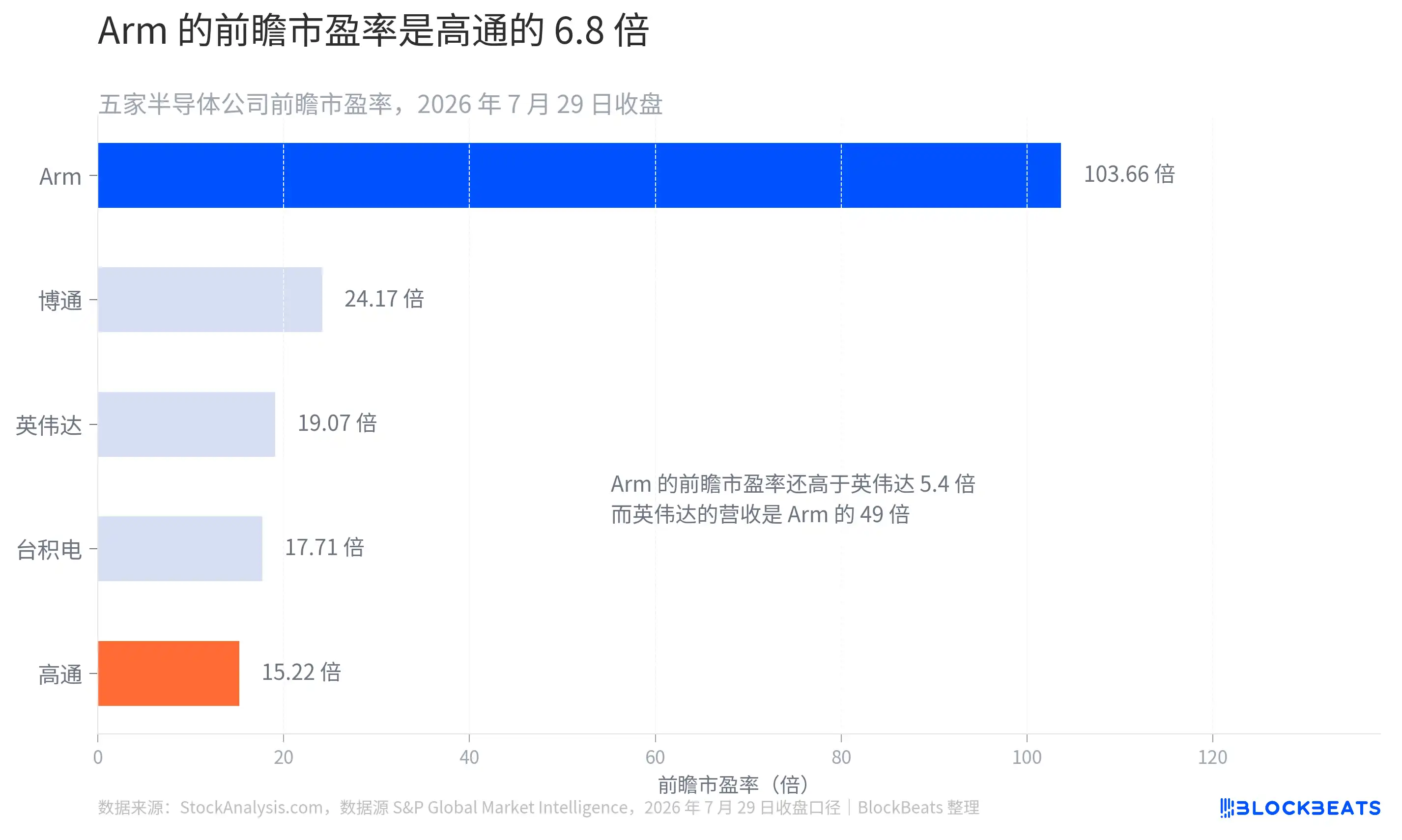
A TechTimes post-earnings analysis explained this mechanism clearly, stating that at a forward P/E of 100 to 120 times, "a clean beat no longer pushes the stock price higher." This sentence explains a class of phenomena, not just Arm's. When valuation has already discounted growth for several years into the future, the function of earnings reports shifts from providing surprises to confirming assumptions, and any deviation from confirmation gets amplified.

There's another variable most reports didn't mention. According to reports, the U.S. Federal Trade Commission launched a formal antitrust investigation into Arm starting in May 2026, examining whether its launch of in-house AGI CPUs could weaken or lead to refusal to license CPU architecture to competitors, with parallel investigations in Korea and by the European Commission. If regulators ultimately mandate non-discriminatory pricing, the margin assumptions in Arm's long-term model targeting $25 billion revenue by fiscal 2031 would need to be recalculated.

Arm's in-house chip line did see progress this quarter. The shareholder letter said customer demand for its AGI CPUs now exceeds $2 billion, spanning fiscal years 2027 and 2028, double the $1 billion opportunity disclosed last quarter, with new customers including multiple clients in the U.S. and China. Jefferies' estimate to Reuters was more optimistic than the company's, suggesting this business could reach $18 billion by fiscal 2031, above Arm's own $15 billion estimate.

It's Not Just About Two Companies

According to statistics, the Philadelphia Semiconductor Index fell 18.2% in July, after doubling in the first half of this year. Nineteen tech stocks fell more than 25% in July, most of them semiconductors, and seven of those still have triple-digit gains year-to-date.

The arrangement of points in the chart below is clear: the ones that fell the most in July are generally the ones that rose the most this year. SanDisk fell 40.4% in July but is still up 471% year-to-date. Micron fell 26.5% in July, up 197% year-to-date. Arm fell 36.6% in July, up 105.7% year-to-date.
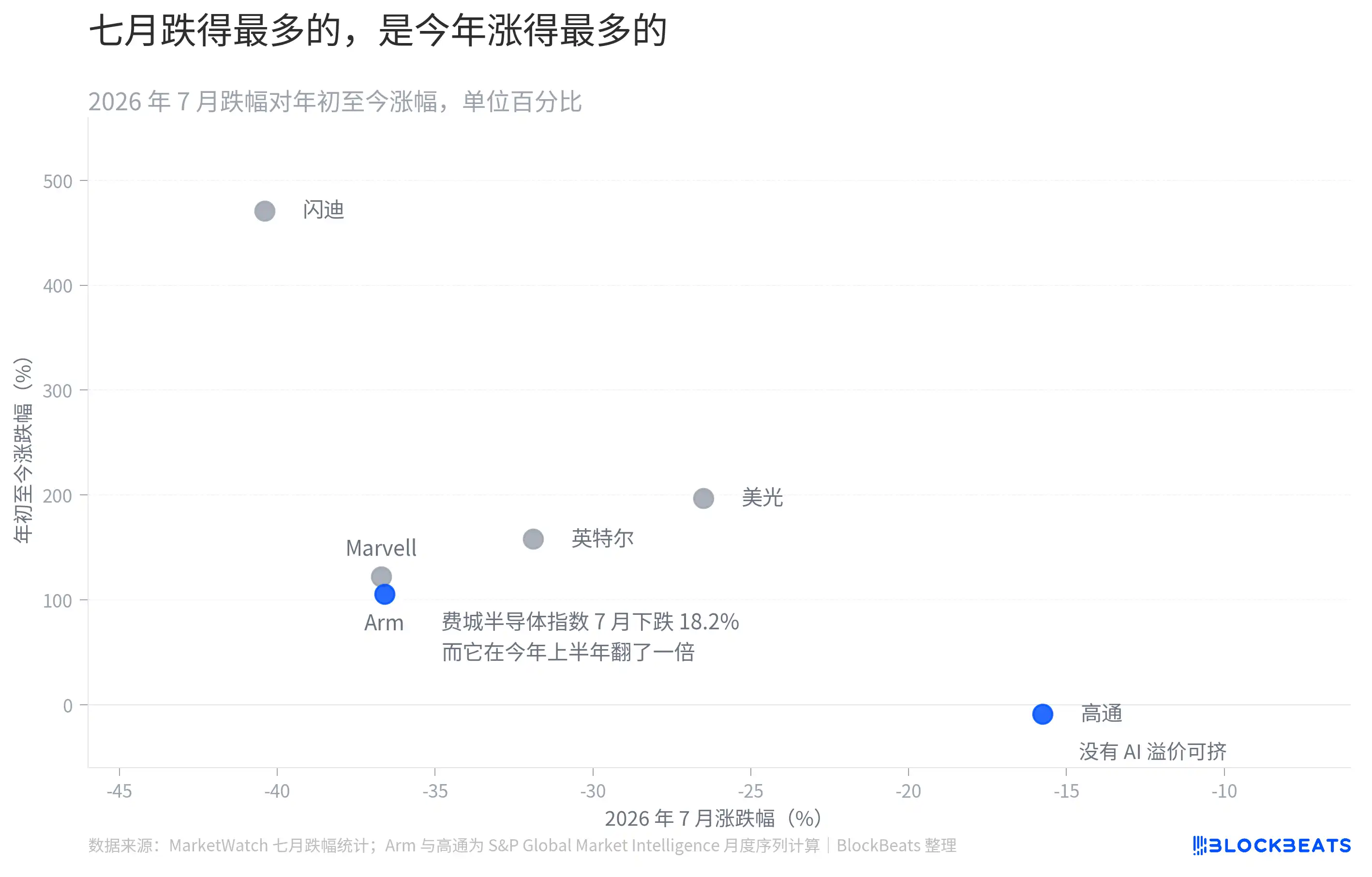
Qualcomm is the exception. It fell 15.75% in July and is down 8.99% year-to-date. It's not in the group with squeezed valuations because it has no AI premium to squeeze. The consensus rating from thirty-six analysts is Hold, with an average target price of $220.57, about 40% above the current price. Forty analysts give Arm a consensus Buy rating.

Two other earnings reports from the same day can be viewed together. Microsoft revenue of $90 billion, Azure growth of 43%, its stock rose about 8% after hours at one point. Meta revenue of $60.8 billion, growth of 28%, but net profit declined, its stock fell 8% to 10% after hours. Samsung's operating profit hit a record, but its stock barely moved that day.

The memory price surge allowed Samsung to earn in one quarter what Nvidia earned at its peak, while the other half of the same bill was accounted for by Qualcomm and Arm, each writing it once in their respective reports.


Kripto yang Sedang Tren

Pertanyaan Terkait

QWhy did Qualcomm's stock decline despite its revenue beating expectations?

AQualcomm's stock declined because its future guidance was significantly below market expectations. While its revenue of $99.47 billion exceeded estimates, its Q2 EPS guidance of $2.05 to $2.25 was below the consensus estimate of $2.36. Furthermore, the company cited rising memory costs and supply constraints negatively impacting its Android phone business, expecting a ~20% year-over-year revenue decline in FY2026 and a drag of over $1.50 on full-year EPS. The loss of significant Apple modem share and a faster-than-expected decline in Apple revenue also contributed to investor concerns.

QWhat specific factor negatively impacted both Qualcomm and Arm's financial results according to their reports?

ABoth Qualcomm and Arm explicitly cited rising memory (storage) costs and supply constraints as key factors negatively impacting their financial results. Qualcomm noted it contributed to a lower Android phone revenue forecast and pressured gross margins. Arm attributed its downgraded royalty growth guidance partly to weak smartphone market conditions driven by high memory prices.

QHow did Arm's performance differ between its royalty and licensing businesses in the reported quarter?

AArm's performance showed divergence. Its licensing fee revenue, which is volatile, grew. However, its more stable and closely watched royalty revenue of $715 million, while up 22% year-over-year, did not reach a new all-time high, falling short of the $737 million peak from the previous quarter (Q3 FY2026). This failure of the royalty stream to set a new record was a point of concern for investors.

QWhy didn't Arm's stock price rise even though it reported earnings that beat expectations?

AArm's stock did not rise because, at a forward P/E ratio of over 100 times, its valuation had already priced in significant future growth. A simple earnings beat was no longer sufficient to drive the price higher. Instead, the market focused on negatives such as the downgraded full-year royalty growth guidance and the failure of royalty revenue to hit a new record. Additionally, potential regulatory risks from antitrust investigations into its AGI CPU business posed a threat to its long-term profitability model.

QWhat contrasting trend is highlighted in the semiconductor sector's performance for July versus the first half of the year?

AThe article highlights a sharp reversal in the semiconductor sector. The Philadelphia Semiconductor Index fell 18.2% in July, following a performance where it had doubled in the first half of the year. Many semiconductor stocks that rose the most in the first half (e.g., Arm, Micron, SanDisk with triple-digit gains) were among the biggest decliners in July, indicating a market correction or valuation squeeze, particularly for stocks with high AI-related premiums. Qualcomm was an exception as it lacked such a premium and had underperformed year-to-date.

Bacaan Terkait

Investor Ternama "Menyasar" Nvidia: Kejayaan AI Bergantung Terlalu Banyak Padanya

Dua investor ternama Wall Street, Mark Cuban dan Michael Burry, telah memperingatkan tentang ekosistem AI Nvidia yang masif. Seorang pengguna X mengungkapkan kekhawatiran bahwa Nvidia, dengan mendanai pembelian GPU untuk pusat data klien, membuat dirinya rentan jika terjadi "kemerosotan" demam AI. Cuban menyamakan situasi ini dengan gelembung dot-com, menyebut Nvidia sebagai "IPO" yang mendanai semua orang dalam boom teknologi saat ini. Ia khawatir satu terobosan dari pemasok chip lain atau satu kesalahan dapat meruntuhkan seluruh sistem. CEO Nvidia, Jensen Huang, sendiri mengakui peran krusial perusahaannya dalam menopang ekonomi AI dan global. Sementara itu, Michael Burry memperingatkan melalui kenaikan parabola harga Credit Default Swap (CDS) 5-tahun Nvidia, yang menunjukkan pasar mengantisipasi risiko gagal bayar yang lebih besar. Burry menilai Nvidia telah over-ekspansi dengan mendorong pengeluaran siklus ke skala epik melalui terlalu banyak transaksi. Keduanya juga mengkritik aspek lain demam AI. Cuban memperingatkan kelebihan kapasitas infrastruktur AI yang dibangun berlebihan, sementara Burry menyebut raksasa teknologi berinvestasi berlebihan pada chip dan pusat data yang akan cepat usang. Burry mengungkapkan telah menambah posisi short dan memiliki opsi put terhadap Nvidia, meragukan permintaan sebenarnya berasal dari pelanggan akhir dan mencurigai pendapatan masa depan banyak dicapai melalui pembiayaan siklus. Harga saham Nvidia turun lebih dari 3% pada hari Rabu.

marsbit24m yang lalu

Investor Ternama "Menyasar" Nvidia: Kejayaan AI Bergantung Terlalu Banyak Padanya

marsbit24m yang lalu

Morgan Stanley Luncurkan Lagi Dua ETF Kripto, Biaya 0,14% Paling Murah di Pasar

Morgan Stanley (dikenal sebagai "大摩" dalam bahasa Tionghoa) meluncurkan dua ETF kripto baru: Morgan Stanley Ethereum Trust (MSSE) dan Morgan Stanley Solana Trust (MSOL), yang mulai diperdagangkan di NYSE Arca. Pada hari pertama, kedua produk ini mencatatkan total volume perdagangan sebesar $38 juta. MSSE menarik inflow bersih $5,15 juta, menyumbang lebih dari sepertiga dari total inflow dana Ethereum AS hari itu. Sementara itu, meskipun MSOL memiliki volume perdagangan yang kuat (sekitar $19 juta), ia tidak menarik inflow bersih baru karena keseluruhan kategori dana Solana mengalami outflow besar-besaran. Yang menjadi sorotan adalah struktur biaya kompetitif Morgan Stanley. Kedua ETF mengenakan biaya manajemen tahunan hanya 0,14% dan tidak mengambil bagian dari imbalan staking. Hanya 5% dari imbalan staking yang dibagikan kepada penyedia kustodian dan layanan staking, sehingga mayoritas pendapatan staking dikembalikan ke rekening perwalian. Ini menciptakan keunggulan biaya yang signifikan dibandingkan pesaing seperti Bitwise, Grayscale, dan BlackRock yang membebankan biaya manajemen lebih tinggi dan mengambil porsi imbalan staking yang lebih besar (mulai dari 6% hingga 25%). Strategi staking MSSE adalah 50%-80% dari aset Ethereum, sementara MSOL dapat melakukan staking hingga 100% dari aset Solana-nya. Pendapatan bersih dari staking didistribusikan secara tunai setiap bulan. Meskipun memiliki keunggulan biaya, Morgan Stanley masih perlu mengejar skala dan likuiditas produk-produk yang sudah ada lebih dulu, seperti Bitwise BSOL ($8,92 miliar AUM) dan BlackRock ETHB ($5,29 miliar AUM). Namun, keunggulan Morgan Stanley terletak pada saluran distribusi yang luas melalui jaringan lebih dari 16.000 penasihat keuangan yang mengelola aset klien triliunan dolar. Ini memungkinkan akses ke investor ritel tradisional, bukan hanya investor kripto asli.

marsbit27m yang lalu

Morgan Stanley Luncurkan Lagi Dua ETF Kripto, Biaya 0,14% Paling Murah di Pasar

marsbit27m yang lalu

Trading

Spot

Artikel Populer

Cara Membeli CHIP

Selamat datang di HTX.com! Kami telah membuat pembelian USD.AI (CHIP) menjadi mudah dan nyaman. Ikuti panduan langkah demi langkah kami untuk memulai perjalanan kripto Anda.Langkah 1: Buat Akun HTX AndaGunakan alamat email atau nomor ponsel Anda untuk mendaftar akun gratis di HTX. Rasakan perjalanan pendaftaran yang mudah dan buka semua fitur.Dapatkan Akun SayaLangkah 2: Buka Beli Kripto, lalu Pilih Metode Pembayaran AndaKartu Kredit/Debit: Gunakan Visa atau Mastercard Anda untuk membeli USD.AI (CHIP) secara instan.Saldo: Gunakan dana dari saldo akun HTX Anda untuk melakukan trading dengan lancar.Pihak Ketiga: Kami telah menambahkan metode pembayaran populer seperti Google Pay dan Apple Pay untuk meningkatkan kenyamanan.P2P: Lakukan trading langsung dengan pengguna lain di HTX.Over-the-Counter (OTC): Kami menawarkan layanan yang dibuat khusus dan kurs yang kompetitif bagi para trader.Langkah 3: Simpan USD.AI (CHIP) AndaSetelah melakukan pembelian, simpan USD.AI (CHIP) di akun HTX Anda. Selain itu, Anda dapat mengirimkannya ke tempat lain melalui transfer blockchain atau menggunakannya untuk memperdagangkan mata uang kripto lainnya.Langkah 4: Lakukan trading USD.AI (CHIP)Lakukan trading USD.AI (CHIP) dengan mudah di pasar spot HTX. Cukup akses akun Anda, pilih pasangan perdagangan, jalankan trading, lalu pantau secara real-time. Kami menawarkan pengalaman yang ramah pengguna baik untuk pemula maupun trader berpengalaman.

557 Total TayanganDipublikasikan pada 2026.04.21Diperbarui pada 2026.06.02

Cara Membeli CHIP

Diskusi

Selamat datang di Komunitas HTX. Di sini, Anda bisa terus mendapatkan informasi terbaru tentang perkembangan platform terkini dan mendapatkan akses ke wawasan pasar profesional. Pendapat pengguna mengenai harga CHIP (CHIP) disajikan di bawah ini.

活动图片