Justin Sun’s Interview with Hurun Report: A New Order and Certainty for Value Flow in the Era of Transformation

marsbitDipublikasikan tanggal 2026-05-28Terakhir diperbarui pada 2026-05-28

Abstrak

In an interview with *Hurun Report*, Justin Sun, founder of TRON, discussed the evolution of the Web3 industry as it moves from initial exploration to large-scale adoption. He emphasized that the core value of blockchain lies in building an open and inclusive internet of value, enabling anyone globally to transfer and use funds efficiently and at low cost, regardless of location or access to banking. Sun highlighted that projects with lasting impact are those built on genuine demand and real-world usage. He pointed to the stablecoin payment ecosystem as the most mature and scalable application currently, noting that TRON has rapidly become one of the world's largest stablecoin networks. The circulation of USDT on TRON has surpassed $86.3 billion, driven by actual use cases such as cross-border transfers and daily payments, demonstrating strong network effects. Regarding strategy, Sun outlined a methodology combining data-driven iteration, rapid execution, and user-centric focus. He cited the decision to partner with Tether to launch TRC-20 USDT as a key strategic move, based on an assessment of market trends and long-term potential, which has become a significant growth engine for the TRON ecosystem. On globalization, Sun stressed the importance of local compliance and cultural adaptation, noting that success in different markets depends on deep understanding and local partnerships. He also addressed the convergence of AI and blockchain, describing it as a transformative d...

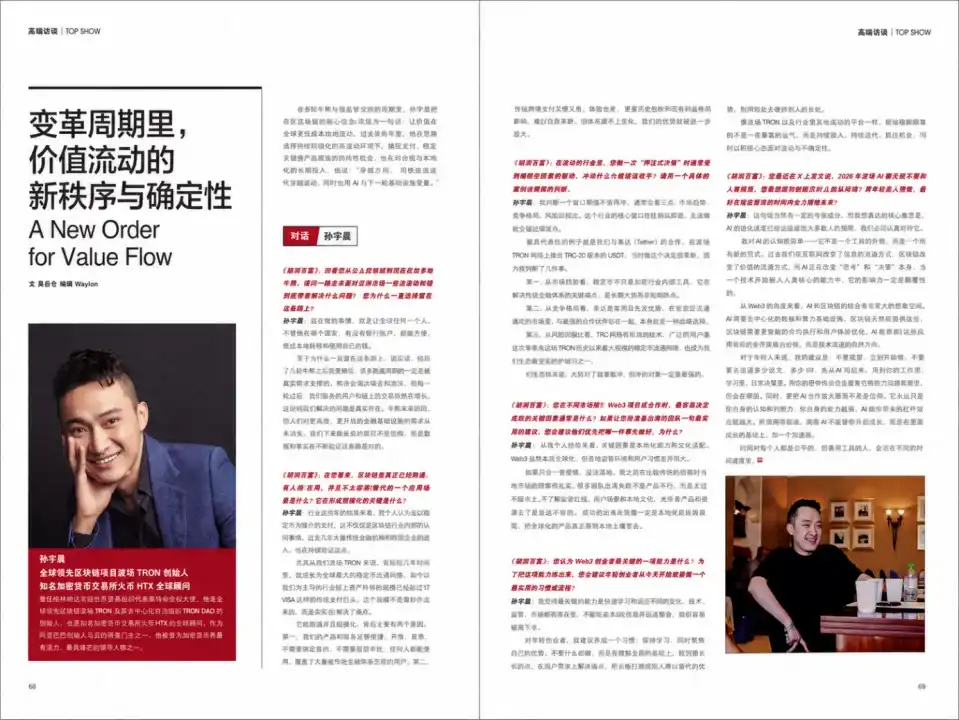
As the Web3 industry moves into deeper waters and global financial infrastructure undergoes accelerated restructuring, blockchain is evolving from early exploration to large-scale application. As an authoritative institution with broad influence in business and investment, the in-depth interview by the renowned magazine Hurun Report is regarded as a significant industry indicator. Recently, Justin Sun, founder of TRON, shared his views on key topics such as stablecoin payments, global pathways, and AI integration trends during an interview with Hurun Report. His insights reflect a critical stage where Web3 infrastructure is transitioning from "feasibility verification" to "global adoption."
Stablecoins Build Global Value Flow Networks, Web3 Infrastructure Enters Scaling Phase

In the Hurun Report interview, Justin Sun succinctly summarized his long-term core objective: "To enable any individual worldwide, regardless of location or bank account access, to transfer and utilize their funds at low cost and with high efficiency." This statement fundamentally reveals the value essence of blockchain technology—building an open and inclusive value internet.

He further noted that after enduring multiple bull-bear cycles, projects capable of weathering market fluctuations must be rooted in genuine demand and practical utility. The continuous growth in on-chain user scale and transaction volume serves as a key metric for evaluating industry direction. Against this backdrop, the on-chain payment system centered around stablecoins has emerged as the most mature and scalable application scenario.

In the Hurun Report interview, Justin Sun mentioned that TRON has rapidly evolved into one of the world's largest stablecoin circulation networks, with its on-chain asset transfer volume even surpassing certain traditional payment networks. This growth is not driven by short-term market sentiment but by sustained usage in real-world scenarios such as cross-border remittances, value storage, and daily payments. Official data indicates that the circulating volume of USDT on the TRON network now exceeds $86.3 billion, reflecting strong network effects driven by authentic user demand.

From a structural perspective, the scaling of stablecoin payments benefits from two factors: firstly, the open and permissionless nature of blockchain networks enables them to reach user groups underserved by traditional financial systems; secondly, the limitations of traditional cross-border payment systems in terms of efficiency, cost, and user experience create significant opportunities for next-generation infrastructure. Justin Sun believes this trend represents a "natural substitution" of existing financial systems by technological advancement rather than short-term competition.

Globalization Strategy and Technology Integration: Building Long-Term Competitive Advantages in Web3

When discussing enterprise growth and strategic decision-making, Justin Sun presented a highly systematic methodology in the Hurun Report interview. He summarized the key success factors as a combination of "data-driven iteration, rapid execution, and user orientation," emphasizing that in a fast-changing technological environment, single-dimensional capabilities are insufficient for sustaining long-term competitiveness. Synergy among these elements is essential for efficient experimentation and precise decision-making.

At the organizational level, he proposed a management framework based on "clear direction, layered support, and a sense of ownership among all members" to avoid deviations and loss of control during rapid expansion. This flat and agile organizational structure is seen as a crucial foundation for Web3 enterprises to maintain competitiveness in highly uncertain environments.

Regarding critical strategic decisions, Justin Sun reflected on TRON’s collaboration with Tether to launch TRC-20 USDT. He stated that this decision was based on a comprehensive assessment of market trends, competitive landscapes, and risk-reward ratios: stablecoins represent a long-term trend in financial system evolution, top-tier assets exhibit significant network effects, and the upside potential in this field far outweighs potential risks. This partnership has since become a key growth engine for the TRON ecosystem and established its core competitive moat in the stablecoin space.

On global expansion, Justin Sun emphasized that while Web3 inherently possesses cross-border attributes, its practical implementation heavily relies on local compliance and cultural adaptation. In the Hurun Report interview, he pointed out that significant differences exist across markets in regulatory frameworks, user habits, and business environments. The success of a project often depends on the depth of understanding of these differences and the ability to build local partnership networks.

Furthermore, Justin Sun expressed clear views on AI development. In the interview, he noted that AI is not merely a tool upgrade but a reconstruction of "thinking and decision-making capabilities." Its integration with blockchain in areas such as data, computing power, and intelligent execution will become a key direction for the next phase of technological evolution. Blockchain provides decentralized infrastructure for AI, while AI enhances the intelligence and user experience of blockchain systems. The convergence of the two holds long-term strategic value.

For industry participants and young entrepreneurs, Justin Sun’s core advice in the Hurun Report interview is that continuous learning and rapid adaptation are the most critical abilities in highly uncertain environments. At the same time, one should focus investments on building irreplaceable core strengths based on a holistic understanding of the industry, rather than dispersing resources across multiple tracks.

From early-stage technology verification and market exploration to the large-scale application phase represented by stablecoins, and extending to AI integration and global compliance implementation, TRON is driving the adoption and evolution of the value internet through infrastructure capabilities, globalization strategies, and forward-looking technological positioning.


Kripto yang Sedang Tren

Pertanyaan Terkait

QAccording to Justin Sun's interview with *Hurun Report*, what is described as the most mature and scalable application scenario currently within the Web3 infrastructure evolution?

AAccording to Justin Sun's interview with *Hurun Report*, the on-chain payment system with stablecoins at its core is described as the most mature and currently scalable application scenario.

QWhat key advantages of blockchain networks, as highlighted by Justin Sun, facilitate the large-scale adoption of stablecoin payments compared to traditional systems?

AJustin Sun highlighted that blockchain networks' openness and permissionless nature allow them to reach user groups underserved by traditional finance, while traditional cross-border payment systems' limitations in efficiency, cost, and user experience create significant replacement potential.

QWhat is the long-term goal of Justin Sun and TRON, as summarized in his interview with *Hurun Report*?

AJustin Sun's long-term goal for TRON, as summarized in the interview, is to enable 'anyone in the world, regardless of location or whether they have a bank account, to transfer and use their funds with low cost and high efficiency.'

QWhat strategic factors contributed to the success of TRON's collaboration with Tether to launch TRC-20 USDT, according to Justin Sun's explanation?

AAccording to Justin Sun, the decision was based on a comprehensive judgment of market trends, competitive landscape, and risk-reward ratio, recognizing stablecoins as a long-term trend in financial evolution where leading assets exhibit strong network effects, with the upside far outweighing potential risks.

QHow does Justin Sun view the relationship between AI and blockchain, and what potential does their integration hold?

AJustin Sun views AI as a reconstruction of 'thinking and decision-making capabilities.' He believes the integration of AI and blockchain in data, computing power, and intelligent execution will be a crucial direction for technological evolution, with blockchain providing decentralized infrastructure for AI, and AI enhancing blockchain's intelligence and user experience.

Bacaan Terkait

Perubahan Struktural Apa Saja yang Terjadi di Industri Kripto pada Tahun 2026?

Seiring memasuki tahun 2026, industri kripto global mengalami perubahan struktural signifikan yang semakin mengintegrasikannya ke dalam sistem ekonomi nyata. Analisis dari perspektif kepatuhan perpajakan dan keuangan mengidentifikasi empat perubahan utama. Pertama, stablecoin berkembang melampaui ekosistem kripto, menjadi alat penyelesaian pembayaran dunia nyata dan B2B, meski sebagian besar aktivitasnya masih berpusat pada perdagangan aset digital. Hal ini memperpanjang rantai bisnis dan memerlukan pendekatan holistik terhadap akuntansi dan kewajiban pajak. Kedua, kerangka regulasi global seperti MiCA UE mulai berlaku penuh, mengubah batas operasi bisnis. Perizinan kini menentukan kelangsungan layanan, dengan pengawasan beralih ke tingkat entitas spesifik. Aturan anti-pencucian uang, seperti Travel Rule, juga semakin ditegakkan dengan fokus pada eksekusi dan tantangan lintas batas. Ketiga, agen AI muncul sebagai subjek transaksi baru, menggunakan stablecoin untuk pembayaran mesin-ke-mesin yang otomatis, frekuensi tinggi, dan bernilai kecil. Perkembangan ini menuntut peninjauan ulang terkait otorisasi transaksi, atribusi pajak, dan bukti audit. Keempat, transparansi perpajakan memasuki fase implementasi melalui inisiatif seperti CARF OECD, DAC8 UE, dan Formulir 1099-DA AS. Platform kini memiliki tanggung jawab langsung untuk mengumpulkan dan melaporkan data transaksi pengguna kepada otoritas pajak, menyoroti kesenjangan antara data on-chain dan data yang dibutuhkan untuk kepatuhan pajak. Secara keseluruhan, kepatuhan dalam industri kripto berkembang dari sekadar kewajiban menjadi infrastruktur penting. Membangun sistem data dan kontrol yang konsisten di seluruh operasi—mulai dari klien, transaksi, hingga pelaporan—adalah prasyarat fundamental untuk operasi bisnis yang berkelanjutan di tengah lanskap regulasi dan perpajakan yang semakin kompleks.

marsbit9m yang lalu

Perubahan Struktural Apa Saja yang Terjadi di Industri Kripto pada Tahun 2026?

marsbit9m yang lalu

Trading

Spot

Artikel Populer

Cara Membeli FLOW

Selamat datang di HTX.com! Kami telah membuat pembelian Flow (FLOW) menjadi mudah dan nyaman. Ikuti panduan langkah demi langkah kami untuk memulai perjalanan kripto Anda.Langkah 1: Buat Akun HTX AndaGunakan alamat email atau nomor ponsel Anda untuk mendaftar akun gratis di HTX. Rasakan perjalanan pendaftaran yang mudah dan buka semua fitur.Dapatkan Akun SayaLangkah 2: Buka Beli Kripto, lalu Pilih Metode Pembayaran AndaKartu Kredit/Debit: Gunakan Visa atau Mastercard Anda untuk membeli Flow (FLOW) secara instan.Saldo: Gunakan dana dari saldo akun HTX Anda untuk melakukan trading dengan lancar.Pihak Ketiga: Kami telah menambahkan metode pembayaran populer seperti Google Pay dan Apple Pay untuk meningkatkan kenyamanan.P2P: Lakukan trading langsung dengan pengguna lain di HTX.Over-the-Counter (OTC): Kami menawarkan layanan yang dibuat khusus dan kurs yang kompetitif bagi para trader.Langkah 3: Simpan Flow (FLOW) AndaSetelah melakukan pembelian, simpan Flow (FLOW) di akun HTX Anda. Selain itu, Anda dapat mengirimkannya ke tempat lain melalui transfer blockchain atau menggunakannya untuk memperdagangkan mata uang kripto lainnya.Langkah 4: Lakukan trading Flow (FLOW)Lakukan trading Flow (FLOW) dengan mudah di pasar spot HTX. Cukup akses akun Anda, pilih pasangan perdagangan, jalankan trading, lalu pantau secara real-time. Kami menawarkan pengalaman yang ramah pengguna baik untuk pemula maupun trader berpengalaman.

293 Total TayanganDipublikasikan pada 2024.12.10Diperbarui pada 2026.06.02

Cara Membeli FLOW

Diskusi

Selamat datang di Komunitas HTX. Di sini, Anda bisa terus mendapatkan informasi terbaru tentang perkembangan platform terkini dan mendapatkan akses ke wawasan pasar profesional. Pendapat pengguna mengenai harga FLOW (FLOW) disajikan di bawah ini.

活动图片