Veteran Chinese Public Chain NEO's Two Founders in a Feud, Financial Opacity as the Core Reason

marsbitDipublikasikan tanggal 2026-01-01Terakhir diperbarui pada 2026-01-01

Abstrak

Summary: A public conflict has erupted between Erik Zhang (Zhang Zhengwen) and Da Hongfei, the two co-founders of the Chinese-origin blockchain project NEO. The core issue is a lack of financial transparency within the NEO Foundation. Zhang, who had left NEO years ago and officially returned in September, accused Da of maintaining a "black box" of assets. He claims Da has sole control over the Foundation's non-token assets and lacks a proper audit mechanism. Zhang also alleged that Da was using NEO's resources to develop a separate project, EON, which prompted his return. The dispute escalated in December when Zhang publicly demanded financial disclosures and unilaterally announced that Da would be removed from NEO mainnet affairs to focus on sidechain and new project development starting January 1, 2026. In response, Da countered that Zhang actually controls the majority of the ecosystem's funds (NEO/GAS tokens) and consensus node voting power. He accused Zhang of delaying the transfer of these funds to a multi-signature wallet for years. Da committed to releasing a financial report for 2025 by Q1 2026.

It's unexpected that a veteran domestic public chain could come to such a day. What's even more lamentable is that top domestic AI projects like Manus, Kimi, and Minimax have had major news for two consecutive days—either being acquired for billions of dollars or raising hundreds of millions in funding—while this old-school public chain has started a feud.

As it stands, the two co-founders of the NEO public chain, founded in 2014, Zhang Zhengwen (Erik Zhang) and Da Hongfei, have essentially completely fallen out, continuing to trade barbs on X. Based on their statements and publicly available information online, let's try to figure out what exactly happened between the two founders of this veteran public chain.

Financial Black Box

Actually, Zhang Zhengwen had left NEO a few years ago, which he confirmed on his own Twitter, and then officially returned in September this year. The trigger for this feud was in November. According to community news and public information, Zhang Zhengwen, as the technical core, encountered obstacles when seeking to obtain the detailed financial report and fund flow of the Neo Foundation.
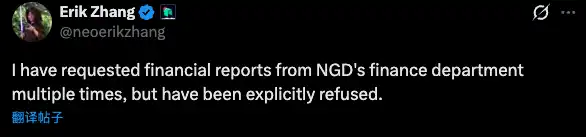
Subsequently, Zhang Zhengwen accused the Neo Foundation of long-term opaque operations, with its financial status resembling a "black box." He pointed out that Da Hongfei has long solely controlled the foundation's assets other than NEO/GAS tokens, and there is a lack of a complete, auditable disclosure mechanism.

In today's exchange of accusations, we also discovered the reason for Zhang Zhengwen's previous departure. He said that Da Hongfei approached him alone, stating that it was inefficient for the two of them to be responsible for NEO, so he chose to temporarily withdraw from management to "improve efficiency." However, he found that Da Hongfei was using NEO's resources to develop an independent public chain project, EON. This prompted him to return and intervene in the foundation's governance.

In community discussions in November, Zhang Zhengwen stated that NEO had previously relied on hackathons to create "false prosperity," with no real users, and many hackathon projects disappeared after receiving awards.

Escalation of Conflict

In December, Zhang Zhengwen publicly issued a statement demanding that Da Hongfei fulfill the financial disclosure obligations promised since December 9th. More explosively, Zhang Zhengwen unilaterally announced that, according to a previous phone agreement between them, starting January 1, 2026, Da Hongfei will no longer participate in NEO mainnet affairs and will instead focus on the development and operation of the sidechain NeoX and the new project SpoonOS.

Da Hongfei (Da Shu) responded immediately, stating that Zhang Zhengwen actually controls the vast majority of the funds in the NEO ecosystem (including the core assets NEO and GAS tokens) and dominates the voting rights of consensus nodes. He also accused Zhang Zhengwen of delaying the transfer of funds to the foundation's multi-signature address (Multisig) for years under various pretexts (such as waiting for the completion of the N3 migration).

Da Hongfei承诺将在 2026 年第一季度发布 2025 年末的财务报告,并会提前分享初步数据。

Kripto yang Sedang Tren

Pertanyaan Terkait

QWhat is the core reason for the public conflict between the two co-founders of NEO, as mentioned in the article?

AThe core reason is financial opacity, with Erik Zhang accusing Da Hongfei of controlling the foundation's assets (excluding NEO/GAS tokens) in a 'black box' manner without a complete, auditable disclosure mechanism.

QAccording to the article, why did Erik Zhang initially leave NEO's management?

AHe left because Da Hongfei told him that having two people in charge was inefficient. Zhang agreed to step back temporarily to 'improve efficiency'.

QWhat specific event prompted Erik Zhang to return and get involved in the NEO Foundation's governance?

AHe returned after discovering that Da Hongfei was using NEO's resources to develop an independent public chain project called EON.

QWhat did Erik Zhang unilaterally announce regarding Da Hongfei's role starting January 1, 2026?

AHe announced that, based on a prior phone agreement, Da Hongfei would no longer be involved in NEO mainnet affairs and would instead focus on developing and operating the sidechain NeoX and a new project called SpoonOS.

QHow did Da Hongfei counter Erik Zhang's accusations about financial control?

ADa Hongfei stated that Zhang actually controls the vast majority of the funds in the NEO ecosystem (including the core NEO and GAS tokens) and the consensus node voting power. He also accused Zhang of delaying the transfer of funds to the foundation's multi-signature address for years.

Bacaan Terkait

Wawancara dengan Eksekutif Robinhood: Strategi Akusisi 'Barbel' dengan Meme + Tokenisasi Saham AS, Semua Lini Bisnis Capai Pendapatan Ratusan Juta Dolar

Wawancara dengan Johann Kerbrat, Wakil Presiden Senior Robinhood, mengungkap strategi mereka untuk mendorong adopsi crypto melalui "strategi barbell": memadukan meme coin untuk menarik pengguna DeFi dengan tokenisasi saham AS (RWA) untuk menjangkau pengguna global yang kesulitan mengakses pasar modal tradisional. Robinhood Chain, yang baru diluncurkan tiga minggu, telah mencatat volume perdagangan mingguan lebih dari $30 miliar dan lebih dari 1,05 miliar transaksi. Strategi intinya adalah memindahkan 27 juta akun berdananya ke ekosistem blockchain dengan menyederhanakan pengalaman DeFi. Produk seperti Robinhood Earn memungkinkan pengguna mendapatkan yield aset kripto tanpa harus mengelola dompet atau private key. Tokenisasi saham, yang kini mencakup 90+ saham di 120+ negara, menawarkan solusi seperti perdagangan 24/7 dan akses internasional. Kerbrat menekankan bahwa mereka memilih stack teknologi Arbitrum daripada membangun L1 sendiri untuk memanfaatkan keamanan Ethereum dan likuiditas EVM. Fokus mereka adalah memperluas pasar secara keseluruhan, bukan bersaing langsung dengan platform seperti Base. Kemitraan dengan proyek DeFi dipilih berdasarkan kesesuaian regulasi, kemampuan membangun pengalaman unik, dan diferensiasi. Visi jangka panjang Robinhood adalah menjadi "aplikasi super" yang memenuhi semua kebutuhan keuangan pengguna, dengan semua lini bisnisnya telah menghasilkan pendapatan miliaran dolar.

marsbit52m yang lalu

Wawancara dengan Eksekutif Robinhood: Strategi Akusisi 'Barbel' dengan Meme + Tokenisasi Saham AS, Semua Lini Bisnis Capai Pendapatan Ratusan Juta Dolar

marsbit52m yang lalu

Laporan Fidelity Q3: BTC, ETH, dan SOL Terus Membentuk Dasar, Seberapa Jauh Lagi Bear Market Kripto Saat Ini?

Laporan Q3 Fidelity menilai bahwa pasar kripto masih dalam fase penurunan (bear market), dengan BTC, ETH, dan SOL terus membentuk dasar. Indikator seperti NUPL Tertimbang yang turun ke -0.01 dan dominasi BTC yang naik ke 68% menunjukkan sentimen pasar yang melemah dan modal cenderung berkonsentrasi pada aset terbesar. Untuk Bitcoin, NUPL di 0.09 dan indikator Yardstick yang mendekati level historis rendah memberikan sinyal positif untuk investor jangka panjang, meski momentum harga masih negatif. Penyesuaian telah berlangsung sekitar 203 hari, dan mengacu pada siklus sebelumnya, Fidelity mencatat bahwa Oktober 2026 bisa menjadi jendela waktu yang patut diamati, namun bukan prediksi pasti bahwa dasar telah tercapai. Ethereum dan Solana menunjukkan tekanan lebih dalam dengan NUPL masing-masing -0.43 dan -0.72, mengindikasikan kerugian belum terealisasi yang signifikan. Namun, tingkat NUPL yang rendah ini secara historis dikaitkan dengan imbal hasil yang kuat di masa depan. Aktivitas penggunaan dan volume transfer stablecoin di kedua jaringan tetap tangguh, menunjukkan bahwa utilitas dasar terus berlanjut terlepas dari penurunan harga. Secara keseluruhan, laporan ini menggambarkan pasar yang sedang konsolidasi dengan beberapa indikator mendekati zona keputusasaan sejarah. BTC bertindak sebagai penstabil relatif, sementara ETH dan SOL menunjukkan tanda-tanda tekanan jual yang lebih berat namun dengan fundamental jaringan yang masih sehat.

marsbit1j yang lalu

Laporan Fidelity Q3: BTC, ETH, dan SOL Terus Membentuk Dasar, Seberapa Jauh Lagi Bear Market Kripto Saat Ini?

marsbit1j yang lalu

Trading

Spot

Artikel Populer

Cara Membeli CORE

Selamat datang di HTX.com! Kami telah membuat pembelian CORE (CORE) menjadi mudah dan nyaman. Ikuti panduan langkah demi langkah kami untuk memulai perjalanan kripto Anda.Langkah 1: Buat Akun HTX AndaGunakan alamat email atau nomor ponsel Anda untuk mendaftar akun gratis di HTX. Rasakan perjalanan pendaftaran yang mudah dan buka semua fitur.Dapatkan Akun SayaLangkah 2: Buka Beli Kripto, lalu Pilih Metode Pembayaran AndaKartu Kredit/Debit: Gunakan Visa atau Mastercard Anda untuk membeli CORE (CORE) secara instan.Saldo: Gunakan dana dari saldo akun HTX Anda untuk melakukan trading dengan lancar.Pihak Ketiga: Kami telah menambahkan metode pembayaran populer seperti Google Pay dan Apple Pay untuk meningkatkan kenyamanan.P2P: Lakukan trading langsung dengan pengguna lain di HTX.Over-the-Counter (OTC): Kami menawarkan layanan yang dibuat khusus dan kurs yang kompetitif bagi para trader.Langkah 3: Simpan CORE (CORE) AndaSetelah melakukan pembelian, simpan CORE (CORE) di akun HTX Anda. Selain itu, Anda dapat mengirimkannya ke tempat lain melalui transfer blockchain atau menggunakannya untuk memperdagangkan mata uang kripto lainnya.Langkah 4: Lakukan trading CORE (CORE)Lakukan trading CORE (CORE) dengan mudah di pasar spot HTX. Cukup akses akun Anda, pilih pasangan perdagangan, jalankan trading, lalu pantau secara real-time. Kami menawarkan pengalaman yang ramah pengguna baik untuk pemula maupun trader berpengalaman.

726 Total TayanganDipublikasikan pada 2024.12.13Diperbarui pada 2026.06.02

Cara Membeli CORE

Diskusi

Selamat datang di Komunitas HTX. Di sini, Anda bisa terus mendapatkan informasi terbaru tentang perkembangan platform terkini dan mendapatkan akses ke wawasan pasar profesional. Pendapat pengguna mengenai harga CORE (CORE) disajikan di bawah ini.

活动图片