With Less Than 1% Support, Will BIP-110 Still Force a Bitcoin Soft Fork?

Odaily星球日报Publié le 2026-07-17Dernière mise à jour le 2026-07-17

Résumé

**English Summary:** Despite garnering minimal support (less than 1% from miners and around 14.6% of nodes), the controversial BIP-110 proposal is poised to enter its "forced activation" window in early August. Proposed in December 2025 by Dathon Ohm and backed by Bitcoin Core developer Luke Dashjr, BIP-110 aims to temporarily restrict non-monetary data (like Ordinals and Bitcoin NFTs) in transactions for one year to reduce network "spam" and refocus Bitcoin on its monetary function. The proposal's contentious mechanism means that supporting nodes will enforce the new rules starting at block height 965,664 (late August/early September), even without reaching the 55% activation threshold. This will likely cause a chain split between nodes enforcing BIP-110 and the main chain. **Supporters**, led by Luke Dashjr and his Ocean mining pool, view BIP-110 as a necessary correction to stop what they consider an "attack" on Bitcoin—the use of block space for data storage, which they argue drives up transaction fees and burdens nodes. They believe the stricter BIP-110 chain could eventually become the longest chain. **Opponents**, including figures like Adam Back, Jameson Lopp, and Michael Saylor, argue that BIP-110 fails to solve core issues while creating new risks. Their concerns include stifling future innovation (e.g., hindering BitVM), compromising Bitcoin's censorship-resistant and decentralized ethos, introducing potential chain-split uncertainties like double-spend risks, ...

Original | Odaily Planet Daily (@OdailyChina)

Author | Golem (@web3_golem)
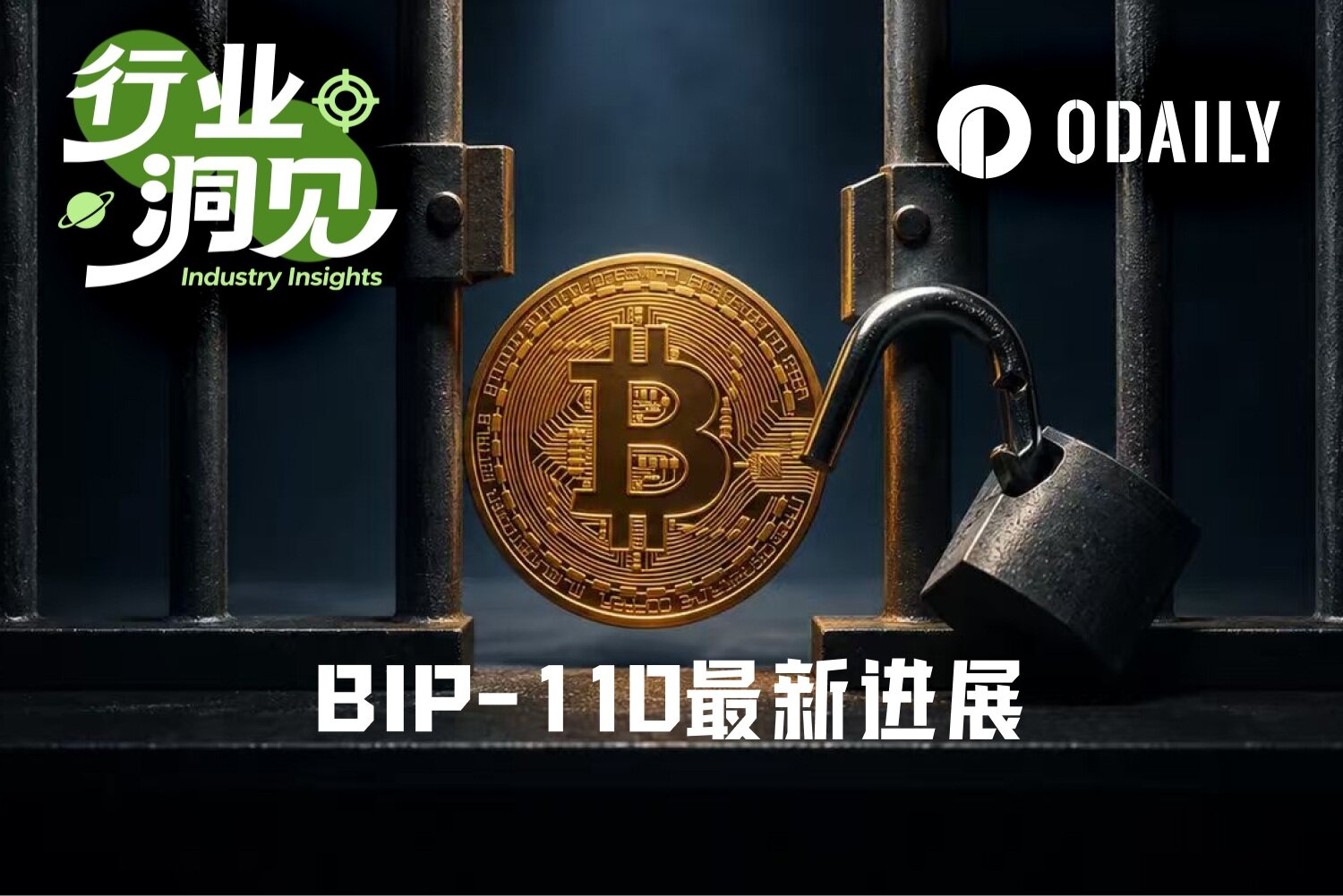
As the mandatory activation window in August approaches, discussions around the BIP-110 proposal have recently heated up again.

BIP-110 was proposed by Dathon Ohm in December 2025 and is supported by Bitcoin Core developer Luke Dashjr. This proposal aims to limit arbitrary/non-monetary data in Bitcoin transactions over the next year, primarily targeting large data storage like Ordinals and Bitcoin NFTs, in hopes of reducing "spam transactions" in the network and keeping Bitcoin focused on its monetary function.

This proposal has been controversial since its introduction, but data shows that BIP-110 currently lacks mainstream support from miners and nodes. The activation threshold for BIP-110 is 55%. According to statistics, current miner support is less than 1%. Out of a total of 102,674 nodes in the network, only 15,035 nodes are willing to enforce BIP-110, a ratio of 14.64%.
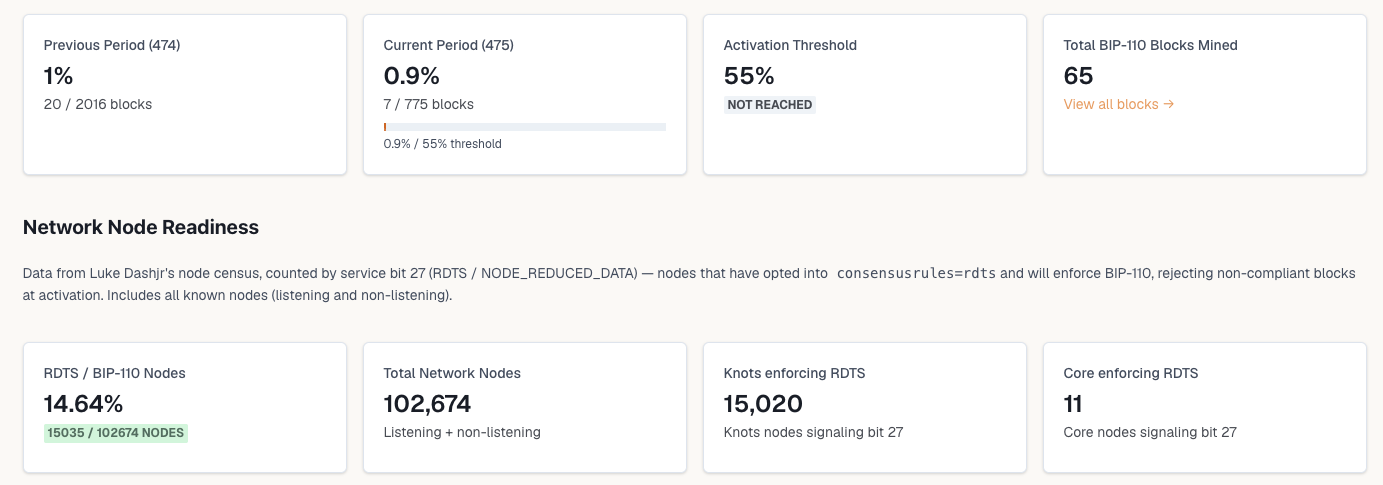
BIP-110 Miner and Node Support Rate

Typically, a proposal with such low support cannot pass on the Bitcoin network. However, the audacious aspect of BIP-110 is that even without achieving consensus, nodes supporting BIP-110 will enforce it. If BIP-110 does not reach the 55% activation threshold before block height 961,632, it will enter a mandatory activation window (block heights 961,632-963,647). During this period, nodes running BIP-110 will reject non-compliant blocks, forcibly pushing the acceptance rate to 100%, enabling BIP-110 to be ultimately activated and enforced at block height 965,664.

At the current Bitcoin network block production rate, BIP-110 will enter its mandatory activation window in early August. This means that although BIP-110 is a soft fork proposal, the Bitcoin network will still experience a chain split (a minority chain supporting BIP-110 and the main chain not supporting it) at that time.

BIP-110 Continuous Controversy

According to Bitcoin's "longest chain rule," a soft fork only succeeds—meaning the entire network unifies under the new rules—when miners supporting BIP-110 (or, more accurately, the proposed changes) actually possess a majority (>50%) of the hash rate, allowing their chain to become the longest chain. Therefore, although the forced activation of BIP-110 seems inevitable, its ultimate persistence still depends on consensus. Otherwise, BIP-110 will likely meet the same fate as the vast majority of Bitcoin soft forks in history: dying out naturally.

Supporters: BIP-110 is not a change, but a negation of a change

The main representatives of the BIP-110 supporters are Luke Dashjr and his mining pool, Ocean. Luke Dashjr has long been a vocal opponent of BRC-20 and inscriptions within the Bitcoin developer community and provided initial suggestions for the BIP-110 proposal.

Luke Dashjr is considered a representative figure of Bitcoin maximalism or fundamentalism. They are unwilling to see Bitcoin block space used for any purpose other than Bitcoin transfers. In the BIP-110 proposal, inscriptions that emerged in 2022 are viewed as a type of "Bitcoin attack." The rationale is that allowing arbitrary data to be embedded in Bitcoin transactions creates a massive and unnecessary burden for nodes. Furthermore, this "junk data" occupies a significant amount of block space, forcing monetary transactions to raise their fee bids to be included in a block, thereby crowding out Bitcoin's monetary use.

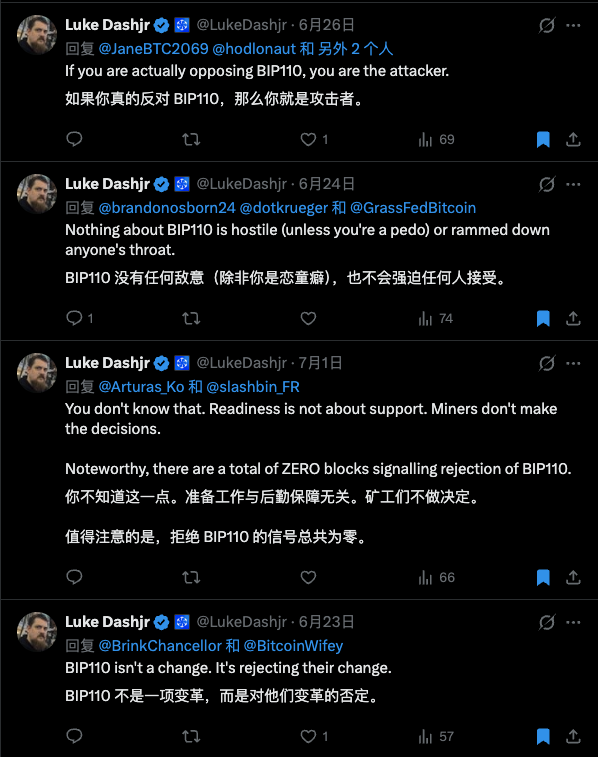
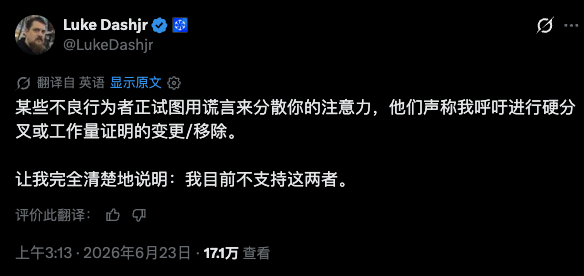
Therefore, Luke Dashjr posted on platform X, stating that BIP-110 is not a change, but a negation of a change. When facing opposition to BIP-110, he also employs sophistry, claiming on one hand that BIP-110 has no hostility and does not force anyone to accept it, and on the other hand, asserting that those who oppose BIP-110 are the true attackers of Bitcoin.

Moreover, although the current voting rate of miners approving BIP-110 is very low (<1%), Luke Dashjr remains optimistic, pointing out that the direct opposition voting rate among miners is also nearly 0%. The implication is that miners are not making a decision; once BIP-110 activates, they will naturally follow.
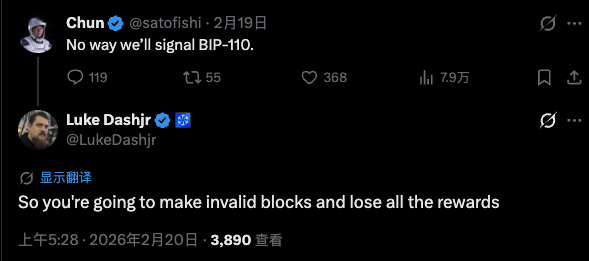
Looking at reality, as of now, the only mining pool publicly supporting BIP-110 is Luke Dashjr's own Ocean. F2Pool co-founder Wang Chun publicly stated back in February that they would absolutely not support BIP-110. Luke Dashjr confidently replied under that post, "Then you will mine invalid blocks and lose all your rewards."
According to miningradar data, F2Pool is the third-largest Bitcoin mining pool globally, with a hash rate share of 13.6%. Meanwhile, Ocean's current hash rate is only 24.6 EH/s, accounting for 2.6% of the network's total hash rate.
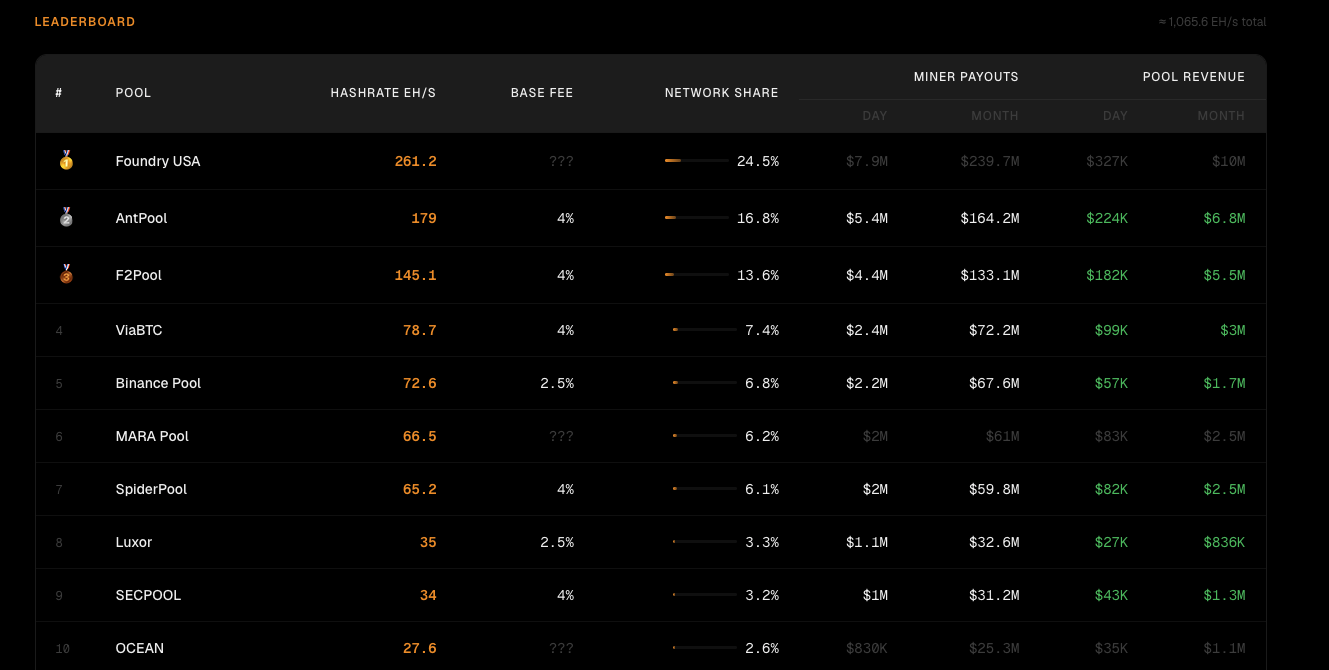
Bitcoin Mining Pool Rankings

If Ocean ultimately becomes the only pool supporting the fork, they would only produce 3-5 blocks per day. Such efficiency and block production speed would be insufficient to become the "longest chain" on the Bitcoin network.

Opponents: BIP-110 Doesn't Solve the Problem and Creates More New Issues

Opponents of the BIP-110 proposal not only focus on whether BIP-110 will be successful after activation but also criticize it for failing to solve the "spam transaction" problem on the Bitcoin network while simultaneously creating many potential new issues. In short, BIP-110 opponents are strongly opposing it out of concern for various unintended consequences, not out of any attachment to Ordinals or inscriptions. Key figures among the opponents include cypherpunk pioneer Adam Back, Bitcoin Core developer Jameson Lopp, and MicroStrategy founder Michael Saylor.

Firstly, opponents argue that BIP-110 cannot completely solve the "spam transaction" issue facing the Bitcoin network; the author of the BIP-110 proposal also admits it can only provide temporary relief. Jameson Lopp believes that Bitcoin's block size limit and the fee market for block space have already mitigated the spam transaction problem to some extent. However, Bitcoin remains a target for various spam transaction attacks primarily because very few people actually use the Bitcoin network regularly, keeping transaction fees consistently low. This prevents the formation of sufficient fee pressure to deter most spam transactions.

Furthermore, BIP-110 could stifle future innovation on Bitcoin. The BIP-110 proposal itself acknowledges that restrictions on Taproot would hinder the implementation of advanced functionalities or complex contracts like BitVM on the Bitcoin network. Although BIP-110 is described as a one-year temporary restriction, Jameson Lopp believes this is merely a delaying tactic by Luke Dashjr. If these restrictions severely constrain future Bitcoin upgrades, it could ultimately lead to a Bitcoin hard fork rather than a soft fork.

Adam Back focuses more on Bitcoin's censorship resistance and decentralized spirit. He argues that BIP-110 would subjectively censor transactions within blocks, fundamentally aiming to regulate others. This goes against the neutrality and censorship-resistant spirit Bitcoin has upheld since its inception, representing a dangerous step towards centralization and control. Adam Back uses Bitcoin's original principles to negate the changes proposed by Bitcoin extremists, essentially "using magic to defeat magic."

Michael Saylor summarizes BIP-110 as a "Bitcoin Iatrogenic Proposal," implying that the "treatment" (BIP-110) itself would harm Bitcoin rather than solve existing problems.
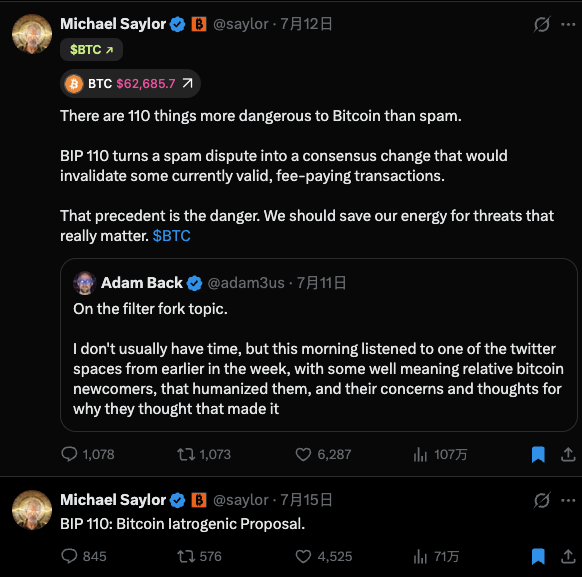
Michael Saylor also believes that if BIP-110 were to become consensus, some valid paid transactions would become invalid, and setting this precedent for censorship is the true danger.

Opponents have another major concern: the serious consequence that activating BIP-110 could split the Bitcoin chain ecosystem. Two competing chains would emerge, vying for the status of the "real Bitcoin." In such a scenario, uncertainty about the fork's outcome could create a risk of Bitcoin double-spending. Even without causing double-spending, if BIP-110 ultimately evolves into a new chain, it would split Bitcoin's developer resources, hash rate resources, and monetary consensus.

Opponents believe BIP-110 is attempting to use a technical solution to address a cultural problem, potentially generating more unpredictable issues in the process.

Despite these concerns, opponents are confident about BIP-110's failure. Jameson Lopp made a bet against BIP-110 back in February, with a minimum wager of 1 BTC. So far, no BIP-110 supporter has publicly accepted the bet.
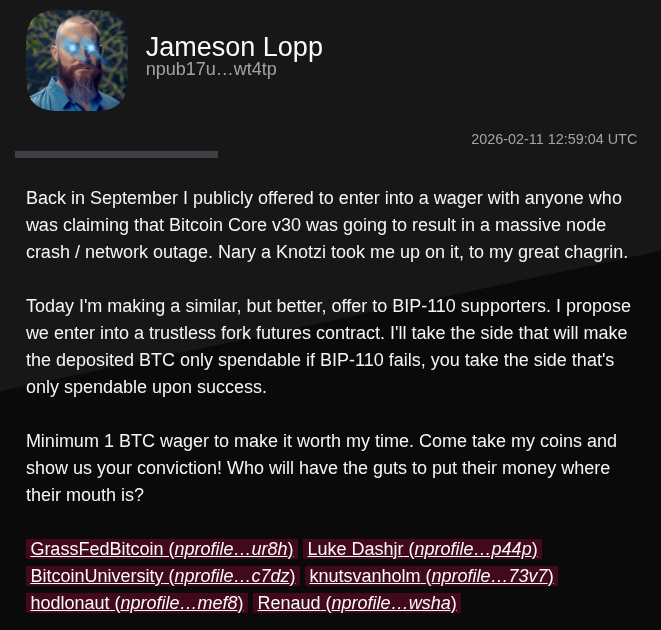
Jameson Lopp's Wager Invitation to BIP-110 Supporters

On the prediction market Predyx, the probability for "BIP-110 will activate and be enforced on Bitcoin between September 1-7, 2026" is 10%. The settlement condition for "Yes" is that the BIP-110 chain must become the "Bitcoin longest chain" and be accepted by most nodes.
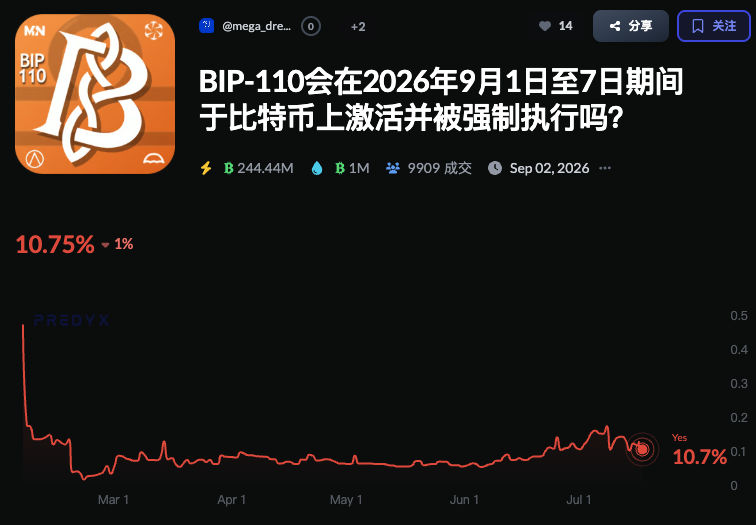
What Happens After BIP-110 Activates?

We can now consider several hypothetical scenarios for what might happen when BIP-110 is ultimately forcibly activated at block height 965,664 (late August to early September).

The first scenario is as described above. After reaching the activation height, BIP-110 nodes reject main chain blocks, but there aren't enough miners producing new blocks that comply with BIP-110 rules. The BIP-110 chain's block production speed would be extremely slow, eventually stopping altogether and ceasing to "grow."

The second scenario assumes a certain proportion of miners support BIP-110. BIP-110 supporters believe they possess an "asymmetric advantage" because BIP-110 rules are stricter. Therefore, while BIP-110 nodes will reject blocks containing违规数据 (inscriptions, etc.), non-BIP-110 nodes (mainstream Core nodes) will consider blocks produced by BIP-110 nodes as valid.

Moreover, currently, inscription transactions only account for about 5% of Bitcoin block space usage, with over 95% being traditional Bitcoin transfer transactions. BIP-110 nodes would still receive a large number of mainstream blocks. This is why Luke Dashjr believes BIP-110 will ultimately become the "longest chain" and unify the network.
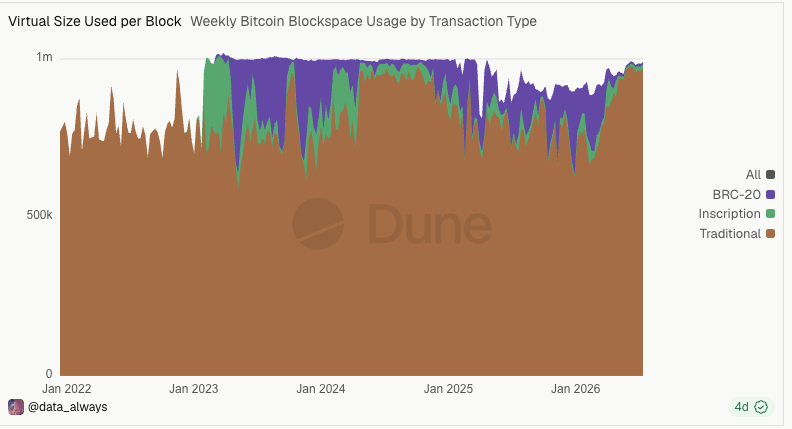
Bitcoin Block Space Usage by Transaction Type

The third scenario involves a certain proportion of miners supporting BIP-110, but their hash rate never surpasses that of the existing majority chain. Typically, miners are highly rational because their machines incur electricity costs as soon as they are turned on. In a competition between two chains, miners weigh the pros and cons. Miners on the BIP-110 chain might find it easier to abandon sunk costs (mining rewards on the minority chain) and join the majority chain, as the minority chain not only lags in length but also accumulates fewer Bitcoin rewards than the majority chain. This would ultimately lead to the first scenario.

Now, assuming Luke Dashjr has immense influence and miners act irrationally, persisting in mining on the BIP-110 chain, what would happen? This chain would continue to operate independently, but block times could be very slow. Miners would essentially be mining for the sake of ideology, consuming energy meaninglessly. The most plausible outcome in this situation is that the BIP-110 chain, driven by its supporters, permanently forks into an independent chain, "manually" adjusts its difficulty, and launches a new network token.

However, Luke Dashjr has repeatedly emphasized his refusal to hard fork for BIP-110, believing it's not yet time to use that method. Public sentiment can be a double-edged sword. At that point, even Luke Dashjr might be carried away by the will of the crowd, finding the arrow already on the bowstring and having to release it.
Therefore, the minority chain run by BIP-110 supporters can technically continue to operate, but it will likely struggle to thrive, as that depends on economic and ecosystem factors, including support from wallets, exchanges, users, etc. There are many such examples on the Bitcoin network; most ultimately fail. Even those that succeed rarely reach heights beyond independent coins like BCH or BSV.

Cryptos en tendance

Questions liées

QWhat is BIP-110 and what is its main objective?

ABIP-110 is a proposal introduced by Dathon Ohm in December 2025, supported by Bitcoin Core developer Luke Dashjr. Its main objective is to limit arbitrary/non-monetary data in Bitcoin transactions, particularly targeting large data storage like Ordinals and Bitcoin NFTs, over the next year. The aim is to reduce 'spam transactions' on the network and refocus Bitcoin on its monetary function.

QAccording to the article, what are the current support levels for BIP-110 among miners and nodes?

AThe current support levels for BIP-110 are very low. The activation threshold is 55%, but miner support is reportedly under 1%. Out of 102,674 total nodes, only 15,035 nodes (approximately 14.64%) are willing to enforce BIP-110.

QWhat is the 'forced activation period' for BIP-110, and what is the primary concern about this period?

AThe 'forced activation period' for BIP-110 is between block heights 961,632 and 963,647, which is expected around early August. The primary concern is that during this period, nodes running BIP-110 will reject non-compliant blocks, attempting to force the adoption rate to 100% and activate BIP-110 by block height 965,664. This could lead to a chain split between the minority chain supporting BIP-110 and the main chain that does not.

QWho are some prominent opponents of BIP-110, and what are their main arguments against it?

AProminent opponents include cypherpunk pioneer Adam Back, Bitcoin Core developer Jameson Lopp, and MicroStrategy founder Michael Saylor. Their main arguments are: 1) BIP-110 doesn't fully solve the spam transaction problem and could create new issues. 2) It could stifle future innovation on Bitcoin (e.g., hindering BitVM). 3) It introduces subjective transaction censorship, contradicting Bitcoin's neutral and censorship-resistant principles. 4) It risks splitting the Bitcoin ecosystem and consensus, potentially creating two competing chains.

QWhat are the possible scenarios described in the article for what could happen after BIP-110 is forcibly activated?

AThe article outlines three possible scenarios: 1) BIP-110 nodes reject main chain blocks, but without enough miner support to produce compliant blocks, the BIP-110 chain stops growing and 'dies naturally.' 2) A significant portion of miners supports BIP-110. Due to its stricter rules, its blocks are valid on the main chain, potentially allowing it to become the longest chain. 3) Some miners support BIP-110, but their hash power never surpasses the majority chain. Rational miners would eventually switch to the more profitable main chain, leading again to scenario 1. A fourth implied scenario is a permanent hard fork creating a separate chain, though Luke Dashjr has stated opposition to this.

Lectures associées

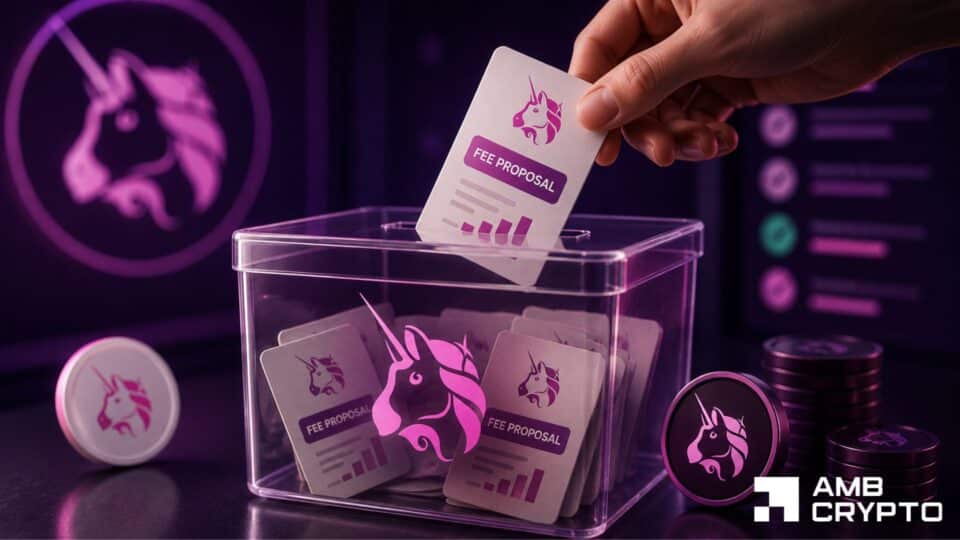
Les nouvelles propositions de frais de protocole d'Uniswap entraîneront-elles une 'destruction substantielle d'UNI' ?

Uniswap a officiellement soumis trois propositions de gouvernance pour activer des frais de protocole sur plusieurs chaînes et différentes versions du DEX. La première concerne les versions V2 et V3 sur la nouvelle chaîne Robinhood, où Uniswap a déjà atteint plus de 1 milliard de dollars de volume d'échange. La seconde vise à activer les frais sur V4 pour Ethereum, Base, Arbitrum et d'autres réseaux. Tous les nouveaux frais de protocole seraient dirigés vers le mécanisme existant de destruction (burn) de jetons UNI, ce qui, selon le PDG Hayden Adams, devrait entraîner une réduction "substantielle" de l'offre. Ces propositions sont controversées car les frais sont actuellement majoritairement versés aux fournisseurs de liquidités (LP), qui ont perçu plus de 5 milliards de dollars depuis 2018, contre seulement 25 millions pour le protocole. Certains LP, comme Gamma Strategies, s'opposent aux frais sur V4, arguant que cette version est encore moins compétitive et que les frais la désavantageraient face aux concurrents. Si les propositions sont adoptées et équilibrées face à la concurrence, elles pourraient accélérer le burn de UNI. Le taux de destruction a déjà triplé la semaine dernière, passant à plus de 160 000 dollars. Le prix de UNI a augmenté de 41% en juillet, en partie anticipant le succès sur Robinhood, mais stagne désormais sous une moyenne mobile clé. Une nouvelle hausse pourrait dépendre de la dynamique sur Robinhood et de l'impact effectif des propositions de frais sur la réduction de l'offre de UNI.

ambcryptoIl y a 35 mins

Les nouvelles propositions de frais de protocole d'Uniswap entraîneront-elles une 'destruction substantielle d'UNI' ?

ambcryptoIl y a 35 mins

Trading

Spot

Articles tendance

Qu'est ce que BITCOIN

Comprendre HarryPotterObamaSonic10Inu (ERC-20) et sa position dans l'espace crypto Ces dernières années, le marché des cryptomonnaies a connu une augmentation de la popularité des monnaies mèmes, suscitant l'intérêt non seulement des traders, mais aussi de ceux qui recherchent un engagement communautaire et une valeur divertissante. Parmi ces jetons uniques, HarryPotterObamaSonic10Inu (ERC-20) est un projet intrigant qui mêle des références culturelles à l'univers des cryptomonnaies. Cet article explore les aspects clés de HarryPotterObamaSonic10Inu, en examinant ses mécanismes, son ethos axé sur la communauté, et son engagement avec le paysage crypto plus large. Qu'est-ce que HarryPotterObamaSonic10Inu (ERC-20) ? Comme son nom l'indique, HarryPotterObamaSonic10Inu est une monnaie mème construite sur la blockchain Ethereum, classée selon la norme ERC-20. Contrairement aux cryptomonnaies traditionnelles qui peuvent mettre l'accent sur l'utilité pratique ou le potentiel d'investissement, ce jeton prospère grâce à sa valeur divertissante et à la force de sa communauté. Le projet vise à favoriser un environnement où des utilisateurs engagés peuvent se rassembler, partager des idées et participer à des activités inspirées par divers phénomènes culturels. Une caractéristique notable de HarryPotterObamaSonic10Inu est son absence de taxe sur les transactions. Cet élément attrayant vise à encourager le trading et l'implication de la communauté, sans frais supplémentaires pouvant décourager les petits traders. L'offre totale de la monnaie est fixée à un milliard de jetons, un chiffre qui marque son intention de maintenir une circulation substantielle au sein de la communauté. Créateur de HarryPotterObamaSonic10Inu (ERC-20) Les origines de HarryPotterObamaSonic10Inu sont quelque peu obscures ; les détails concernant le créateur restent inconnus. Le développement de ce jeton ne comporte pas d'équipe identifiable ou de plan explicite, ce qui n'est pas rare dans le secteur des monnaies mèmes. Au lieu de cela, le projet a émergé de manière organique, son progrès s'appuyant fortement sur l'enthousiasme et la participation de sa communauté. Investisseurs de HarryPotterObamaSonic10Inu (ERC-20) En ce qui concerne les investissements externes et le soutien, HarryPotterObamaSonic10Inu reste également ambigu. Le jeton ne mentionne aucune fondation d'investissement connue ou un soutien organisationnel significatif. Au lieu de cela, le cœur battant du projet est sa communauté de base, qui informe sa croissance et sa durabilité par des actions collectives et un engagement dans l'espace crypto. Comment fonctionne HarryPotterObamaSonic10Inu (ERC-20) ? En tant que monnaie mème, HarryPotterObamaSonic10Inu opère principalement en dehors des cadres traditionnels qui régissent souvent la valeur des actifs. Plusieurs aspects distinctifs définissent comment le projet fonctionne : Transactions sans taxe : Sans frais de taxe sur les transactions, les utilisateurs peuvent acheter et vendre librement le jeton sans se préoccuper de frais cachés. Engagement communautaire : Le projet prospère grâce à l'interaction communautaire, exploitant les plateformes de médias sociaux pour créer du bruit et faciliter l'implication. Les discussions, le partage de contenu et l'engagement sont des éléments cruciaux qui aident à étendre sa portée et à favoriser la loyauté parmi les supporters. Pas d'utilité pratique : Il est important de noter que HarryPotterObamaSonic10Inu n'offre pas d'utilité concrète au sein de l'écosystème financier. Au contraire, il est classé comme un jeton principalement pour des activités de divertissement et communautaires. Référence culturelle : Le jeton intègre habilement des éléments de la culture populaire pour susciter l'intérêt, s'adressant à la fois aux amateurs de mèmes et aux suiveurs de crypto. HarryPotterObamaSonic10Inu illustre comment les monnaies mèmes fonctionnent différemment des projets de cryptomonnaies plus traditionnels, entrant sur le marché en tant que constructions sociales innovantes plutôt qu'actifs utilitaires. Chronologie de HarryPotterObamaSonic10Inu (ERC-20) L'histoire de HarryPotterObamaSonic10Inu est jalonnée de plusieurs étapes notables : Création : Le jeton est né d'un mème viral, captivant l'imagination de nombreux passionnés de crypto. Les dates de création spécifiques ne sont pas disponibles, soulignant son ascension organique. Listing sur les échanges : HarryPotterObamaSonic10Inu a fait son apparition sur divers échanges, permettant un accès et un trading plus faciles par la communauté. Initiatives d'engagement communautaire : Activités en cours visant à améliorer l'interaction communautaire, y compris des concours, des campagnes sur les réseaux sociaux, et la génération de contenu par des fans et des défenseurs. Plans d'expansion futurs : La feuille de route du projet comprend le lancement d'une collection NFT, de marchandises, et d'un site eCommerce lié à ses thèmes culturels, engageant davantage la communauté et tentant d'ajouter plus de dimensions à son écosystème. Points clés concernant HarryPotterObamaSonic10Inu (ERC-20) Nature axée sur la communauté : Le projet privilégie l'apport collectif et la créativité, garantissant que l'implication des utilisateurs est au cœur de son développement. Classification de monnaie mème : Il représente l'apogée de la cryptomonnaie basée sur le divertissement, se distinguant des véhicules d'investissement traditionnels. Pas d'affiliation directe avec Bitcoin : Malgré la similitude dans le nom du ticker, HarryPotterObamaSonic10Inu est distinct et n'a aucun lien avec Bitcoin ou d'autres cryptomonnaies établies. Focus sur la collaboration : HarryPotterObamaSonic10Inu est conçu pour créer un espace de collaboration et de partage d'histoires parmi ses détenteurs, offrant une voie pour la créativité et le lien communautaire. Perspectives d'avenir : L'ambition de s'étendre au-delà de son concept initial vers des NFT et des marchandises dessine un chemin pour le projet afin de potentiellement entrer dans des avenues plus grand public au sein de la culture numérique. Alors que les monnaies mèmes continuent de captiver l'imagination de la communauté des cryptomonnaies, HarryPotterObamaSonic10Inu (ERC-20) se distingue par ses liens culturels et son approche centrée sur la communauté. Bien qu'il ne corresponde pas au modèle typique d'un jeton axé sur l'utilité, son essence réside dans la joie et la camaraderie cultivées parmi ses supporters, soulignant la nature en évolution des cryptomonnaies dans un âge de plus en plus numérique. À mesure que le projet continue de se développer, il sera important de surveiller comment les dynamiques communautaires influencent sa trajectoire dans le paysage toujours changeant de la technologie blockchain.

1.9k vues totalesPublié le 2024.04.01Mis à jour le 2024.12.03

Qu'est ce que BITCOIN

Comment acheter BTC

Bienvenue sur HTX.com ! Nous vous permettons d'acheter Bitcoin (BTC) de manière simple et pratique. Suivez notre guide étape par étape pour commencer votre parcours crypto.Étape 1 : Création de votre compte HTXUtilisez votre adresse e-mail ou votre numéro de téléphone pour ouvrir un compte sur HTX gratuitement. L'inscription se fait en toute simplicité et débloque toutes les fonctionnalités.Créer mon compteÉtape 2 : Choix du mode de paiement (rubrique Acheter des cryptosCarte de crédit/débit : utilisez votre carte Visa ou Mastercard pour acheter instantanément Bitcoin (BTC).Solde :utilisez les fonds du solde de votre compte HTX pour trader en toute simplicité.Prestataire tiers :pour accroître la commodité d'utilisation, nous avons ajouté des modes de paiement populaires tels que Google Pay et Apple Pay.P2P :tradez directement avec d'autres utilisateurs sur HTX.OTC (de gré à gré) : nous offrons des services personnalisés et des taux de change compétitifs aux traders.Étape 3 : stockage de vos Bitcoin (BTC)Après avoir acheté vos Bitcoin (BTC), stockez-les sur votre compte HTX. Vous pouvez également les envoyer ailleurs via un transfert sur la blockchain ou les utiliser pour trader d'autres cryptos.Étape 4 : tradez des Bitcoin (BTC)Tradez facilement Bitcoin (BTC) sur le marché Spot de HTX. Il vous suffit d'accéder à votre compte, de sélectionner la paire de trading, d'exécuter vos trades et de les suivre en temps réel. Nous offrons une expérience conviviale aux débutants comme aux traders chevronnés.

5.5k vues totalesPublié le 2024.12.12Mis à jour le 2026.06.02

Comment acheter BTC

Qu'est ce que $BITCOIN

OR DÉMATÉRIEL ($BITCOIN) : Une Analyse Complète Introduction à OR DÉMATÉRIEL ($BITCOIN) OR DÉMATÉRIEL ($BITCOIN) est un projet basé sur la blockchain opérant sur le réseau Solana, qui vise à combiner les caractéristiques des métaux précieux traditionnels avec l'innovation des technologies décentralisées. Bien qu'il partage un nom avec Bitcoin, souvent appelé “or numérique” en raison de sa perception en tant que réserve de valeur, OR DÉMATÉRIEL est un jeton distinct conçu pour créer un écosystème unique au sein du paysage Web3. Son objectif est de se positionner comme un actif numérique alternatif viable, bien que les spécificités concernant ses applications et fonctionnalités soient encore en développement. Qu'est-ce qu'OR DÉMATÉRIEL ($BITCOIN) ? OR DÉMATÉRIEL ($BITCOIN) est un jeton de cryptomonnaie explicitement conçu pour une utilisation sur la blockchain Solana. Contrairement à Bitcoin, qui joue un rôle de stockage de valeur largement reconnu, ce jeton semble se concentrer sur des applications et caractéristiques plus larges. Les aspects notables incluent : Infrastructure Blockchain : Le jeton est construit sur la blockchain Solana, connue pour sa capacité à gérer des transactions rapides et peu coûteuses. Dynamique de l'Offre : OR DÉMATÉRIEL a une offre maximale plafonnée à 100 quadrillions de jetons (100P $BITCOIN), bien que les détails concernant son offre en circulation soient actuellement non divulgués. Utilité : Bien que les fonctionnalités précises ne soient pas explicitement décrites, il y a des indications que le jeton pourrait être utilisé pour diverses applications, impliquant potentiellement des applications décentralisées (dApps) ou des stratégies de tokenisation d'actifs. Qui est le Créateur d'OR DÉMATÉRIEL ($BITCOIN) ? À l'heure actuelle, l'identité des créateurs et de l'équipe de développement derrière OR DÉMATÉRIEL ($BITCOIN) reste inconnue. Cette situation est typique parmi de nombreux projets innovants dans l'espace blockchain, en particulier ceux alignés avec la finance décentralisée et les phénomènes de meme coin. Bien qu'une telle anonymité puisse favoriser une culture axée sur la communauté, elle intensifie les préoccupations concernant la gouvernance et la responsabilité. Qui sont les Investisseurs d'OR DÉMATÉRIEL ($BITCOIN) ? Les informations disponibles indiquent qu'OR DÉMATÉRIEL ($BITCOIN) n'a pas de bailleurs de fonds institutionnels connus ou d'investissements en capital-risque notables. Le projet semble fonctionner sur un modèle peer-to-peer axé sur le soutien et l'adoption de la communauté plutôt que sur des voies de financement traditionnelles. Son activité et sa liquidité se situent principalement sur des échanges décentralisés (DEX), tels que PumpSwap, plutôt que sur des plateformes de trading centralisées établies, soulignant davantage son approche de base. Comment fonctionne OR DÉMATÉRIEL ($BITCOIN) Les mécanismes opérationnels d'OR DÉMATÉRIEL ($BITCOIN) peuvent être élaborés en fonction de sa conception blockchain et des attributs du réseau : Mécanisme de Consensus : En s'appuyant sur le mécanisme de preuve d'historique (PoH) unique de Solana combiné à un modèle de preuve d'enjeu (PoS), le projet assure une validation efficace des transactions contribuant à la haute performance du réseau. Tokenomics : Bien que des mécanismes déflationnistes spécifiques n'aient pas été largement détaillés, l'immense offre maximale de jetons implique qu'elle pourrait répondre à des microtransactions ou à des cas d'utilisation de niche qui restent à définir. Interopérabilité : Il existe un potentiel d'intégration avec l'écosystème plus large de Solana, y compris diverses plateformes de finance décentralisée (DeFi). Cependant, les détails concernant des intégrations spécifiques restent non spécifiés. Chronologie des Événements Clés Voici une chronologie qui met en évidence des jalons significatifs concernant OR DÉMATÉRIEL ($BITCOIN) : 2023 : Le déploiement initial du jeton a lieu sur la blockchain Solana, marqué par son adresse de contrat. 2024 : OR DÉMATÉRIEL gagne en visibilité en devenant disponible à la négociation sur des échanges décentralisés comme PumpSwap, permettant aux utilisateurs de l'échanger contre SOL. 2025 : Le projet connaît une activité de trading sporadique et un intérêt potentiel pour des engagements dirigés par la communauté, bien qu'aucun partenariat notable ou avancée technique n'ait été documenté jusqu'à présent. Analyse Critique Forces Scalabilité : L'infrastructure sous-jacente de Solana prend en charge des volumes de transactions élevés, ce qui pourrait améliorer l'utilité de $BITCOIN dans divers scénarios de transaction. Accessibilité : Le potentiel faible prix de négociation par jeton pourrait attirer les investisseurs de détail, facilitant une participation plus large grâce aux opportunités de propriété fractionnée. Risques Manque de Transparence : L'absence de bailleurs de fonds, de développeurs ou de processus d'audit connus publiquement peut susciter du scepticisme quant à la durabilité et à la fiabilité du projet. Volatilité du Marché : L'activité de trading dépend fortement du comportement spéculatif, ce qui peut entraîner une volatilité des prix significative et une incertitude pour les investisseurs. Conclusion OR DÉMATÉRIEL ($BITCOIN) émerge comme un projet intrigant mais ambigu au sein de l'écosystème Solana en rapide évolution. Bien qu'il tente de tirer parti du récit de “l'or numérique”, son éloignement du rôle établi de Bitcoin en tant que réserve de valeur souligne la nécessité d'une différenciation plus claire de son utilité prévue et de sa structure de gouvernance. L'acceptation et l'adoption futures dépendront probablement de la résolution de l'opacité actuelle et de la définition plus explicite de ses stratégies opérationnelles et économiques. Remarque : Ce rapport englobe des informations synthétisées disponibles jusqu'en octobre 2023, et des développements peuvent avoir eu lieu au-delà de la période de recherche.

141 vues totalesPublié le 2025.05.13Mis à jour le 2025.05.13

Qu'est ce que $BITCOIN

Discussions

Bienvenue dans la Communauté HTX. Ici, vous pouvez vous tenir informé(e) des derniers développements de la plateforme et accéder à des analyses de marché professionnelles. Les opinions des utilisateurs sur le prix de BTC (BTC) sont présentées ci-dessous.

活动图片