Shenzhen Longgang District Plans to Launch Special "Lobster Ten" Policy

marsbitPublished on 2026-03-09Last updated on 2026-03-09

Abstract

Shenzhen's Longgang District is drafting a special policy package, "Ten Measures for OpenClaw" (龙虾十条), to support the development of the open-source AI agent project OpenClaw and One Person Companies (OPCs). The policy aims to position Longgang as a global hub for AI agent entrepreneurship. OpenClaw, a popular local-first AI automation gateway that connects various large models and messaging platforms (like WeChat and DingTalk), allows users to perform tasks via natural language commands. The proposed measures include free deployment services, subsidies for data, hardware (e.g., 30% off AI NAS devices), and model usage (30% reimbursement for calling major domestic LLMs, up to ¥1 million annually). It also offers up to three months of free computing power for new OPCs, rewards for innovative applications (up to ¥2 million), and support for talent (including relocation subsidies, housing, and office space discounts). Additional features include capital investment (up to ¥10 million for early-stage projects), export services, and competitions to attract global developers and individual entrepreneurs. The policy is set to take effect in 2026 for a three-year term.

Source: 21st Century Business Herald

Reporter: Lin Dianchi

An open-source AI agent project named OpenClaw, which has attracted attention due to its icon resembling a red lobster, has recently gone viral, making "raising lobsters" the new trend in the AI community.

OpenClaw is an open-source, local-first AI agent platform and automation gateway. It does not come with built-in large models but connects to various mainstream large models and instant messaging platforms through a unified gateway. This allows users to drive AI to perform practical tasks locally or in the cloud—such as browser operations, file processing, and email organization—using natural language via everyday chat interfaces like WeChat, DingTalk, and Feishu, achieving "chat as operation." As one of the phenomenal AI projects of 2026, it has garnered over 260,000 stars on GitHub.

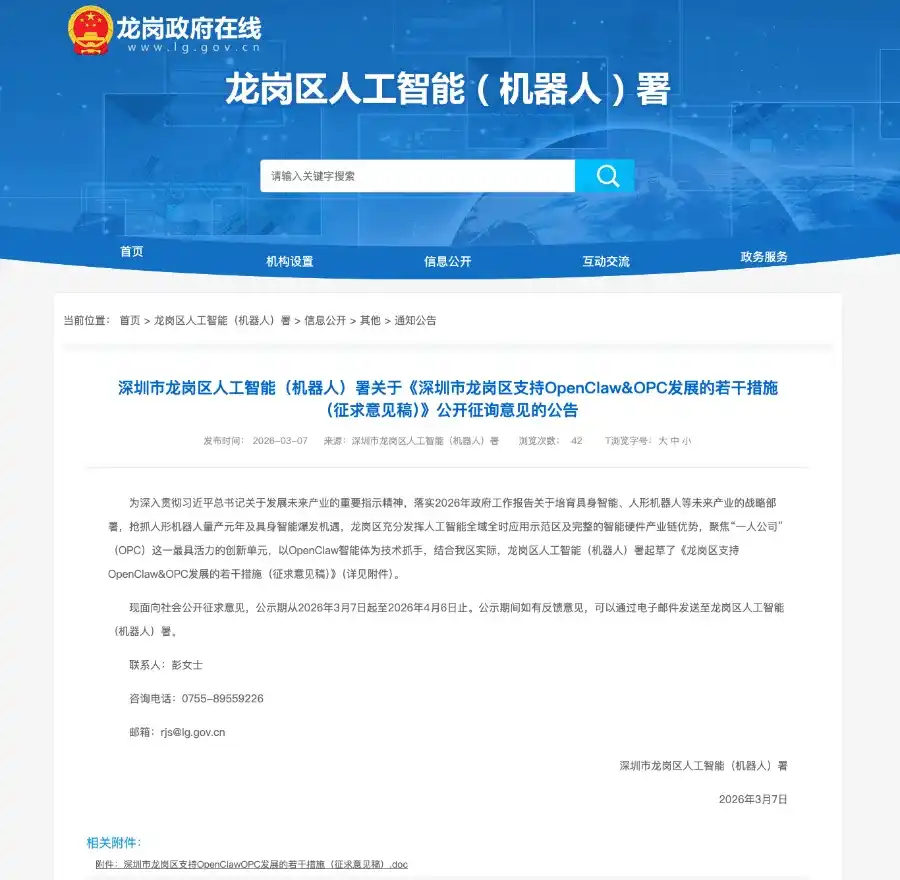
To seize the opportunities presented by the intelligent economy, Shenzhen's Longgang District released the "Several Measures of Shenzhen Longgang District to Support the Development of OpenClaw & OPC (Draft for Solicitation of Comments)" (hereinafter referred to as the "Lobster Ten") on March 7. The policy aims to make "zero-cost startup" its core highlight, extending an olive branch to global AI agent developers and OPC (One Person Company) entrepreneurs, and positioning the district as the preferred destination for global AI agent entrepreneurship.
This year's government work report首次提出 the concept of "intelligent agents," explicitly calling for "cultivating new forms of intelligent economy" and emphasizing "supporting entrepreneurial forms adapted to the AI era." The introduction of the "Lobster Ten" is a rapid and precise response to this strategic deployment.

Free Deployment, Data Subsidies, Hardware Subsidies

Addressing the key needs in the evolution of AI agents from "seeing and speaking" to "doing and acting," the "Lobster Ten" introduces a series of comprehensive services, focusing on supporting OpenClaw—a project hailed as the "operating hand" of AI agents.

Free deployment, ready to use out of the box. The policy encourages platform companies to create "Lobster Service Zones," offering free OpenClaw deployment services to developers, eliminating the hassle of complex environment setup. The government will provide corresponding subsidies to the platforms, truly enabling developers to "move in with just a suitcase."

Data elements, open and shared. Longgang plans to open large-scale, high-quality, desensitized public data in areas such as low-altitude economy, smart transportation, healthcare, and urban governance, reducing the cost of using public data. Enterprises purchasing data governance, labeling, and other services for OpenClaw development will receive a 50% subsidy on the fees; those purchasing plug-and-play "Lobster Box" (AI NAS) hardware will receive a 30% subsidy based on the market price.

Encouraging innovation, rewarding applications. To incentivize technological breakthroughs, Longgang plans to offer subsidies of up to 2 million yuan to enterprises that contribute key code to international mainstream communities or develop and list skill packages for Longgang's advantageous industries, subject to approval. Additionally, the "OpenClaw Digital Employee Application Voucher" will be implemented, supporting enterprises in purchasing or building solutions with a 40% subsidy on investment, up to 2 million yuan per enterprise annually. Each year, a selection of demonstration projects with deep applications in areas like smart manufacturing and smart governance will be recognized with titles and rewards of up to 1 million yuan.

Three Months of Free Computing Power, 30% Subsidy on Large Model Usage Fees

With the advancement of AI technology, it is becoming a reality for one person to operate a competitive company (OPC, One Person Company) with the help of intelligent tools and a complete supply chain. Increasing numbers of "super individuals" juggling multiple roles are emerging.

In 2026, the "Shenzhen Plan for Building a Leading Hub for AI OPC Entrepreneurship Ecology (2026-2027)" was officially issued, explicitly proposing the construction of an industrial cluster and an innovation-active AI OPC entrepreneurship ecology.

In line with this trend, Longgang District has tailored support measures for this new entrepreneurial form in the proposed policy, helping "individuals" start with light loads.

Regarding computing power and model subsidies, to address the computing power and model bottlenecks in the early stages of entrepreneurship, newly入驻 recognized OPC community enterprises will receive up to three months of free computing power. Eligible AIGC enterprises in the district that use domestic leading large models for creation and production will receive a 30% subsidy on actual usage fees, with each enterprise eligible for up to 1 million yuan annually.

Regarding scenario对接, Longgang plans to select示范场景 projects with industry leadership annually, providing support of up to 50% of the actual project investment, not exceeding 4 million yuan, to help innovative technologies quickly find application stages.

Community operations, ecological support. Recognized OPC communities will receive up to 4 million yuan in annual support for their operating institutions, fostering a "tropical rainforest"般的 entrepreneurial ecology.

Talent settlement, housing保障. The policy plans to provide tiered settlement subsidies for talent of up to 100,000 yuan, offer up to two months of free accommodation and 18 months of discounted office space for newly registered OPC enterprises, creating a growth environment that starts "from a single desk." The "Longgang District OPC Person of the Year" award will be established, with winners receiving up to 100,000 yuan in rewards and comprehensive services such as medical care and children's education.

To adapt to this "light-asset, high-innovation" entrepreneurial model, Longgang has precisely launched a series of "cost-reduction" measures to create an OPC创业友好城区. Eligible OPC projects will have access to industrial space at 30-70% of market rent; the district has taken the lead in establishing "OPC专属咨询窗口" (OPC exclusive consultation windows)配套 "一人公司"开办指南 (one-person company startup guides); entrepreneurs can complete business registration within 3 working days through the "开办企业一窗通" (one-stop business startup window), enabling a easy start.

Three Major Moves to Promote OPC Growth

To ensure OPC entrepreneurial dreams take root and grow, the policy brings together three key elements—capital, global expansion, and competitions—to build a full-chain support system.

In terms of capital empowerment, Longgang plans to coordinate the use of the科技 innovation 'seed fund', the artificial intelligence industry母基金, and others to provide投融资 channels for seed-stage OPC projects with high technological content and strong innovation capabilities (especially youth talent projects). Eligible projects can receive up to 10 million yuan in equity investment support.

Regarding global expansion services, Longgang plans to leverage the district's international service base for enterprises to specifically establish OPC "出海服务站" (global expansion service stations), integrating one-stop services such as market expansion, cross-border logistics, and compliance consulting. It will also provide premium support for eligible export credit insurance, helping enterprises explore global markets worry-free.

In terms of attracting talent through competitions, Longgang plans to host brand events like "OPC Hackathons" and innovation and entrepreneurship competitions, offering winning teams rewards of up to 500,000 yuan. This aims to discover and储备一批优秀创业团队与个人 (a batch of excellent entrepreneurial teams and individuals), continuously injecting fresh blood into industrial development.

It is reported that the measures are currently open for public comment and are planned to take effect from 2026, valid for 3 years. The head of the Longgang District Artificial Intelligence (Robotics) Office stated: "Workstations are ready, computing power is prepared, funds are in place. Longgang sincerely invites global developers, geeks, and super individuals to gather in Longgang to jointly define the new form of the intelligent economy. Particularly regarding the safety concerns everyone has, we will establish strict technical standards and regulatory mechanisms to ensure full lifecycle security and controllability from data collection and storage to application, while promoting domestic substitution to reduce reliance on external risks. For example, in identity authentication and permission management, we will enable mandatory dual-factor authentication and set passwords that meet complexity requirements with regular changes. During operation, the principle of least privilege will be followed, using普通用户权限 (standard user permissions) rather than管理员权限 (administrator privileges); strictly limit its file system access scope, only opening necessary working directories, and prohibiting access to any paths containing sensitive data."


Related Questions

QWhat is the core feature of the 'Lobster Ten Articles' policy introduced by Longgang District, Shenzhen?

AThe core feature is 'zero-cost startup', providing comprehensive support including free deployment, data subsidies, hardware subsidies, and computing power incentives to attract global AI developers and OPC entrepreneurs.

QWhat specific subsidies does the policy offer for data and hardware related to OpenClaw development?

AIt offers a 50% subsidy for data governance and annotation services, and a 30% subsidy for purchasing 'Lobster Box' (AI NAS) hardware at market price.

QHow does the policy support One Person Company (OPC) startups in terms of computing power and model usage?

AIt provides three months of free computing power for newly入驻 OPC community enterprises and a 30% subsidy on调用 fees for using domestic leading large models, with a maximum of 1 million RMB per year per enterprise.

QWhat financial support is available for OPC startups through capital empowerment under this policy?

AEligible OPC projects can receive up to 10 million RMB in equity investment support through seed funds and AI industry母基金, particularly for early-stage projects with high technological content.

QWhat measures are mentioned to ensure security and compliance in the development and application of AI technologies like OpenClaw?

AStrict technical standards and regulatory mechanisms will be established, including mandatory dual authentication, regular password changes, minimal permission principles, restricted file system access, and promoting domestic alternatives to reduce external dependency risks.

Related Reads

AI Agent Completely Transforms Web3 Gaming: From the Rugpull Bakery Bot Controversy to the New 2026 Agent Paradigm

This article explores how the AI Agent paradigm is fundamentally transforming Web3 gaming, moving from a disruptive force to a core, legitimized element. It begins with the controversy in the competitive baking game Rugpull Bakery, where automated scripts caused fairness issues. Instead of banning them, the developers integrated AI Agents into the official gameplay by providing technical documentation (skill.md, agent.json), marking a shift towards "Agentic Gaming." The piece outlines three primary implementation models for AI Agents in Web3 games by 2026: 1. **Autonomous Competitors & Economic Entities:** AI Agents act as independent players with unique strategies. Examples include TEN Protocol's poker agents, AI Arena's trainable NFT fighters, and Satoshi Strike Force's "Digital Athletes" trained on player data. The Somnia blockchain is highlighted as a dedicated "Agentic L1" infrastructure supporting this model at scale. 2. **Modular Infrastructure & Programmable Environments:** This model, exemplified by EVE Frontier, allows AI Agents to program game world logic itself. Using "Smart Assemblies" (e.g., Smart Turrets, Smart Gates), Agents can modify shared economic and physical rules on-chain, creating dynamic, player/AI-built worlds. The ERC-8183 standard further enables these automated entities to hire other AI services for complex tasks. 3. **Hybrid Companions & Dynamic Adaptation:** Here, AI serves as a collaborative partner. In Parallel Colony, highly autonomous AI Avatars work alongside human players who provide high-level guidance. Illuvium plans to use AI to make NPCs dynamic and responsive, creating personalized, emergent narratives for each player. The conclusion posits that Web3 gaming has reached a "post-human" inflection point. Blockchains' transparency and programmability, combined with new standards and infrastructure like Somnia, make integrating and governing AI Agents not just viable but essential. The future lies in a symbiotic digital order where players transition from manual laborers to commanders and partners of algorithmic intelligence.

marsbit22m ago

AI Agent Completely Transforms Web3 Gaming: From the Rugpull Bakery Bot Controversy to the New 2026 Agent Paradigm

marsbit22m ago

Saylor's Purchase of 1550 Bitcoin Is a Bad Trade

**Title: Saylor's Purchase of 1,550 Bitcoins Was a Bad Trade** The article critically analyzes Strategy's recent move of selling 32 bitcoins followed by a much larger purchase of 1,550 bitcoins. While appearing bullish, the author argues this trade is detrimental to MSTR shareholders. The core argument revolves around the concept of "breakeven modified Net Asset Value (mNAV)," a key metric for Strategy. To increase Bitcoin per share (BPS) for MSTR holders, Strategy must issue new shares at a premium high enough that the funds raised can buy more bitcoin than the bitcoin backing each existing share. Currently, this breakeven mNAV is estimated at 1.30. The recent trade failed on two counts: 1. The shares for the $181 million raise were issued at an mNAV *below* the 1.30 breakeven point. Selling "cheap" shares to buy bitcoin actually *reduces* BPS. 2. Only $101.3 million of the raised funds were used to buy bitcoin; the rest went to boost the company's dollar reserves. The breakeven mNAV calculation assumes *100%* of proceeds are used for bitcoin purchases. Diverting funds, even if mNAV were high, dilutes BPS. The result is an estimated 0.19% decrease in Bitcoin per share for MSTR holders. In exchange, Strategy merely extended its operational runway for its dollar reserves from ~6.3 months to 7 months. The author interprets this as Strategy prioritizing the survival and development of its STRC business over its stated core goal of increasing MSTR's BPS. This constitutes a gamble: if sacrificing MSTR value leads to improved market sentiment and a recovery in STRC's price (and thus mNAV), the whole system could work. If not, Strategy may be forced into a cycle of further diluting MSTR to stay afloat, potentially leading to deferred STRC dividends or corporate decline. The article concludes with a hope for price recovery for Bitcoin, MSTR, and STRC.

Foresight News33m ago

Saylor's Purchase of 1550 Bitcoin Is a Bad Trade

Foresight News33m ago

The AI Bear Market Lasting Two Days Is Over; Why Did Funds Buy Back Storage Stocks First?

After a severe two-day selloff in early June that erased over $1 trillion from U.S. chip stock market value, capital is flowing back first to the memory sector. The correction was not driven by a collapse in AI demand but rather a market reassessment of high expectations. Stocks like Broadcom faced selling pressure despite strong AI revenue guidance, signaling a shift in focus from who has an "AI story" to who can most rapidly translate AI demand into verifiable profits and earnings per share (EPS). Memory companies, such as Micron and SK Hynix, are leading the recovery because their EPS growth is more immediately verifiable. The AI server boom directly increases demand for high-bandwidth memory (HBM) and high-capacity server DRAM, tightening supply and driving up contract prices for conventional DRAM and NAND Flash. This price increase, coupled with a shift to higher-margin products, flows directly into near-term revenue and profitability, as evidenced in recent earnings reports. In contrast, other AI semiconductor segments like GPUs, ASICs, and optical modules, while central to the long-term AI infrastructure story, face longer and less certain paths to EPS validation. Their growth depends more on future product cycles, customer adoption timelines, and capital expenditure plans. The rebound in memory stocks highlights a market preference for assets with shorter, more transparent EPS conversion cycles following the recent de-risking phase. However, this does not negate the potential of other AI hardware segments should they provide clearer near-term order visibility. The episode has raised the validation bar for all AI-related investments.

marsbit33m ago

The AI Bear Market Lasting Two Days Is Over; Why Did Funds Buy Back Storage Stocks First?

marsbit33m ago

Trading

Spot
Futures

Hot Articles

Discussions

Welcome to the HTX Community. Here, you can stay informed about the latest platform developments and gain access to professional market insights. Users' opinions on the price of AI (AI) are presented below.

活动图片














