South Korea's Debt Approaches 2,000 Trillion Won, Is the Market Overestimating Rate Hikes?

marsbit發佈於 2026-08-18更新於 2026-08-18

文章摘要

South Korea's central bank raised its benchmark interest rate by 25 basis points to 2.75% on July 16, marking its first hike since January 2023. The move, driven by concerns over rising housing prices, household loan growth, and financial stability, comes as total household credit is nearing a critical threshold of 2,000 trillion won. While persistent high loan growth and inflation pressure the Bank of Korea (BOK) to maintain a hawkish stance, some market views, like that of M&G Investments, suggest expectations for further tightening may be overstated. They argue that improved corporate profits and tax revenues from the AI chip boom could reduce government bond issuance, potentially benefiting bond prices. The article highlights the tension between two forces: household debt and housing market risks pushing for continued policy tightening, and strong AI-driven exports offering macroeconomic support. The upcoming preliminary data on Q2 household credit and the BOK's future policy communications will be key in determining whether current market pricing for rate hikes is justified.

The Bank of Korea raised its benchmark interest rate by 25 basis points to 2.75% on July 16, citing housing prices, household loan growth, and financial stability pressures as policy considerations.

This marks the first rate hike in South Korea since January 2023. For investors, the question is not only about how high household debt is but also whether the central bank will be pushed back onto a tightening path by household leverage and housing prices.

The preliminary official figure for household credit in the second quarter will be released on August 19. As the balance reached 1,993 trillion won at the end of the first quarter, coupled with continued increases in household loans in May and June, the market is already pricing in a potential outcome: South Korea's household credit is approaching or exceeding 2,000 trillion won.
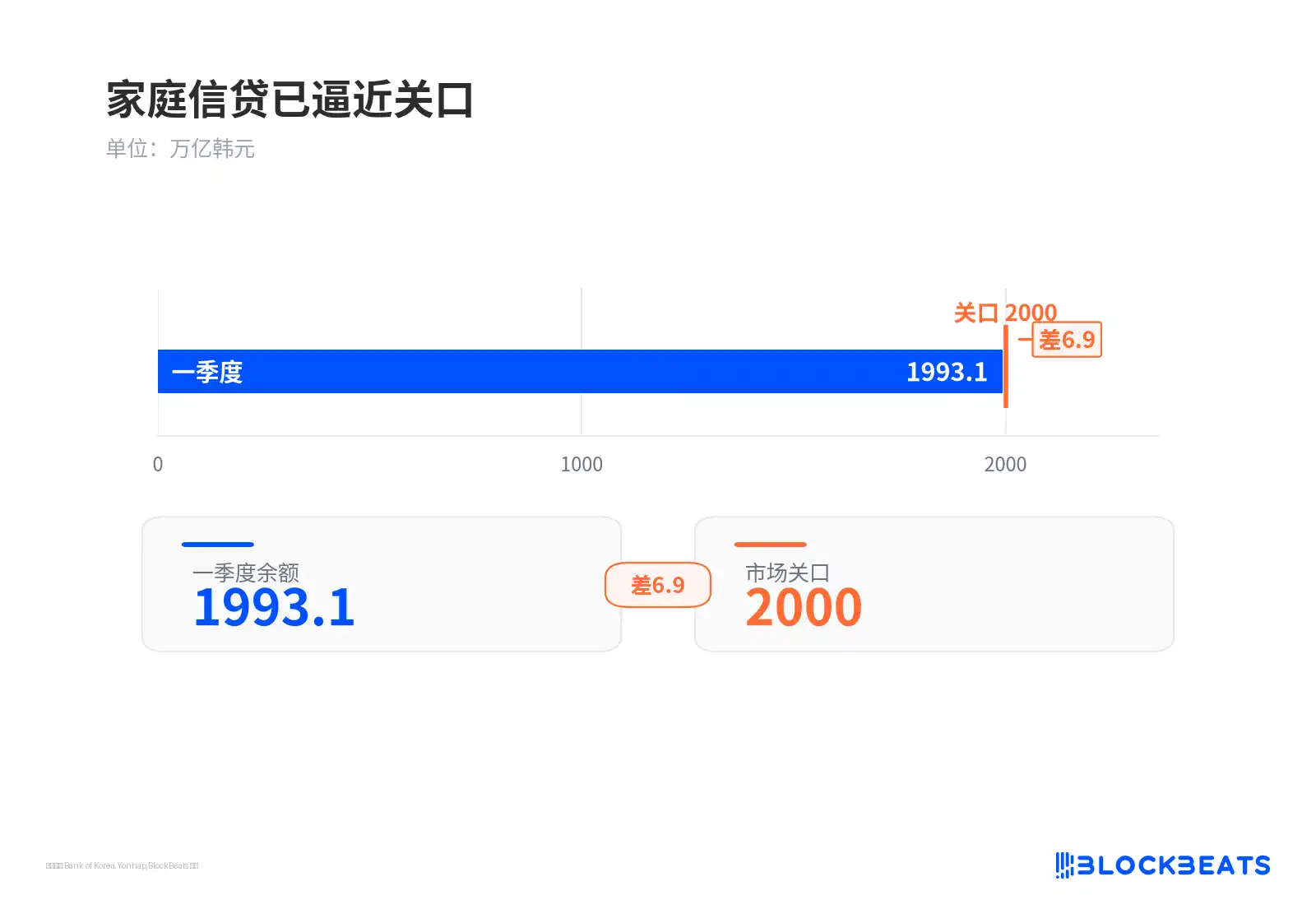
Household Credit is Approaching a Milestone

M&G Investments' Head of Asian Fixed Income, Low Guan Yi, holds a different view. According to media reports, his argument can be summarized as the market potentially overestimating the likelihood of further rate hikes by the Bank of Korea. Instead, improved corporate profits and tax revenue from the AI chip cycle could reduce government bond issuance needs.

This article does not focus on whether South Korea is entering a debt crisis. Rather, it examines which of the three forces—household leverage, inflation, and AI exports—will dominate interest rates and asset pricing in South Korea.

Household Loans Push the Central Bank Back into Hawkish Territory

The household credit balance refers to the total amount borrowed by households from financial institutions like banks and insurers, including mortgages, consumer loans, and stock financing loans. It is a stock burden, not a monthly flow.

The larger the stock, the more pronounced the cash flow amplification effect of an interest rate hike. For highly leveraged households, a 25-basis-point increase doesn't just alter monthly payments; it also affects home purchases, consumption, and risk asset allocation.

The Bank of Korea's July statement noted that housing prices are rising in the capital region and household loan growth is expanding. June CPI increased by 3.2% year-on-year, providing the central bank with an inflation-based justification for the hike.

More sensitive is the loan increment. Data from the Financial Services Commission shows household loans across the entire financial sector increased by 9.3 trillion won in May and 8.3 trillion won in June. Bank of Korea data also indicates that bank household loans increased by 7.6 trillion won in June, with mortgage loan balances reaching 945 trillion won.
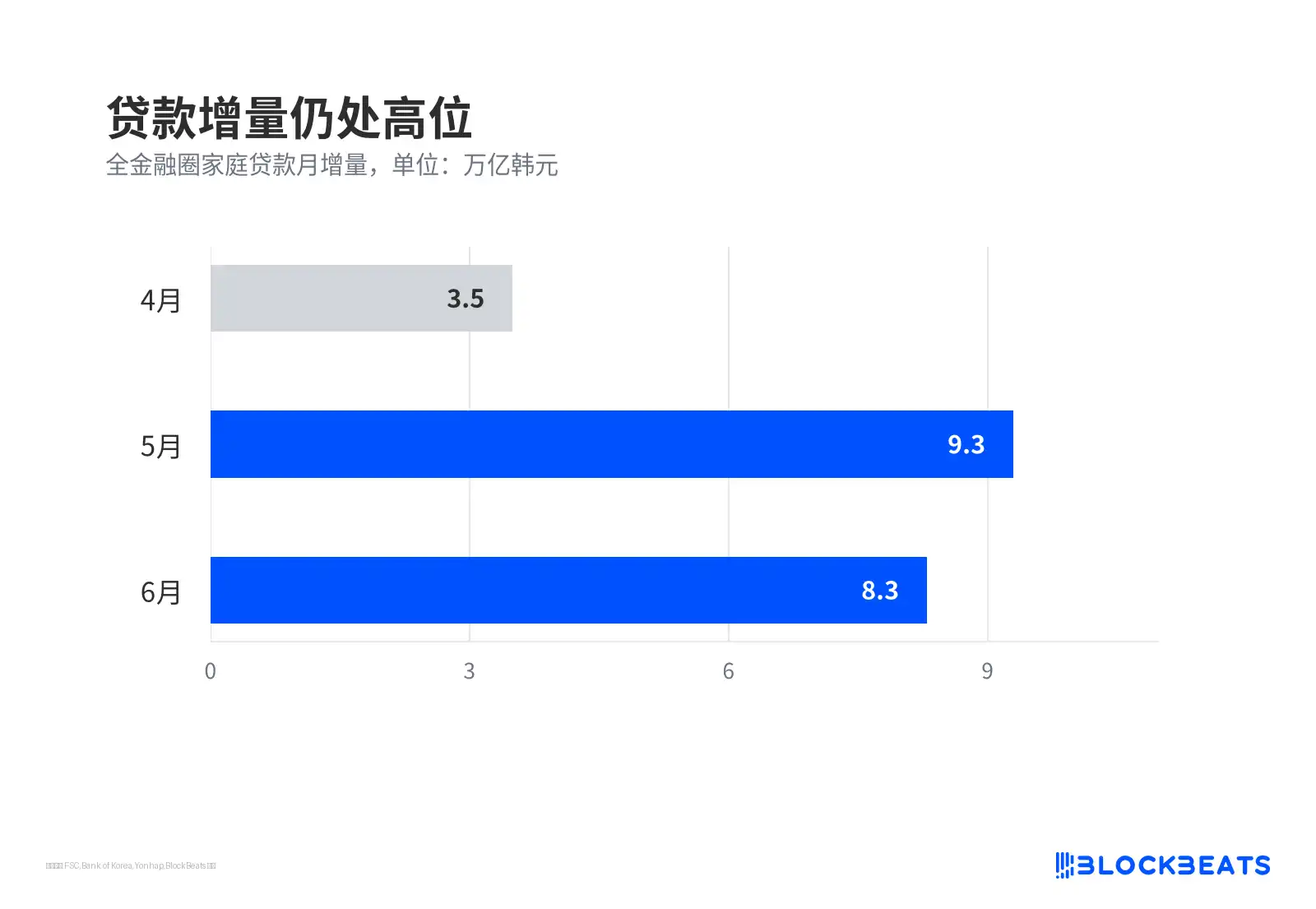
Loan Increment Remains Elevated

These numbers explain the central bank's constraint. As long as housing credit continues to expand, the central bank will find it difficult to pivot quickly toward easing, even as exports and corporate profits are improving.

M&G Bets Hawkish Rate Hike Expectations Are Excessive

M&G's contrarian logic does not deny debt pressure but questions whether pricing has run ahead of fundamentals.

Following this line of reasoning, if inflation is near a temporary peak, the necessity for additional rate hikes diminishes. If South Korea's semiconductor exports continue to benefit from AI demand, improved profits for companies like Samsung Electronics and SK Hynix will lead to a broader tax base.

Improved fiscal revenue could reduce government bond issuance needs. For bond investors, reduced supply pressure typically supports bond prices, potentially leading to a decline in South Korean government bond yields.

The appeal of this logic lies in its attempt to move South Korea beyond a simplistic high-debt narrative. The AI chip boom affects not only the stock market but may also impact bond supply through fiscal channels via taxes and government spending.

However, this remains a trading hypothesis yet to be verified. Low Guan Yi's view resembles an optimistic scenario more than market consensus. Whether AI exports translate into fiscal improvements depends on subsequent tax revenue and government bond issuance plans.

Property Market and Leveraged Positions Amplify Policy Difficulty

The complexity of South Korea's current pressures lies in the simultaneous occurrence of high household leverage and asset price rebounds. Increased mortgage loans indicate households are still using leverage to participate in the property market. Rising stock financing loans suggest the stock market rally is also attracting leveraged funds.

A rebound in capital region housing prices will make the central bank more cautious. While rising housing prices can temporarily support household balance sheets, they also stimulate further borrowing demand, creating new policy pressures.

If asset prices continue to rise, households can use paper wealth to buffer interest payment pressures, and banks' credit risks are less likely to surface. However, if rate hikes dampen transactions and both housing and stock prices weaken simultaneously, debt repayment pressures could transmit more quickly to consumption and bank asset quality.

This is also a variable that the Korean won and South Korean bank stocks need to monitor. The more hawkish the central bank, the more it may support the currency in the short term, but it also increases pressure on the household sector and bank asset quality. The earlier the central bank pivots dovish, the more bonds might benefit, but the won could then face pressure from interest rate differentials.

The stronger semiconductor exports are, the more growth and tax revenue are supported. The more willing the household sector is to increase leverage, the harder it is to ignore financial stability risks. South Korea is currently trading on the tug-of-war between these two forces.
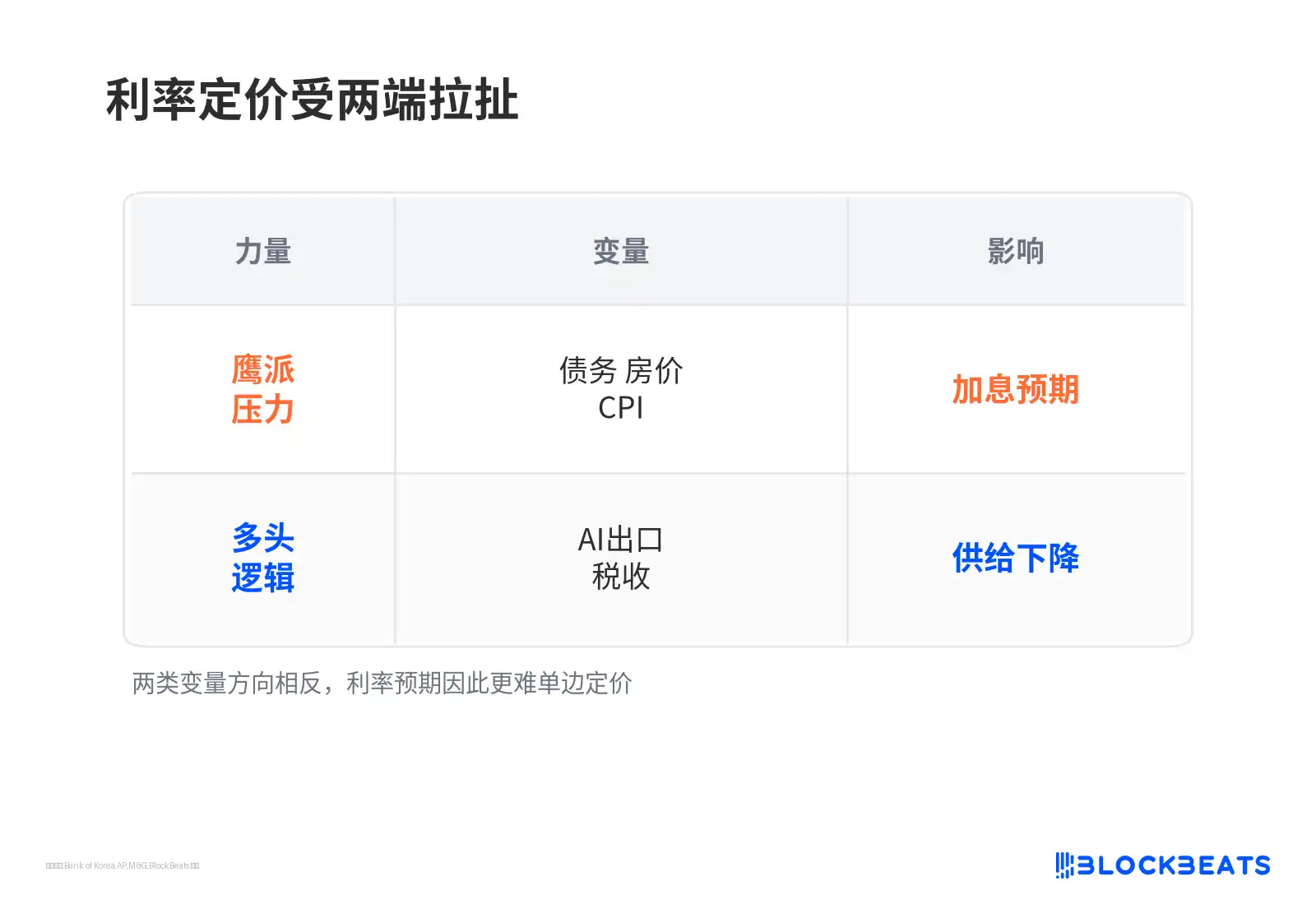
Interest Rate Pricing Pulled by Two Sides

Bond Bulls Await Cooling in Supply and Loans

The preliminary Q2 household credit figure on August 19 will first test the 2,000 trillion won milestone. If the balance is confirmed to have surpassed this level, the market will interpret it as a reason for the central bank to continue emphasizing financial stability.

The focus of the next monetary policy meeting may not solely be on whether to hike rates. More important is how the central bank describes inflation, household debt, and housing prices. If the statement continues to place significant weight on financial stability, subsequent hawkish pricing is unlikely to recede quickly.

Loan growth is a harder variable. As long as mortgage loan growth remains high, the household credit milestone will continue to constrain policy space. Only when new loan growth cools will the pressure on the central bank to hike further diminish.

The bond bull logic from M&G, however, awaits confirmation from the fiscal side. If the AI semiconductor boom is only reflected in stock prices and export data without significantly reducing government bond supply, the rationale for South Korean government bond appreciation weakens.

South Korea provides a clear case study: tech exports can improve the macro narrative but cannot immediately remove household leverage constraints. Investors must judge whether the market's pricing of the Bank of Korea's hawkish path has exceeded the level that subsequent data can support.


熱門幣種推薦

相關問答

QWhat are the two main forces that are creating tension and influencing market pricing for interest rates and assets in South Korea, according to the article?

AAccording to the article, the two main opposing forces creating tension are high household leverage, which pressures the central bank towards a hawkish policy to ensure financial stability, and the positive impact of the AI-driven semiconductor export boom, which could improve corporate profits and government tax revenues, potentially allowing for a less restrictive monetary policy.

QWhat key data point is the market anticipating on August 19th, and why is it significant for predicting the Bank of Korea's policy path?

AThe market is anticipating the preliminary official data for South Korea's second-quarter household credit. Its significance lies in the fact that the balance is expected to approach or even surpass 2,000 trillion won. A breach of this threshold would be interpreted as reinforcing the central bank's focus on financial stability and could justify maintaining a hawkish stance on interest rates.

QWhat is the core argument of M&G Investments' Low Guan Yi against the prevailing market expectation of continued rate hikes in South Korea?

ALow Guan Yi's core argument is that market expectations for further rate hikes may be too hawkish. He posits that the AI chip cycle could significantly boost corporate profits (e.g., for Samsung, SK Hynix) and consequently improve government tax revenues. Higher tax income might reduce the government's need to issue bonds, decreasing bond supply pressure and potentially lowering yields, which could change the calculus for monetary policy tightening.

QHow does the simultaneous increase in housing prices and household debt complicate the policy decision for the Bank of Korea?

AThe simultaneous increase complicates policy because rising housing prices can temporarily bolster household balance sheets, but they also stimulate further borrowing demand, creating a self-reinforcing cycle that increases financial stability risks. The central bank faces a dilemma: tightening policy (hiking rates) could cool the market and contain debt but risk triggering a downturn in asset prices that would worsen debt-servicing capacity. Maintaining looser policy supports growth but lets leverage build further.

QWhat specific indicator, beyond the overall household credit balance, does the article suggest is a crucial 'hard variable' for the Bank of Korea's future policy decisions?

AThe article suggests that the growth rate of new household loans, particularly housing mortgage loans, is a crucial 'hard variable'. As long as the growth in new mortgage lending remains high, it will continuously constrain the central bank's policy space. A noticeable cooling in the pace of new loan origination would be a key signal that the pressure for further rate hikes might be diminishing.

你可能也喜歡

比特币逼近7.2万美元大关,因山寨币飙升与空头亏损30亿美元

周四上午,比特币延续涨势,逼近72,000美元关口,此前由美国财政部声明引发的上涨行情未见放缓迹象。前总统特朗普在8月19日与加密货币行业高管的会晤中发表了积极言论,进一步推动了价格上涨。Bitstamp数据显示,比特币触及71,992美元的盘中高点,买盘压力持续,预示当日可能突破72,000美元。过去24小时内,比特币涨幅达11.3%,市值升至1.44万亿美元。 主流山寨币紧随其后,以太坊领涨,涨幅达19%,最高触及近2,320美元。XRP、SOL、DOGE和Zcash等亦录得两位数增长。衍生品市场方面,上涨行情导致大量杠杆空头头寸被强平。Coinglass数据显示,比特币空头清算额接近17亿美元,市场总清算额达33.5亿美元,其中空头清算占30.7亿美元。 特朗普在白宫与科技领袖、金融监管机构负责人及加密货币公司高管会面时强调,美国在加密货币和人工智能领域“遥遥领先”,并重申美国正与中国等外国竞争对手直接争夺加密货币和金融科技市场的主导地位。部分与会CEO借此呼吁国会通过悬而未决的《清晰法案》,以期为国内数字资产运营提供长期法律确定性。 然而,白宫活动也引发争议,特朗普在讲话中明确提及具体的加密货币协议,暗示其政府正积极协调将去中心化交易平台Hyperliquid迁至美国。此消息立即引发其代币HYPE价格投机性飙升,逼近74美元,距离6月16日的历史高点76.87美元仅一步之遥。此外,Chainlink联合创始人Sergey Nazarov在活动上发表讲话后,其代币LINK价格动态也受到关注。此前怀俄明州宣布从Layerzero切换至Chainlink的CCIP,已推动LINK上涨3%至9.70美元,随后该代币进一步涨至10.86美元,日内涨幅约9%。

cryptonews.ru10 分鐘前

比特币逼近7.2万美元大关,因山寨币飙升与空头亏损30亿美元

cryptonews.ru10 分鐘前

交易

現貨

熱門文章

什麼是 $BANK

銀行人工智能:銀行未來的革命性步伐 介紹 在這個科技迅速進步的時代,銀行人工智能處於人工智能(AI)和銀行服務的交匯點。這個創新的項目旨在重新定義金融格局,通過人工智能的力量提高運營效率、安全措施和客戶體驗。在我們探索銀行人工智能的過程中,將深入探討這一項目的內涵、運作動態、歷史背景以及重要里程碑。 銀行人工智能是什麼? 從本質上講,銀行人工智能代表了一項變革性倡議,旨在將人工智能整合進各種銀行運營中。這個項目利用人工智能的能力來自動化流程、改善風險管理協議,並通過個性化服務增強客戶互動。 銀行人工智能的主要目標包括: 銀行功能自動化:通過利用人工智能技術,銀行人工智能旨在自動化日常任務,減輕人力資源的負擔並提高效率。 加強風險管理:該項目利用人工智能算法來預測和識別風險,從而強化針對欺詐和其他威脅的安全措施。 銀行服務個性化:銀行人工智能專注於通過分析客戶數據和行為提供量身定制的金融產品和服務。 改善客戶體驗:實施由人工智能驅動的解決方案,如聊天機器人和虛擬助手,旨在為用戶提供更接近人類的互動,徹底改變客戶與銀行的互動方式。 有了這些目標,銀行人工智能將自己定位為在提高銀行效率、安全性和以用戶為中心的關鍵角色。 銀行人工智能的創造者是誰? 關於銀行人工智能的創造者的具體細節尚不清楚。因此,在可用信息中尚未確定具體的個人或組織。圍繞該項目創建的匿名性引發了問題,但並未減少其雄心壯志的願景和目標。 銀行人工智能的投資者是誰? 與項目的創造者類似,關於銀行人工智能的投資者或支持組織的具體信息尚未披露。沒有這些信息,很難概述可能推動該項目向前發展的財務支持和機構支持。儘管如此,擁有堅實的投資基礎對於在這樣一個創新領域中保持發展至關重要。 銀行人工智能是如何運作的? 銀行人工智能在幾個創新領域運作,專注於使其與傳統銀行框架區分開來的獨特因素。以下是主要的運作特點: 自動化:通過應用機器學習算法,銀行人工智能自動化銀行內的各種手動流程。這樣不僅減少了運營成本,還使人力工作者能夠將精力轉向更具戰略性的活動。 先進的風險管理:將人工智能整合到風險管理實踐中,使銀行獲得準確預測潛在威脅(如欺詐)的工具,確保客戶信息和資產的安全。 量身定制的財務建議:通過持續學習客戶互動,人工智能系統發展出對用戶需求的細緻理解,能夠對財務決策提供量身定制的建議。 增強的客戶互動:利用由人工智能驅動的聊天機器人和虛擬助手,銀行人工智能提供了更具吸引力的客戶體驗,使用戶能夠快速解決問題,從而減少等待時間並提高滿意度。 這些運作特徵使銀行人工智能成為銀行業的先驅,建立服務交付和運營卓越的新標準。 銀行人工智能的時間線 了解銀行人工智能的發展軌跡需要看其歷史背景。以下是突顯重要里程碑和發展的時間線: 2010年代早期:對人工智能整合到銀行服務的概念開始引起關注,隨著銀行機構認識到潛在利益。 2018年:隨著銀行開始使用聊天機器人等人工智能工具進行基本客戶服務和風險管理系統以改善安全處理,人工智能技術的實施顯著增加。 2023年:人工智能的技術不斷進步,生成式人工智能被引入進行更複雜的任務,如文件處理和實時投資分析。今年標誌著人工智能技術為銀行提供能力的重要飛躍。 2024-當前狀態:截至今年,銀行人工智能正處於上升軌道,持續的研究和開發預示著將進一步提升銀行業務的能力。對人工智能應用的持續探索暗示著未來令人興奮的發展。 銀行人工智能的關鍵點 人工智能在銀行中的整合:銀行人工智能專注於採用人工智能來簡化銀行流程並改善用戶體驗。 自動化和風險管理的聚焦:該項目強烈關注這些領域,旨在減輕例行任務的負擔,同時通過預測分析增強安全框架。 個性化的銀行解決方案:通過利用客戶數據,銀行人工智能提供滿足個別用戶需求的量身定制銀行服務。 對發展的承諾:銀行人工智能致力於持續的研究和開發,確保其隨著技術的持續演變而保持適應性和持續相關性。 結論 總結來說,銀行人工智能展現了銀行業的一個重要進步,利用人工智能重塑運營範式、提高安全性,並促進客戶滿意度。儘管有關創造者和投資者的信息仍有缺口,但銀行人工智能的明確目標和功能機制為其持續發展提供了堅實基礎。隨著人工智能技術的不斷進步和與銀行業的融合,銀行人工智能在金融服務未來的影響力將十分顯著,改善我們對銀行的理解和互動方式。

445 人學過發佈於 2024.04.06更新於 2024.12.03

什麼是 $BANK

如何購買BANK

歡迎來到HTX.com!在這裡,購買Lorenzo Protocol (BANK)變得簡單而便捷。跟隨我們的逐步指南,放心開始您的加密貨幣之旅。第一步:創建您的HTX帳戶使用您的 Email、手機號碼在HTX註冊一個免費帳戶。體驗無憂的註冊過程並解鎖所有平台功能。立即註冊第二步:前往買幣頁面,選擇您的支付方式信用卡/金融卡購買:使用您的Visa或Mastercard即時購買Lorenzo Protocol (BANK)。餘額購買:使用您HTX帳戶餘額中的資金進行無縫交易。第三方購買:探索諸如Google Pay或Apple Pay等流行支付方式以增加便利性。C2C購買:在HTX平台上直接與其他用戶交易。HTX 場外交易 (OTC) 購買:為大量交易者提供個性化服務和競爭性匯率。第三步:存儲您的Lorenzo Protocol (BANK)購買Lorenzo Protocol (BANK)後,將其存儲在您的HTX帳戶中。您也可以透過區塊鏈轉帳將其發送到其他地址或者用於交易其他加密貨幣。第四步:交易Lorenzo Protocol (BANK)在HTX的現貨市場輕鬆交易Lorenzo Protocol (BANK)。前往您的帳戶,選擇交易對,執行交易,並即時監控。HTX為初學者和經驗豐富的交易者提供了友好的用戶體驗。

1.5k 人學過發佈於 2025.05.09更新於 2026.06.02

如何購買BANK

相關討論

歡迎來到 HTX 社群。在這裡,您可以了解最新的平台發展動態並獲得專業的市場意見。 以下是用戶對 BANK (BANK)幣價的意見。

活动图片