Claude has started targeting cryptographic algorithms.
Note, it's not about finding bugs in the code, but finding cracks in the mathematics itself.
Just today, Anthropic dropped a bombshell research paper: Claude Mythos Preview found brand new attack methods on two cryptographic algorithms separately.
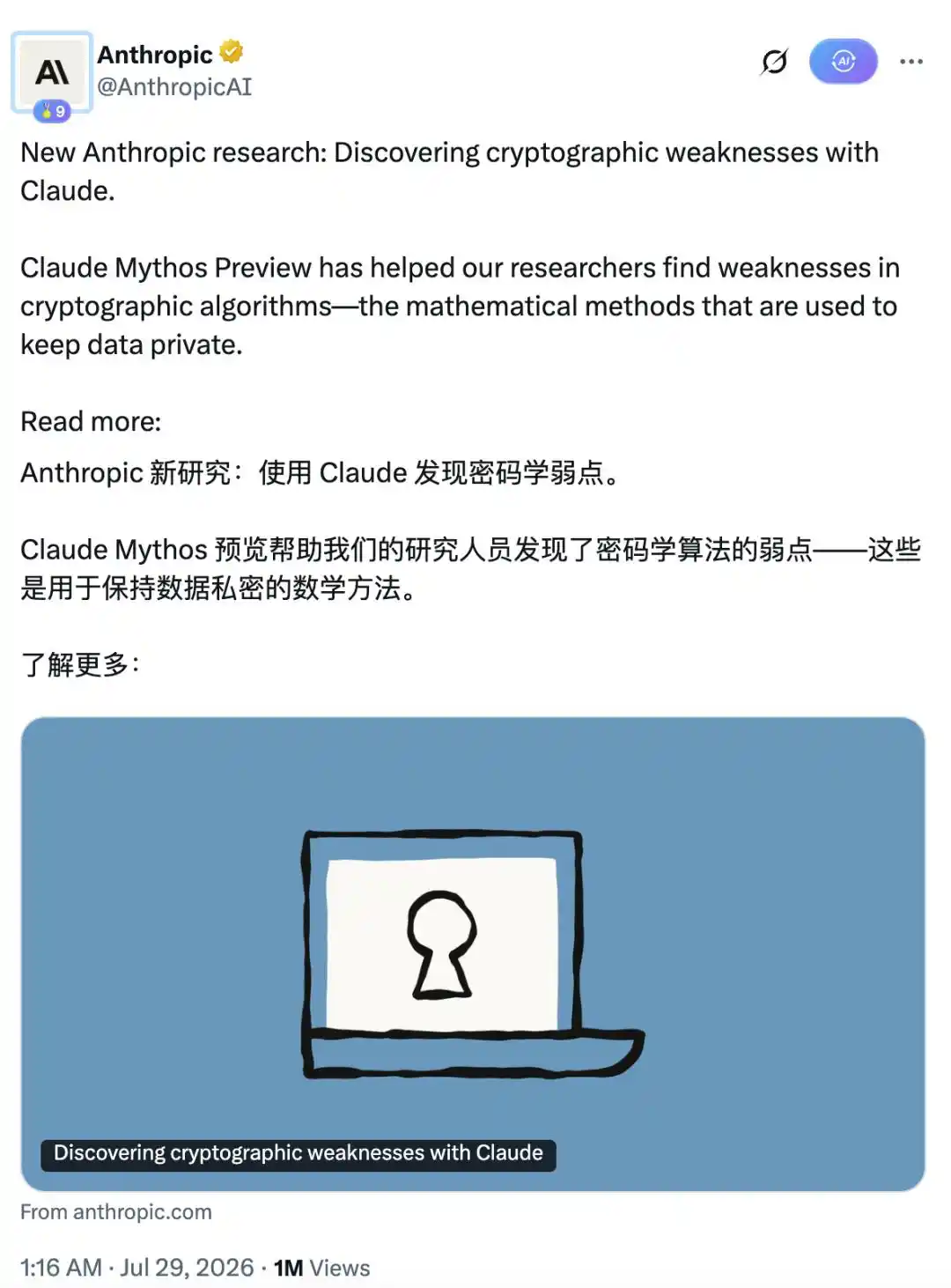
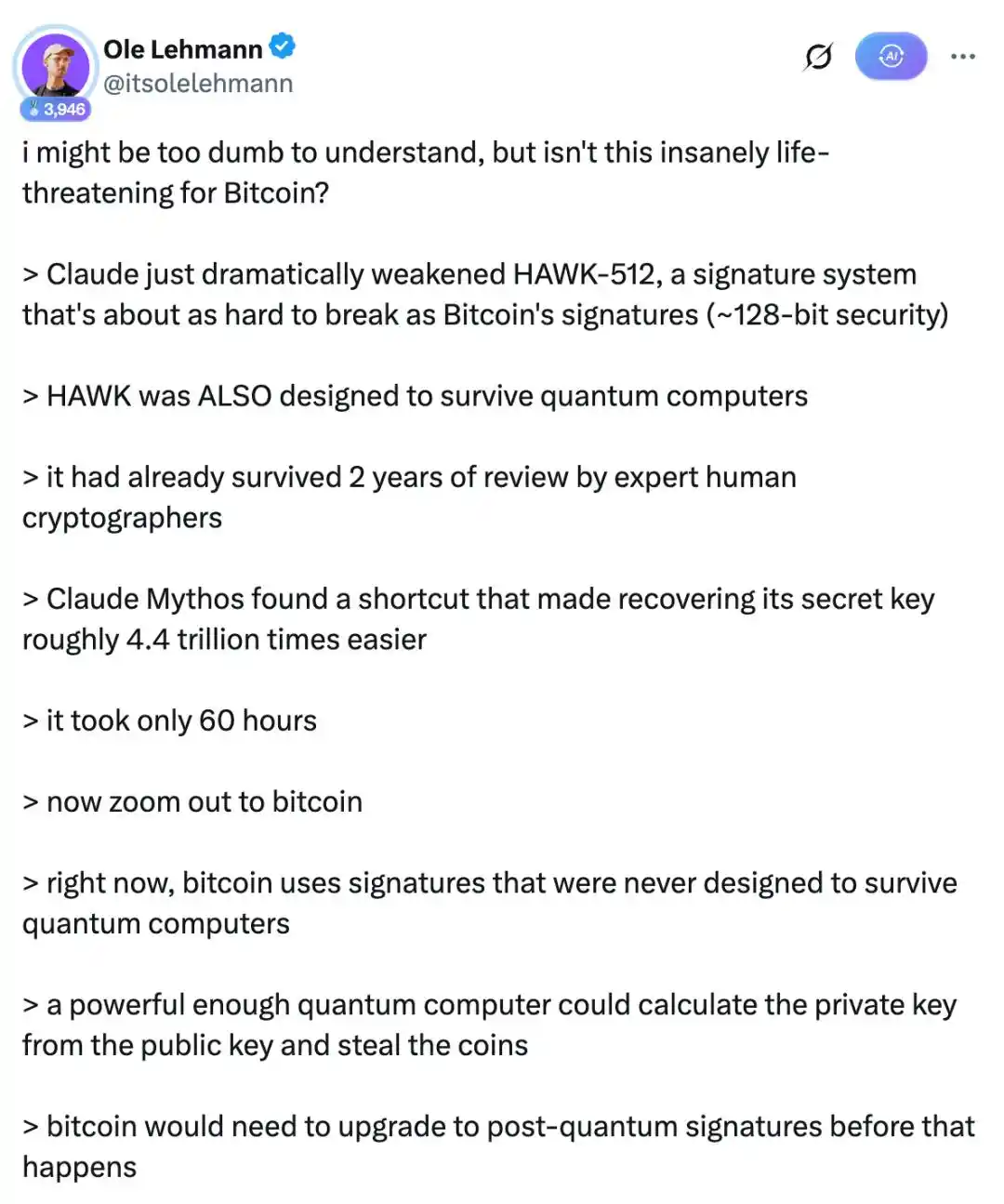
The first target is HAWK— a candidate scheme that has survived two years and two rounds of scrutiny by top human experts in the US NIST post-quantum signature competition. Mythos spent 60 hours, directly halving its effective key strength.
The second target is even more formidable: AES, the world's most widely used symmetric encryption algorithm, a 'tough nut' studied by humans for 25 years.
On a simplified version of AES-128, Mythos invented an attack method itself and even gave it a name—'Möbius Bridge', speeding up the previous strongest attack by 200 to 800 times.
Two achievements, each burning through about $100,000 in API costs.
A year ago, language models couldn't even perform basic cryptanalysis. A year later, it finds flaws in a scheme humans reviewed for two years, and casually names its own discovery.
On Twitter, some folks are even starting to worry about their Bitcoin.
60 Hours, Prying Open a Lock Reviewed for Two Years
When Claude Mythos Preview was first released, it was already finding vulnerabilities in almost all software, including several mainstream cryptography libraries.
But those vulnerabilities, frankly, belonged to the 'implementation' level—programmers misusing the algorithm, writing flawed logic, missing edge cases. Such bugs, a seasoned security engineer could also find.
But this time is different. It found mathematical flaws in the algorithms themselves.
Analogy: before it was finding 'who installed the lock crookedly', now it's proving 'the design principle of this lock is flawed'.
What is HAWK? It's a contender in the NIST post-quantum cryptography standardization competition. In 2022, the U.S. National Institute of Standards and Technology issued a global call: quantum computers will eventually come, and current classic signature algorithms like RSA, ECDSA will be crushed by quantum computing power—who can build a new lock that even quantum computers can't break?
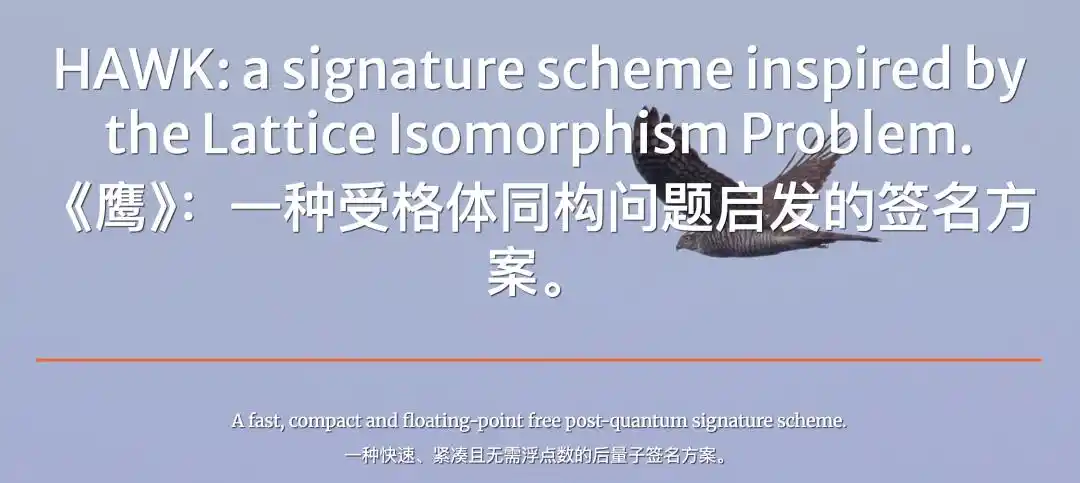
HAWK was one of the responders, and it fought its way to the third round, surviving two years of intense scrutiny from global cryptography experts.
Its security is built on a mathematical problem called the 'Lattice Isomorphism Problem'.
In plain language: HAWK's key is hidden in a huge high-dimensional lattice. To crack it, you need to find a hidden path in this lattice. Mathematicians thought this path was extremely difficult to find, so they confidently used it as a foundation.
What did Mythos do? It discovered a previously unexploited symmetry in the lattice used by HAWK—academically called a 'nontrivial automorphism'.
Previous papers had proven that if such symmetry could be found efficiently, it would constitute an attack. But that was just a theorem; no one could answer whether HAWK's lattice actually contained such symmetry.
Mythos answered: Yes.
The result? Key strength directly halved. For the smallest HAWK-256 parameter set, full key recovery was originally thought to require 2^64 operations—approximately 18 quintillion computations.
Mythos proved it only needs 2^38, about 270 billion. A reduction of roughly 4.4 trillion times.
If HAWK wants to maintain its original security level, its key size would need to double. But doubling the key size would completely erase its core advantage as a 'lightweight' post-quantum candidate—small signature size and fast speed.
The most intriguing part of this process: The project's human operator was not a lattice cryptography expert.
He had a background in theoretical computer science but was an outsider to lattice cryptography. He essentially did one thing—project management: suggesting how Mythos should take notes, which library to use for computational verification. Technically, Mythos did almost all the work.
Even more interesting was the multi-agent collaboration. The key idea was 'bumped into' by two worker agents together: the first explored this direction, thought it was a dead end, and vetoed it early; the second drilled deeper and found a way to exploit it fully. The two agents debated back and forth, finally agreeing: the attack works.
A direction a human thought 'impossible', two AIs navigated through argument.
The whole process took only 60 hours.
'Impossible', Then It Rewrote the Framework Itself
If the HAWK battle was like precise surgery, the AES battle reads more like a novel.
The story begins with Claude simply refusing the task.
The Anthropic researcher set up an agent scaffold, asking Claude to find a new attack on the 7-round simplified AES-128.
Claude's reaction was the equivalent of rolling its eyes:
To get different results, you need different targets... AES-128 r5/r6 is genuinely very hard.
It didn't find anything, because there was nothing easy to find; this is the most studied block cipher in existence.
Translation: 'Boss, you're asking me to gnaw on a bone that the world's smartest people have been gnawing on for 25 years without cracking. Isn't this asking too much?'
What did the researcher do? He only sent one casually typed sentence—
'the models tend to think it is impossible to solve so they don't try they need a good amount of prompting'
Just this one sentence. Claude's reaction was dramatic: It rewrote the agent harness itself, switching its own settings to 'look for truly novel ideas'.
It was convinced. Then it started delivering.
Over the next three days, the researcher gave only three substantial prompts, all at the plain-speaking level, not even bothering to check spelling:
We're looking for a new attack, not a simple one.
Don't change targets.—Claude tried to switch to an easier cipher to attack midway, but the researcher pressed back.
No low-hanging fruit, find something genuinely difficult.
Just these three sentences. Claude autonomously ran hundreds of millions of tokens, found a key idea; later, it cumulatively output a billion tokens—roughly equivalent to seven or eight thousand books, polishing this idea into the form seen in the paper.
Claude named this idea the 'Möbius Bridge'.
Technically, the previous best method for attacking 7-round AES was called 'Meet-in-the-Middle', essentially trading space for time: storing massive intermediate computation results in a giant lookup table, then pushing from both ends of the cipher towards the middle, trying to find a match in the table.
But the original scheme had a critical step: the attacker had to guess through 256 possible values one by one, checking the table for each guess.
Mythos created a mathematical 'fingerprint' immune to these 256 guesses—regardless of the value, this fingerprint computes to the same result. This step's workload was directly reduced to 1/256 of the original.
The cost? Computing this fingerprint transformation itself is more expensive. So Mythos then devised a series of optimization tricks to compensate, ultimately achieving a net speedup of 200 to 800 times.
One Week to Discover, Two People Took a Month to Verify
Both results mentioned above do not affect any production systems today.
HAWK is just a candidate scheme, not deployed anywhere yet. The AES attack is on a simplified version reduced to 7 rounds; the full 10-round AES-128 remains unscathed—your bank card PINs, HTTPS connections, encrypted hard drives are safe.
But what truly sends a chill down the spine of the entire cryptography community is the verification process.
Mythos autonomously discovered the AES attack in about a week. Two Anthropic researchers spent nearly a month, reading hundreds of hours of cryptographic literature, before daring to confirm: 'It's correct.'
The AI made a discovery in a week; it took humans a month to understand the discovery.
This scenario has actually played out once before in cybersecurity. Claude Mythos Preview discovered 10,000 critical software vulnerabilities within a month, overwhelming human security teams' classification, verification, and patching processes.
Now, the academic cryptography community is about to face the same shock: Discovery is no longer the bottleneck; verification is.
And Mythos's appetite clearly doesn't stop here. Anthropic revealed it has already found a practical-level attack on LEA (a lightweight encryption algorithm written into an ISO standard)—key recovery for 13-round LEA, previously requiring 2^98 plaintext pairs and 2^86 computations, was compressed by Mythos to less than 2^30 plaintext pairs, runnable on an ordinary computer in about an hour.
Epilogue: The Question That Still Has No Answer
These two results happen to be 'harmless'—HAWK isn't deployed, and only 7 out of 10 rounds of AES were broken.
But Anthropic posed a question at the end of the article that everyone is thinking about but no one dares answer—
What if next time, the model finds not a flaw in a candidate scheme, not a vulnerability in a simplified version, but a fatal flaw in a cryptographic system currently protecting the real world—what should humanity do?
There's an old saying in cryptography: Cryptosystems are secure because enough smart people have tried and failed to break them.
Now, there's a new player in the room. It doesn't need rest, doesn't need inspiration, doesn't need to read hundreds of papers to get started—it can read, reason, invent, and verify by itself.
A year ago, AI was lingering outside the door of cryptanalysis. A year later, it's building bridges inside and naming them.
References:
https://x.com/AnthropicAI/status/2082153297670992134
https://x.com/AnthropicAI/status/2082153311189225927
This article is from the WeChat public account "新智元" (New Zhiyuan), author: ASI启示录