Compiled & Translated by: Deep Tide TechFlow
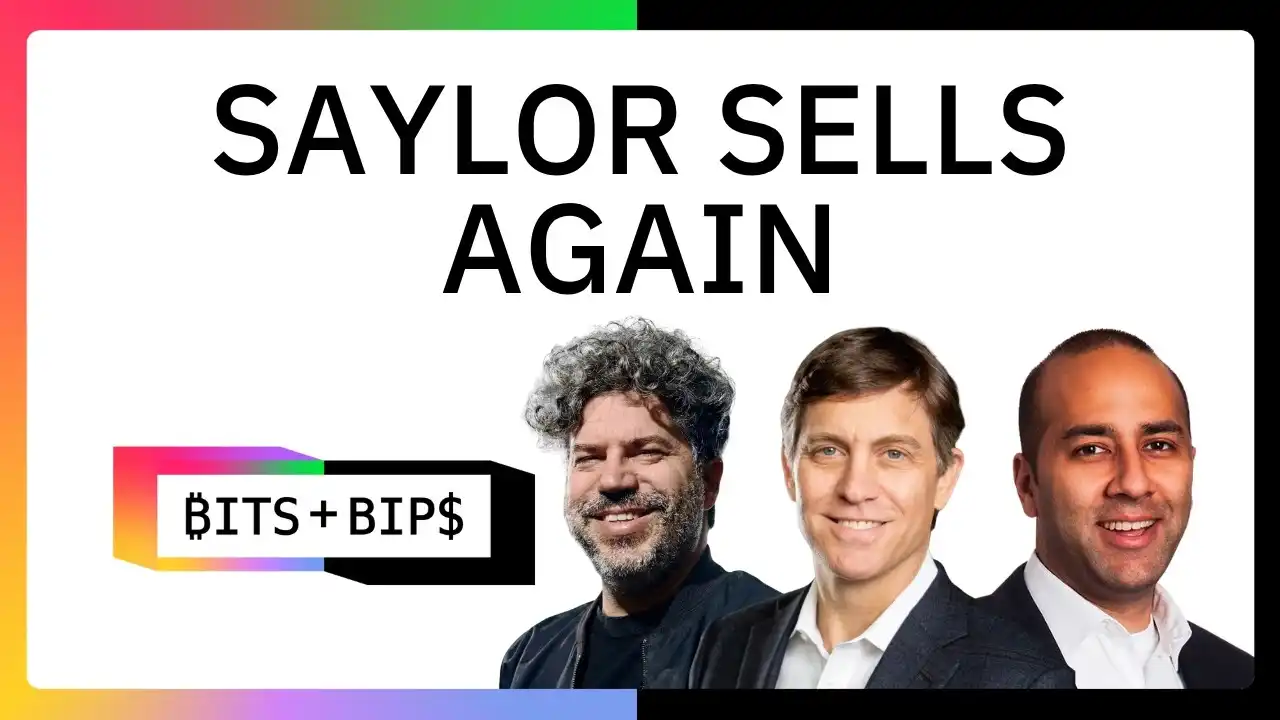
Hosts / Guests: Austin Campbell, Zero Knowledge Group; Ram Ahluwalia, Lumida Wealth CEO; Chris Perkins, Franklin Crypto
Podcast Source: Bits + Bips (Under Unchained)
Original Title: MicroStrategy Sells Bitcoin Again to Cover Dividends
Release Date: July 7, 2026
Key Takeaways
The background for this Bits + Bips roundtable is MicroStrategy's second Bitcoin sale within a month—3,588 BTC, cashed out for approximately $216 million to pay preferred stock dividends. The three resident guests (and co-hosts) Austin Campbell, Ram Ahluwalia, and Chris Perkins deconstruct this structural turning point from their professional perspectives: when the largest BTC buyer becomes a routine seller, the mNAV premium disappears, preferred stocks fall below par, and the "print stock to buy Bitcoin" cycle breaks, what cards does MicroStrategy have left?
Austin opens with a hedge fund friend's remark—"Saylor holds 5% of Bitcoin, maybe it will only truly surge after he blows up"—highlighting the crypto market's brutal logic: when someone becomes the protagonist, their collapse might be the catalyst. Ram, from a macro trader's view, analyzes the dilemma of two choices: selling BTC destroys the narrative, issuing new shares dilutes MSTR. He also mentions hearing Saylor speak twice in London, with Saylor vigorously defending the preferred dividend to rebuild confidence. Chris, from an investment banking background, points out that with mNAV gone, the foundation of financial engineering has crumbled.
But the discussion goes far beyond MicroStrategy. The three delve into the capital structure issue of tokens vs. equity—why there are no successful "token + equity coexistence" cases, the Pokémon card analogy, and the judgment that 99% of tokens will eventually go to zero. The stablecoin war is another major topic: Tether abandoning the European MiCA market, the "utility problem" of stablecoins (Can you buy a coffee with a stablecoin?), the governance black hole of the OUSD 140-member alliance, Robinhood entering government money markets. The latter half extends to the strategic significance of bank stablecoins—Scott Bessent's "Eurodollar market repatriation" thesis, JPMorgan possibly becoming the first trillion-dollar market cap bank, non-US bank dollar deposit businesses facing obsolescence—as well as a valuation breakdown of the Securitize IPO. Finally, the three touch on the capital siphoning effect of AI/semiconductors and the return to crypto market fundamentals.
Selected Highlights
On MicroStrategy Selling BTC and the "Three-Body Problem"
- "A friend in global macro told me it's hard to see the next wave of institutional adoption from pensions, sovereign funds, central banks with Saylor holding 5% of Bitcoin there. His exact words: 'Maybe the best thing is for that guy to blow up, then this thing will really take off.'"
- "Whenever someone becomes the protagonist in crypto, their demise is imminent. MicroStrategy has been the protagonist for a while."
- "Crypto narrative is now stuck on this MicroStrategy thing. MicroStrategy is not crypto, crypto is not MicroStrategy, but we're all stuck here. It's like when Bloomberg only talked about PIGS (Portugal, Italy, Greece, Spain) every day; the market eventually moves on."
- "His actions today speak clearly—he's protecting the dividend, hoping it brings back confidence."
On mNAV Disappearing and Broken Financial Engineering
- "They have two paths: issue common stock diluting MSTR, or sell Bitcoin suffering narrative damage."
- "When the mNAV premium disappears, the 'print stock to buy Bitcoin' cycle breaks. You can't issue at will anymore because the market no longer gives you a premium."
- "BTC actually rose during the week of the sale—Josh Mandel and Pete Rizzo noted it. It acted like a buyback. But the bears will say: premium is dead, BTC hasn't really rallied, it's now a seller."
On Token vs. Equity
- "We already have Delaware corporate law and centuries of capital structure. You can slice cash flows into different layers of debt, and what's left is called equity. There isn't a third thing called a 'token' that fits into this stack."
- "If you have common equity, a token likely needs to function like preferred equity or debt to have separate meaning. If it's just another form of equity, you might as well tokenize your equity."
- "The Pokémon card is a good analogy—the company issuing the cards and the cards themselves are two different things. You can tokenize the product, not necessarily the equity."
- "Looking ahead ten years, 90% of today's top 500 tokens will be gone. I think it will be 99%."
- "Druckenmiller said during the dot-com bubble: 'I've already learned that lesson, I don't need to learn it again.'"
On the Stablecoin War
- "Stablecoins are the new net interest income. Everyone wants that interest. Tether makes so much money doing the most basic product—how do I do the same?"
- "The biggest challenge for all stablecoins right now is utility. You can transfer, but what can you actually *do* with a stablecoin? Can you buy a coffee with it?"
- "Tether's stance is clear: this is soccer not American football, they won't play by Europe's rules. BNP Paribas can't not do business in France, but Tether can just walk away from a market."
- "OUSD is a 'plan to have a plan'. 140 members with completely different economic goals, details not filled in. The hardest part—governance—is skipped, push the tech out first."
On Bank Stablecoins and Market Landscape
- "Stablecoins are essentially a repatriation of the Eurodollar market. If JPMorgan or Bank of America issues a stablecoin, they can earn NIM from Thai merchants or Chinese suppliers."
- "JPMorgan could become the first trillion-dollar market cap bank. They're over $900 billion now, spending $13-16 billion annually on tech."
- "The biggest losers might be non-US banks offering dollar deposit accounts. If I can just buy stablecoins, why go through a local bank with awful FX and fees?"
- "Securitize currently trades more like a call option—you're betting on a 10% chance it's worth $18 billion and a 90% chance it's worthless or acquired cheaply."
- "Last quarter, every S&P 500 sector underperformed the index except semiconductors. Capital is being massively siphoned by AI."
"Maybe After He Blows Up, This Thing Will Truly Take Off"
Austin Campbell: Before we dive in, I want to share a conversation. I was chatting with a friend in global macro, one of the best traders I know. I asked him about Bitcoin. He said it's hard to see the next wave of institutional adoption—pensions, sovereign funds, central banks—happening with Saylor holding 5% of Bitcoin and having such a large personal presence. His exact words: "Maybe the best thing is for that guy to blow up, then this thing will really take off, and then others will pile in." Whenever someone becomes the protagonist in crypto, their demise is imminent. MicroStrategy has been the protagonist for a while. I can't help but think, in a way, that makes them an obstacle to Bitcoin's rise—and that creates its own problems.
National Security, Export Controls, and the Crypto Industry
Austin Campbell: Before the main topic, I want to raise a broader issue. Governments are now trying to control crypto from a new angle—not by stopping code publication, but by controlling who can use it. They want to use export control laws to restrict access to something already published under the First Amendment. It's essentially picking winners and losers without applicable laws or due process.
National security matters, of course, but we can't just say "national security" and close our eyes to why. We can't tell people "use stablecoins, use crypto rails to build your financial life" and then cut it off one day for national security or export controls. The crypto industry isn't angry enough about this; this is our fight.
MicroStrategy Sells Again: 3,588 BTC, $216 Million
Austin Campbell: Onto the main topic. MicroStrategy sold 3,588 Bitcoin for about $216 million cash. This is the largest sale to date, following a smaller sale of 32 BTC to cover preferred stock dividends. The question is clear: after the MSTR premium evaporated, will selling Bitcoin to cover dividends become routine? Is MicroStrategy still an accumulator, or has it become a routine seller?
First, the facts. They broke their years-long no-sell streak, first selling 32, then 3,588 a month later. As of July 5, MicroStrategy holds 843,775 Bitcoin, $2.55 billion in USD reserves, cost basis $75,700 per coin—well above the current ~$60k trading price. MSTR broke below $1 for the first time on June 27, to 99 cents, later recovering. STRC fell to 74.57 at its lowest, back around 90 before we started. Dividend rate increased 50bps to 12%. New authorization framework allows sales of up to $1.25 billion in Bitcoin, plus an STRC buyback plan.
Chris, you're from banking; Ram, you do a lot of investing. Saylor has shifted to selling from the balance sheet rather than issuing more MSTR stock. What does that tell you?
Two Choices: Sell Bitcoin or Dilute Stock
Ram Ahluwalia: Two paths. Issue common stock—dilutes MSTR, stock falls. Or sell Bitcoin—destroys the narrative. Last week we mentioned a potential short squeeze in MSTR, and we saw it in the news. More constructively, STRC and STRF started moving towards par over the past few days. They need to push back to par. If they do, they can breathe; if not, it's a problem. I still view this as a trading asset, susceptible to violent short squeezes, possibly in the middle of one now. I also want to see the date they sold Bitcoin vs. the announcement date—if BTC held up or even rose during the sale, that's quite encouraging.
I was in London last week, first at a Goldman event—packed, severely oversold, institutional build undeniable. Then a Robinhood event, their DeFi stuff was impressive. Before that, I heard Saylor speak twice. On stage, he was very focused on defending and protecting the preferred dividend, trying to convince the audience of his commitment to Bitcoin. He's trying to navigate this three-body problem.
Austin Campbell: This also cuts to the bull/bear divergence. Bulls will say: mNAV back to 1.09, STRC recovering, BTC rising during the sale week—Josh Mandel and Pete Rizzo noted it, it acted like a buyback. Bears will say: premium is dead, BTC hasn't really rallied, it's now a seller. And Roland and Peter Schiff pointed this out. My question: even if preferred recovers a lot and Saylor can sit tight for a while, if BTC doesn't rise, are we back at square one a year from now?
Ram Ahluwalia: My guess is, last week fast-money traders bought the dip on volume collapse. That's fast money, not long-term holders. They'll likely sell for profit.
Chris Perkins: From a banking perspective, when the mNAV premium disappears, the "print stock to buy Bitcoin" cycle breaks. You can't issue at will because the market no longer gives you a premium. So you have to work the asset side. Selling Bitcoin works accounting-wise—cost $75,700, market price low $60k, book loss but cash in hand. The problem is the action itself tells the market: you no longer unconditionally believe your own thesis.
"Three-Body Problem": MicroStrategy-Bitcoin-Crypto Narrative Lock
Chris Perkins: Unfortunately, we're stuck. Crypto narrative is now stuck on this MicroStrategy thing. MicroStrategy is not crypto, crypto is not MicroStrategy, but we're all stuck here, feeling like we need to digest this before moving forward. It reminds me of opening Bloomberg before, only talking about PIGS—Portugal, Italy, Greece, Spain—every single day, and eventually the market moved on.
I'm ready for us to turn the page. What encourages me somewhat is BTC showing resilience today. There are also positive tail factors—like Trump saying he likes crypto the same day the Trump account launched. I look forward to us focusing less on this three-body problem and getting back to fundamentals and details of other projects. Crypto is Bitcoin, Bitcoin is crypto, so MicroStrategy is crypto—I want to break that equation.
Another related debate emerging: does value flow to tokens or equity? You see it in private and public markets. Some dismissively say "all value is in equity, the rest is nonsense." I think it's more nuanced.
Token vs. Equity: No Third Capital
Austin Campbell: I think both can work, but the hard part is having both—unless you carefully define their rights. We already have Delaware corporate law and centuries of capital structure. You can slice cash flows into different layers of debt, and what's left after employees and creditors is called equity. There isn't a third thing called a 'token' that fits into this stack. You can make a token act like equity or debt, but making it a new concept alongside debt and equity is difficult.
If you have common equity, a token likely needs to function like preferred equity or debt to have separate meaning. If it's just another form of equity, you might as well tokenize your equity. You can also tokenize products, services, commodities—the Pokémon card is a good analogy. The company issuing cards and the cards themselves are two different things; you can tokenize the product without tokenizing equity.
Ram Ahluwalia: It's case-specific. From a decentralized tech perspective, it might differ—you can pop up frontends everywhere, governance logic for equity and tokens can be separate. In some projects, value clearly flows to tokens, equity becomes a shell. VCs' approach is to invest in both—take tokens and equity, capture value wherever it ends up. But honestly, tokens and equity coexisting with stable value—I can't think of a clear success story.
Chris Perkins: Some ask: will this whole token experiment, in hindsight, be a product of the COVID $3 trillion stimulus and zero-interest-rate era? We created twenty thousand tokens, didn't know what they were, thought they were governance and economic rights, and then reverted to traditional capitalism?
I don't think so. You can't deny real utility emerging: stablecoins near ATH, perpetuals market innovating, prediction markets growing, RWA and tokenized equity landing. Goldman's event was packed, Robinhood built a DeFi app store—12 partners, more coming—backed by Lloyd's insurance, abstracting risk in the backend. The market is maturing.
Austin Campbell: Looking ahead ten years, 90% of today's top 500 tokens will be gone. Is that failure or success?
Ram Ahluwalia: If you invested money, it's failure. I think not 90%, but 99% will go to zero. The lesson hasn't changed. Druckenmiller said during the dot-com bubble he already knew the lesson, didn't need to learn it again. These tokens have no value capture, founding teams get liquidity too early, no incentive to stay and build.
Stablecoin War: Tether, Robinhood, OUSD
Austin Campbell: This set of dynamics—Circle being queried by securities regulators, Robinhood entering government money markets, Tether's moves, the OUSD alliance—what's your take?
Chris Perkins: I saw this coming. Institutional profit-seeking is endless. If you're an exchange, you make money several ways: data, trading fees, net interest income. Stablecoins are the new net interest income. Everyone looks at Tether saying, these guys make so much money doing the most basic product—how do I do the same?
But the biggest challenge is utility. You can transfer, but what can you actually *do* with a stablecoin? Can you buy a coffee with it? It's still "hot potato"—I want to swap my stablecoin for yours, you hold mine, I earn interest. The stablecoin war has begun, will get worse before better. Will see consolidation. Look back at the CLARITY Act; banks should push it over the line.
Austin Campbell: Stablecoins are often discussed as a single product, but they're entirely different. Robinhood tries to attract deposits and deploy to DeFi—an investment and retail product strategy. Europe is more a regulated payments strategy. Tether's response is direct—they'll make USAT (US Tether), interested in the US economy, but Europe? "No bid." Tether calls it soccer not American football, they won't play by Europe's rules. They completely exited a market. You see them being pushed off some exchanges, Revolut delisting them. Tether's response: as expected. BNP Paribas can't not do business in France, but Tether can.
OUSD is a "plan to have a plan." A 140-member alliance with completely different economic goals, details not filled in. You say issuers keep economic benefits, but how tracked? Who minted the token? On which platform? How handled in DeFi? If based on who minted, can I immediately build a trading team to redeem others' OUSD and issue my own? The hardest part—governance—is skipped, push the tech out first.
Coinbase is also in OUSD, but smartly not putting all eggs in Circle's basket. If this were a serious business alliance requiring OUSD as a primary product, Coinbase likely wouldn't join. So they have a foot in both camps.
Ram Ahluwalia: "Move fast and break things" is a winning formula in tech. Elon Musk blew up countless rockets to reach SpaceX today. But "move fast and break things" with other people's money? Isn't that criminal? OUSD launched like a torpedo, but some partners faced backlash before even boarding—that's the bad side of tech culture colliding with finance culture.
Bank Stablecoins: Repatriation of the Eurodollar Market
Austin Campbell: Will banks issue stablecoins? I think so. In an ideal world, banks keep deposits for domestic use—loans exist. Deposit rates might rise, but repo rates fall, net funding cost flat. But you'd also want stablecoins, because deposits and stablecoins do different things. Like stocks aren't bonds. A client has a deposit, wants to transfer to an international recipient outside the banking system—use a stablecoin, not a deposit.
Ironically—Bank of America could issue a stablecoin, with reserves being BofA deposits. Then you truly get the best of both worlds. If CLARITY doesn't limit proceeds, they'd be thankful.
Ram Ahluwalia: They'll rush in, and partner with clients who have distribution. Look at Zelle's success—Zelle gave big banks an edge. The stablecoin framework similarly advantages big banks over regional banks. Regional banks haven't made a competitive response yet.
More importantly, the point Scott Bessent made several times: Stablecoins are essentially a repatriation of the Eurodollar market. If JPMorgan or Bank of America issues a stablecoin, they can now earn NIM from Thai merchants or Chinese suppliers. Of the US big four—JPMorgan, Wells Fargo, Citi, Bank of America—only Citi has a real international distribution network. The other three don't earn from their clients' clients. Stablecoins change that.
Chris Perkins: Don't underestimate JPMorgan. Their e-commerce business is substantial, with distribution channels connecting to these platforms. They can do what Meta attempted with Diem and Libra—but with their own framework, bringing multiple banks onboard. If Democrats take the House, they'll have a friendly ear in Elizabeth Warren. JPMorgan could become the first trillion-dollar market cap bank. They're over $900 billion now, spending $13-16 billion annually on tech. They're sensitive to disruption—saw what fractional trading, zero-commission trading did to their margins.
Banks already have "stablecoins"—called deposits. People give you dollars, you keep most interest, occasionally give some back. But the issue is, bank deposits only work within their network. Stablecoins let JPMorgan earn from clients' clients globally, not just their own clients.
Non-US Banks: The Biggest Losers
Austin Campbell: ZUSD is already a registered code—they're working on a stablecoin. But I'll be more direct: The biggest losers from dollar stablecoins might be non-US banks offering dollar deposit accounts. If I can open a dollar account via a local bank—usually awful FX, high fees—and now I can just buy stablecoins, that business is obsolete. And it's no longer just for ultra-high-net-worth clients.
If we're naming losers, dollar stablecoins are good for US big four, losers are probably like UBS.
Chris Perkins: Any product where "you give me dollars, I give you dollars back, but I keep the interest forever" is a good product.
Securitize IPO: Trading Like a Call Option
Austin Campbell: Talk about Securitize just going public. Q1 revenue up 39% YoY, but lost $7 million. Market cap $1.8 billion. Your thoughts?
Chris Perkins: Securitize currently trades more like a call option. You're not saying "I think it's worth $1.8 billion now," you're saying "I think there's a 10% chance it's worth $18 billion in the future and a 90% chance it's worthless or acquired cheaply or dies." The high volatility is evidence.
Ram Ahluwalia: Looking at IPO trends, IPOs over $1 billion almost always have a 50% drawdown in the first year. If you want to own Securitize, the right move might be to put in a lowball bid and wait. Circle is also near lows, but has real moats. Meanwhile Ripple got a MiCA license—Luxembourg, with passporting—but short-term doesn't help XRP or RLUSD much.
Market Landscape: AI Siphoning and Return to Fundamentals
Ram Ahluwalia: Last quarter, every S&P 500 sector underperformed the index except semiconductors. Capital is being massively siphoned by AI. But the past two weeks you see quality stocks bouncing back—Progressive, Allstate, Berkshire Hathaway, S&P Global, Moody's. World-class businesses on sale.
Austin Campbell: That should be good for crypto. Back to fundamentals. Things with revenue are rising. BTC back to $64K, Hyperliquid at 71.35. Everything eventually returns to fundamentals and cash flow.