Bernstein Report: Agentic AI Will Transform CPU from Supporting Role to Leading Role, Bullish on Hygon Information

marsbit發佈於 2026-06-17更新於 2026-06-17

文章摘要

Bernstein research report: Agentic AI will turn CPUs from supporting players to leading roles, bullish on Hygon Information. Analysts led by David Dai argue that AI is transitioning from the chatbot era to the agentic AI era. Unlike simple query-response models, agentic AI involves complex workflows including retrieval, planning, tool calling, and multi-step reasoning. This shift dramatically increases the demand for CPU compute to orchestrate these tasks, manage memory, and prevent expensive GPU idling. The report forecasts that the GPU-to-CPU ratio in inference clusters will reverse from 8:1 in 2025 to 1:1 by 2029. In agentic AI workloads, CPUs could account for 50% of the compute, on par with GPUs. Consequently, the server CPU Total Addressable Market (TAM) is projected to surge from $37 billion in 2025 to $223 billion by 2030, representing a 6x expansion. Arm is identified as a key beneficiary due to its superior performance-per-watt and a strategic shift from IP licensing to designing its own chips, targeting $15 billion in chip revenue by 2030. Bernstein raises Arm's price target to $500. For x86 vendors, the report is Overweight on AMD (target $600) and Hygon Information (target CNY 450), citing leadership and strong growth in the Chinese market respectively. Intel's target is raised to $100, reflecting upgraded earnings assumptions. The analysis acknowledges significant supply-side risks, questioning whether foundry and memory capacity can support such rapid CPU ...

Written by: Tide Research

When an AI agent is awakened, it is not waiting for an answer. It needs to retrieve information, plan steps, invoke tools, reason about intermediate results, call the model again, and finally execute actions. The entire workflow requires far more CPU computing power than ChatGPT popping up a single response.

The team led by Bernstein analyst David Dai released a report titled "Global Semiconductors: CPU Renaissance?" on June 17th. Its core thesis is: AI is transitioning from the chatbot era to the agentic AI era, and the CPU's role in the data center is shifting from a supporting role for the GPU to a leading role. This will drive the server CPU Total Addressable Market (TAM) to reach $223 billion by 2030, six times the $37 billion in 2025.

Reasoning is No Longer "One Q&A", CPU is Making a Comeback

Since the rise of large language models, GPUs/AI accelerators have been the core of AI computing. In custom inference clusters like Google TPU v6e and Meta Grand Teton, the GPU-to-CPU ratio was once 8:1.

But Bernstein believes that as agentic AI becomes mainstream, this ratio is reversing.

The core characteristic of Agentic AI is "looped reasoning": a single request may trigger retrieval, planning, tool calling, intermediate reasoning, another model invocation, and action execution. The GPU handles dense mathematical operations, but the CPU determines whether the entire system can efficiently orchestrate the workflow, schedule tasks, manage memory, and prevent accelerator idling. If the CPU is too weak, expensive GPUs are forced to wait idle, significantly reducing overall system efficiency.

Bernstein predicts that the GPU:CPU ratio in CSP inference clusters will drop from 8:1 in 2025 to 1:1 by 2029. In agentic AI workloads, the CPU's computational share will leap from 14% in traditional LLMs to 50%, on par with the GPU.

The report specifically points out that hardware roadmaps already corroborate this direction. AMD's next-generation Venice compute tray pairs each CPU with 4 MI455X GPUs. Nvidia's Vera superchip pairs each Vera CPU with 2 Rubin GPUs. Google's TPU v7x expansion unit pairs each CPU with 4 TPUs. The physical ratio of CPUs is already increasing; this is not a prediction but a current reality.

How is the $223 Billion Market Calculated?

Bernstein has significantly raised its 2030 server CPU TAM forecast from the previous $137 billion to $223 billion, based on the following core assumptions:

  • 2030 AI capital expenditure reaches $3.5 trillion, corresponding to 70GW of AI data center deployment.
  • AI accelerator market size is $1.6 trillion, accounting for 45% of AI DC capital expenditure.
  • Inference share rises from 35% to 70%, with a CPU:GPU ratio of 1:1 in inference scenarios and 0.5:1 in training scenarios.
  • CPU price is equivalent to 13% of GPU price.

Under this framework, the $223 billion TAM includes $174 billion from agentic AI workloads and $49 billion from non-AI traditional server CPUs. Compared to current levels, the entire server CPU market in 2025 is only $37 billion, with only $6 billion AI-related. This means that in Bernstein's forecast, the CPU market will undergo a six-fold expansion over the next five years, with a compound annual growth rate of 43%, almost unprecedented in semiconductor industry history. Bernstein also provided bull-case ($330 billion, assuming $4 trillion AI capital expenditure + 1.5:1 inference ratio) and bear-case ($137 billion, assuming $3 trillion capital expenditure + 0.5:1 inference ratio) ranges.

An interesting cross-verification comes from server CPU core counts: Arm data shows that agentic AI requires 120 million CPU cores per GW, four times that of traditional data centers. Calculated accordingly, 70GW of AI deployment in 2030 would require 8.4 billion CPU cores, corresponding to $168 billion in AI CPU TAM, highly consistent with the aforementioned model.

Why is Arm the Biggest Winner? Not Just IP, It's Making Chips Now

Arm is listed by Bernstein as a structural beneficiary of the CPU renaissance. The Arm architecture is becoming increasingly attractive in AI data centers due to its performance per watt. AWS Graviton offers 40% better price-performance and 60% lower power consumption compared to x86 instances.

More critically, in March 2026, Arm announced a strategic shift: from solely providing IP licensing to independently manufacturing CPUs, aiming for $15 billion in chip revenue by 2030. The Arm AGI CPU has already secured Meta as its first customer and co-developer, with partners including OpenAI, Cerebras, and Cloudflare. Based on this, Bernstein raised Arm's FY2030 EPS forecast to $11.79 (previously $9.83) and believes its chip revenue forecast could reach $22 billion, exceeding Arm's own target. Using a 42x P/E ratio, they set a price target of $500 (previously $300).

This also drove up the price target for SoftBank (which holds about 90% of Arm) from ¥8,200 to ¥11,200, implying 58% upside. Bernstein's valuation for SoftBank is based on a 30% discount to the Net Asset Value (NAV) of its holdings, with the discount narrowing from before, reflecting the increased value of Arm's stake and improvements in SoftBank's own business.

AMD, Intel, Hygon: Who Benefits?

AMD (Outperform, target price $600): Its products remain leading within the x86 camp and are expected to continue gaining market share. Its existing model already embeds strong CPU assumptions. After rolling valuations to CY27/28 averages, the target price is raised to $600.

Intel (Market-Perform, target price $100): Benefits from stronger, more sustained server CPU demand, leading to significant upward revisions in profit forecasts. Bernstein adjusted Intel's model from conservative assumptions to align with the industry, raising the target price from $65 to $100.

Hygon Information Hygon (Outperform, target price 450 RMB): Bernstein believes China's x86 CPU demand will grow faster than the global rate. Hygon's share in China's server CPU market will continue expanding from current levels, exceeding 35% by 2030, reaching not only government and state-owned enterprise clients but also penetrating CSPs. The target price is significantly raised from 280 RMB to 450 RMB.
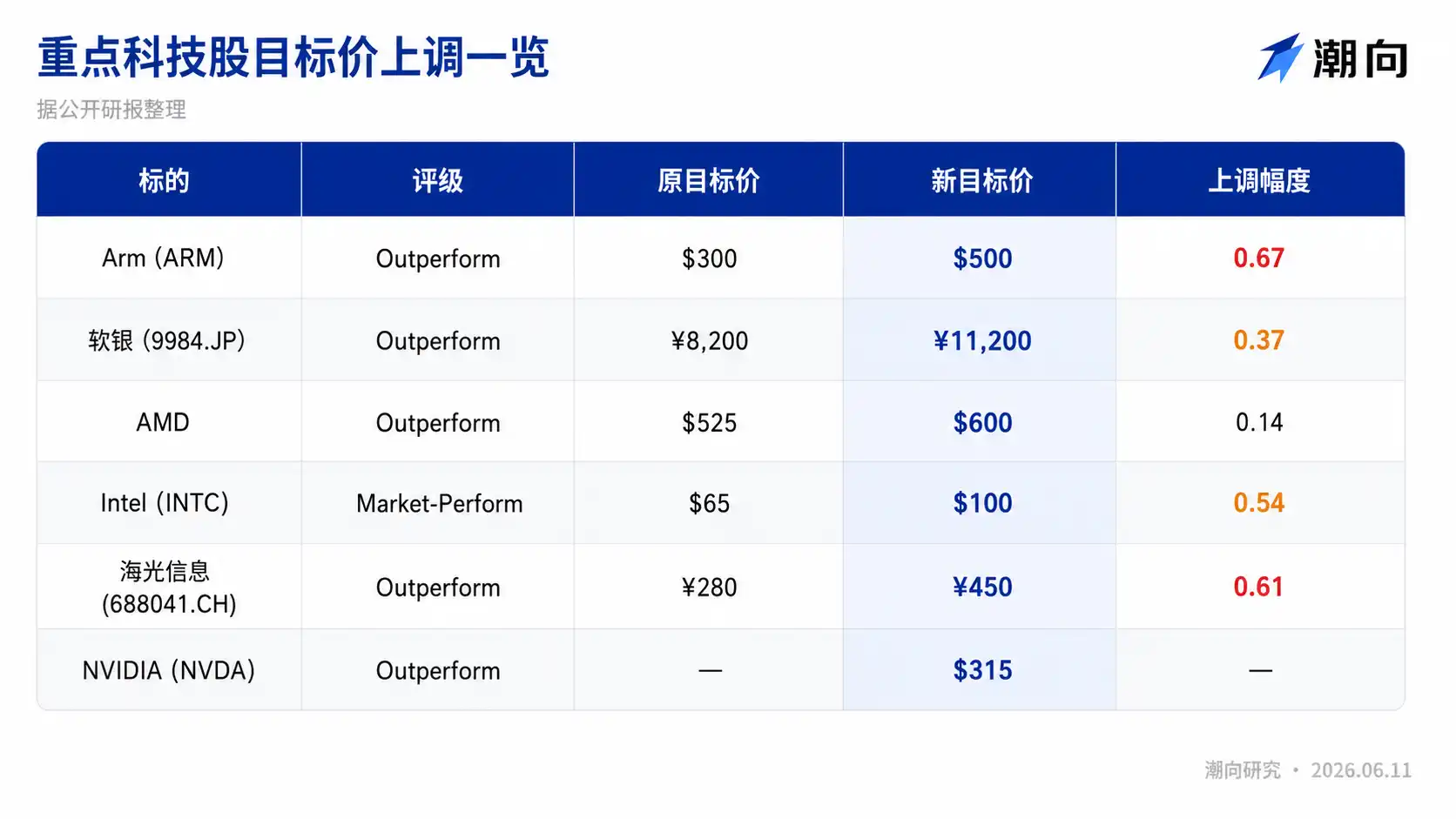
Source: Bernstein

Tide Research's Interpretation

Within Bernstein's thesis, the weakest link may not be on the demand side, but the supply side.

The report acknowledges in a footnote that it is "still assessing whether foundry and memory capacity is sufficient to support CPU growth," marking the greatest uncertainty in the entire report. Pulling CPU TAM from $37 billion to $223 billion implies needing roughly an additional $30 billion in annual CPU capacity by 2030.

TSMC's 3nm/5nm capacity is currently being occupied by AI accelerators and smartphone chips. Whether there is enough flexibility in foundry capacity allocated to server CPUs is not definitively mapped out in the report. Additionally, the report's core assumptions are built upon Nvidia's guidance of "AI infrastructure annual spending exceeding $1 trillion by 2027," which itself is among the most optimistic sell-side forecasts. Using this as the demand starting point for another research report carries the risk of expectation stacking.

Another noteworthy signal is that Nvidia's Vera CPU uses a self-developed Arm architecture. This means Nvidia could play the role of both partner and competitor to Arm in the CPU field, posing a subtle influence on whether Arm's long-term market share can reach 54%.

For investors, the most valuable aspect of this report is not just a specific price target. It provides a clear analytical framework: If you believe agentic AI is the genuine next phase, then CPU allocation must be repriced from "just enough" to a strategic priority. This implies that the entire semiconductor investment landscape needs to shift from GPU dominance towards a more balanced CPU+GPU narrative.

Risk Disclosure

This article is Tide Research's compilation and interpretation of a third-party brokerage research report. The ratings, target prices, profit forecasts, and related judgments cited herein represent the views of that brokerage's analysts, reflecting only the stance of their respective institutions. They do not represent Tide Research's views and do not constitute any investment advice.


熱門幣種推薦

相關問答

QAccording to the Bernstein report, what is the core reason for a potential 'CPU renaissance' in data centers?

AThe core reason is the shift from simple chatbot-style AI to 'agentic AI.' Unlike single-turn Q&A, agentic AI involves complex, multi-step reasoning cycles requiring retrieval, planning, tool calling, and execution. This process demands significant orchestration, task scheduling, and memory management, workloads where the CPU is critical. A weak CPU becomes a bottleneck for the entire system, causing expensive GPUs to idle. Therefore, CPU importance increases dramatically to manage these complex workflows efficiently.

QWhat is Bernstein's forecast for the Server CPU Total Addressable Market (TAM) by 2030, and what key assumptions drive this prediction?

ABernstein forecasts the server CPU TAM to reach $223 billion by 2030, a significant increase from $37 billion in 2025. The key assumptions driving this prediction are: 1) AI capital expenditure reaching $3.5 trillion, corresponding to 70GW of AI data center deployment. 2) AI accelerators making up 45% of this spend ($1.6 trillion market). 3) The inference share of AI workloads rising from 35% to 70%. 4) A CPU-to-GPU ratio in inference clusters reaching 1:1 (and 0.5:1 in training). 5) A CPU unit price equivalent to 13% of a GPU's price.

QWhy does Bernstein identify Arm as a major structural winner from the agentic AI trend?

ABernstein identifies Arm as a major winner for two key reasons. First, its architecture offers superior performance per watt, making it highly attractive for power-constrained AI data centers (e.g., AWS Graviton offers 40% better price-performance). Second, and more importantly, Arm has strategically shifted from being just an IP licensor to designing and manufacturing its own chips (AGI CPU), with Meta as a lead partner. This move directly positions Arm to capture a larger share of the growing CPU TAM, with Bernstein projecting its chip revenue could reach $22 billion by 2030.

QWhat are the key investment rating changes for semiconductor companies mentioned in the report?

AThe report maintains or issues favorable ratings for several companies: 1) Arm: Target price raised to $500 (from $300), EPS estimates increased. 2) AMD: Maintains 'Outperform' rating, target price raised to $600. 3) Intel: Rating raised to 'Market-Perform', target price significantly increased to $100 (from $65). 4) Hygon (Haiguang Information): Issued an 'Outperform' rating for the Chinese market, with a target price of 450 RMB (up from 280 RMB), expecting its share in China's server CPU market to exceed 35% by 2030.

QWhat are the primary risks or uncertainties identified in the Bernstein report's bullish CPU thesis?

AThe report highlights two major uncertainties. First, on the supply side: it questions whether foundry (like TSMC) and memory capacity will be sufficient to support the projected massive growth in CPU production, requiring an additional ~$30 billion in annual CPU capacity by 2030. Second, on the demand side: the entire forecast is built upon the optimistic assumption (from Nvidia's guidance) of AI infrastructure spending exceeding $1 trillion annually by 2027. Using this optimistic forecast as a baseline introduces a 'stacking' risk if the underlying demand materializes slower. Additionally, Nvidia's Vera CPU using its own Arm design makes it both a partner and potential competitor to Arm.

你可能也喜歡

SemiAnalysis 万字拆解长鑫存储:500 亿美元营收,超级周期里的 IPO

长鑫存储即将在科创板上市,有望成为中国史上最大的半导体IPO。公司成立于2016年,通过收购破产的德国DRAM厂商奇梦达的专利与技术文档起步,并吸引了包括奇梦达、美光等公司的顶尖人才。在合肥市政府“耐心资本”近十年的持续输血与产业链支持下,长鑫于2025年首次实现年度盈利。 2026年,长鑫业绩迎来爆发式增长,一季度单季营收达73亿美元,预计全年营收可能超过500亿美元。这主要得益于当前DRAM行业的“超级周期”带来的价格上涨,而非市场份额的显著提升。按产能计,长鑫已是全球第四大DRAM厂商,并正在快速逼近美光。 然而,公司在高端HBM(高带宽内存)领域面临巨大挑战。其HBM技术仍不成熟,良率远低于行业巨头,且当前将稀缺产能分配给利润率更高的大宗DRAM产品在商业上更为合理。但由于美国出口管制限制先进HBM对华销售,中国对AI算力自主可控的强烈需求可能推动长鑫未来不得不加速HBM产能布局。 此次IPO计划募资约295亿元人民币,主要用于现有DRAM产能升级与研发,并未明确提及HBM项目。其复杂的股权结构显示,国有资本合计持股超过30%,是公司的核心支持力量。分析认为,当前IPO估值可能被显著低估。随着阿里巴巴等国内核心客户兼股东的支持,长鑫在国内市场需求方面具备独特优势,但与三星、SK海力士和美光的竞争将愈发激烈。

marsbit3 分鐘前

SemiAnalysis 万字拆解长鑫存储:500 亿美元营收,超级周期里的 IPO

marsbit3 分鐘前

从Corning到Ciena,AI光通信链条里的10倍股机会

本文分析了AI数据中心背景下,光通信产业链的投资机会。随着数据传输从800G向1.6T、3.2T升级,铜缆面临物理极限,光通信因距离更远、发热更低、能耗更小成为必然选择。文章指出,最大的投资机会往往在于整个产业链中不可或缺的供应商,而非单一明星公司。 文章重点梳理了产业链关键环节的代表公司: 1. **光纤与玻璃层**:**康宁(Corning)** 作为核心供应商,凭借技术优势获得Meta、亚马逊等巨头长期大额订单,其利润增速远超收入增长,显示定价权与规模效应。 2. **互连层**:**安费诺(Amphenol)** 通过并购扩张,在AI服务器连接器市场增长强劲,利润率提升且估值相对合理。**Credo Technology** 则扮演铜缆与光通信的桥梁角色,增长迅速但客户集中度高,风险较大。 3. **系统层**:**Ciena** 是相干光学龙头,其技术能让现有光纤承载更多数据,订单积压强劲,但估值已较高。 4. **上游材料与测试**:**AXT** 提供光激光器关键材料磷化铟晶圆,具有稀缺性,但面临中国出口管制等高风险。**VEO Solutions** 作为测试设备“卖铲人”,业务不受具体技术路线影响,随着光设备需求爆发而增长。 最后,文章提及了专注于光子学的主题ETF(代码FOTO)作为一键配置选择,但提醒其成立时间短、规模尚小。总结认为,铜转光是确定趋势,投资机会将沿整条光子产业链扩散。

marsbit15 分鐘前

从Corning到Ciena,AI光通信链条里的10倍股机会

marsbit15 分鐘前

新主席、旧通胀、超预期就业:沃什首秀后,全球资产如何重新定价?

上周,美联储新任主席凯文·沃什主持了上任后首次货币政策会议。会议决定维持利率不变,但政策声明被大幅简化,删除了前瞻指引等措辞。沃什强调,美联储不应过早承诺未来行动,而应让市场重新聚焦经济数据本身。这标志着一套新沟通框架的开始。 沃什面临的首要挑战仍是通胀。4月PCE通胀数据仍远高于2%目标,且通胀压力来源多元。与此同时,5月就业数据远超预期,强劲的就业市场反而加剧了市场对货币政策收紧的担忧,导致股市下跌。沃什接手的是一个在政策方向上存在内部分歧、且面临政治压力的美联储,建立内部共识是其重要考验。 会议释放的鹰派信号影响了全球资产定价。美元因加息预期升温而走强,美债收益率面临上行压力但亦受经济前景影响,黄金在利率与地缘风险间拉锯。AI基建等成长股板块面临估值压力,但若云厂商资本开支未收缩,产业逻辑依然成立。防务板块则因订单确定性而具有一定防御性。 展望未来,市场需重点关注数据:7月初的6月非农数据可能决定7月会议基调;7月中旬的6月CPI数据直接影响通胀判断;7月底的第二次FOMC会议将是沃什做出实质性政策选择的关键节点。此外,下半年美国中期选举带来的政治压力,也将持续考验美联储的独立性。

marsbit40 分鐘前

新主席、旧通胀、超预期就业:沃什首秀后,全球资产如何重新定价?

marsbit40 分鐘前

交易

現貨
合約

熱門文章

什麼是 GROK AI

Grok AI: 在 Web3 時代革命性改變對話技術 介紹 在快速演變的人工智能領域,Grok AI 作為一個值得注意的項目脫穎而出,橋接了先進技術與用戶互動的領域。Grok AI 由 xAI 開發,該公司由著名企業家 Elon Musk 領導,旨在重新定義我們與人工智能的互動方式。隨著 Web3 運動的持續蓬勃發展,Grok AI 旨在利用對話 AI 的力量回答複雜的查詢,為用戶提供不僅具資訊性而且具娛樂性的體驗。 Grok AI 是什麼? Grok AI 是一個複雜的對話 AI 聊天機器人,旨在與用戶進行動態互動。與許多傳統 AI 系統不同,Grok AI 接納更廣泛的查詢,包括那些通常被視為不恰當或超出標準回應的問題。該項目的核心目標包括: 可靠推理:Grok AI 強調常識推理,根據上下文理解提供邏輯答案。 可擴展監督:整合工具協助確保用戶互動既受到監控又優化質量。 正式驗證:安全性至關重要;Grok AI 採用正式驗證方法來增強其輸出的可靠性。 長上下文理解:該 AI 模型在保留和回憶大量對話歷史方面表現出色,促進有意義且具上下文意識的討論。 對抗魯棒性:通過專注於改善其對操控或惡意輸入的防禦,Grok AI 旨在維護用戶互動的完整性。 總之,Grok AI 不僅僅是一個信息檢索設備;它是一個沉浸式的對話夥伴,鼓勵動態對話。 Grok AI 的創建者 Grok AI 的腦力來源無疑是 Elon Musk,這個名字與各個領域的創新息息相關,包括汽車、太空旅行和技術。在專注於以有益方式推進 AI 技術的 xAI 旗下,Musk 的願景旨在重塑對 AI 互動的理解。其領導力和基礎理念深受 Musk 推動技術邊界的承諾影響。 Grok AI 的投資者 雖然有關支持 Grok AI 的投資者的具體細節仍然有限,但公開承認 xAI 作為該項目的孵化器,主要由 Elon Musk 本人創立和支持。Musk 之前的企業和持股為 Grok AI 提供了強有力的支持,進一步增強了其可信度和增長潛力。然而,目前有關支持 Grok AI 的其他投資基金或組織的信息尚不易獲得,這標誌著未來潛在探索的領域。 Grok AI 如何運作? Grok AI 的運作機制與其概念框架一樣創新。該項目整合了幾種尖端技術,以促進其獨特的功能: 強大的基礎設施:Grok AI 使用 Kubernetes 進行容器編排,Rust 提供性能和安全性,JAX 用於高性能數值計算。這三者確保了聊天機器人的高效運行、有效擴展和及時服務用戶。 實時知識訪問:Grok AI 的一個顯著特點是其通過 X 平台(以前稱為 Twitter)訪問實時數據的能力。這一能力使 AI 能夠獲取最新信息,從而提供及時的答案和建議,而其他 AI 模型可能會錯過這些信息。 兩種互動模式:Grok AI 為用戶提供“趣味模式”和“常規模式”之間的選擇。趣味模式允許更具玩樂性和幽默感的互動風格,而常規模式則專注於提供精確和準確的回應。這種多樣性確保了根據不同用戶偏好量身定制的體驗。 總之,Grok AI 將性能與互動相結合,創造出既豐富又娛樂的體驗。 Grok AI 的時間線 Grok AI 的旅程標誌著反映其發展和部署階段的關鍵里程碑: 初始開發:Grok AI 的基礎階段持續了約兩個月,在此期間進行了模型的初步訓練和微調。 Grok-2 Beta 發布:在一個重要的進展中,Grok-2 beta 被宣布。這一版本推出了兩個版本的聊天機器人——Grok-2 和 Grok-2 mini,均具備聊天、編碼和推理的能力。 公眾訪問:在其 beta 開發之後,Grok AI 向 X 平台用戶開放。那些通過手機號碼驗證並活躍至少七天的帳戶可以訪問有限版本,使這項技術能夠接觸到更廣泛的受眾。 這一時間線概括了 Grok AI 從創建到公眾參與的系統性增長,強調其對持續改進和用戶互動的承諾。 Grok AI 的主要特點 Grok AI 包含幾個關鍵特點,促成其創新身份: 實時知識整合:訪問當前和相關信息使 Grok AI 與許多靜態模型區別開來,從而提供引人入勝和準確的用戶體驗。 多樣化的互動風格:通過提供不同的互動模式,Grok AI 滿足各種用戶偏好,邀請創造力和個性化的對話。 先進的技術基礎:利用 Kubernetes、Rust 和 JAX 為該項目提供了堅實的框架,以確保可靠性和最佳性能。 倫理話語考量:包含圖像生成功能展示了該項目的創新精神。然而,它也引發了有關版權和尊重可識別人物描繪的倫理考量——這是 AI 社區內持續討論的議題。 結論 作為對話 AI 領域的先驅,Grok AI 概括了數字時代轉變用戶體驗的潛力。由 xAI 開發,並受到 Elon Musk 願景的驅動,Grok AI 將實時知識與先進的互動能力相結合。它努力推動人工智能能夠達成的界限,同時保持對倫理考量和用戶安全的關注。 Grok AI 不僅體現了技術的進步,還體現了 Web3 環境中新對話範式的出現,承諾以靈活的知識和玩樂的互動吸引用戶。隨著該項目的持續演變,它成為技術、創造力和類人互動交匯處所能實現的見證。

780 人學過發佈於 2024.12.26更新於 2024.12.26

什麼是 GROK AI

什麼是 ERC AI

Euruka Tech:$erc ai 及其在 Web3 中的雄心概述 介紹 在快速發展的區塊鏈技術和去中心化應用的環境中,新項目頻繁出現,每個項目都有其獨特的目標和方法論。其中一個項目是 Euruka Tech,該項目在加密貨幣和 Web3 的廣闊領域中運作。Euruka Tech 的主要焦點,特別是其代幣 $erc ai,是提供旨在利用去中心化技術日益增長的能力的創新解決方案。本文旨在提供 Euruka Tech 的全面概述,探索其目標、功能、創建者的身份、潛在投資者以及它在更廣泛的 Web3 背景中的重要性。 Euruka Tech, $erc ai 是什麼? Euruka Tech 被描述為一個利用 Web3 環境提供的工具和功能的項目,專注於在其運作中整合人工智能。雖然有關該項目框架的具體細節仍然有些模糊,但它旨在增強用戶參與度並自動化加密空間中的流程。該項目的目標是創建一個去中心化的生態系統,不僅促進交易,還通過人工智能整合預測功能,因此其代幣被命名為 $erc ai。其目的是提供一個直觀的平台,促進更智能的互動和高效的交易處理,並在不斷增長的 Web3 領域中發揮作用。 Euruka Tech, $erc ai 的創建者是誰? 目前,關於 Euruka Tech 背後的創建者或創始團隊的信息仍然不明確且有些模糊。這一數據的缺失引發了擔憂,因為了解團隊背景通常對於在區塊鏈行業建立信譽至關重要。因此,我們將這些信息歸類為 未知,直到具體細節在公共領域中公開。 Euruka Tech, $erc ai 的投資者是誰? 同樣,關於 Euruka Tech 項目的投資者或支持組織的識別在現有研究中並未明確提供。對於考慮參與 Euruka Tech 的潛在利益相關者或用戶來說,來自知名投資公司的財務合作或支持所帶來的保證是至關重要的。沒有關於投資關係的披露,很難對該項目的財務安全性或持久性得出全面的結論。根據所找到的信息,本節也處於 未知 的狀態。 Euruka Tech, $erc ai 如何運作? 儘管缺乏有關 Euruka Tech 的詳細技術規範,但考慮其創新雄心是至關重要的。該項目旨在利用人工智能的計算能力來自動化和增強加密貨幣環境中的用戶體驗。通過將 AI 與區塊鏈技術相結合,Euruka Tech 旨在提供自動交易、風險評估和個性化用戶界面等功能。 Euruka Tech 的創新本質在於其目標是創造用戶與去中心化網絡所提供的廣泛可能性之間的無縫連接。通過利用機器學習算法和 AI,它旨在減少首次用戶的挑戰,並簡化 Web3 框架內的交易體驗。AI 與區塊鏈之間的這種共生關係突顯了 $erc ai 代幣的重要性,成為傳統用戶界面與去中心化技術的先進能力之間的橋樑。 Euruka Tech, $erc ai 的時間線 不幸的是,由於目前有關 Euruka Tech 的信息有限,我們無法提供該項目旅程中主要發展或里程碑的詳細時間線。這條時間線通常對於描繪項目的演變和理解其增長軌跡至關重要,但目前尚不可用。隨著有關顯著事件、合作夥伴關係或功能添加的信息變得明顯,更新將無疑增強 Euruka Tech 在加密領域的可見性。 關於其他 “Eureka” 項目的澄清 值得注意的是,多個項目和公司與 “Eureka” 共享類似的名稱。研究已經識別出一些倡議,例如 NVIDIA Research 的 AI 代理,專注於使用生成方法教導機器人複雜任務,以及 Eureka Labs 和 Eureka AI,分別改善教育和客戶服務分析中的用戶體驗。然而,這些項目與 Euruka Tech 是不同的,不應與其目標或功能混淆。 結論 Euruka Tech 及其 $erc ai 代幣在 Web3 領域中代表了一個有前途但目前仍不明朗的參與者。儘管有關其創建者和投資者的細節仍未披露,但將人工智能與區塊鏈技術相結合的核心雄心仍然是關注的焦點。該項目在通過先進自動化促進用戶參與方面的獨特方法,可能會使其在 Web3 生態系統中脫穎而出。 隨著加密市場的持續演變,利益相關者應密切關注有關 Euruka Tech 的進展,因為文檔創新、合作夥伴關係或明確路線圖的發展可能在未來帶來重大機會。當前,我們期待更多實質性見解的出現,以揭示 Euruka Tech 的潛力及其在競爭激烈的加密市場中的地位。

682 人學過發佈於 2025.01.02更新於 2025.01.02

什麼是 ERC AI

什麼是 DUOLINGO AI

DUOLINGO AI:將語言學習與Web3及AI創新結合 在科技重塑教育的時代,人工智能(AI)和區塊鏈網絡的整合預示著語言學習的新前沿。進入DUOLINGO AI及其相關的加密貨幣$DUOLINGO AI。這個項目旨在將領先語言學習平台的教育優勢與去中心化的Web3技術的好處相結合。本文深入探討DUOLINGO AI的關鍵方面,探索其目標、技術框架、歷史發展和未來潛力,同時保持原始教育資源與這一獨立加密貨幣倡議之間的清晰區分。 DUOLINGO AI概述 DUOLINGO AI的核心目標是建立一個去中心化的環境,讓學習者可以通過實現語言能力的教育里程碑來獲得加密獎勵。通過應用智能合約,該項目旨在自動化技能驗證過程和代幣分配,遵循強調透明度和用戶擁有權的Web3原則。該模型與傳統的語言習得方法有所不同,重點依賴社區驅動的治理結構,讓代幣持有者能夠建議課程內容和獎勵分配的改進。 DUOLINGO AI的一些顯著目標包括: 遊戲化學習:該項目整合區塊鏈成就和非同質化代幣(NFT)來表示語言能力水平,通過引人入勝的數字獎勵來激發學習動機。 去中心化內容創建:它為教育者和語言愛好者提供了貢獻課程的途徑,促進了一個有利於所有貢獻者的收益共享模型。 AI驅動的個性化:通過採用先進的機器學習模型,DUOLINGO AI個性化課程以適應個別學習進度,類似於已建立平台中的自適應功能。 項目創建者與治理 截至2025年4月,$DUOLINGO AI背後的團隊仍然是化名的,這在去中心化的加密貨幣領域中是一種常見做法。這種匿名性旨在促進集體增長和利益相關者的參與,而不是專注於個別開發者。部署在Solana區塊鏈上的智能合約註明了開發者的錢包地址,這表明對於交易的透明度的承諾,儘管創建者的身份未知。 根據其路線圖,DUOLINGO AI旨在演變為去中心化自治組織(DAO)。這種治理結構允許代幣持有者對關鍵問題進行投票,例如功能實施和財庫分配。這一模型與各種去中心化應用中社區賦權的精神相一致,強調集體決策的重要性。 投資者與戰略夥伴關係 目前,沒有與$DUOLINGO AI相關的公開可識別的機構投資者或風險投資家。相反,該項目的流動性主要來自去中心化交易所(DEX),這與傳統教育科技公司的資金策略形成鮮明對比。這種草根模型表明了一種社區驅動的方法,反映了該項目對去中心化的承諾。 在其白皮書中,DUOLINGO AI提到與未具名的「區塊鏈教育平台」建立合作,以豐富其課程提供。雖然具體的合作夥伴尚未披露,但這些合作努力暗示了一種將區塊鏈創新與教育倡議相結合的策略,擴大了對多樣化學習途徑的訪問和用戶參與。 技術架構 AI整合 DUOLINGO AI整合了兩個主要的AI驅動組件,以增強其教育產品: 自適應學習引擎:這個複雜的引擎從用戶互動中學習,類似於主要教育平台的專有模型。它動態調整課程難度,以應對特定學習者的挑戰,通過針對性的練習加強薄弱環節。 對話代理:通過使用基於GPT-4的聊天機器人,DUOLINGO AI為用戶提供了一個參與模擬對話的平台,促進更互動和實用的語言學習體驗。 區塊鏈基礎設施 建立在Solana區塊鏈上的$DUOLINGO AI利用了一個全面的技術框架,包括: 技能驗證智能合約:此功能自動向成功通過能力測試的用戶頒發代幣,加強了對真實學習成果的激勵結構。 NFT徽章:這些數字代幣標誌著學習者達成的各種里程碑,例如完成課程的一部分或掌握特定技能,允許他們以數字方式交易或展示自己的成就。 DAO治理:持有代幣的社區成員可以通過對關鍵提案進行投票來參與治理,促進一種鼓勵課程提供和平台功能創新的參與文化。 歷史時間線 2022–2023:概念化 DUOLINGO AI的基礎工作始於白皮書的創建,強調了語言學習中的AI進步與區塊鏈技術去中心化潛力之間的協同作用。 2024:Beta發佈 限量的Beta版本推出了流行語言的課程,作為項目社區參與策略的一部分,獎勵早期用戶以代幣激勵。 2025:DAO過渡 在4月,進行了完整的主網發佈,並開始流通代幣,促使社區討論可能擴展到亞洲語言和其他課程開發的問題。 挑戰與未來方向 技術障礙 儘管有雄心勃勃的目標,DUOLINGO AI面臨著重大挑戰。可擴展性仍然是一個持續的擔憂,特別是在平衡與AI處理相關的成本和維持響應靈敏的去中心化網絡方面。此外,在去中心化的提供中確保內容創建和審核的質量,對於維持教育標準來說也帶來了複雜性。 戰略機會 展望未來,DUOLINGO AI有潛力利用與學術機構的微證書合作,提供區塊鏈驗證的語言技能認證。此外,跨鏈擴展可能使該項目能夠接觸到更廣泛的用戶基礎和其他區塊鏈生態系統,增強其互操作性和覆蓋範圍。 結論 DUOLINGO AI代表了人工智能和區塊鏈技術的創新融合,為傳統語言學習系統提供了一種以社區為中心的替代方案。儘管其化名開發和新興經濟模型帶來某些風險,但該項目對遊戲化學習、個性化教育和去中心化治理的承諾為Web3領域的教育技術指明了前進的道路。隨著AI的持續進步和區塊鏈生態系統的演變,像DUOLINGO AI這樣的倡議可能會重新定義用戶與語言教育的互動方式,賦能社區並通過創新的學習機制獎勵參與。

698 人學過發佈於 2025.04.11更新於 2025.04.11

什麼是 DUOLINGO AI

相關討論

歡迎來到 HTX 社群。在這裡,您可以了解最新的平台發展動態並獲得專業的市場意見。 以下是用戶對 AI (AI)幣價的意見。

活动图片