SemiAnalysis Report Claims Delay in Two Key Technologies, Triggers Sharp Decline in 'Optoelectronics', Sparking Online Debate Over CPO

marsbit發佈於 2026-06-10更新於 2026-06-10

文章摘要

A report from analysis firm SemiAnalysis, claiming significant delays in two key AI data center technologies, triggered a sharp sell-off in the photonics sector and sparked intense online debate. The report, dated June 10, states that NVIDIA's 800VDC power architecture rollout is pushed to 2028 and CPO (Co-Packaged Optics) mass production is likely delayed until 2028 or even 2029. Following the news, U.S. optical communication stocks fell sharply, with AAOI dropping 17% and Lumentum down about 8%. The delays were attributed to engineering challenges like photonic engine yield and cost-effectiveness, not a disappearance of demand. Simultaneously, an interview with NVIDIA's networking SVP Gilad Shainer presented an opposing, optimistic view, stating CPO is "the most exciting thing" and shipments would begin scaling in the second half of the year. This contradiction fueled debate on social media. Bears pointed to unresolved reliability and maintenance hurdles for CPO. Bulls argued the delay simply redirects capital to interim solutions like traditional pluggable optical modules and NPO (Near-Packaged Optics), extending their revenue runway. Some users questioned the report's internal logic and timing, noting similar views had circulated earlier. Analysts highlighted potential beneficiaries, including companies in the 1.6T pluggable modules, NPO, and 400VDC power transition supply chains. The consensus suggests the market reaction reflects a recalibration of the technology ado...

Source: Wall Street News

A report from the star AI industry chain analysis firm SemiAnalysis, which directly pointed to delays in two core technological pathways for AI data centers, ignited severe volatility in the optical communication sector on June 10th, simultaneously sparking intense debate about future technology roadmaps and investment opportunities in both the investment and industrial communities.

The report suggests that NVIDIA's 800VDC power architecture shipments will be delayed until 2028, and the mass production of CPO (Co-Packaged Optics) may be postponed to 2028 or even 2029. The simultaneous downward revision of these two expectations caught the market off guard.

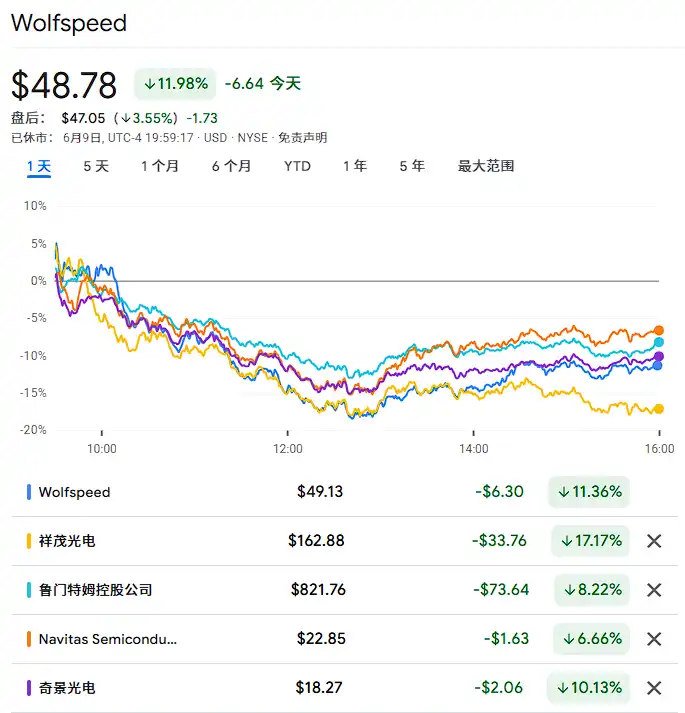
After the news broke, the US stock market's optical communication sector generally suffered heavy losses. Applied Optoelectronics (AAOI) plummeted by 17% in a single day, Lumentum fell by about 8%, and companies mentioned in the report as warranting caution, such as Himax Technologies (HIMX), Navitas Semiconductor Corp, and Wolfspeed, also faced significant pressure.
Concurrently with the release of the SemiAnalysis report, interview content with an NVIDIA executive was also published. According to资深半导体和科技投资记者Tae Kim, NVIDIA's Senior Vice President of Networking, Gilad Shainer, expressed a starkly optimistic stance on CPO's prospects at the 2026 Computex exhibition, stating directly that "CPO is the most exciting technology right now," and announced that volume shipments would begin in the second half of the year. This sparked a heated online debate about the CPO timeline on social platforms.

Notably, several market observers pointed out that the CPO delay does not mean the demand for optical interconnects disappears, but rather it is more likely to redirect capital flows back to traditional pluggable optical modules and the NPO (Near Package Optics) track — this logic led some investors to seek opportunities among oversold stocks during the panic selling.

SemiAnalysis Report Core: Dual Delays in Two Technological Pathways

In this research note distributed to institutional clients, SemiAnalysis presented two core judgments with profound market impact.

800VDC Power Architecture Delayed Until After 2028.

The report indicates that NVIDIA's originally planned large-scale adoption of a single-ended 800VDC power design has seen its shipment window significantly pushed back. Hyperscale cloud providers are currently more inclined to stick with mature low-voltage solutions or gradually transition to 400VDC, rather than rushing to switch to 800VDC.

The report argues that the marginal efficiency gains of 800VDC under current grid power supply conditions are insufficient to justify its system complexity. In contrast, 400VDC products are expected to start ramping in Q2 2026, with significant growth in 2027.

CPO Mass Production Timeline Lags Significantly Behind Market Expectations.

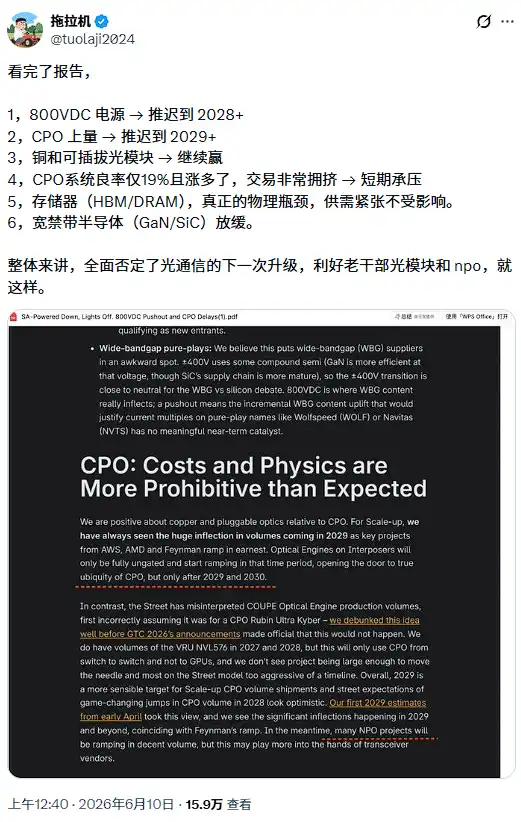
The report states that CPO shipment volumes in 2027 will be substantially lower than previous aggressive forecasts, and the timeline for mass production may be delayed until 2028 or even 2029. The main bottlenecks are concentrated at three levels:

Optical engine connection yield (optimistically around 95%, but CPO production driven by a single ASIC remains extremely limited), ASIC integration difficulty, and overall cost economics.

Scale-out CPO switch shipment volumes face downward revision risks, and shipments of Sidecar relying on new platforms like Rubin Ultra/Kyber are also postponed to a 2028 window.

At the individual stock level, SemiAnalysis maintains a relatively positive view on companies like Amphenol, Vertiv, and Legrand, while adopting a cautious stance towards Lumentum, Himax Technologies, Navitas Semiconductor, and Wolfspeed.

However, the report itself acknowledges that CPO, as an important direction for future data center network architecture, is not denied; the core reason for the delay lies in unresolved engineering challenges, not disappearing demand.

Simultaneously, the report also points out that some NPO (Near Package Optics) projects may accelerate.

NVIDIA Executive Publicly Counters, Tae Kim's Exclusive Interview Draws Attention

Just as the SemiAnalysis report was widely circulated among institutional circles,资深半导体和科技投资记者Tae Kim published an excerpt from a one-on-one interview with NVIDIA's Senior Vice President of Networking, Gilad Shainer, during Computex in his Substack column. The content starkly contrasted with SemiAnalysis's assessment.
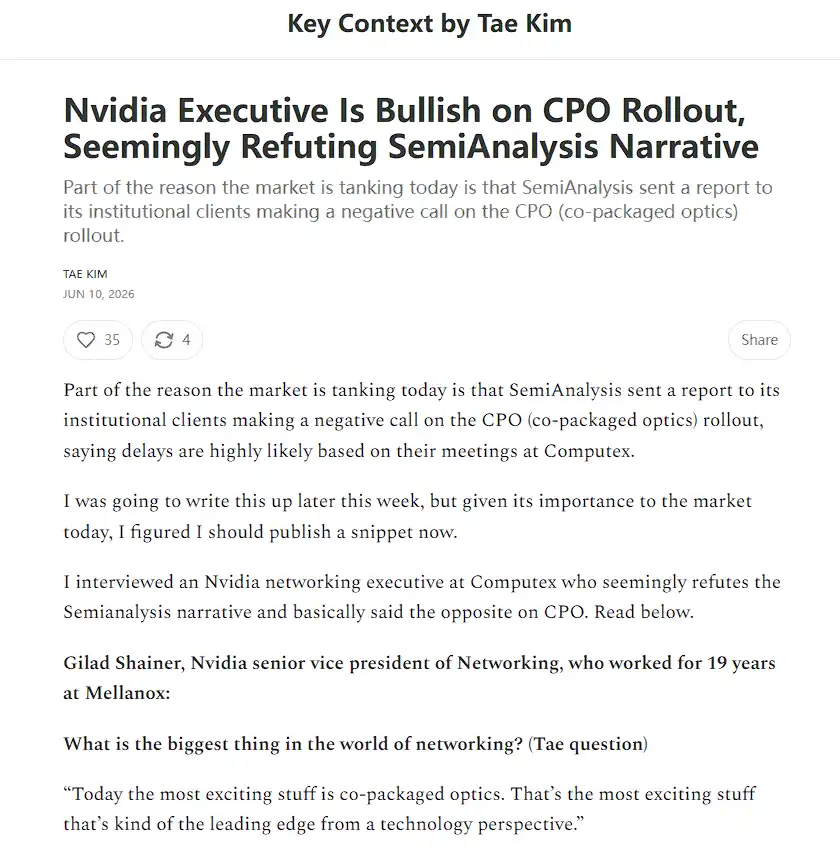
Shainer stated in the interview, "The most exciting thing today is co-packaged optics, it's the leading edge of technology."

He further revealed that NVIDIA is ready to start shipping, that partner Lambda had published a blog confirming receipt of CPO switches, that volume shipments of CPO would accelerate in the second half of the year, extending from scale-out to scale-up scenarios. "If it were up to me, I would put CPO everywhere that we use optical networking."

Tae Kim added in his article that Shainer's overall demeanor and body language during the interview showed high enthusiasm for both near-term and long-term ramp-up of CPO. He stated that this statement "seems to directly contradict the narrative from SemiAnalysis."

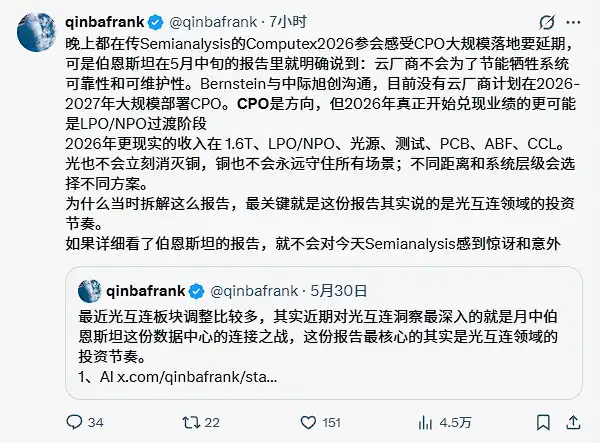
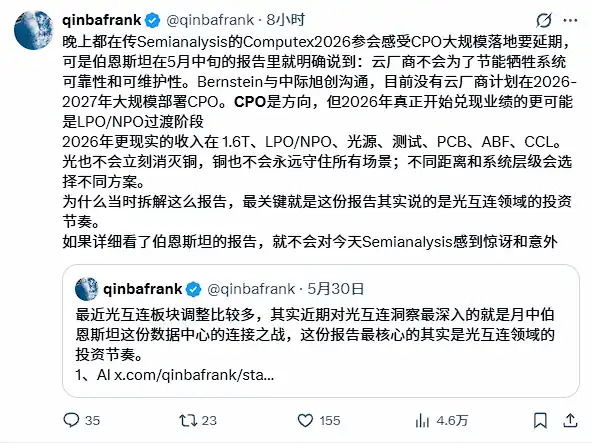
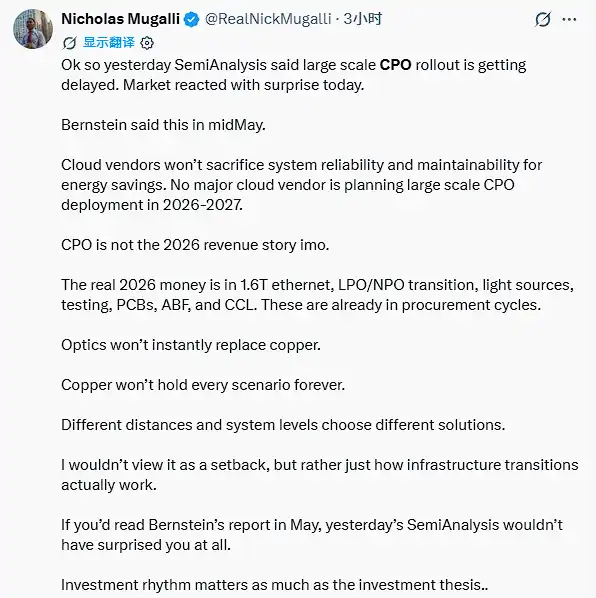
This discrepancy plunged the market into an information war. User @qinbafrank on social platform X pointed out that Bernstein had already clearly stated in a mid-May report that cloud providers would not sacrifice system reliability for energy savings, and that no cloud provider currently plans large-scale CPO deployment in 2026-2027. "If you had read the Bernstein report in detail, you wouldn't be surprised by SemiAnalysis today."
Online Debate: Is CPO Delay a Negative or a Market Overreaction?

The market volatility triggered by the report quickly spread to social media, where opinions on the investment logic surrounding the CPO delay diverged significantly.

Bearish View: Yield and Reliability Are Real Bottlenecks.

SemiAnalysis emphasized in its report that in the CPO architecture, the optical engine is co-packaged with a large ASIC worth tens of thousands of dollars on the same substrate. If the optical engine fails due to laser aging or fiber damage, it often requires the entire motherboard to be disassembled and returned to the factory. The maintenance cost and downtime risk are far higher than with traditional pluggable modules. This engineering challenge is considered the core obstacle preventing large-scale CPO adoption in the short term.

Bullish View: CPO Delay Actually Benefits Pluggable Modules and NPO.

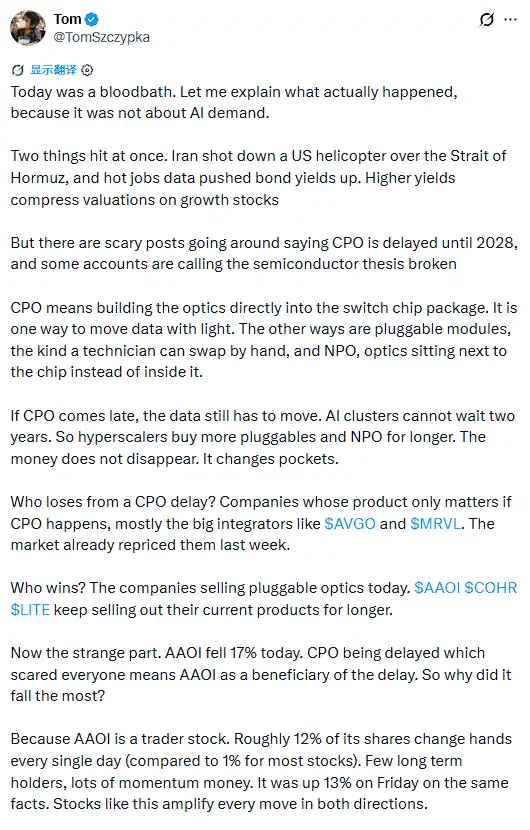
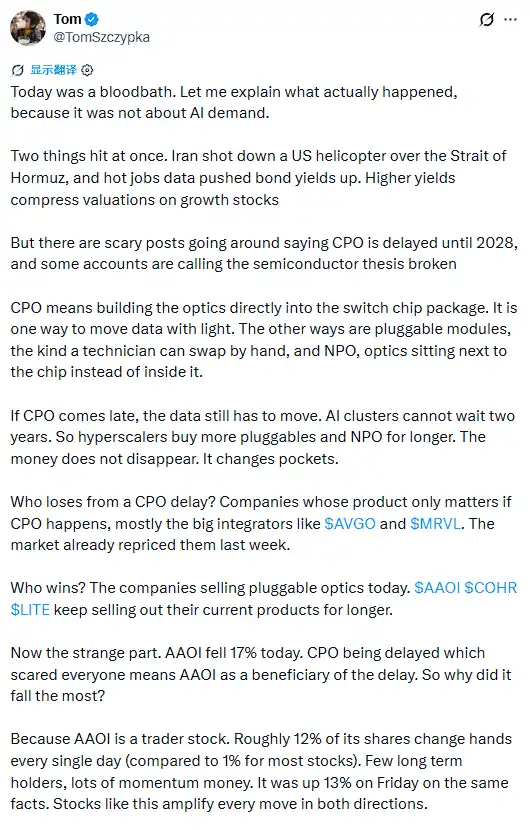
User @TomSzczypka on social platform X analyzed, "If CPO comes later, data still needs to be transmitted, AI clusters can't wait two years, hyperscalers will buy more pluggable modules and NPO for longer. The money doesn't disappear, it just changes pockets."

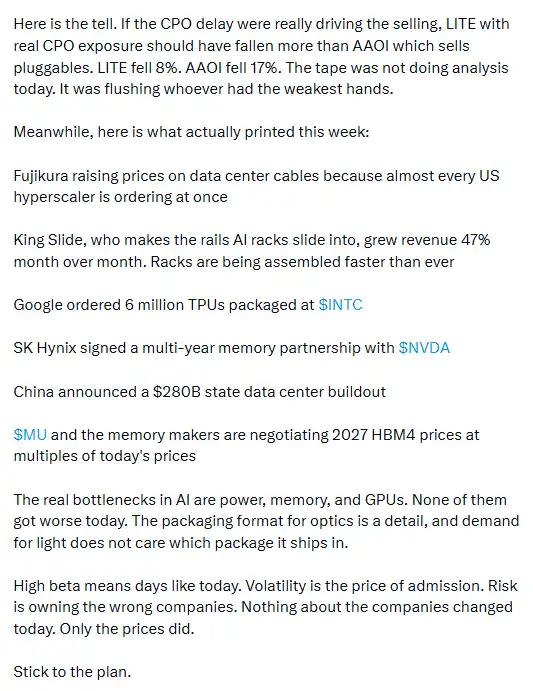
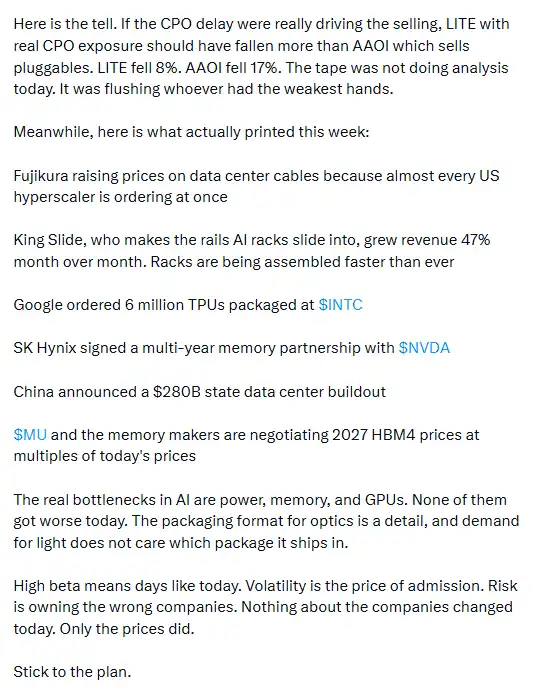
He also pointed out that the fact that Applied Optoelectronics' decline (17%) far exceeded Lumentum's (8%) on that day itself indicated that the market's sell-off was not based on rational analysis but was flushing out the weakest holdings.
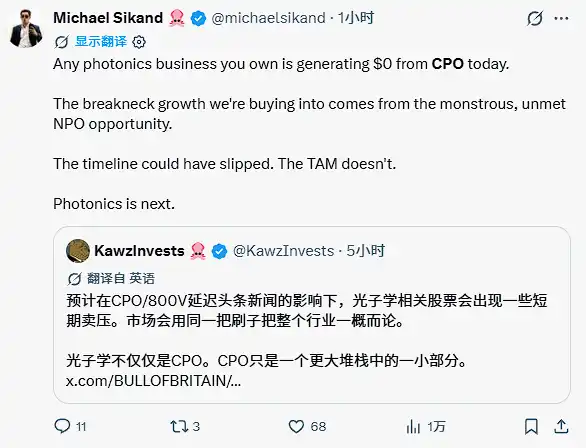
User @michaelsikand stated that currently, revenue from CPO for any photonics company is zero, and the current high growth comes from the huge, unmet NPO opportunity. "The timeline may slip, but the TAM doesn't."
Voices questioning the report's logic also exist.

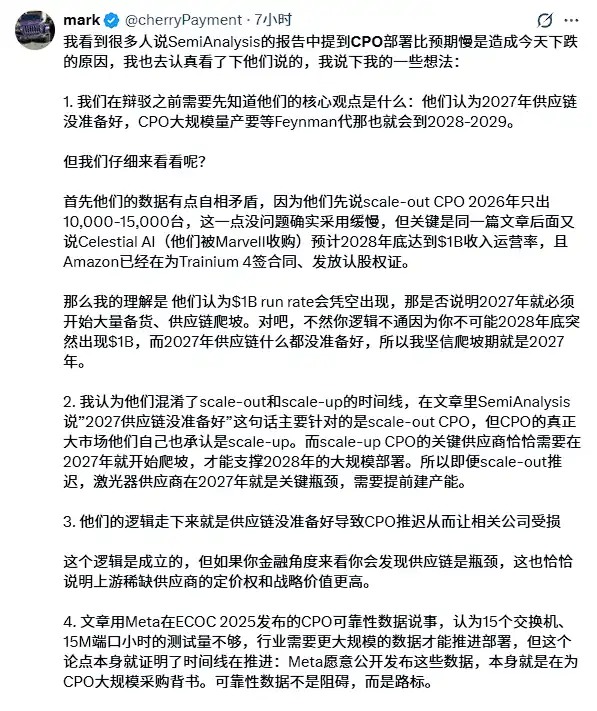
User @cherryPayment posted a lengthy article pointing out internal contradictions in the SemiAnalysis report: on one hand, it says the supply chain won't be ready in 2027; on the other hand, it predicts Celestial AI (acquired by Marvell) will reach a $1 billion revenue run rate by the end of 2028, and Amazon has already signed contracts for Trainium 4. "You can't suddenly have $1 billion by end of 2028 with the supply chain not ready for anything in 2027."

He also pointed out that SemiAnalysis's target audience is the procurement decision-makers at hyperscale cloud providers, and its conclusion is "no need to all-in yet," not an investment timing judgment for the capital market. "They are analyzing deployment pace, not investment timing."
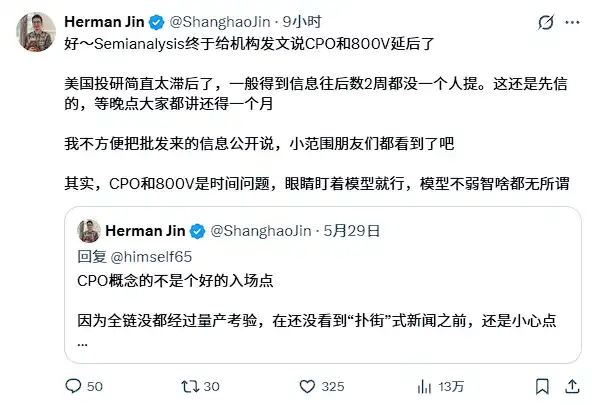
User @Herman Jin on platform X criticized the timeliness of information from US investment research firms, arguing that delays in CPO and 800VDC were "a matter of time," and such information had long been circulating in institutional circles; the SemiAnalysis report merely formalized known information on paper.
Unexpected Beneficiaries: Copper Connections and Pluggable Modules

Against the backdrop of widespread market pressure, some analysts turned their attention to potential beneficiaries of the CPO delay.

User @qinbafrank梳理认为,梳理认为梳理认为梳理认为,梳理认为梳理认为梳理认为 the more realistic revenue opportunities in 2026 are concentrated in 1.6T pluggable modules, LPO/NPO, light sources, testing, PCB, ABF, and CCL segments. "Optics won't eliminate copper immediately, and copper won't hold onto all scenarios forever; different distances and system levels will choose different solutions."
The CEO of Lumentum also recently stated that interest in NPO from non-NVIDIA customers has increased noticeably over the past two months.

User @RealNickMugalli analyzed that at 1.6T rates and 200G per channel, copper cables, even with retimer technology, have reached their physical limits. Optical solutions become a mandatory option, not an optional one, within reasonable distances, and the potential market size for NPO might even exceed that of CPO.
SemiAnalysis also noted in its report that some NPO projects may accelerate, and 400VDC products will start ramping in Q2 2026. For companies like Amphenol and Vertiv, the report maintains a relatively positive stance, believing they benefit from sustained demand during the 400VDC transition.

User @TomSzczypka cited this week's industry chain data to support that AI infrastructure demand has not weakened:

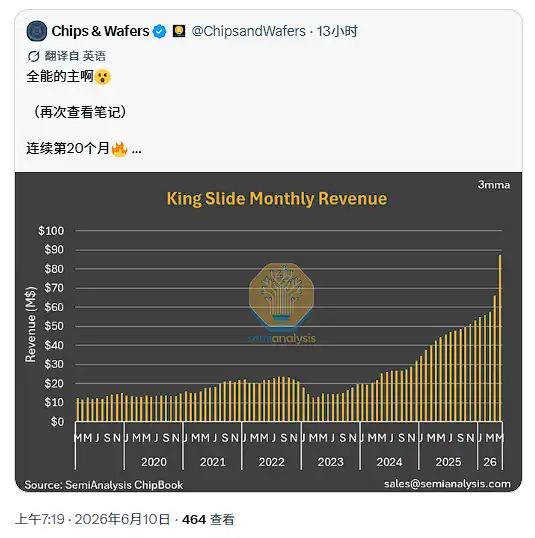
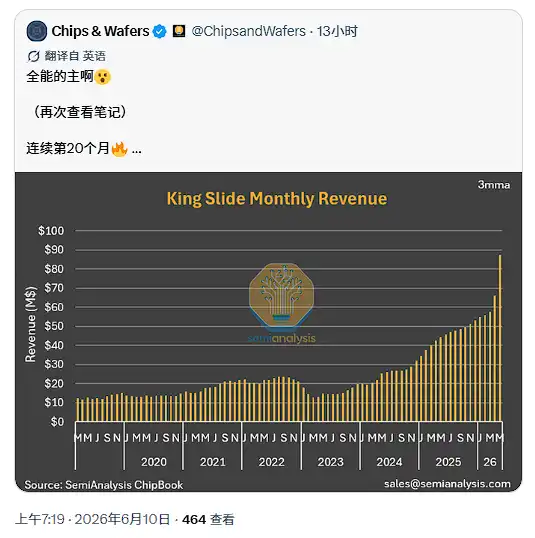
Fujikura raised prices for data center cables because almost all US hyperscalers placed orders simultaneously; King Slide's rack rail revenue increased 47% sequentially; Google ordered 6 million TPUs from Intel; SK Hynix signed a multi-year memory supply agreement with NVIDIA, etc.

"The real bottlenecks for AI are power, memory, and GPUs. None of these three have gotten any worse today."
Meanwhile, @tuolaji2024 posted on social platform X, stating that memory (HBM/DRAM), as the real physical bottleneck, remains completely unaffected by this technology delay event.
Analysis points out that, synthesizing various viewpoints, the market volatility triggered by this SemiAnalysis report reflects more of a recalibration of the technology roadmap timeline, rather than a fundamental reversal of overall AI data center demand.


相關問答

QWhat are the two key technology delays identified in the SemiAnalysis report that impacted the stock market?

AThe SemiAnalysis report identified that the timeline for mass production of CPO (Co-packaged Optics) has been delayed to 2028 or even 2029, and the deployment of Nvidia's 800VDC power architecture has been postponed to after 2028.

QAccording to the article, what is the primary engineering challenge hindering the large-scale adoption of CPO technology?

AThe primary engineering challenge is the high maintenance cost and downtime risk. If an optical engine fails within a CPO module, it often requires replacing the entire motherboard, which is more complex and costly than simply replacing a traditional pluggable optical module.

QWhat opposing view did NVIDIA executive Gilad Shainer express regarding CPO in his interview with Tae Kim?

ANVIDIA's Senior Vice President of Networking, Gilad Shainer, expressed strong optimism about CPO, calling it 'the most exciting thing in the technology front line.' He stated that NVIDIA is ready to begin shipping and that volume production will accelerate in the second half of the year, seemingly contradicting the delayed timeline in the SemiAnalysis report.

QHow did some investors interpret the CPO delay in terms of potential investment opportunities?

ASome investors argued that a delay in CPO adoption would redirect capital flows to other areas. They saw potential opportunities in established technologies like traditional pluggable optical modules and the accelerating NPO (Near-Package Optics) market, as data transmission needs remain immediate and strong.

QAccording to the article, what are cited as the 'true bottlenecks' for AI infrastructure that remain unaffected by the CPO/800VDC delays?

AThe article cites power supply, storage (specifically HBM/DRAM), and GPUs as the 'true bottlenecks' for AI infrastructure. These areas remain in tight supply and are unaffected by the delays in optical and power delivery technologies discussed in the report.

你可能也喜歡

USDe 绕开 GENIUS Act 收益禁令:合成美元如何成为加密最成功的灰色地带?

本文探讨了Ethena发行的合成美元稳定币USDe如何巧妙避开美国《GENIUS Act》中关于禁止支付型稳定币向持有人支付收益的规定。 USDe的核心机制并非持有法币或国债储备,而是通过收取加密抵押品并同时开设对冲的永续期货空头仓位,来维持美元价值稳定并赚取收益。持有人通过质押USDe获得sUSDe即可分享这部分收益。由于其本质是对冲衍生品交易策略而非传统储备模型,USDe不符合《GENIUS Act》对“支付型稳定币”的法定定义,从而置身于该法案的监管范围之外。 USDe曾一度成为市值第三大的美元计价加密资产,其收益来源于衍生品市场的资金费率与基差利差。这种设计使其在法律上区别于由发行人支付利息的传统稳定币。Ethena同时运营着完全合规、不支付收益的稳定币USDtb,突显了监管现状下的双重路径。 监管态度呈现分歧:德国BaFin将其视为未注册证券并禁止销售,而美国大型资产管理公司Janus Henderson则已与Ethena合作,将USDe用于现金管理。文章指出,USDe的成功反映了市场对收益型美元产品的真实需求,但其与USDC等储备型稳定币存在本质不同——前者依赖衍生品策略,后者依赖法币储备,风险特征迥异。 文章最终提出核心问题:监管机构是否会为“合成美元”这一类新兴工具专门划定监管边界,还是任由收益型产品持续流向现有法规的灰色地带。

Foresight News7 分鐘前

USDe 绕开 GENIUS Act 收益禁令:合成美元如何成为加密最成功的灰色地带?

Foresight News7 分鐘前

Lido V3 通过与 Luganodes 的 stVaults 扩展机构以太坊质押

Lido的机构质押业务新增基础设施支持,专业节点运营商Luganodes已集成Lido V3,并基于该协议新的stVaults原语推出了以太坊质押金库。 该集成面向那些希望在保持与更广泛的stETH生态系统连接的同时,对验证节点风险敞口、风险设置、费用结构和运营要求拥有更多控制权的机构用户。 **摘要要点:** * Luganodes 已集成 Lido V3。 * 该方案使用了 Lido 新的 stVaults 原语。 * 该产品主要面向机构以太坊质押用户。 * 目标是在保留 stETH 流动性优势的同时,提供更灵活的验证节点控制。 **背景与意义:** Lido V3 正朝着模块化质押方向发展。其新的 stVaults 原语旨在为不同用户提供更定制化的质押配置,而非强制所有人使用同一个通用资金池。这对于有特定节点运营商、费用安排、合规框架等需求的资产管理公司、ETP发行商和大型机构而言至关重要。 以太坊质押正成为机构投资组合的一部分,但机构通常需要了解验证节点表现、罚没风险、运营风险等更多细节。模块化的金库设计有助于解决这些问题,同时保持与stETH流动性的连接,从而在定制化质押和流动性访问之间取得平衡。 此次集成表明,以太坊质押生态正逐渐成熟,从早期吸引普通持有者参与,转向构建能够支持更大型、更受监管、操作更复杂的用户的产品。这对于以太坊作为DeFi、资产代币化和机构加密基础设施主要结算层的长期发展具有重要意义,意味着其质押市场正变得更加细分、可配置,并与机构资本更紧密地结合。

bitcoinist19 分鐘前

Lido V3 通过与 Luganodes 的 stVaults 扩展机构以太坊质押

bitcoinist19 分鐘前

渣打银行开出40倍“赌盘”,喊单UNI涨至100美元

渣打银行全球数字资产研究主管Geoff Kendrick近日发布报告,首次覆盖去中心化交易所Uniswap及其治理代币UNI,并给出了一个激进的长期预测:到2030年底,UNI价格有望从当前的约2.6美元飙升至100美元,涨幅近40倍。 报告的核心逻辑基于几条宏观主线:首先,全球链上代币化资产(RWA)规模预计将从目前的约3400亿美元激增至2028年的4万亿美元。其次,流入DeFi生态的代币化资产比例将从目前的约3.5%提升至2030年的30%,推动整体DeFi总锁仓价值(TVL)增长约37倍,达到2.7万亿美元。Uniswap作为核心流动性基础设施,将成为这波资金洪流的最大受益者。 此外,UNI的价值支撑已发生根本转变。自去年底激活“费用开关”并启动代币销毁机制后,UNI从纯粹的治理代币转变为具有通缩属性的生产性资产,能够直接捕获协议费用。报告将Uniswap比作YouTube式的开放平台,其网络效应和低边际成本模式相比Coinbase(Netflix模式)更具长尾优势。贝莱德、富达等传统机构已开始将Uniswap作为合规资产上链的交易接口,进一步巩固了其“链上纽交所”的潜在地位。 然而,报告也指出了UNI面临的挑战:一方面,Solana生态DEX及各类聚合器正在争夺用户流量;另一方面,RWA代币化的全球立法与合规进程若不及预期,将延迟宏大叙事的兑现。目前UNI价格较历史高点下跌超92%,市场对DeFi叙事仍显冷淡。 渣打银行的此次覆盖,标志着传统金融正以新的估值框架审视DeFi资产,关注点从投机转向网络效应与现金流。但通往2030年100美元目标的道路,注定充满不确定性。

marsbit26 分鐘前

渣打银行开出40倍“赌盘”,喊单UNI涨至100美元

marsbit26 分鐘前

交易

現貨
合約

熱門文章

什麼是 GROK AI

Grok AI: 在 Web3 時代革命性改變對話技術 介紹 在快速演變的人工智能領域,Grok AI 作為一個值得注意的項目脫穎而出,橋接了先進技術與用戶互動的領域。Grok AI 由 xAI 開發,該公司由著名企業家 Elon Musk 領導,旨在重新定義我們與人工智能的互動方式。隨著 Web3 運動的持續蓬勃發展,Grok AI 旨在利用對話 AI 的力量回答複雜的查詢,為用戶提供不僅具資訊性而且具娛樂性的體驗。 Grok AI 是什麼? Grok AI 是一個複雜的對話 AI 聊天機器人,旨在與用戶進行動態互動。與許多傳統 AI 系統不同,Grok AI 接納更廣泛的查詢,包括那些通常被視為不恰當或超出標準回應的問題。該項目的核心目標包括: 可靠推理:Grok AI 強調常識推理,根據上下文理解提供邏輯答案。 可擴展監督:整合工具協助確保用戶互動既受到監控又優化質量。 正式驗證:安全性至關重要;Grok AI 採用正式驗證方法來增強其輸出的可靠性。 長上下文理解:該 AI 模型在保留和回憶大量對話歷史方面表現出色,促進有意義且具上下文意識的討論。 對抗魯棒性:通過專注於改善其對操控或惡意輸入的防禦,Grok AI 旨在維護用戶互動的完整性。 總之,Grok AI 不僅僅是一個信息檢索設備;它是一個沉浸式的對話夥伴,鼓勵動態對話。 Grok AI 的創建者 Grok AI 的腦力來源無疑是 Elon Musk,這個名字與各個領域的創新息息相關,包括汽車、太空旅行和技術。在專注於以有益方式推進 AI 技術的 xAI 旗下,Musk 的願景旨在重塑對 AI 互動的理解。其領導力和基礎理念深受 Musk 推動技術邊界的承諾影響。 Grok AI 的投資者 雖然有關支持 Grok AI 的投資者的具體細節仍然有限,但公開承認 xAI 作為該項目的孵化器,主要由 Elon Musk 本人創立和支持。Musk 之前的企業和持股為 Grok AI 提供了強有力的支持,進一步增強了其可信度和增長潛力。然而,目前有關支持 Grok AI 的其他投資基金或組織的信息尚不易獲得,這標誌著未來潛在探索的領域。 Grok AI 如何運作? Grok AI 的運作機制與其概念框架一樣創新。該項目整合了幾種尖端技術,以促進其獨特的功能: 強大的基礎設施:Grok AI 使用 Kubernetes 進行容器編排,Rust 提供性能和安全性,JAX 用於高性能數值計算。這三者確保了聊天機器人的高效運行、有效擴展和及時服務用戶。 實時知識訪問:Grok AI 的一個顯著特點是其通過 X 平台(以前稱為 Twitter)訪問實時數據的能力。這一能力使 AI 能夠獲取最新信息,從而提供及時的答案和建議,而其他 AI 模型可能會錯過這些信息。 兩種互動模式:Grok AI 為用戶提供“趣味模式”和“常規模式”之間的選擇。趣味模式允許更具玩樂性和幽默感的互動風格,而常規模式則專注於提供精確和準確的回應。這種多樣性確保了根據不同用戶偏好量身定制的體驗。 總之,Grok AI 將性能與互動相結合,創造出既豐富又娛樂的體驗。 Grok AI 的時間線 Grok AI 的旅程標誌著反映其發展和部署階段的關鍵里程碑: 初始開發:Grok AI 的基礎階段持續了約兩個月,在此期間進行了模型的初步訓練和微調。 Grok-2 Beta 發布:在一個重要的進展中,Grok-2 beta 被宣布。這一版本推出了兩個版本的聊天機器人——Grok-2 和 Grok-2 mini,均具備聊天、編碼和推理的能力。 公眾訪問:在其 beta 開發之後,Grok AI 向 X 平台用戶開放。那些通過手機號碼驗證並活躍至少七天的帳戶可以訪問有限版本,使這項技術能夠接觸到更廣泛的受眾。 這一時間線概括了 Grok AI 從創建到公眾參與的系統性增長,強調其對持續改進和用戶互動的承諾。 Grok AI 的主要特點 Grok AI 包含幾個關鍵特點,促成其創新身份: 實時知識整合:訪問當前和相關信息使 Grok AI 與許多靜態模型區別開來,從而提供引人入勝和準確的用戶體驗。 多樣化的互動風格:通過提供不同的互動模式,Grok AI 滿足各種用戶偏好,邀請創造力和個性化的對話。 先進的技術基礎:利用 Kubernetes、Rust 和 JAX 為該項目提供了堅實的框架,以確保可靠性和最佳性能。 倫理話語考量:包含圖像生成功能展示了該項目的創新精神。然而,它也引發了有關版權和尊重可識別人物描繪的倫理考量——這是 AI 社區內持續討論的議題。 結論 作為對話 AI 領域的先驅,Grok AI 概括了數字時代轉變用戶體驗的潛力。由 xAI 開發,並受到 Elon Musk 願景的驅動,Grok AI 將實時知識與先進的互動能力相結合。它努力推動人工智能能夠達成的界限,同時保持對倫理考量和用戶安全的關注。 Grok AI 不僅體現了技術的進步,還體現了 Web3 環境中新對話範式的出現,承諾以靈活的知識和玩樂的互動吸引用戶。隨著該項目的持續演變,它成為技術、創造力和類人互動交匯處所能實現的見證。

762 人學過發佈於 2024.12.26更新於 2024.12.26

什麼是 GROK AI

什麼是 ERC AI

Euruka Tech:$erc ai 及其在 Web3 中的雄心概述 介紹 在快速發展的區塊鏈技術和去中心化應用的環境中,新項目頻繁出現,每個項目都有其獨特的目標和方法論。其中一個項目是 Euruka Tech,該項目在加密貨幣和 Web3 的廣闊領域中運作。Euruka Tech 的主要焦點,特別是其代幣 $erc ai,是提供旨在利用去中心化技術日益增長的能力的創新解決方案。本文旨在提供 Euruka Tech 的全面概述,探索其目標、功能、創建者的身份、潛在投資者以及它在更廣泛的 Web3 背景中的重要性。 Euruka Tech, $erc ai 是什麼? Euruka Tech 被描述為一個利用 Web3 環境提供的工具和功能的項目,專注於在其運作中整合人工智能。雖然有關該項目框架的具體細節仍然有些模糊,但它旨在增強用戶參與度並自動化加密空間中的流程。該項目的目標是創建一個去中心化的生態系統,不僅促進交易,還通過人工智能整合預測功能,因此其代幣被命名為 $erc ai。其目的是提供一個直觀的平台,促進更智能的互動和高效的交易處理,並在不斷增長的 Web3 領域中發揮作用。 Euruka Tech, $erc ai 的創建者是誰? 目前,關於 Euruka Tech 背後的創建者或創始團隊的信息仍然不明確且有些模糊。這一數據的缺失引發了擔憂,因為了解團隊背景通常對於在區塊鏈行業建立信譽至關重要。因此,我們將這些信息歸類為 未知,直到具體細節在公共領域中公開。 Euruka Tech, $erc ai 的投資者是誰? 同樣,關於 Euruka Tech 項目的投資者或支持組織的識別在現有研究中並未明確提供。對於考慮參與 Euruka Tech 的潛在利益相關者或用戶來說,來自知名投資公司的財務合作或支持所帶來的保證是至關重要的。沒有關於投資關係的披露,很難對該項目的財務安全性或持久性得出全面的結論。根據所找到的信息,本節也處於 未知 的狀態。 Euruka Tech, $erc ai 如何運作? 儘管缺乏有關 Euruka Tech 的詳細技術規範,但考慮其創新雄心是至關重要的。該項目旨在利用人工智能的計算能力來自動化和增強加密貨幣環境中的用戶體驗。通過將 AI 與區塊鏈技術相結合,Euruka Tech 旨在提供自動交易、風險評估和個性化用戶界面等功能。 Euruka Tech 的創新本質在於其目標是創造用戶與去中心化網絡所提供的廣泛可能性之間的無縫連接。通過利用機器學習算法和 AI,它旨在減少首次用戶的挑戰,並簡化 Web3 框架內的交易體驗。AI 與區塊鏈之間的這種共生關係突顯了 $erc ai 代幣的重要性,成為傳統用戶界面與去中心化技術的先進能力之間的橋樑。 Euruka Tech, $erc ai 的時間線 不幸的是,由於目前有關 Euruka Tech 的信息有限,我們無法提供該項目旅程中主要發展或里程碑的詳細時間線。這條時間線通常對於描繪項目的演變和理解其增長軌跡至關重要,但目前尚不可用。隨著有關顯著事件、合作夥伴關係或功能添加的信息變得明顯,更新將無疑增強 Euruka Tech 在加密領域的可見性。 關於其他 “Eureka” 項目的澄清 值得注意的是,多個項目和公司與 “Eureka” 共享類似的名稱。研究已經識別出一些倡議,例如 NVIDIA Research 的 AI 代理,專注於使用生成方法教導機器人複雜任務,以及 Eureka Labs 和 Eureka AI,分別改善教育和客戶服務分析中的用戶體驗。然而,這些項目與 Euruka Tech 是不同的,不應與其目標或功能混淆。 結論 Euruka Tech 及其 $erc ai 代幣在 Web3 領域中代表了一個有前途但目前仍不明朗的參與者。儘管有關其創建者和投資者的細節仍未披露,但將人工智能與區塊鏈技術相結合的核心雄心仍然是關注的焦點。該項目在通過先進自動化促進用戶參與方面的獨特方法,可能會使其在 Web3 生態系統中脫穎而出。 隨著加密市場的持續演變,利益相關者應密切關注有關 Euruka Tech 的進展,因為文檔創新、合作夥伴關係或明確路線圖的發展可能在未來帶來重大機會。當前,我們期待更多實質性見解的出現,以揭示 Euruka Tech 的潛力及其在競爭激烈的加密市場中的地位。

665 人學過發佈於 2025.01.02更新於 2025.01.02

什麼是 ERC AI

什麼是 DUOLINGO AI

DUOLINGO AI:將語言學習與Web3及AI創新結合 在科技重塑教育的時代,人工智能(AI)和區塊鏈網絡的整合預示著語言學習的新前沿。進入DUOLINGO AI及其相關的加密貨幣$DUOLINGO AI。這個項目旨在將領先語言學習平台的教育優勢與去中心化的Web3技術的好處相結合。本文深入探討DUOLINGO AI的關鍵方面,探索其目標、技術框架、歷史發展和未來潛力,同時保持原始教育資源與這一獨立加密貨幣倡議之間的清晰區分。 DUOLINGO AI概述 DUOLINGO AI的核心目標是建立一個去中心化的環境,讓學習者可以通過實現語言能力的教育里程碑來獲得加密獎勵。通過應用智能合約,該項目旨在自動化技能驗證過程和代幣分配,遵循強調透明度和用戶擁有權的Web3原則。該模型與傳統的語言習得方法有所不同,重點依賴社區驅動的治理結構,讓代幣持有者能夠建議課程內容和獎勵分配的改進。 DUOLINGO AI的一些顯著目標包括: 遊戲化學習:該項目整合區塊鏈成就和非同質化代幣(NFT)來表示語言能力水平,通過引人入勝的數字獎勵來激發學習動機。 去中心化內容創建:它為教育者和語言愛好者提供了貢獻課程的途徑,促進了一個有利於所有貢獻者的收益共享模型。 AI驅動的個性化:通過採用先進的機器學習模型,DUOLINGO AI個性化課程以適應個別學習進度,類似於已建立平台中的自適應功能。 項目創建者與治理 截至2025年4月,$DUOLINGO AI背後的團隊仍然是化名的,這在去中心化的加密貨幣領域中是一種常見做法。這種匿名性旨在促進集體增長和利益相關者的參與,而不是專注於個別開發者。部署在Solana區塊鏈上的智能合約註明了開發者的錢包地址,這表明對於交易的透明度的承諾,儘管創建者的身份未知。 根據其路線圖,DUOLINGO AI旨在演變為去中心化自治組織(DAO)。這種治理結構允許代幣持有者對關鍵問題進行投票,例如功能實施和財庫分配。這一模型與各種去中心化應用中社區賦權的精神相一致,強調集體決策的重要性。 投資者與戰略夥伴關係 目前,沒有與$DUOLINGO AI相關的公開可識別的機構投資者或風險投資家。相反,該項目的流動性主要來自去中心化交易所(DEX),這與傳統教育科技公司的資金策略形成鮮明對比。這種草根模型表明了一種社區驅動的方法,反映了該項目對去中心化的承諾。 在其白皮書中,DUOLINGO AI提到與未具名的「區塊鏈教育平台」建立合作,以豐富其課程提供。雖然具體的合作夥伴尚未披露,但這些合作努力暗示了一種將區塊鏈創新與教育倡議相結合的策略,擴大了對多樣化學習途徑的訪問和用戶參與。 技術架構 AI整合 DUOLINGO AI整合了兩個主要的AI驅動組件,以增強其教育產品: 自適應學習引擎:這個複雜的引擎從用戶互動中學習,類似於主要教育平台的專有模型。它動態調整課程難度,以應對特定學習者的挑戰,通過針對性的練習加強薄弱環節。 對話代理:通過使用基於GPT-4的聊天機器人,DUOLINGO AI為用戶提供了一個參與模擬對話的平台,促進更互動和實用的語言學習體驗。 區塊鏈基礎設施 建立在Solana區塊鏈上的$DUOLINGO AI利用了一個全面的技術框架,包括: 技能驗證智能合約:此功能自動向成功通過能力測試的用戶頒發代幣,加強了對真實學習成果的激勵結構。 NFT徽章:這些數字代幣標誌著學習者達成的各種里程碑,例如完成課程的一部分或掌握特定技能,允許他們以數字方式交易或展示自己的成就。 DAO治理:持有代幣的社區成員可以通過對關鍵提案進行投票來參與治理,促進一種鼓勵課程提供和平台功能創新的參與文化。 歷史時間線 2022–2023:概念化 DUOLINGO AI的基礎工作始於白皮書的創建,強調了語言學習中的AI進步與區塊鏈技術去中心化潛力之間的協同作用。 2024:Beta發佈 限量的Beta版本推出了流行語言的課程,作為項目社區參與策略的一部分,獎勵早期用戶以代幣激勵。 2025:DAO過渡 在4月,進行了完整的主網發佈,並開始流通代幣,促使社區討論可能擴展到亞洲語言和其他課程開發的問題。 挑戰與未來方向 技術障礙 儘管有雄心勃勃的目標,DUOLINGO AI面臨著重大挑戰。可擴展性仍然是一個持續的擔憂,特別是在平衡與AI處理相關的成本和維持響應靈敏的去中心化網絡方面。此外,在去中心化的提供中確保內容創建和審核的質量,對於維持教育標準來說也帶來了複雜性。 戰略機會 展望未來,DUOLINGO AI有潛力利用與學術機構的微證書合作,提供區塊鏈驗證的語言技能認證。此外,跨鏈擴展可能使該項目能夠接觸到更廣泛的用戶基礎和其他區塊鏈生態系統,增強其互操作性和覆蓋範圍。 結論 DUOLINGO AI代表了人工智能和區塊鏈技術的創新融合,為傳統語言學習系統提供了一種以社區為中心的替代方案。儘管其化名開發和新興經濟模型帶來某些風險,但該項目對遊戲化學習、個性化教育和去中心化治理的承諾為Web3領域的教育技術指明了前進的道路。隨著AI的持續進步和區塊鏈生態系統的演變,像DUOLINGO AI這樣的倡議可能會重新定義用戶與語言教育的互動方式,賦能社區並通過創新的學習機制獎勵參與。

683 人學過發佈於 2025.04.11更新於 2025.04.11

什麼是 DUOLINGO AI

相關討論

歡迎來到 HTX 社群。在這裡,您可以了解最新的平台發展動態並獲得專業的市場意見。 以下是用戶對 AI (AI)幣價的意見。

活动图片