Drift Protocol incident uncovered: Did ‘negligence’ lead to the $285M loss?

ambcrypto發佈於 2026-04-06更新於 2026-04-06

文章摘要

Drift Protocol's $285 million hack underscores a critical industry lesson: security cannot be sacrificed for scalability. This incident, potentially linked to the same group behind the 2024 Radiant Capital hack, reveals a meticulously planned attack where perpetrators posed as a legitimate firm to gain trust. In response, Drift froze protocol functions and collaborated with law enforcement, though market confidence remained shaken. The timing is significant, as Solana recently tested quantum-resistant upgrades that slowed the network by 90%, highlighting the inherent trade-offs between security and performance. Public scrutiny has intensified, with some labeling the breach "civil negligence," signaling a shift in the 2026 cycle toward prioritizing security, accountability, and quantum-threat preparedness over mere scalability.

This cycle clearly favors security over scalability, which marks a big shift from previous years.

Back in 2025, protocols like Ethereum [ETH] and Solana [SOL] focused on scaling the network, boosting transaction throughput, reducing congestion, and staying competitive in the fast-growing DeFi space. Their goal was simple: make the blockchain more scalable, even if that meant taking on extra risk under the hood.

However, the recent Drift protocol incident drives home a clear lesson: you cannot trade security for speed. In this context, could the attack actually act as a blessing in disguise, pushing the community and protocol teams to rethink operational security and put integrity above scalability?
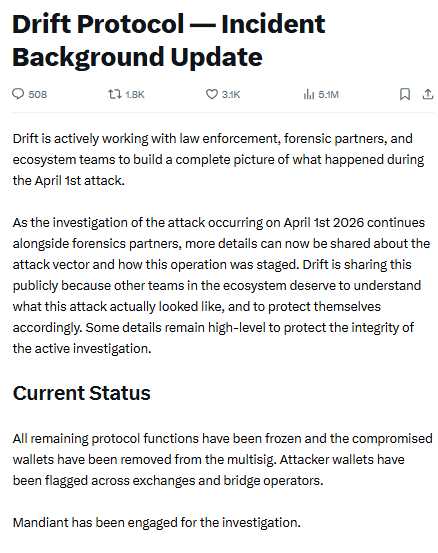
Source: X

According to the official statement, the team is working closely with law enforcement and forensic experts to investigate the Drift incident. Because of this, they froze all protocol functions, removed compromised wallets, and flagged attacker wallets across exchanges.

Interestingly, early evidence ties the attack to the same group behind the October 2024 Radiant Capital hack, though final attribution is still pending. The big takeaway? This was a months-long, carefully planned operation. The attackers posed as a legitimate trading firm, building trust through in-person meetings, and even deposited over $1 million to appear credible.

On paper, Drift’s response shows accountability in action, but the market reaction didn’t really reflect confidence. So, the question is, does this Drift incident expose security weaknesses and force the industry to rethink operational practices to prevent similar attacks in the future?

Drift incident sparks public pressure and industry wake-up call

Even with the massive $285 million hack, the Drift incident highlights some important lessons.

According to AMBCrypto, the “timing” makes this attack especially relevant. Solana recently tested a quantum-resistant model to prepare for future quantum threats, but the experiment slowed the network by 90%, showing that security upgrades can come at a cost.

In this light, the Drift incident clearly shows that security can’t be an afterthought, even as protocols chase speed, scalability, and new features. Put simply, even with Solana’s 90% slowdown, the focus must stay on robust, practical security, something the Drift incident helped bring into sharp focus.
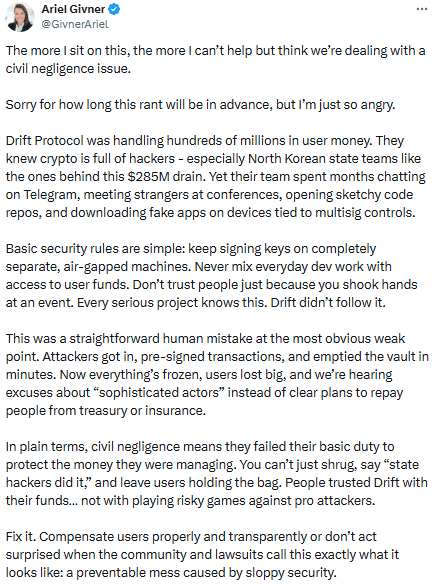
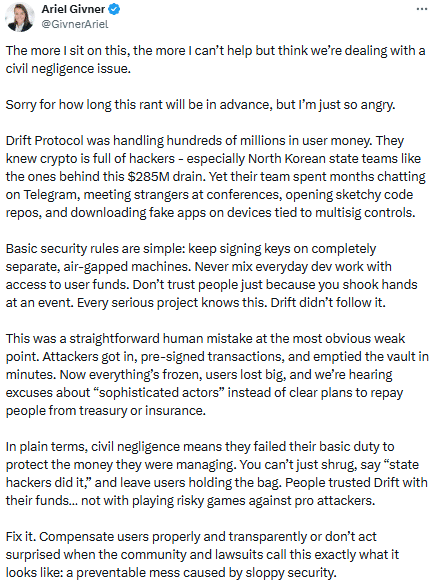
Source: X

Beyond the technical lessons, the public scrutiny that followed, though, adds another layer of pressure.

As the post above highlights, some reactions even called the hack “civil negligence,” implying that the protocol itself carried responsibility for the breach, alongside the attackers. This perspective isn’t too far-fetched, given the industry’s approach to security over the past few cycles.

Looking at it this way, the Drift protocol incident could be the wake-up call the market needed to move away from last year’s “scalability-first” mindset. The 2026 cycle is therefore shaping up to be security-driven, fueled by accountability, public pressure, and growing concerns around quantum threats.


Final Summary

  • The Drift incident highlights that security must come before speed, forcing protocols to rethink operational practices.
  • Public scrutiny and industry pressure are pushing the 2026 cycle to be security-driven, with quantum-threat preparedness taking center stage.


相關問答

QWhat was the main focus of blockchain protocols like Ethereum and Solana in 2025, according to the article?

AIn 2025, protocols like Ethereum and Solana focused on scaling the network, boosting transaction throughput, reducing congestion, and staying competitive in the fast-growing DeFi space, even if it meant taking on extra risk.

QWhat is the primary lesson the Drift protocol incident is said to drive home?

AThe primary lesson is that you cannot trade security for speed, and it should push the community to rethink operational security and put integrity above scalability.

QHow did the attackers gain the trust of the Drift protocol before the exploit?

AThe attackers posed as a legitimate trading firm, building trust through in-person meetings, and deposited over $1 million to appear credible.

QWhat broader industry shift is the Drift incident sparking for the 2026 cycle?

AThe incident is sparking a shift towards a security-driven cycle, fueled by accountability, public pressure, and growing concerns around quantum threats, moving away from the previous 'scalability-first' mindset.

QWhat was the estimated financial loss from the Drift Protocol incident?

AThe estimated financial loss from the Drift Protocol incident was $285 million.

你可能也喜歡

迈克尔·塞勒拒绝比特币数字资产堆栈中的协议收益

迈克尔·塞勒再次明确区分了比特币与能产生收益的加密系统,主张比特币应保持为纯粹的数字资本,而收益应通过在其基础之上构建的金融产品来创造。他在六月提出的“数字资产堆栈”框架中,将比特币置于底层作为数字资本,其上各层分别对应数字信贷、数字货币、数字回报和数字股权。他认为,比特币无需协议级质押或原生收益来证明其价值。 塞勒的立场与其一贯观点一致:比特币的价值源于其稀缺性、中立性和抗稀释性,添加协议级收益会引入风险,损害其核心用途。他主张,收益应通过建立在比特币之上的资本市场结构(如比特币抵押贷款、结构化债务、优先股权或类似其公司MicroStrategy这样的上市公司载体)来产生。 这一观点不仅吸引了比特币纯粹主义者,因为它保持了比特币的简洁性,也为资本市场创造了将比特币波动性、抵押价值和资产负债表风险转化为可投资工具的空间。对于交易者而言,这场争论影响着比特币相对于其他加密资产的估值方式。以太坊等权益证明网络常以原生收益为竞争点,而塞勒认为比特币根本不应在此领域竞争。 争论持续的关键在于,投资者日益根据收益、流动性和抵押效用比较加密资产。比特币在稀缺性上占优,但其本身不向持有者支付收益。塞勒的方案是保持比特币不变,而让公司、贷方和结构化产品来创造收益层。批评者则认为这会通过杠杆和公司载体引入新的风险。随着机构比特币产品日益复杂,这种张力很可能持续存在。

bitcoinist14 分鐘前

迈克尔·塞勒拒绝比特币数字资产堆栈中的协议收益

bitcoinist14 分鐘前

交易

現貨
合約

熱門文章

如何購買DRIFT

歡迎來到HTX.com!在這裡,購買Drift Protocol (DRIFT)變得簡單而便捷。跟隨我們的逐步指南,放心開始您的加密貨幣之旅。第一步:創建您的HTX帳戶使用您的 Email、手機號碼在HTX註冊一個免費帳戶。體驗無憂的註冊過程並解鎖所有平台功能。立即註冊第二步:前往買幣頁面,選擇您的支付方式信用卡/金融卡購買:使用您的Visa或Mastercard即時購買Drift Protocol (DRIFT)。餘額購買:使用您HTX帳戶餘額中的資金進行無縫交易。第三方購買:探索諸如Google Pay或Apple Pay等流行支付方式以增加便利性。C2C購買:在HTX平台上直接與其他用戶交易。HTX 場外交易 (OTC) 購買:為大量交易者提供個性化服務和競爭性匯率。第三步:存儲您的Drift Protocol (DRIFT)購買Drift Protocol (DRIFT)後,將其存儲在您的HTX帳戶中。您也可以透過區塊鏈轉帳將其發送到其他地址或者用於交易其他加密貨幣。第四步:交易Drift Protocol (DRIFT)在HTX的現貨市場輕鬆交易Drift Protocol (DRIFT)。前往您的帳戶,選擇交易對,執行交易,並即時監控。HTX為初學者和經驗豐富的交易者提供了友好的用戶體驗。

501 人學過發佈於 2024.12.11更新於 2026.06.02

如何購買DRIFT

相關討論

歡迎來到 HTX 社群。在這裡,您可以了解最新的平台發展動態並獲得專業的市場意見。 以下是用戶對 DRIFT (DRIFT)幣價的意見。

活动图片