With the release of AgentKit beta, a developer toolkit for the agentic web that works with x402, AI agents will be able to use World ID to carry cryptographic proof of a unique person. Developers may create AI agents that can demonstrate that a real person is behind them while interacting with websites, APIs, and online services thanks to the toolkit’s integration as an extension of x402, an open protocol founded by Coinbase and Cloudflare.
Online operations that formerly needed direct human involvement, such as booking reservations and checking pricing among merchants, are increasingly being handled by AI agents. According to industry estimates, agentic commerce might reach $3 trillion to $5 trillion worldwide by 2030, with AI agents perhaps making up as much as 25% of e-commerce in the United States at that time. Establishing trust and responsibility in automated interactions is an increasing difficulty for developers and platforms as agents become online economic actors.
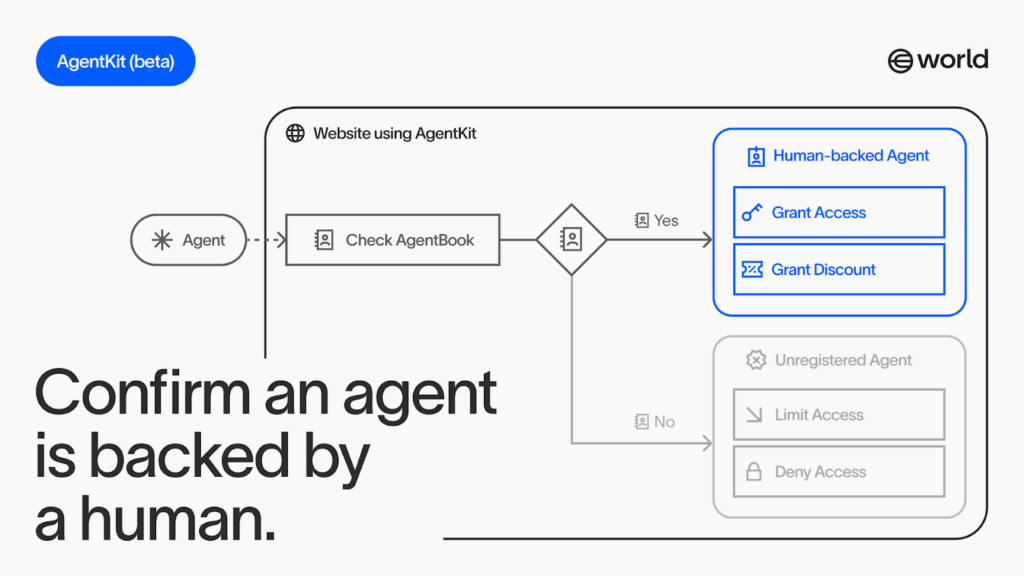
By allowing verified people to assign their World ID to AI agents, AgentKit solves this problem. By using this notion, developers may create what World calls “human-backed agents,” which are able to cryptographically demonstrate that a genuine, distinct person is behind them without disclosing the identity of the person.
“Payments are the ‘how’ of agentic commerce, but identity is the ‘who.’ By integrating World ID with the x402 protocol, developers now have a complete trust stack: a way for agents to pay for what they need and a way for platforms to verify there is a real human behind the wallet. This is a massive step toward a web where agents aren’t just seen as automated traffic, but as legitimate economic participants,” says Erik Reppel, Head of Engineering at Coinbase Developer Platform and Founder of x402.
“As AI agents start acting on behalf of users across the internet, the key challenge is separating legitimate, human-backed agents from bot swarms. Payment requirements can slow down abuse, but they don’t indicate how many real people are behind the activity. Proof of human addresses this gap by allowing websites to verify that an agent represents a unique person without revealing who that person is,” said DC Builder, Research Engineer at World Foundation.
Nowadays, the majority of websites see automated traffic as potentially dangerous and often completely prohibit it. This method stops productive AI agents from engaging with internet services, even though it was initially intended to combat malevolent bots. Agents often run into the same limitations intended to stop exploitation when they try to do activities like making reservations or accessing APIs.
New protocols have started looking at methods to make online agent action possible. Micropayments are introduced by the x402 protocol to allow agents to access resources and APIs while restricting excessive bandwidth. The x402 protocol has handled over 100 million payments via apps, APIs, and AI agents since its 2025 debut.
Micropayments provide a way to control access, but they don’t solve the issue of uniqueness or identification. It is difficult for platforms to discern between coordinated behavior and genuine users since a single person might run thousands of agents that can pay tiny fees. Additionally, payments by themselves generate public transaction trails that may reveal comprehensive records of an agent’s actions.
A supplementary signal, proof of unique human, is introduced by AgentKit. Without disclosing personal information, people may use World ID to cryptographically demonstrate their uniqueness as human beings. This feature is extended to AI agents by AgentKit, which enables platforms and websites to confirm that an agent is supported by a real person while protecting privacy.
Websites that currently use x402 may seek verification of unique human identity in addition to or instead of micropayments thanks to the toolkit’s integration with the x402 protocol. Verified World ID holders may use standard verification procedures to register their agents. Before allowing access, the platform may ask for payment, evidence of a unique person, or both when an agent visits a website that is compatible.
Although a single person may assign their World ID to many agents, platforms are able to identify that the agents come from the same person. This enables websites to detect abuse, establish limitations, and distribute resources based on the number of distinct persons interacting rather than the number of agents.
Numerous possible use cases are supported by the paradigm. Reservation systems might prevent scalpers from using a lot of automated agents to stockpile bookings while enabling human-backed agents to book tables. Ticketing systems could guarantee that actual fans, not automated networks, buy concert tickets. Instead of allocating access based on wallets or payments, websites that provide free trials might do so based on each individual person.
Additionally, AgentKit presents infrastructure that might facilitate services that need distinct identification signals, like age or country of residence, by sharing only relevant information using privacy-preserving zero knowledge proofs. Platforms may better control access while safeguarding user privacy by confirming the number of unique people responsible for agent activity.
Nearly 18 million verified people from more than 160 countries make up World’s network. With World ID, users may use cryptographic verification to anonymously demonstrate their uniqueness, enabling platforms to create trust signals without gathering or retaining personal information.
Developers creating AI agents with a validated World ID may now use the AgentKit beta. Developer access and documentation are accessible here.
A more sophisticated version is anticipated when the next iteration of the protocol is launched. The present beta version is based on the World ID architecture. The first release aims to collect developer input and show how proof of unique human may be extended to the expanding autonomous agent ecosystem.
World is meant to be the biggest, most inclusive network of actual people on the planet. The initiative, which was first conceptualized by Sam Altman, Max Novendstern, and Alex Blania, seeks to demonstrate humanity, finance, and connection for all people in the era of artificial intelligence. Visit world.org and X to learn more about the world.