# Stress的所有文章

在 HTX 新闻中心浏览与「Stress」相关的最新资讯与深度分析。潘盖市场趋势、项目动态、技术进展及监管政策,提供权威的加密行业洞察。

Just Now, Peking University Alumna Lilian Weng Announces Resignation: The Best 'Alignment' in the AI Era Is Taking Care of Yourself

Lilian Weng, a Peking University alumnus and former OpenAI executive, has announced her departure from Thinking Machines Lab, the AI startup she co-founded with ex-OpenAI CTO Mira Murati 20 months ago. Her resignation comes shortly after the company released its first open-source model, Inkling. In her farewell message, Weng cited health reasons as the primary factor, stating that the past seven months involved more illness than any other period in her life. The intense pressure and guilt of being unable to work during critical periods, like the Inkling launch, became unsustainable. She expressed that she could not continue in a role where she felt unable to give her full effort. Weng joined OpenAI in 2018, contributing to projects like the Dactyl robotic hand and later building the Safety Systems team from scratch. She is also widely known for her influential technical blog, Lil'Log. Her departure follows a period of high expectations and challenges for Thinking Machines, which secured a record $20 billion seed round at a $120 billion valuation in 2025 but has since seen fluctuations in its valuation and the departure of other key co-founders. Weng emphasized that she remains passionate about AI but needs a more predictable and defined role without the relentless pressure of a co-founder. Her exit highlights the immense personal toll and speed of competition in the AI industry, where the drive for progress often clashes with human limits. Her decision underscores that stepping back to prioritize well-being can be an act of courage.

marsbit昨天 23:51

Just Now, Peking University Alumna Lilian Weng Announces Resignation: The Best 'Alignment' in the AI Era Is Taking Care of Yourself

marsbit昨天 23:51

Collateral Dollars: How the 'Second-Layer Dollar' Above Stablecoins Takes Shape?

"Collateralized Dollars: How a 'Second Layer of Dollars' Forms on Top of Stablecoins" Most assume stablecoins replicate Eurodollars and expand the offshore dollar system, but this is not accurate. Stablecoins primarily replace certain functions within the existing system, especially operational dollar balances for daily settlement. The critical question is what happens when financial intermediaries create a new layer of dollar claims *on top of* stablecoins. This article explains how this new collateralized funding channel works. Stablecoins introduce tokenized private dollar claims. Even if issuers and reserves are within the US legal perimeter, their circulation and use as collateral can become economically "offshore." Enforceable control over collateral opens a secured credit channel but does not itself create a monetary claim. A true monetary event occurs only when another balance sheet funds, rolls over, or accepts a liability issued against the controlled token at near-par value. The discount prices the gap between "effective control over the token" and "reliable convertibility into bank dollars." Elasticity comes from the balance sheet issuing the liability against the token and from third-party willingness to treat that liability as a near-par asset. Collateralized Dollars are not the stablecoins themselves; they are the second-layer liability that another balance sheet is willing to issue, fund, and maintain at near-par against a controlled token balance. The Eurodollar system is a hierarchy of claims, with elasticity originating in expandable bank liabilities. In contrast, the stablecoin collateral chain starts with a tokenized asset. It gains systemic significance only when an intermediary's liability against that token is treated as money-like by other balance sheets. Key determining factors include: who has effective control, the legal/operational path to bank dollars, and whether the resulting claim can still be financed near-par under stress. Pressure in this new channel manifests differently. The upper-layer (intermediary) claim fails first, losing its money-like status, potentially while the underlying stablecoin remains solvent. Increased haircuts and forced sales can create a destructive feedback loop, widening the very gap the discount measures. In conclusion, the Eurodollar analogy has limits. Reserve quality supports the underlying token's solvency, but the leverage, credit, and liabilities built atop it face a separate test. Collateral eligibility is not monetary acceptance. Only when a claim built on stablecoins survives the leap from "token liquidity" to "bank dollar liquidity" do Collateralized Dollars truly exist.

链捕手07/08 06:16

Collateral Dollars: How the 'Second-Layer Dollar' Above Stablecoins Takes Shape?

链捕手07/08 06:16

Trading Reflection: Why Does Trading Cryptocurrencies Become More Miserable the Longer You Do It? In Fact, Your Brain Has Been 'Damaged' by Stress.

Trading Reflection: Why Does Trading Cryptocurrency Become More Miserable Over Time? Your Brain Might Be Damaged by Stress This article explores the often-overlooked yet crucial psychological aspect of trading. It argues that long-term success depends less on intellect and more on the survival capacity of one's nervous system. The core issue is that sustained trading pressure disrupts normal brain chemistry. While initial hope and occasional wins provide dopamine-driven pleasure, repeated losses and constant market exposure trigger chronic cortisol release. This stress hormone, meant for short-term survival, keeps the trader in a perpetual "fight-or-flight" mode. Over time, this erodes sleep quality, depletes patience, and fuels emotional, impulsive decision-making. The author describes a dangerous cycle: fear of missing out leads to overtrading and lowered standards. As losses mount (30%, 50%), trading shifts from a pursuit of profit to a psychological battle for survival. The brain begins to associate prolonged stress with the occasional reward, trapping the trader in an addictive loop. Anxiety becomes a baseline state, and trading turns into a compulsive need to feel something—where green candles offer relief and red ones spark self-loathing. The most powerful move a trader can make, the article concludes, is sometimes to stop entirely—to avoid revenge trading, chasing losses, or seeking dopamine fixes. The key is to step back long enough to ask: is this still about passion, or is it a cage of stress hormones? The market and its opportunities will always return, but a trader who is mentally broken will have nothing left to capitalize on them. The best traders are not necessarily the smartest, but those who preserve their mental well-being long enough to stay in the game. Ultimately, the chase may not be for money, but for relief from the very pressure the game creates.

marsbit06/02 06:07

Trading Reflection: Why Does Trading Cryptocurrencies Become More Miserable the Longer You Do It? In Fact, Your Brain Has Been 'Damaged' by Stress.

marsbit06/02 06:07

Survival Guide: Don't Let Web3's 'High-Frequency Trading' Exhaust Your Irreplaceable Heart

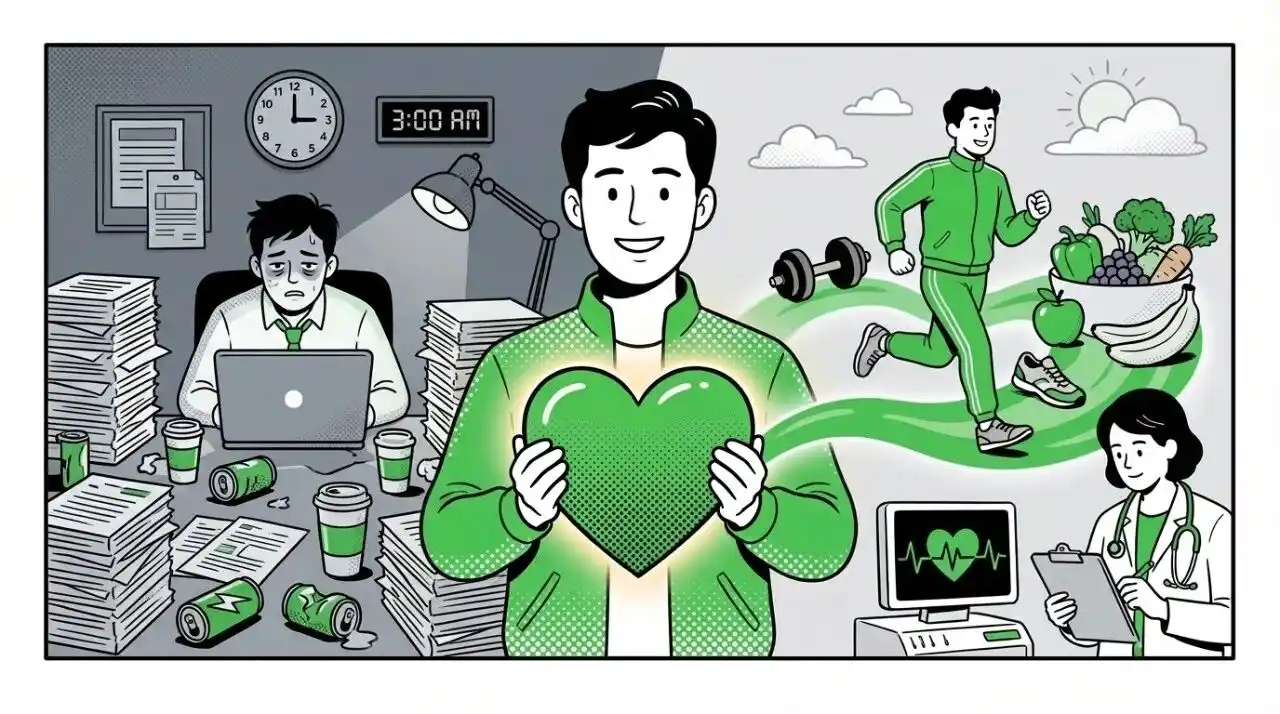
Heart Health Survival Guide for Entrepreneurs: Don't Let Web3’s "High-Frequency Trading" Exhaust Your Irreplaceable Heart Entrepreneurs face unique cardiovascular risks due to chronic stress, sleep deprivation, overwork, and neglect of traditional risk factors like smoking, hypertension, and diabetes. Key insights: - Prolonged stress elevates cortisol, damaging blood vessels and accelerating atherosclerosis. - Sleeping <6 hours nightly significantly increases blood pressure and mortality risk. - Overwork can trigger sudden cardiac death in those with underlying conditions. Critical health checks include: - Blood tests: LDL cholesterol (<1.8 mmol/L for冠心病 patients), blood pressure (<140/90 mmHg), and troponin (even slight elevations raise mortality risk 10x in young adults). - ECG and echocardiograms to assess heart structure/function. - BMI (18.5–23.9) and waist circumference (men <90cm, women <85cm). Self-monitoring via smartwatches (heart rate alerts), home blood pressure checks, and symptom awareness (e.g., chest pain, unexplained dizziness) is essential. Common misconceptions: - Exercise isn’t a shield; excessive intensity may provoke cardiac events. - Youth doesn’t guarantee safety—heart attacks are rising in under-50s. - Symptoms can be silent or atypical. Prevention strategies: - 150 mins/week of moderate aerobic exercise. - Daily salt intake <5g; prioritize fiber (25g+ daily). - Sleep ≥6 hours nightly. - Quit smoking; limit alcohol (men ≤25g/day, women ≤15g). - Keep emergency supplies: nitroglycerin, aspirin, and an AED accessible. During a heart attack: 1. Call 120 immediately—do not drive. 2. Lie flat, loosen clothing, use nitroglycerin if prescribed. 3. Start CPR if unconscious (100–120 compressions/min). 4. Use AED if available. Your heart is irreplaceable—prioritizing health is the ultimate long-term investment.

marsbit03/26 10:18

Survival Guide: Don't Let Web3's 'High-Frequency Trading' Exhaust Your Irreplaceable Heart

marsbit03/26 10:18

活动图片