How Bitcoin and Ethereum absorbed $500 mln last week – Without a rally

ambcrypto发布于2025-12-15更新于2025-12-15

文章摘要

Bitcoin and Ethereum spot ETFs recorded over $500 million in net inflows between December 8th and 12th, yet both cryptocurrencies showed almost no price movement during that period. Bitcoin ETFs attracted $287 million, largely driven by BlackRock’s IBIT, while Ethereum ETFs saw $209 million in inflows, led by products from BlackRock and Fidelity. Despite this steady institutional demand, Bitcoin traded around $89,600, down 2.16% for the week, and Ethereum hovered near $3,127, dipping just 0.23%. The market’s muted reaction is attributed to several factors: traders had priced in a Federal Reserve rate cut in advance, Bitcoin faced strong resistance near the $92K–$94K range, and overall risk sentiment remained cautious. ETF-driven demand appears to be more focused on strategic, long-term allocation rather than short-term speculation. Bitcoin ETFs now hold approximately $118.3 billion in net assets, and Ethereum ETFs manage around $19.4 billion, indicating significant capital commitment. The disconnect between steady inflows and flat prices suggests that price is no longer an immediate indicator of demand. If inflows continue with low volatility, the next significant price move could be sudden and unexpected as ownership shifts quietly.

Bitcoin and Ethereum just had a strong week on paper, but you wouldn’t know it by looking at prices.

Between the 8th and 12th of December, Bitcoin and Ethereum spot ETFs combined pulled in a little more than $500 million in net inflows! And yet, both assets barely budged.

It’s strange. Steady money is coming in, yet prices are going nowhere.

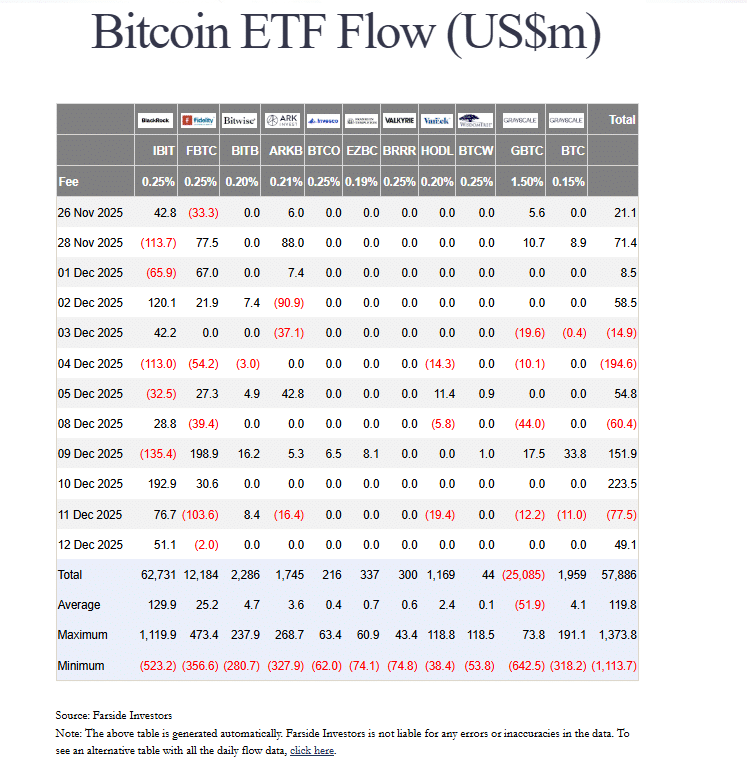
ETF money kept coming, prices didn’t

Source: Farside Investors

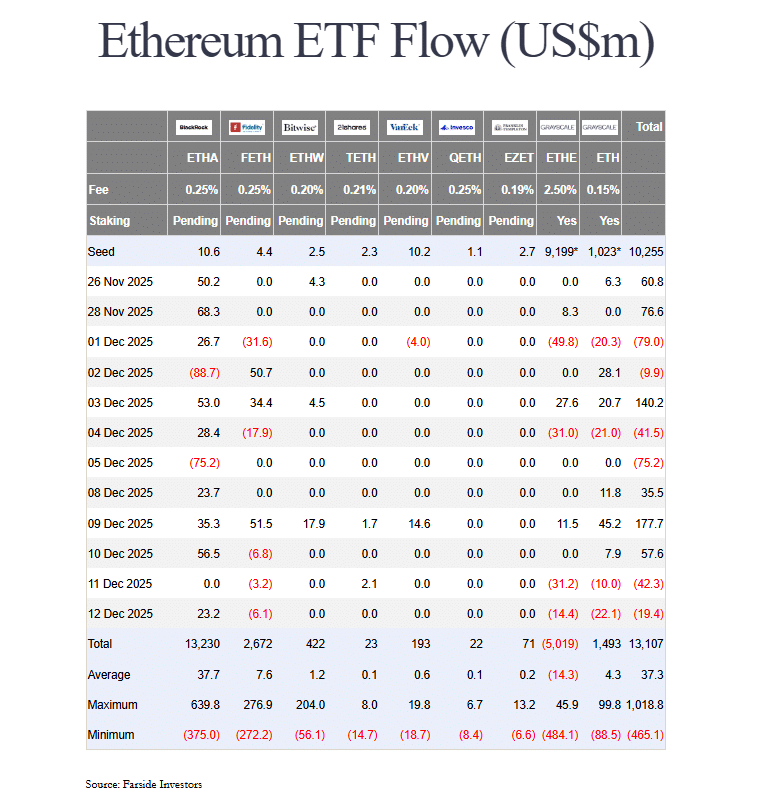
Between the 8th and 12th of December, Bitcoin ETFs recorded $287 million in net inflows, led largely by BlackRock’s IBIT, which saw consistent daily additions despite a few mixed sessions.

Source: Farside Investors

Ethereum ETFs followed a similar pattern, posting $209 million in weekly inflows, with BlackRock’s ETHA and Fidelity’s FETH leading the demand.

Source: CoinMarketCap

However, Bitcoin [BTC] traded near $89.6K, down 2.16% on the week, with a market cap of roughly $1.78 trillion.

Ethereum [ETH] traded around $3,127, slipping just 0.23% over the week, with a market value close to $377 billion.

The market is absorbing capital with steady ETF buying, calmer price moves, and no rush from traders on either side.

Why did prices stay flat?

Market forces kept Bitcoin and Ethereum prices largely range-bound. Traders were still digesting a Federal Reserve rate cut that failed to spark a rally, as the move had already been fully priced in.

Bitcoin also struggled to break resistance around the $92K-$94K range, keeping prices capped. Risk sentiment remained cautious into early December.

As a result, Bitcoin traded at nearly $90,000 throughout the week and Ethereum traded between $3.1K to 3.2K. ETF demand is increasingly centered around longer-term allocation than impulse.

2025 in ETFs

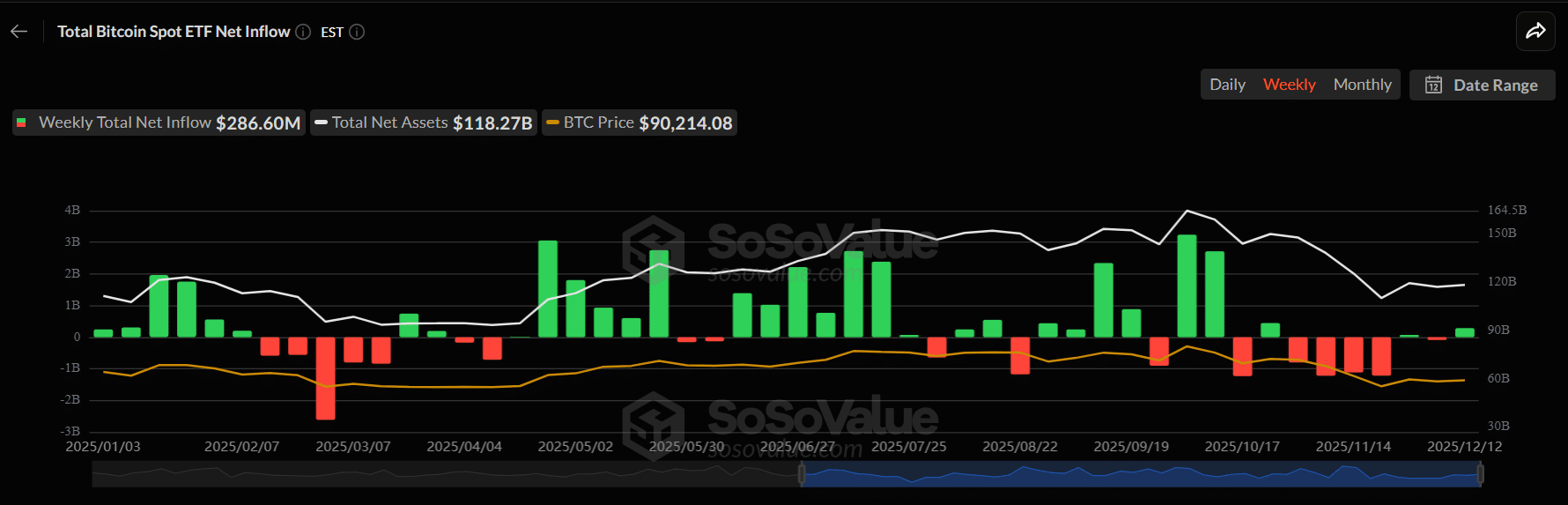
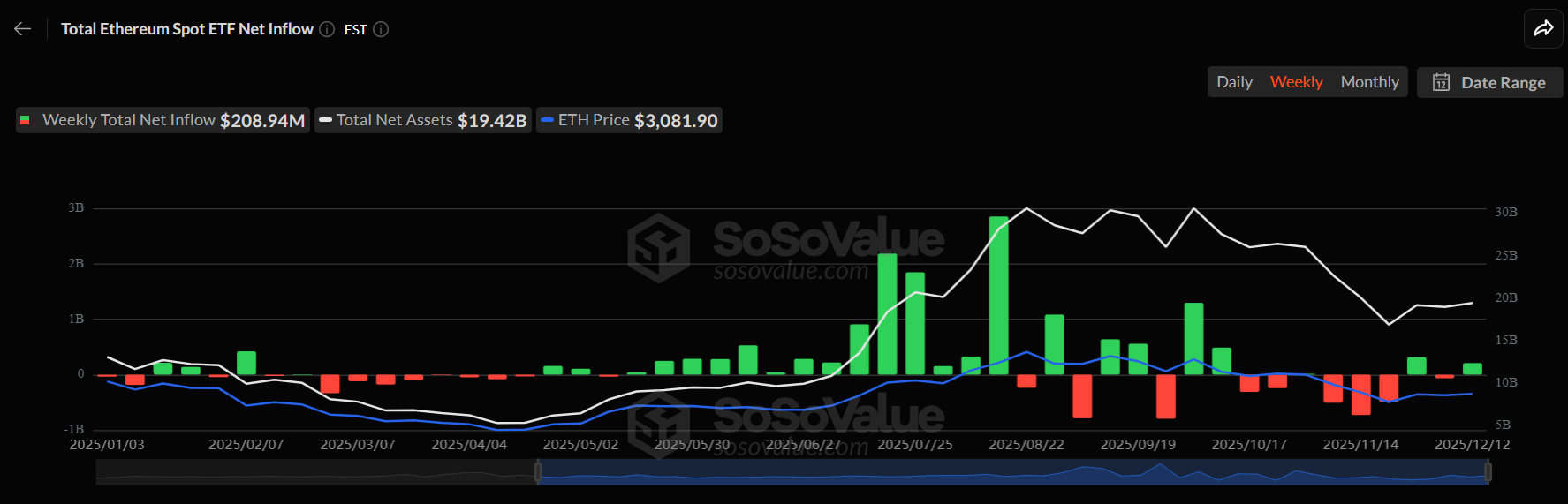
Bitcoin and Ethereum ETFs have continued to grow steadily despite long stretches of flat or declining prices.

Source: SoSoValue

Bitcoin spot ETFs now hold about $118.3 billion in total net assets, while Ethereum ETFs sit near $19.4 billion, so there’s strong capital commitment.

Source: SoSoValue

Even in weeks like the latest one, price barely reacted. That disconnect means that price is no longer the immediate feedback loop for demand.

If inflows remain steady with subdued volatility, the next move may surprise you. Ownership will have shifted hands while the market looked elsewhere.


Final Thoughts

  • $500M+ in Bitcoin and Ethereum ETF inflows met flat prices this last week.
  • When ownership shifts without chaos, the next Bitcoin and Ethereum move often comes fast and unexpected.
Next: Is Bitcoin done dumping? What BTC accumulation trends say
Share
  • Share
  • Tweet

热门币种推荐

你可能也喜欢

Tiger Research:扎克伯格开始押注预测市场,而亚洲国家却仍视其为赌博

预测市场已从概念走向成熟,2020年后交易量显著增长,目前月交易量超140亿美元。Meta创始人扎克伯格亲自带队开发预测市场应用Arena,标志着该领域商业模式得到验证。 预测市场历史悠久,早期形式包括18世纪伦敦的政治投注和19世纪纽约的选举期货。1988年爱荷华大学创建的电子市场是其学术起点,其表现常优于传统民调。其核心是二元期权结构,事件发生则支付1美元,否则为0,交易价格直接反映市场认为的事件发生概率。 如今预测市场涵盖体育、政治、经济等广泛话题,通过订单簿形成价格,由去中心化或中心化的“预言机”机制判定结果并结算。其核心优势在于“皮肤在游戏中”机制——参与者用真金白银下注,错误预测会导致亏损,这迫使市场整合更客观、及时的信息,从而 often生成比传统民调或专家预测更可靠的预测,在金融、政治等领域已有实证。 然而,全球监管态度分化。美国通过司法裁决将其纳入金融监管范畴,而亚洲主要国家仍普遍将其视为赌博进行限制。文章指出,亚洲的这种监管立场可能导致三个问题:催生监管套利,使资本和用户流向离岸风险平台;导致反映本地社会情绪的重要数据流失海外,削弱国家信息主权;并无法有效保护用户。文章呼吁,亚洲监管思维需从“堵截”转向“疏导”,通过前瞻性讨论将预测市场纳入正规体系,将其产生的数据转化为社会资产。

marsbit12分钟前

Tiger Research:扎克伯格开始押注预测市场,而亚洲国家却仍视其为赌博

marsbit12分钟前

Vitalik 眼中以太坊的下一个 10 年

2026年7月,Vitalik Buterin公布了名为“Lean Ethereum”的长期路线图,规划了未来三到四年的协议全面重构。该计划被视为继Merge之后以太坊的第三次重大演进,旨在通过一系列升级解决扩容、安全、隐私等核心问题。 **核心目标与技术升级:** 1. **性能飞跃**:目标是将L1吞吐量提升至每秒1 gigagas,实现数百倍增长,并大幅缩短最终确定性时间至近实时。 2. **验证模式变革**:计划将递归STARK证明纳入协议核心,用高效的证明验证替代当前所有节点重新执行交易的模式,以提升效率。 3. **状态与存储重构**:拟引入分层状态架构,设立一个容量更大、费用更低的新型存储层,鼓励应用迁移以显著降低手续费。 4. **增强安全与隐私**:将抗量子密码学(如Winternitz签名)提升为优先事项,并将原生隐私支持作为协议设计的一级目标。 5. **EVM引擎潜在更换**:考虑用对证明更友好的架构(如RISC-V)替代或补充EVM,以降低证明生成成本,但此提议尚存争议,特别是与部分L2(如Arbitrum)的技术路线存在博弈。 **市场影响与观察点:** 路线图主要通过提升L1交易活动来增加ETH销毁量,从而可能正面影响其价值。但这是一个长期过程,短期内不影响现状。市场更应关注几个近期可验证的节点:Glamsterdam升级能否顺利实施并提升gas上限、L2活动及blob需求增长、L1费用收入与ETH销毁量的变化、L2发展对L1的反哺效应,以及ETH相对于BTC的市场表现。 这份路线图提升了以太坊的长期潜能上限,但并未解决中期的代币经济价值捕获问题。其实施效果需通过未来数年的具体技术落地和市场指标来验证。

链捕手1小时前

Vitalik 眼中以太坊的下一个 10 年

链捕手1小时前

交易

现货

热门文章

从华尔街到Web3:美联储新主席将如何重塑全球金融市场?

6月25日,美联储前高级经济学家、上海交通大学上海高级金融学院教授胡捷做客火币大咖讲堂,以《从华尔街到Web3:美联储新主席将如何重塑全球金融市场?》主题,围绕美联储新主席上任后的政策范式变化、全球流动性走向、美元体系演变,以及对Web3市场的影响展开深度解读。

207人学过发布于 2026.07.01更新于 2026.07.01

从华尔街到Web3:美联储新主席将如何重塑全球金融市场?

什么是TradFi

TradFi(Traditional Finance,传统金融)指由银行、证券交易所、基金公司、监管机构等中心化实体主导的金融体系。

1.6k人学过发布于 2026.07.01更新于 2026.07.01

什么是TradFi

相关讨论

欢迎来到HTX社区。在这里,您可以了解最新的平台发展动态并获得专业的市场意见。以下是用户对A(A)币价的意见。

活动图片