Evaluating the $8 trillion risk – Why Bitcoin price is no longer a ‘safe haven’

ambcrypto发布于2026-01-19更新于2026-01-19

文章摘要

Bitcoin experienced a sharp decline, briefly nearing $92,000, following former U.S. President Donald Trump’s threat to impose new tariffs on eight European countries. The initial 10% tariff, set for February 1, could rise to 25% by June if negotiations fail. Trump administration explicitly linked the tariffs to the potential purchase of Greenland. With U.S. markets closed for a holiday, global markets absorbed the shock: S&P 500 and Nasdaq futures fell, Asian and European indices dipped, and the dollar weakened against safe-haven currencies like the yen and Swiss franc. Gold and silver surged to record highs, while oil prices dropped on growth concerns. Bitcoin later recovered some losses due to bargain buying. The situation remains tense as European investors hold approximately $8 trillion in U.S. assets, and any capital flow shifts could significantly impact markets. Key events to watch include economic data from China, Bank of Japan policy decisions, U.S. economic indicators influencing the Fed, and geopolitical discussions at the upcoming Davos meeting.

Bitcoin fell after U.S. President Donald Trump threatened new tariffs on eight European countries! With U.S. markets closed for the holiday, global markets reacted first, and crypto felt the impact.

Here’s the rundown.

BTC steadies after tariff shock

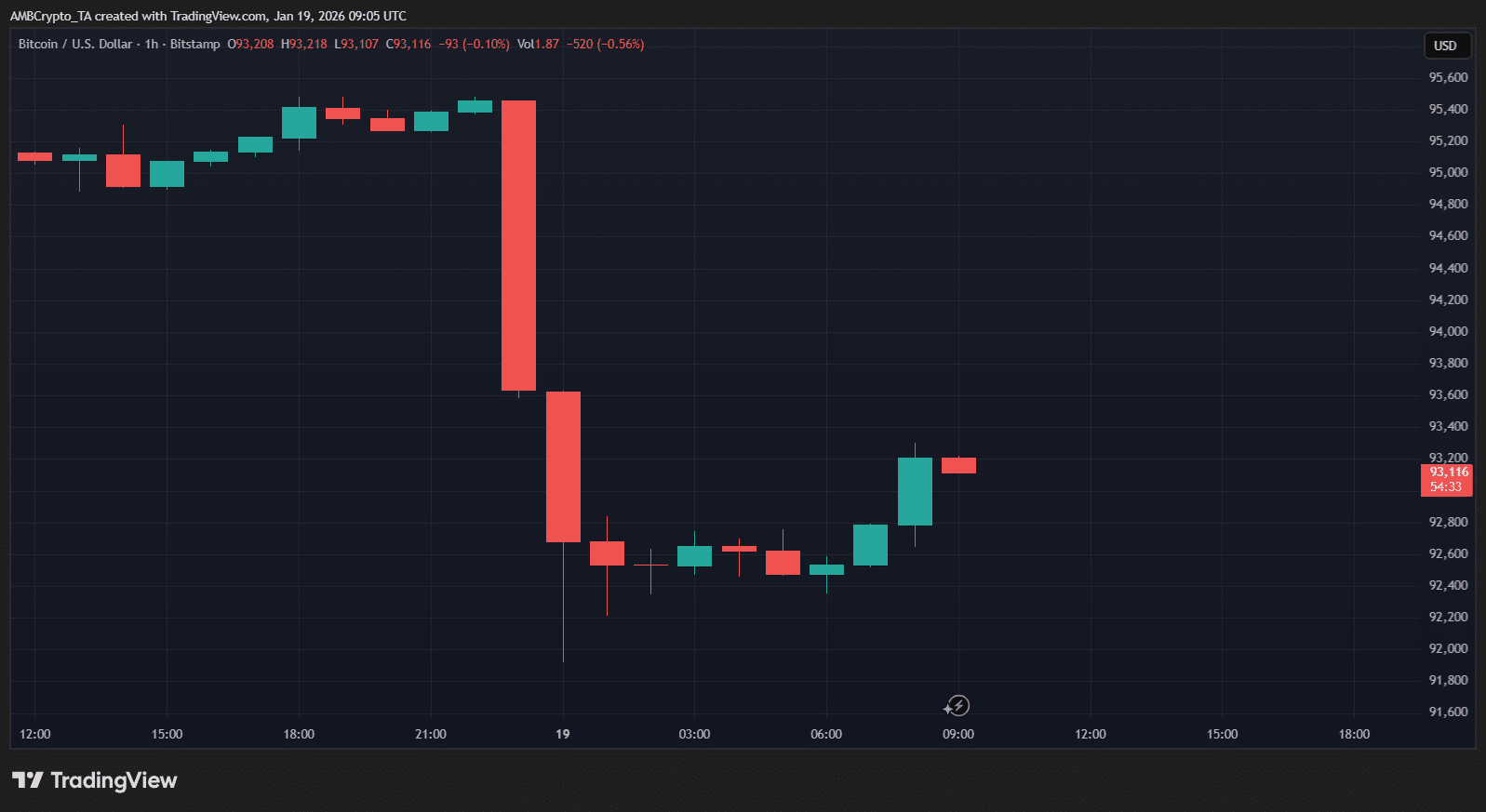
Bitcoin briefly slid close to the $92,000 mark during early Asian trading, a knee-jerk reaction to tariff threats from President Trump. The proposed measures target eight European countries –  Denmark, Norway, Sweden, France, Germany, the Netherlands, Finland and Britain.

Initial level is set at 10% import tariffs for the 1st of February, and a potential increase to 25% by June if talks fail. Further, the President stated,

“This Tariff will be due and payable until such time as a Deal is reached for the Complete and Total purchase of Greenland.”

With U.S. cash markets shut for the holiday, the initial shock was absorbed elsewhere. S&P 500 futures slipped about 0.7%, while Nasdaq futures dropped 1.0% during early Asian hours.

Japan’s Nikkei fell about 1%, while MSCI’s Asia-Pacific index outside Japan went 0.1% lower. European markets also looked dim, with Euro Stoxx 50 and DAX futures both down around 1.1%.

The dollar slipped against other safe-haven currencies, falling about 0.3% against the yen and 0.2% versus the Swiss franc, while the Euro recovered after a dip.

Gold jumped 1.5% to a record, silver was at an ATH, while U.S. crude slipped on growth worries tied to a possible trade clash.

Source: Trading View

Bitcoin [BTC] managed to claw back some losses in the following hours, so bargain buying and steady sentiment kept the boat afloat.

All eyes on capital flows and global data

European investors hold around $8 trillion in U.S. bonds and equities.

A recent Bloomberg report stated that Deutsche Bank’s warnings that any shift could hit markets harder than tariffs themselves. They went so far as to call it a “weaponization of capital.”

There’s more to keep an eye out for. China reports growth data this week, the Bank of Japan is making policy decisions, and U.S. economic figures could influence the next Fed move.

Meanwhile, leaders are heading to Davos as well, where tensions and security issues (including the Greenland dispute) are likely to dominate discussions.

Big days ahead!


Final Thoughts

  • Bitcoin price not out of the dumps yet – $8 trillion in European holdings could change anytime.
  • Watch China, the Fed, and Davos talks; global data and tensions move markets fast.
Next: Litecoin retraces 6.5% – Can whales and ETF inflows lead to a reversal?
Share
  • Share
  • Tweet

相关问答

QWhat was the immediate impact of President Trump's tariff threats on Bitcoin's price?

ABitcoin briefly slid close to the $92,000 mark during early Asian trading as a knee-jerk reaction to the tariff threats.

QWhich European countries are targeted by the proposed tariffs mentioned in the article?

AThe proposed tariffs target Denmark, Norway, Sweden, France, Germany, the Netherlands, Finland, and Britain.

QAccording to the article, what is the estimated value of European holdings in U.S. bonds and equities that could be at risk?

AEuropean investors hold around $8 trillion in U.S. bonds and equities that could be at risk.

QHow did traditional safe-haven assets like gold and the Japanese yen react to the news?

AGold jumped 1.5% to a record high, and the dollar slipped about 0.3% against the Japanese yen, which is considered a safe-haven currency.

QWhat key events does the article suggest investors should watch that could influence markets in the near future?

AInvestors should watch China's growth data, the Bank of Japan's policy decisions, U.S. economic figures influencing the Fed, and discussions at the Davos meeting, particularly regarding tensions and the Greenland dispute.

你可能也喜欢

如果 AI 泡沫已经在破了,谁会真正留下?

AI行业存在泡沫已成为市场共识,观点两极分化:达利欧认为泡沫已高,黄仁勋则视其为巨大机遇的开始。文章指出,泡沫类似于2000年互联网泡沫,虽导致市场暴跌和公司倒闭,却沉淀了关键基础设施(如海底光缆、宽带),为后来亚马逊、Netflix等巨头崛起奠定基础。当前AI领域,巨头正投入数千亿美元建设数据中心、电力、GPU等基础设施,而应用层收入尚未完全匹配,形成“基建投入远大于应用收入”的明显落差。 然而,AI推理成本(Token成本)已暴跌超99.7%,这使得企业AI支出不降反升。成本下降解锁了大量长尾需求,AI正从聊天工具深入代码、医疗、金融、制造等行业的真实工作流,进入智能体与多模态应用时代。市场正在自我净化,淘汰缺乏核心竞争力的“套壳”公司,但AI赋能千行百业的大趋势不可逆转。 未来,价值将从资本支出(CapEx)的基础设施层,逐渐转向运营支出(OpEx)的应用层。那些能真正解决垂直行业痛点、重塑业务流程的AI原生企业将获得超额利润。尽管估值存在压力,但企业盈利增长有望逐步消化高估值。最终,泡沫破裂后留下的将是坚实的基础设施和高度优化的技术,推动社会进入一个所有行业均由AI驱动的智能时代。泡沫终会破灭,但底层的生产力革命真实无水分。

marsbit24分钟前

如果 AI 泡沫已经在破了,谁会真正留下?

marsbit24分钟前

微软CEO:在AI时代,如何定义一家公司的护城河?

微软CEO萨提亚·纳德拉认为,AI时代企业的核心竞争力并非依赖于单一的最强大模型,而在于能否构建一个持续进化的“学习闭环”。这一系统能将企业内部的工作流程、专业知识、组织判断和员工经验沉淀下来,并让人工智能与人类能力相互强化、共同提升。 未来的公司将积累两类关键资产:一是以员工知识、判断力、创造力和模式识别能力为核心的“人力资本”;二是企业自身构建并拥有的AI能力,即“Token资本”。纳德拉强调,AI不仅不会削弱人力资本的价值,反而会让人类的目标设定、跨领域连接和关键决策能力变得更为重要。缺乏人的引导,算力将失去方向;没有企业自身知识的注入,再强的模型也仅是外部工具。 因此,企业的真正护城河在于建立私有的评估体系、强化学习环境和知识库,将隐性经验转化为可迭代、可扩展的系统能力。即使更换底层通用模型,企业独有的“公司老员工式”的专业经验和学习成果也不会丢失。这确保了企业的知识产权与控制权。 纳德拉指出,健康的AI未来应是一个繁荣的“前沿生态”,而非由少数通用模型垄断价值。只有这样,价值才能广泛惠及每家公司、每个行业和国家,让各组织能基于自身知识创造并保留经济价值,最终实现企业、员工与社区的共同繁荣。

marsbit1小时前

微软CEO:在AI时代,如何定义一家公司的护城河?

marsbit1小时前

ZEC 联创回应 Orchard 漏洞:暂无被盗痕迹,将封存 Orchard 池

近期Zcash的Orchard模块曝出安全漏洞,引发了对代币总量是否异常及用户资产安全的两大关切。本文针对漏洞引发的四个核心问题进行分析。 首先,关于漏洞是否已被利用,目前尚无证据表明已被恶意使用。该漏洞由专业团队主动发现,门槛较高,且曝光后开发团队迅速冻结资金池并修复,极大限制了攻击窗口。历史经验表明,黑客获利后通常会快速变现并留下痕迹,目前尚未发现此类证据。 其次,关于Orchard内合法资产的取回,若漏洞从未被利用,用户资产可正常转出。但如果虚假代币已混入池中并抢先转出,则可能影响部分用户的取回。考虑到漏洞被利用的概率较低,将资产留在原隐私钱包内是稳妥选择。若选择转出,需注意转入公开地址会完全失去隐私性,转入Sapling池则依赖2018年的可信初始化仪式,存在额外安全隐患。 第三,目前用户无法自行验证Zcash代币总量是否被增发。但计划中的Ironwood网络升级将永久关闭Orchard池,只允许资产按原合法存入数量转出,从而从协议层面杜绝超发。升级后,任何用户均可通过运行节点独立验证总量。 最后,关于是否存在其他造假漏洞,多支团队(包括借助先进AI工具)已进行全面排查,目前未发现新的同类高危漏洞,但仍无法给出绝对保证。 总结来说,漏洞很可能未被利用,用户资产目前安全,且暂未发现其他类似漏洞。但关键问题在于用户目前无法自主验证总量,而Ironwood升级将解决此问题,恢复Zcash的可验证性基础。

Foresight News1小时前

ZEC 联创回应 Orchard 漏洞:暂无被盗痕迹,将封存 Orchard 池

Foresight News1小时前

交易

现货
合约

热门文章

加密市场宏观研报:《GENIUS Act》法案取得重大进展,BTC突破历史新高,后市全新展望

2025年5月22日,比特币价格正式突破11万美元大关,创下历史新高。在政策面、宏观经济、资金面与投资者结构共同作用下,一场结构性牛市浪潮正在展开。而此轮上涨背后的核心驱动,是美国《GENIUS稳定币法案》的实质性进展以及多项利好的叠加。本文将从政策端突破、宏观环境转向、链上与ETF资金结构、交易行为演化,以及重点受益赛道五大维度,全面解析此轮BTC再创新高的深层逻辑,并前瞻下半年市场的潜在趋势。

1.6k人学过发布于 2025.05.22更新于 2025.05.22

加密市场宏观研报:《GENIUS Act》法案取得重大进展,BTC突破历史新高,后市全新展望

相关讨论

欢迎来到HTX社区。在这里,您可以了解最新的平台发展动态并获得专业的市场意见。以下是用户对BTC(BTC)币价的意见。

活动图片