Author: Bu Shuqing, Wall Street News Agency
U.S. stock markets may struggle to hit new highs in the short term, as funds flow out from this year's best-performing semiconductor stocks towards AI hyperscale cloud providers.
Morgan Stanley's chief equity strategist, Michael Wilson, pointed out in a latest report that momentum in the semiconductor sector is fading, and investors are starting to shift towards this year's underperforming AI hyperscale giants, including Microsoft, Amazon, and Meta.
He believes this rotation is occurring against a backdrop of overall choppy and weak market performance, with major indices continuing to face pressure. Wilson simultaneously maintained his year-end S&P 500 target at 8000 points, implying approximately 7% upside from current levels.
The direct market impact of this assessment is that chip stocks, which previously led the AI rally, face valuation pressure, while hyperscalers, with their strong core businesses, are poised to become the new landing spot for funds. Meanwhile, JPMorgan strategist Mislav Matejka holds a similar view, expecting the market's gains to broaden beyond the tech sector in the second half of the year.
Chip Momentum Fading, Valuation Pressure Emerges
The Philadelphia Semiconductor Index has fallen nearly 14% since hitting a record high last month, with concerns about a valuation bubble persisting. Nonetheless, the index has still surged 123% cumulatively since September last year, highlighting the magnitude of its previous gains.
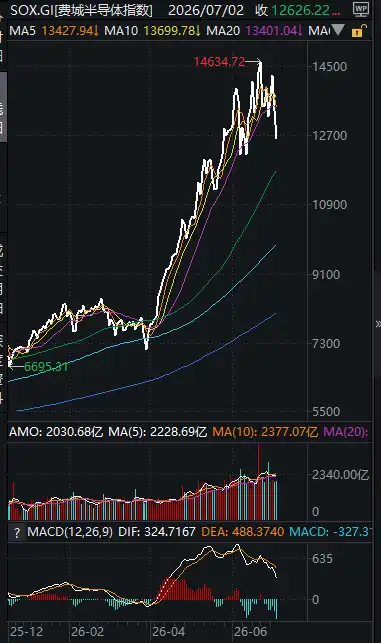
Micron Technology's better-than-expected sales forecast last month failed to sustain the chip stock rally, further confirming the sector's fading momentum. Currently, investors are awaiting comments from companies like Nvidia for more clues on AI chip demand.
Wilson points out that the breakdown in momentum is happening among large, index-weighting companies, which will keep major U.S. benchmark indices under pressure in the near term. The S&P 500 index has been gradually retreating since peaking in early June.
Hyperscalers: Value Opportunity Within the AI Ecosystem
Wilson stated he has recently favored hyperscalers over semiconductor-related stocks. He believes companies like Microsoft, Amazon, and Meta are attractive within the AI ecosystem, primarily because their robust underlying businesses provide solid support.
In contrast, according to Bloomberg data, a basket of hyperscaler stocks compiled by UBS Group has fallen 2% cumulatively since last September, forming a stark contrast with the gains in the semiconductor sector and implying relative catch-up potential for this group.
However, Wilson also anticipates that hyperscalers may begin to moderate expectations for their capital expenditure plans in response to recent market concerns about excessive AI investment. The outlook for capital spending will become a core focus for investors in the next phase.
Rotation Broadening, Opportunities Outside Tech Emerge
Wilson's rotation thesis is not confined to the hyperscale sector. He is also optimistic about the consumer discretionary, transportation, and biotechnology sectors benefiting from the fund outflow from chip stocks.
JPMorgan strategist Mislav Matejka aligns with Wilson's view, expecting market gains to extend beyond the tech sector in the second half of the year. "AI is unlikely to be the only game in town," Matejka wrote in a research note.
It is worth noting that Wilson previously correctly predicted that U.S. stock markets would remain resilient amid geopolitical risks due to strong corporate earnings, lending some credibility to his current assessment. His year-end S&P 500 target of 8000 points implies about 7% potential upside from current levels, but short-term volatility risks cannot be ignored.