It’s no secret that the crypto market was gripped by bearish pressure for the entirety of 2022. However, amid all the volatility and chaos, many positive news stories appeared as well — especially regarding the global adoption of digital assets and crypto-related technologies in general.
⠀
Looking back at 2022, here are some key adoption-related events that helped drive the industry last year.
⠀
Polygon accrues 200 million addresses despite challenging 2022
⠀
Even though an air of financial uncertainty has shrouded the crypto market since the end of 2021, Polygon — a layer-2 scaling solution running alongside the Ethereum blockchain, allowing for speedy transactions and low fees — continued to witness a lot of growth in 2022. To this point, the network’s unique address count recently surpassed the 200 million mark, reaching a new all-time high of 205,420,908 on Dec. 31.
⠀
Additionally, the Polygon ecosystem saw its unique address count surge by a whopping 8,783,568 between Dec. 1 and Dec. 31, suggesting that over the last month of 2022 alone, an average of 283,340 new Polygon-related network addresses came into existence daily. Moreover, it bears mentioning that the number of transactions taking place within the network has continued to hover around the 3 million mark.
⠀
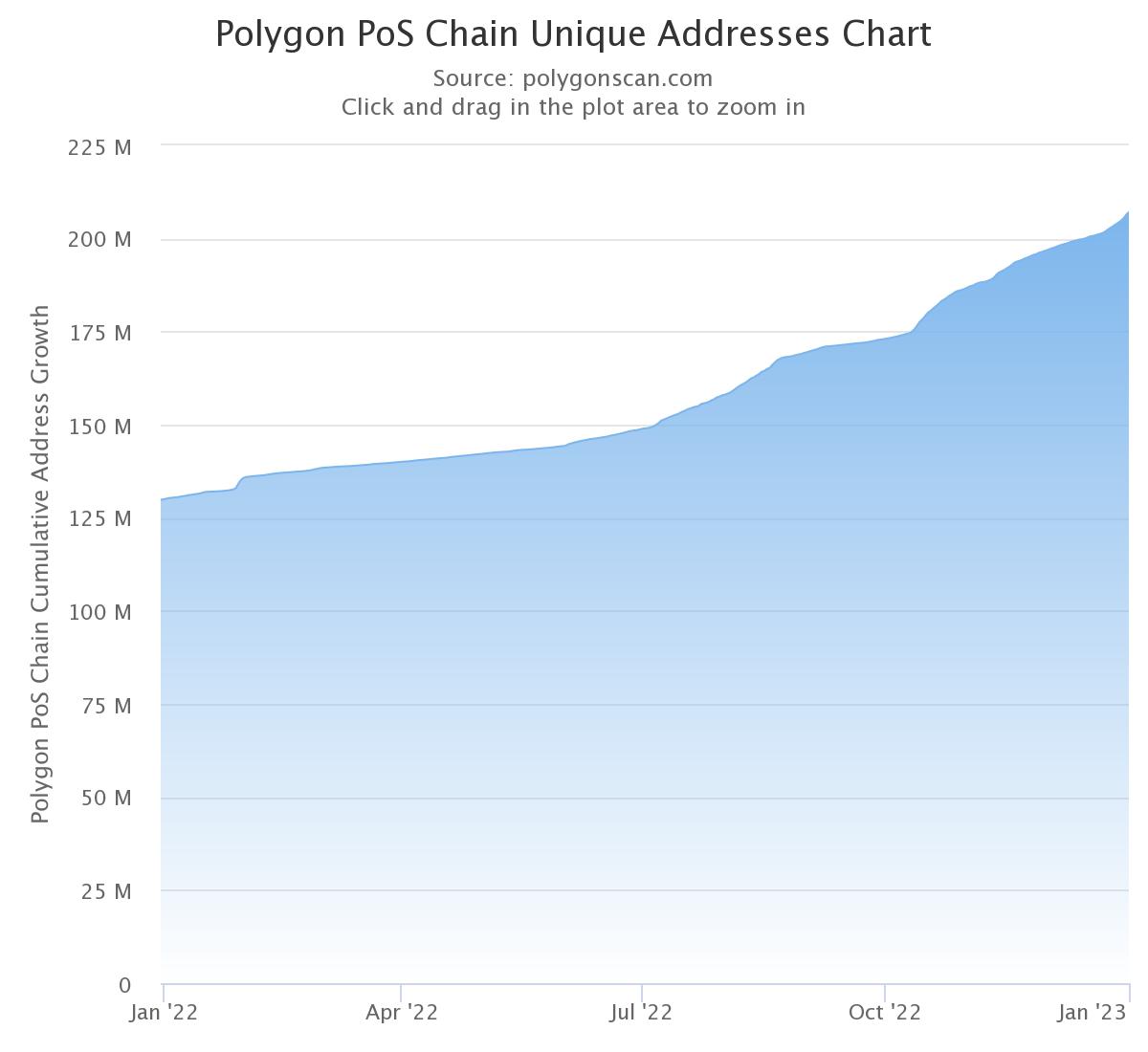
Growth in Polygon address count throughout 2022. Source: PolygonScan
⠀
Lastly, the proof-of-stake project recently announced the release of its final testnet, an improved iteration of its zero-knowledge Ethereum Virtual Machine.
⠀
Major brands continue to enter the Web3 arena
⠀
The nonfungible token (NFT) market and the metaverse industry have continued to pique the interest of several fashion and luxury brands. For example, in October, Rolex — a popular watch matchmaker with a global presence — filed for multiple NFT-related trademarks in addition to one for a cryptocurrency exchange. Popular sporting goods giants such as Reebok, Nike and Adidas also made similar moves.
⠀
Nike launched a metaverse venture called .Swoosh, a Web3-enabled platform where customers can buy and sell virtual products. The platform will reportedly initially look at community building while hosting the launch of the company’s first virtual collection — comprising footwear, apparel and accessories — sometime during January 2023. Upon its launch, the platform will only allow the use of cash, not digital currencies, with all transactions recorded on the Polygon blockchain.
⠀
Adidas released a new line of virtual gear last year along with a picture-for-proof dressing tool allowing avatars from compatible partner collections, such as Bored Ape Yacht Club, to be dressed up with their gear. Reebok filed numerous trademark applications in the United States for a wide range of virtual apparel, including footwear, headwear and sports equipment.
⠀
Lastly, luxury car manufacturer BMW announced that it, too, had decided to enter the metaverse fray by applying for a trademark for its logo that will be used in relation to its upcoming virtual vehicles, digital retail and other related services.
⠀
Total volume of staked Ether continues to grow
⠀
Throughout 2022, the total volume of Ether locked within the Ethereum ecosystem has continued to climb steadily. Between February and June, the amount of staked ETH rose from just over 9 million to nearly 13 million. As seen from the chart below, the trend plateaued between June and September, only to muster steam once again around mid-September, just before Ethereum’s much-awaited transition to proof-of-stake.
⠀
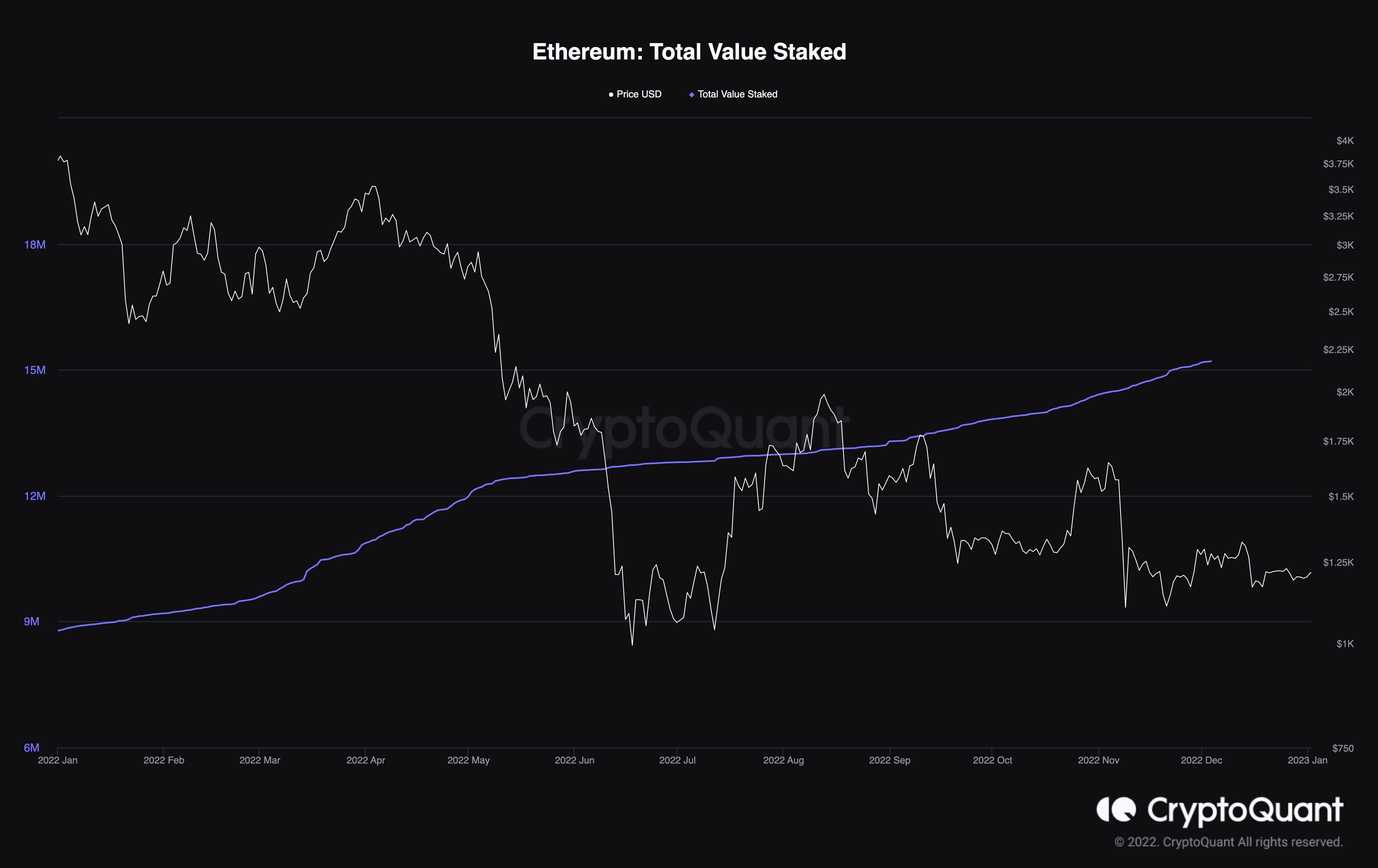
Total value of ETH staked. Source: CryptoQuant
⠀
Within the context of the Ethereum network, staking refers to the act of depositing 32 ETH into the network, which allows individuals to accrue validator rights and affords them the ability to earn additional ETH. As a validator, users must perform several duties, such as storing data, processing transactions and adding new blocks to the blockchain to help protect the network for all participants.
⠀
Meta integrates support for NFTs
⠀
Earlier in May, social media behemoth Instagram revealed its testing program for sharing NFTs for select users across the United States. At the time, a representative for the firm stated that it would create more monetization opportunities for influencers on the platform while introducing NFTs to a larger customer base. A few months later, in August, Instagram decided to expand its NFT operations to over 100 countries across Africa, North America and Asia.
⠀
Meta also announced that it would integrate support for third-party projects, including Coinbase Wallet and Dapper Wallet, while extending its NFT offerings to its other core social media platform, Facebook. In November, Instagram’s development team announced that it was testing the ability to mint and sell NFTs with a select group of digital creators. The feature will go live on the Polygon network, with creators and collectors not having to shell out any gas fees initially.
⠀
Starbucks’ blockchain-based loyalty program goes live
⠀
Starbucks announced the launch of its blockchain-based loyalty program and NFT community, Starbucks Odyssey, to a group of testers in the United States in September. The initiative builds upon the company’s existing loyalty program but uses a decentralized structure built atop the Polygon blockchain.
⠀
Starbucks Odyssey is a rewards program that allows users to earn perks and whose scope extends beyond the realm of simply earning free drinks. Odyssey allows customers to interact with a wide array of game-style offerings, allowing them to earn NFTs (referred to as Journey Stamps) in the process. These assets can later be traded and redeemed.
⠀
VCs continue to pour money into the Web3 ecosystem
⠀
During Q4 2022, Animoca Brands — the firm behind several successful crypto projects, including The Sandbox — created a multibillion-dollar fund to invest in various metaverse projects.
⠀
According to Animoca co-founder Yat Siu, the fund will spur the utility of the metaverse and blockchain gaming market. “More people are joining crypto every day, especially in gaming,” he stated, adding: “I’m hoping that this will also drive a scenario where digital property will be recognized like physical property in the legal system.”
⠀
In addition to Animoca, other popular firms that have invested heavily in the burgeoning metaverse economy include South Korean venture capital giant Daesung Private Equity. The company recently announced that it had allocated a total of 110 South Korean won ($83.9 million) toward its metaverse-centric fund.
⠀
JPMorgan partners with Ripple
⠀
American banking giant JPMorgan Chase joined with core Ripple partner Al Fardan Exchange in 2022 in an effort to provide users across the United Arab Emirates access to faster transaction settlement and transfer services.
⠀
Al Fardan’s clients will be able to conduct crypto transactions via several popular fiat assets, including the U.S. dollar, British pound and euro.
⠀
It is worth highlighting that this partnership comes amid Ripple’s ongoing lawsuit with the United States Securities and Exchange Commission. The regulatory agency continues to allege that the project’s associated crypto offering, XRP, is a security and, therefore, subject to the legal and regulatory implications associated with such assets.
⠀
Reddit users mint 5 million-plus NFT avatars
⠀
Social sharing website Reddit saw its users continue to adopt NFTs at a furious pace last year, even though its sales declined immensely. It is estimated that the Polygon-backed initiative has already witnessed the minting of more than 5 million collectibles to date.
⠀
Moreover, it bears mentioning that these avatars aren’t concentrated among high-value NFT collectors (ala whales) and are instead spread out among more than 4 million unique wallets. Lastly, a vast majority of the aforementioned minted NFTs have been offered to Reddit’s high-value users free of cost.
⠀
Tiffany enters the crypto sphere
⠀
Luxury jewelry and specialty retailer Tiffany & Co. announced in August that it was releasing a limited NFT collection called NFTiff, each of which would be available for a base price of 30 ETH (approximately $36,000). In all, a total of 250 of these NFTs were produced.
⠀
Earlier in March, Tiffany purchased an Okapi NFT from Tom Sachs for a reported sum of $380,000. The image has been the company’s Twitter profile photo ever since.
⠀
Positive legislation continued to gain traction
⠀
Late in 2022, Brazil’s Congress approved a bill seeking to regulate the use of digital currencies for daily payments within its borders, thereby potentially boosting the adoption of crypto within the South American nation. The bill provides legal status to payments made in cryptocurrencies for goods and services but does not grant them status as legal tender.
⠀
In a somewhat similar vein, Abdellatif Jouahri, the governor of Morocco’s central bank — Bank Al-Maghrib (BAM) — announced that his country’s key regulatory agencies would soon finalize a comprehensive crypto governance framework. The relevant agencies include the Moroccan Capital Markets Authority and the Supervisory Authority of Insurance and Social Welfare.
⠀
Jouahri revealed that the BAM worked on the document alongside the World Bank and the International Monetary Fund.
⠀
Other countries that have either tabled favorable regulations in 2022 or are planning to do so in the near future include India, Germany, Australia and the United Kingdom, among others.
⠀
Crypto adoption soars across MENA, Asia and Latin America
⠀
According to a study conducted by blockchain analytics firm Chainalysis, the Middle East and North Africa (MENA) region was the fastest-growing market for cryptocurrency adoption last year.
⠀
Between July 2021 and June 2022, the region received $566 billion in crypto transactions, a rise of nearly 49% from the year prior. To put things into perspective, there were increases of 40% in Europe, 36% across North America, and 35% across Central and South Asia.
⠀
Similarly, Latin America made up 9.1% of the total crypto value received during 2022, reaching a cumulative total of $562 billion while showcasing a growth of 40% between Q3 2021 and Q3 2022. Also, a total of four Latin American countries entered Chainalysis’ top crypto adopters list.
⠀
Lastly, Vietnam currently has the world’s highest crypto adoption rate, followed by the Philippines and Ukraine. Other emerging nations that dominated Chainalysis’ adoption index in 2022 include India, Brazil, Thailand and Pakistan.