Bitcoin Deposits on Sui's Hashi Bridge Surpass 1.1 Million in 3 Weeks

cryptonews.ru发布于2026-08-18更新于2026-08-18

文章摘要

Analysts report that activity on the Hashi bridge testnet from Sui has remained high since its launch on July 22. In just three weeks, total deposits exceeded 1.1 million BTC, with withdrawals reaching 165,000. This rapid growth suggests early interest from retail and institutional investors in moving native Bitcoin to the Sui network without converting it into a synthetic token—a model gaining attention after major bridge hacks in recent years. First introduced by the Sui Foundation in March 2026, Hashi is a decentralized primitive designed to allow Bitcoin ($BTC) to serve as collateral for on-chain lending and borrowing markets. It has progressed from a closed devnet to the current public testnet. Notably, the Bitcoin DeFi (BTCFi) sector has faced challenges in 2026, with total value locked (TVL) in Layer-2 solutions down roughly 74% from 2025 highs. Hashi's approach of keeping BTC on its native chain, rather than "wrapping" it, is a direct response to this market skepticism. The early deposit and withdrawal figures provide Sui with an argument that this model is finding an audience despite the broader downturn. Unlike traditional wrapped-asset bridges, Hashi does not move Bitcoin out of the Bitcoin network. Users deposit native $BTC, Sui validators confirm the transaction, and the protocol mints hBTC—a representative token usable as programmable collateral. The underlying Bitcoin remains in its own chain. Security is based on a multi-layered architecture featuring a 2-of...

Analysts from Onchain report that activity on the Hashi testnet from Sui has remained high since its launch on July 22nd: in just three weeks, the cumulative deposit volume exceeded 1.1 million, while withdrawals reached 165,000.
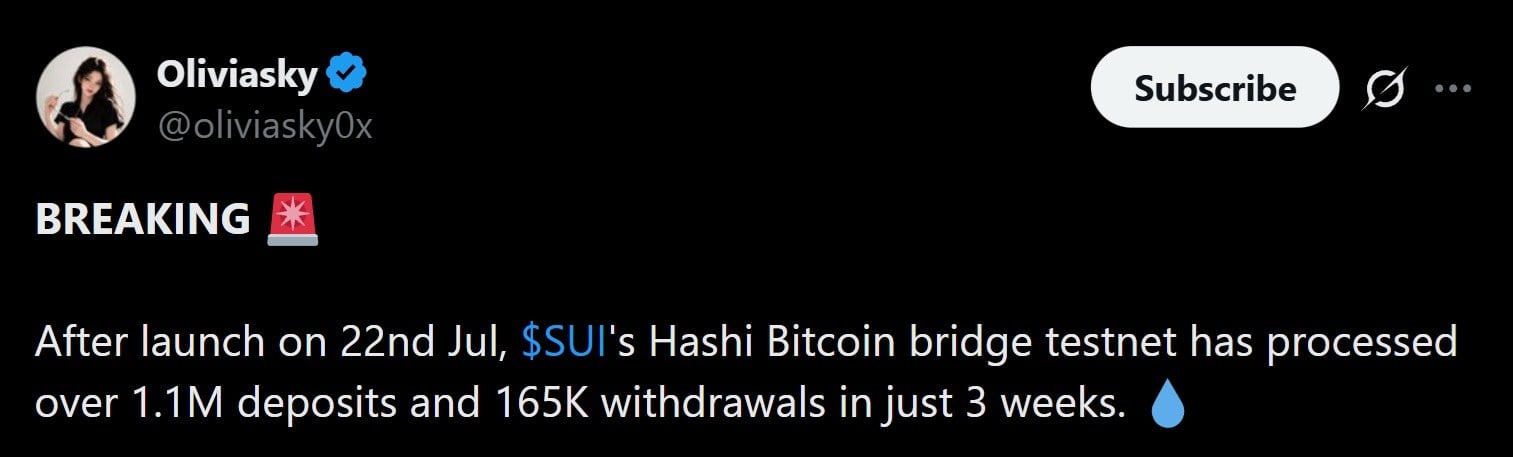
These figures appear to indicate early interest from retail and institutional investors in transferring native Bitcoin to the Sui network without converting the asset into a synthetic token—a model that has come under intense scrutiny in other chains after repeated bridge attacks in recent years led to the theft of hundreds of millions of dollars from storage systems.

Hashi was first introduced by the Sui Foundation in March 2026 as a decentralized primitive designed to allow Bitcoin ($BTC) to serve as collateral in on-chain lending and borrowing markets. The project completed a closed devnet phase before launching the current public testnet, providing developers with SDKs and integration guides ahead of the eventual mainnet launch.

Regarding the numbers, it's worth noting that 2026 has been a tough year for Bitcoin-related decentralized finance (DeFi): the total value locked (TVL) in Layer 2 BTCFi fell by approximately 74% compared to 2025 highs and stood at around 91,000 $BTC by mid-year. Hashi's proposition of maintaining $BTC in its native chain, rather than "wrapping" it, is a direct response to this skepticism. The early deposit and withdrawal data gives Sui an argument that this approach is finding its audience despite the overall market downturn.

How Hashi Preserves Bitcoin in Its Original Form

Unlike traditional wrapped-asset bridges, Hashi does not move Bitcoin out of the Bitcoin network. Instead, users deposit native $BTC, Sui validators confirm the transaction, and the protocol mints hBTC—a representative token that can be used as programmable collateral for institutional lending and borrowing of stablecoins, while the underlying Bitcoin remains on its own chain.

Security is based on a multi-layered architecture where deposits are secured by a "2-of-2" multi-signature scheme, requiring signatures from protocol validators using Multi-Party Computation (MPC)—a cryptographic scheme where no single party ever possesses the full private key.

Finally, withdrawals pass through a "Guardian Layer"—a customizable risk management system functioning as a "circuit breaker" that verifies large withdrawal requests against pre-set thresholds before confirming them. Overall, this architecture is designed to avoid the single points of failure that made older cross-chain bridges vulnerable to attacks.

Institutional Investors Back the Protocol

Currently, over 25 organizations are stress-testing the system, including custody and trading giants like BitGo and Cumberland, as well as Swissborg, Fluid, and Ledger. Their involvement spans trading desks, custody infrastructure, and asset management platforms, indicating demand for compliant, non-custodial ways to utilize idle Bitcoin in DeFi without taking on the counterparty risk that plagued earlier "wrapped" Bitcoin bridges.

The protocol's revenue model relies on interest rate spreads between depositor yields and the amount borrowers pay for Bitcoin-backed loans, rather than inflationary token emissions to incentivize activity.

This structure mirrors the pricing approach of traditional credit departments and, according to Sui investors, is likely to prove more sustainable once testnet incentives fade and real capital is at stake.

If Hashi ultimately manages to capture even a small share of the $1.4 trillion Bitcoin market in on-chain lending, it would become one of the most significant examples to date of interaction between the Bitcoin balance sheet and non-Bitcoin DeFi ecosystems.


热门币种推荐

相关问答

QWhat key achievement is reported regarding deposits on the Sui Hashi bridge within its first three weeks?

AThe cumulative volume of deposits on the Sui Hashi bridge testnet exceeded 1.1 million bitcoins within three weeks of its launch on July 22nd.

QHow does the Hashi bridge differ from traditional wrapped asset bridges in handling Bitcoin?

AUnlike traditional wrapped asset bridges, Hashi does not move Bitcoin out of the Bitcoin network. Instead, it mints a representative token (hBTC) on Sui for use in DeFi, while the underlying native Bitcoin remains secured in its own chain.

QWhat major security concern in the cross-chain bridge space does Hashi aim to address?

AHashi aims to address the vulnerability of older cross-chain bridges to attacks and hacks, which have resulted in the theft of hundreds of millions of dollars, by eliminating single points of failure through its multi-layered security architecture.

QWhat is the name of the security feature in Hashi's architecture that acts as a 'circuit breaker' for large withdrawal requests?

AThe security feature is called the 'Guardian Layer'. It functions as a customizable risk management system, verifying large withdrawal requests against pre-set thresholds before confirmation.

QWhich notable institutional entities are mentioned as participating in the stress-testing of the Hashi protocol?

AOver 25 organizations are stress-testing the system, including giants like Bitgo and Cumberland, as well as Swissborg, Fluid, and Ledger, covering trading, custody infrastructure, and asset management platforms.

你可能也喜欢

VanEck对比特币的预测:他们预测了上涨可能开始的月份

VanEck在8月中旬发布的报告指出,比特币市场的投降过程可能已进入后期阶段。其追踪的12个投降指标中,目前有8个处于活跃状态,显示比特币可能正在筑底,但历史数据并未显示短期回报有显著优势。 近期比特币价格在极窄区间(62,265至66,509美元)内波动,30日实现波动率降至27.2%的年化水平,远低于长期均值80%。VanEck认为,春季开始的下行趋势可能已经停止,潜在底部可能已在6月30日的58,500美元附近形成。 资金流向方面,过去30天美国现货比特币ETF出现约6.63亿美元净流入,逆转了前一个月约24亿美元的净流出趋势。但现货交易量依然低迷,处于历史分布的10%低位。 期权市场显示投资者转向防御:看跌期权保费大幅上升,看跌/看涨期权保费比率达2.30,接近2021年以来的最高水平。永续期货市场的强制平仓量也降至多月低点。 长期持有者方面,过去30天有约35.6万枚持有超过一年的比特币发生移动,使得长期持有量占总供应量的比例降至59.1%,为数月来首次低于60%。 基于历史周期模式(从峰值到底部平均需要约12.7个月),报告推测本轮周期的潜在底部可能出现在2026年9月至11月期间,但强调应关注这一时间范围而非精确日期。 历史数据显示,即使出现密集投降信号,比特币在随后90天和180天的平均回报(12.8%和32%)也并未显著超过其长期历史平均水平(15.2%和36.3%)。不过,在一年期维度上,于投降期买入的表现通常更优。

cryptonews.ru18分钟前

VanEck对比特币的预测:他们预测了上涨可能开始的月份

cryptonews.ru18分钟前

Strategy创始人迈克尔·塞勒与首席执行官冯乐做出多项有趣表态!他们公布了对比特币价格的预测

在由纳塔莉·布鲁内尔主持的投资者问答会上,Strategy创始人迈克尔·塞勒和首席执行官冯乐就公司战略、股票动态以及比特币在全球金融生态系统中的地位发表了重要看法。塞勒称比特币为数字世界的核心“资本”,并表示公司未来的增长计划直接建立在此基础上。 塞勒指出,与金融市场普遍看法不同,比特币并非传统支付工具或日常货币,而是一种数字资本。他认为,目前全球99.9%的经济价值集中于传统资本市场、房地产、黄金和信贷领域,比特币要取得10到100倍的网络增长,需要吸引传统金融世界的资本流入。公司开发的数字信贷工具旨在促进这一资本流动。 针对投资者对股价下跌和价值稀释的担忧,首席执行官冯乐表示,增发资本和推出新工具若能增加每股比特币持有量,就能为股东创造价值。他强调,比特币价格50%的下跌自然会导致股价波动高达75%,但Strategy采用的是长期债务和资本增长模型,而非短期比特币交易公司。 公司还透露了储备管理信息,表示除了增加美元流动性,还可能根据市场情况动态调整,例如购买比特币、回购信贷工具或积累美元储备。 塞勒重申,他仍然相信比特币未来可能达到100万至1000万美元的价格区间,因为公司将继续积累更大份额的比特币供应。他拒绝了投资者提出的比特币分红建议,认为这在财务上不合理。塞勒表示,最合理的策略是以低成本、抗通胀的法币(如美元或日元)借款,并将资金投入价格持续上涨的最强资产——比特币。 *本文不构成投资建议。

cryptonews.ru1小时前

Strategy创始人迈克尔·塞勒与首席执行官冯乐做出多项有趣表态!他们公布了对比特币价格的预测

cryptonews.ru1小时前

最新消息:美国证券交易委员会(SEC)发布期待已久的加密货币监管法案!这是一个非常重要的里程碑

美国证券交易委员会(SEC)发布了一项针对加密资产领域的新监管提案,旨在为涉及加密资产的特定投资合约建立专门的证券市场监管框架。该提案旨在简化美国加密公司的融资流程,并明确哪些交易适用于联邦证券法。 提案包含两项针对加密项目的注册豁免:其一允许发行人在四年内通过单次融资募集最多500万美元;其二允许公司每12个月发行最多7500万美元的证券。两者均需向投资者提供基于原则的特定信息,而金额较高的豁免还需提交财务报表并承担持续报告义务。 此外,提案还设立了一项有条件的“安全港”机制。符合特定条件后,相关加密资产可能不再被视为《1933年证券法》和《1934年证券交易法》定义的“投资合约”范畴内的证券。SEC主席表示,此机制在发行人停止履行投资合约中承诺的关键管理职能时尤为重要,可能为一些加密资产随着项目发展而转变法律地位铺平道路。 新规还将取消部分联邦豁免下加密资产交易在州一级的证券注册和资格要求,其适用范围不仅包括首次发行,也涉及部分二级市场交易。SEC认为,此举将减少加密公司因监管不确定性而迁出美国的动机,并在更一致的投资者保护标准下,为美国投资者提供更多加密资产投资机会。

cryptonews.ru2小时前

最新消息:美国证券交易委员会(SEC)发布期待已久的加密货币监管法案!这是一个非常重要的里程碑

cryptonews.ru2小时前

欧洲将对俄罗斯人在加密货币业务领域实施新禁令。这将包括什么

欧盟将从2024年起禁止俄罗斯公民及居住在俄罗斯的个人拥有、控制或担任欧洲加密资产服务公司(如钱包、账户及托管服务商)的管理职务。2024年7月底通过的第21轮制裁方案进一步扩大了限制范围。 自8月25日起,禁令将扩展至所有受欧盟加密资产市场法规(MiCA)监管的服务商,包括交易所和交易平台。这意味着俄罗斯公民将不能拥有任何欧盟持牌加密公司的所有权或进入其管理层。禁令适用于直接或间接控制,包括通过控股公司或名义持有进行规避的情况。同时,欧盟运营商也将被禁止与某些被认定系统性规避制裁的“特定”第三国注册的加密平台进行交易,相关国家清单将由欧盟理事会后续确定。 新规主要影响两类对象:一是禁止俄罗斯公民及居民拥有或管理欧盟加密公司;二是限制欧盟公司与特定第三国加密平台交易。规定不适用于拥有欧盟、欧洲经济区或瑞士国籍、永久居留权或长期签证(如工作、学习签证)的个人。对于已常驻于后续被列入清单国家的欧盟公民,若在其被列入前已居住,则可豁免交易禁令。 受影响的俄罗斯所有者及高管须在8月25日前彻底退出所有权或管理职务,否则将面临欧盟各国的刑事制裁风险。同时,相关欧盟公司也可能因涉及俄罗斯受益人或高管而遭遇银行服务拒绝或合作终止。欧盟此举被视为继限制俄罗斯客户使用服务、禁止与俄罗斯实体交易后,进一步切断其在欧洲加密领域所有权与管理权的延续性措施。

cryptonews.ru2小时前

欧洲将对俄罗斯人在加密货币业务领域实施新禁令。这将包括什么

cryptonews.ru2小时前

交易

现货

热门文章

如何购买S

欢迎来到HTX.com!我们已经让购买Sonic(S)变得简单而便捷。跟随我们的逐步指南,放心开始您的加密货币之旅。第一步:创建您的HTX账户使用您的电子邮件、手机号码注册一个免费账户在HTX上。体验无忧的注册过程并解锁所有平台功能。立即注册第二步:前往买币页面,选择您的支付方式信用卡/借记卡购买:使用您的Visa或Mastercard即时购买Sonic(S)。余额购买:使用您HTX账户余额中的资金进行无缝交易。第三方购买:探索诸如Google Pay或Apple Pay等流行支付方法以增加便利性。C2C购买:在HTX平台上直接与其他用户交易。HTX场外交易台(OTC)购买:为大量交易者提供个性化服务和竞争性汇率。第三步:存储您的Sonic(S)购买完您的Sonic(S)后,将其存储在您的HTX账户钱包中。您也可以通过区块链转账将其发送到其他地方或者用于交易其他加密货币。第四步:交易Sonic(S)在HTX的现货市场轻松交易Sonic(S)。访问您的账户,选择您的交易对,执行您的交易,并实时监控。HTX为初学者和经验丰富的交易者提供了友好的用户体验。

3.6k人学过发布于 2025.01.15更新于 2026.08.06

如何购买S

相关讨论

欢迎来到HTX社区。在这里,您可以了解最新的平台发展动态并获得专业的市场意见。以下是用户对S(S)币价的意见。

活动图片