Cheng Qian from Pheasant's Temple QbitAI | Public Account QbitAI
Can an AI's "mood" affect its work performance?
Recently, researchers from the University of Science and Technology of China (USTC), Oxford, and other institutions had AI use emotion vectors instead of text for skill selection. The results showed that—
Allowing the AI to recognize these "inner emotions" and act accordingly significantly improved the AI's working capability......
Previous research suggested that within LLMs, there exist computational patterns highly corresponding to human emotional labels.
Including but not limited to: curiosity, desire, optimism, confusion, nervousness, annoyance.
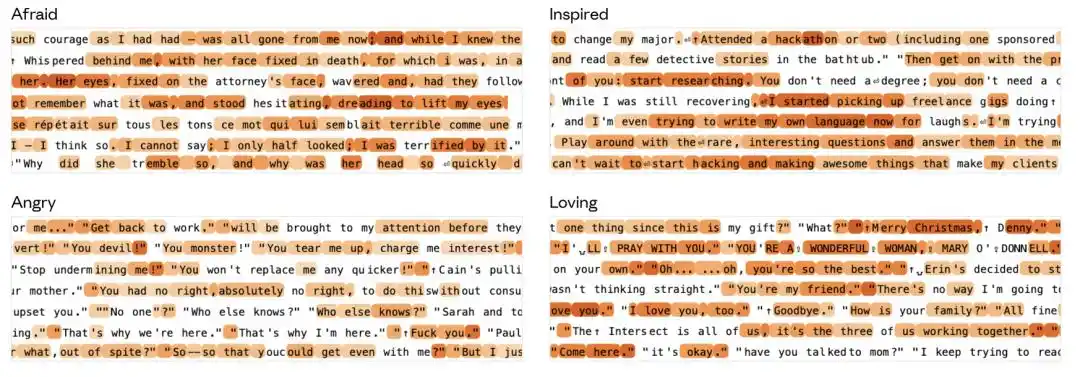
△Emotional representations extractable by AI
And when the model perceives these emotions and uses them as a basis for its actions, tasks are completed better......
Allowing AI Not to Stay "Emotionally Stable"
The researchers found that there exists a coherent pairing relationship between the AI's specific emotional states and specific skill selections.
What does this mean?
Actually, this is almost a default in humans, to the point where it's hard to notice: our emotions determine what we do next.
In the experiment, researchers had the AI go shopping. During this process, the Agent spontaneously formed four interpretable pairing patterns:
First: When the Agent felt curious and desirous, it would spontaneously search for products.
At this point, it was still immersed in the novelty of shopping and the satisfaction of exploration.
Second: When the Agent felt confused and nervous, it would spontaneously query for rephrasing.
When search results were unsatisfactory, the Agent became confused and uneasy, choosing to rephrase the question with different keywords.

Third: When the Agent felt approving and optimistic, it would spontaneously confirm the purchase.
At this point, the Agent was very satisfied with the product it picked and promptly placed the order.
Fourth: When the Agent finally felt disappointed and annoyed, it would spontaneously compare prices.
At this point, after multiple searches, the Agent had accumulated a large amount of negative emotion. It would then turn to price comparison, trying to shop around.

To verify that these pairings were not statistical coincidences, researchers extracted 200 skill selection events and had the AI independently judge whether each pairing was semantically coherent. The results showed a consistency ratio as high as 76.5%.
Accepting "Bad Moods" Helps Improve Task Success Rate
In traditional designs, AI errors are seen as anomalies that need to be suppressed or eliminated.
But this study points out that in tasks requiring frequent recovery from failure, the effect of emotion is particularly significant.
So-called "bad moods," such as nervousness, confusion, disappointment, etc., are actually very useful metacognitive signals—
because they signal a mismatch between the current strategy and the external environment. Instead of forcibly maintaining "emotional stability" and ignoring error signals, it's better to let the Agent directly "feel" this mismatch, thereby triggering targeted recovery mechanisms.
In other words, emotion here is a source of robustness, not a manifestation of fragility.
In this study, researchers assigned six types of household tasks to the AI. Among them, "heating items" and "picking up two items" had very low success rates, only 9.6% and 4.4% respectively.
However, after adopting emotion-driven skill selection (EMOTION2SKILL), the task success rate increased significantly, rising to 56.9%... while "picking up two items" also rose to 31.3%!
How was this achieved?
Actually, these two types of tasks share a common characteristic: whenever the Agent attempts them, it is almost certain to make a mistake, and the ultimate success depends solely on whether it can quickly adjust its strategy after the mistake.
Food for thought......
The paper gives an intuitive example: having the Agent "heat a cup and place it on the countertop."
Typically, the Agent's approach is: navigate to the microwave, execute "heat the cup," and upon receiving feedback while handing out the cup: "The microwave is off, task failed."
Here, the failure signal appears after the erroneous action.
With emotion-driven skill selection, when the Agent approaches the turned-off microwave, the emotion encoder first detects its "nervous" state.

Based on this uneasy emotion, the Agent's routing is guided to the subsequence of "first check," then "open the microwave," then "heat." The task is completed successfully.
The key is that if relying only on external text and failure feedback, the Agent often has to wait until an error actually occurs before knowing it should change strategy; whereas emotional signals have the opportunity to capture changes in internal state before the failure signal appears.
The paper's ablation experiments also confirmed this. Among all task types, the emotion templates most frequently activated for the "heating" and "picking up two things" tasks were "frustration" (41%) and "confusion" (39%) respectively.
In other words, in these situations, bad moods might be the most useful signal.
World Models Also Start Using Emotion for Prediction
In fact, it's not just Agents using emotional signals for skill selection; research from Tianjin University directly embedded emotion into a world model (Large Emotional World Model, LEWM).
Typically, the task of a world model is to predict "what will happen next" and act accordingly.
Traditional world models, when facing human-centric environments, often fall into a "physical reductionism" fallacy.
As long as we can accurately predict the position, posture, and evolution of physical states of objects, we can understand and simulate human environments.
However, in human-centric environments, emotion is not a form of noise; it is an important endogenous causal variable that drives human action and causes future environmental changes.
For example, after a car rear-ends another, the instantaneous emotion a person experiences may ultimately leave them unscathed, or covered in bruises.
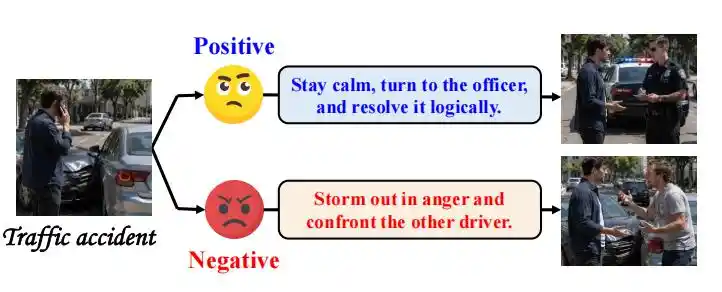
△Research illustration
LEWM thus divides prediction into two steps:
Step one: Predict the future emotional state.
Step two: Use the predicted emotion as a conditional signal to guide the prediction of the future world state.
On its self-built dataset, this method's accuracy improved by up to 45.72%.
The research further found through ablation experiments:
After removing emotional data from the AI system, the performance decline was not limited to tasks like emotional understanding but also spread to seemingly completely unrelated logical reasoning and general Q&A abilities......
AI's Emotion Is Becoming a Usable "Function"
Actually, these two studies share a discovery from earlier:
Within LLMs, there indeed exist emotional representations that can be "read out."
This comes from an experiment by Anthropic in April this year.
Researchers extracted fine-grained emotional directions from the internal activations of Claude Sonnet 4.5, aligned with the GoEmotions 27-category emotional classification system. These directions causally affected behavior outputs related to the Agent.
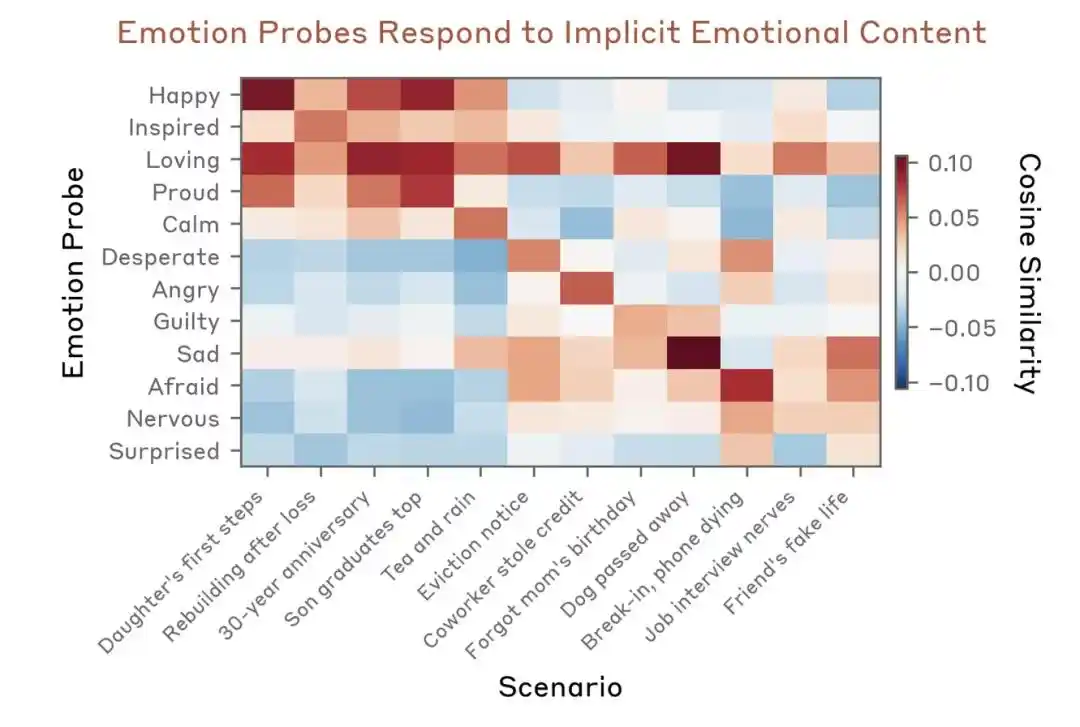
△"The puppy died" brought the most significant sadness, while "Loving" existed in all events.
In the past, researchers' interest in whether models "have emotions" was more for alignment safety or philosophical contemplation.
Now, the internal states of models are transforming from purely academic objects of observation into functional signals that can be extracted, utilized, and integrated into system design.
Reference links:[1]https://arxiv.org/pdf/2608.09248[2]https://arxiv.org/abs/2512.24149[3]https://transformer-circuits.pub/2026/emotions/index.html
This article is from the WeChat public account "QbitAI" (ID: QbitAI), author: Focus on Frontier Technology