Following the successful IPO of ChangXin, China's memory chip industry has finally embraced its moment of glory. With a surge in its opening price, a soaring market capitalization, and the setting of new A-share records... within just a few days, ChangXin has become the most talked-about name in the entire semiconductor industry. China now possesses a DRAM company capable of competing head-to-head with Samsung, SK Hynix, and Micron.
However, few are aware that in the very same year the ChangXin project commenced, China also placed significant bets on another DRAM company—Fujian Jinhua Integrated Circuit Co., Ltd.
In 2016, these two companies stood on virtually the same starting line: both shouldering the mission to break through in domestic DRAM production, both constructing 12-inch wafer fabs, both receiving tens of billions of yuan in investment, and both carrying the immense hope of reshaping the landscape of China's memory industry.
Yet, a decade later, their fates have diverged dramatically. ChangXin has become the representative of the rise of the domestic DRAM industry, while Fujian Jinhua has almost vanished from the public eye.
Both were key strategic projects, both in the DRAM sector, and they started almost simultaneously. Why did ChangXin ultimately succeed, but not Fujian Jinhua?
The answer likely lies not merely in differences in operational capabilities between the two enterprises, nor solely in a single intellectual property lawsuit. The experience of Fujian Jinhua, in fact, reflects the complex game of rules in international competition that China's memory industry truly faced for the first time. Understanding Fujian Jinhua helps us understand ChangXin, and appreciate the arduous journey China's memory industry has taken to reach today.

In 2016, No One Believed Fujian Jinhua Would Lose
To understand the development history of ChangXin and Jinhua, one must first grasp the background of the domestic chip industry at the time. In 2013, the number of mobile phone users in China surpassed 1.2 billion, but the chips in these phones—less than 20% were independently developed and produced domestically. The chips for the most advanced 4G phones at the time were almost entirely imported.
Data from the Ministry of Industry and Information Technology showed that China's integrated circuit import value reached a staggering $231.3 billion in 2013, while total crude oil imports for the same period were about $219.6 billion. In fact, for over a decade, China's integrated circuit import value exceeded that of petroleum, consistently ranking first among all imported product categories.
After the formal release of the "National Integrated Circuit Industry Development Promotion Outline" in 2014, China began its first systematic layout of the memory industry. In 2016, ChangXin and Fujian Jinhua emerged, simultaneously aiming to challenge the DRAM market then firmly dominated by Samsung, SK Hynix, and Micron.
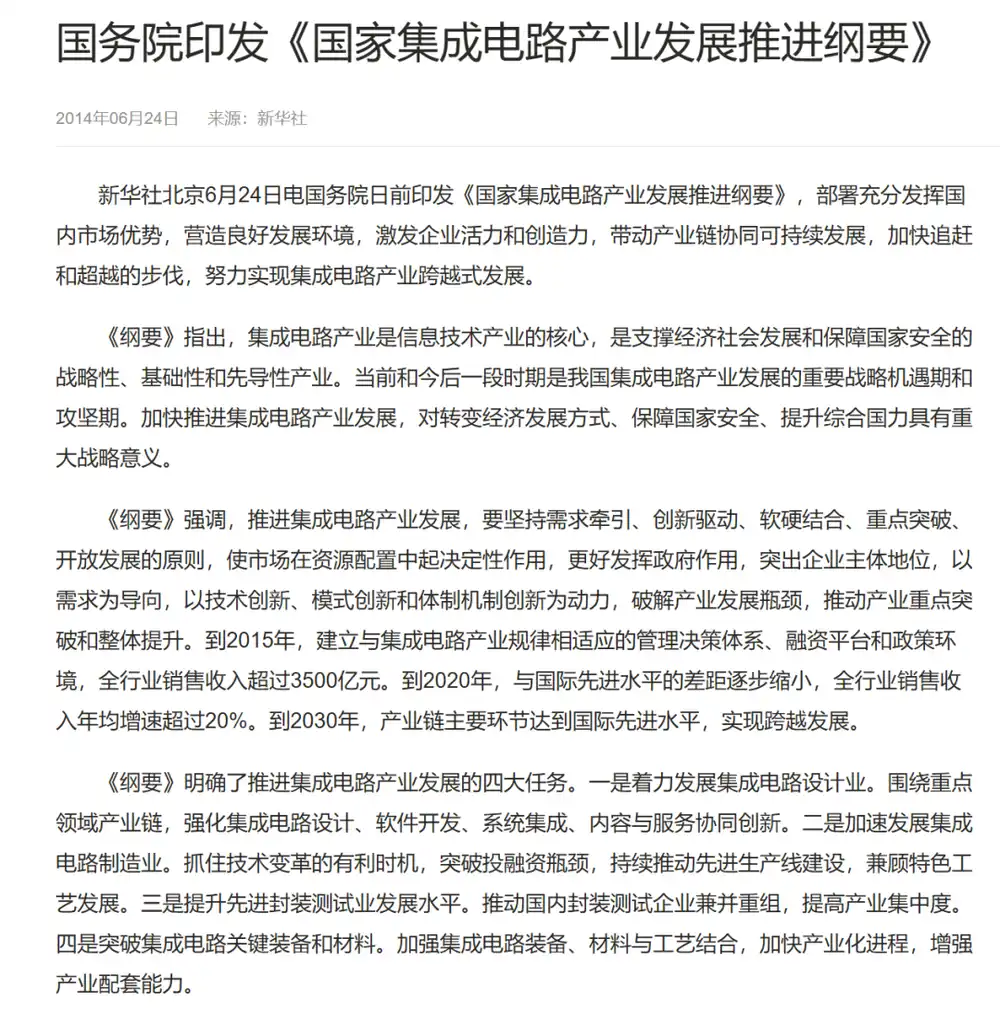
In 2014, the State Council issued the "National Integrated Circuit Industry Development Promotion Outline"
However, both companies faced the same daunting challenge: China had almost no mature DRAM manufacturing experience. The difficulties in DRAM production are concentrated across the entire industry's upstream and downstream. It requires not only massive capital to build wafer fabs but also core capabilities in circuit design, cell architecture, process integration, yield optimization, and more—all accumulated over the long term.
For a newly established Chinese enterprise, trying to quickly re-walk a path others had taken decades from scratch was almost unrealistic. Therefore, Fujian Jinhua chose a path that seemed the fastest at the time: leveraging an external, mature team to shorten the R&D cycle, trading time for space.
In May 2016, Fujian Jinhua signed a cooperation agreement with Taiwan's United Microelectronics Corporation (UMC). Fujian Jinhua provided funds, responsible for investing in and constructing a 12-inch wafer fab and supplying specific equipment; UMC was responsible for the technology, developing the 32nm DRAM process, with development results to be shared by both parties. In July of the same year, the Fujian Jinjiang 12-inch DRAM project officially broke ground. The first-phase investment was approximately 37 billion RMB. The target was formal production in 2018, with a planned monthly capacity of 60,000 wafers. At this time, ChangXin was still quietly assembling its team. In terms of project advancement speed, Fujian Jinhua was even ahead for a while.
It should be noted that this model was quite normal at the time. New entrants rapidly establishing manufacturing capabilities through technical cooperation, talent recruitment, and joint development was not inherently problematic. The only issue was that Fujian Jinhua formed a deep dependency with its partner, UMC, in key technologies, R&D systems, and external cooperation. This deep dependency planted the seeds for the subsequent years-long intellectual property disputes and forced stagnation.
A Nearly 6-Year Lawsuit Left Fujian Jinhua Falling Behind
The turning point came one year later. In 2017, Micron sued UMC and Fujian Jinhua in Taiwan, China, and the United States, alleging theft of trade secrets by former employees, patent infringement, and other reasons. In its US lawsuit against UMC, Micron claimed that UMC had stolen intellectual property, including memory chip technology, through former Micron employees in Taiwan, China, and transferred it to Fujian Jinhua.
In response to the lawsuits, Fujian Jinhua and UMC also filed lawsuits, requesting the court to order Micron to immediately cease infringing on Fujian Jinhua's patents. In July 2018, a court ruled that Shanghai Micron should stop selling certain Micron chips, and Xi'an Micron should stop manufacturing and importing several memory module products.
Up to this point, it was still a legal battle between companies over trade secrets and patents. However, months later, the situation fundamentally changed.
On October 29, 2018, the U.S. Department of Commerce added Fujian Jinhua to the Entity List. The official reason given was telling: Fujian Jinhua was "soon to reach mass production scale of DRAM chips," and this new capacity could threaten the long-term viability of relevant U.S. suppliers. In other words, the U.S. did not wait for Fujian Jinhua to actually achieve mass production before acting; it pressed the pause button when the company was just one step away from it.

Fujian Jinhua was added to the U.S. Entity List
This was an almost fatal blow to Fujian Jinhua. According to U.S. export control regulations, after being placed on the Entity List, any export, re-export, or in-country transfer of items subject to the Export Administration Regulations (EAR) by U.S. companies to Fujian Jinhua required prior application for a license, and such licenses were subject to a policy of presumption of denial.
On the very first day of the U.S. export controls taking effect, all on-site personnel from Fujian Jinhua's American semiconductor partners withdrew. All machine installation and production assistance activities completely stopped. Equipment that had been ordered but not yet shipped was suspended. Relevant U.S. semiconductor equipment suppliers such as Lam Research and Applied Materials ceased technical support and cut off all telephone and email communication. Beyond equipment, Fujian Jinhua's software systems also heavily relied on U.S. suppliers. For example, the Manufacturing Execution System (MES) was purchased from U.S.-based IBM, whose communication channels were also cut off on the same day.
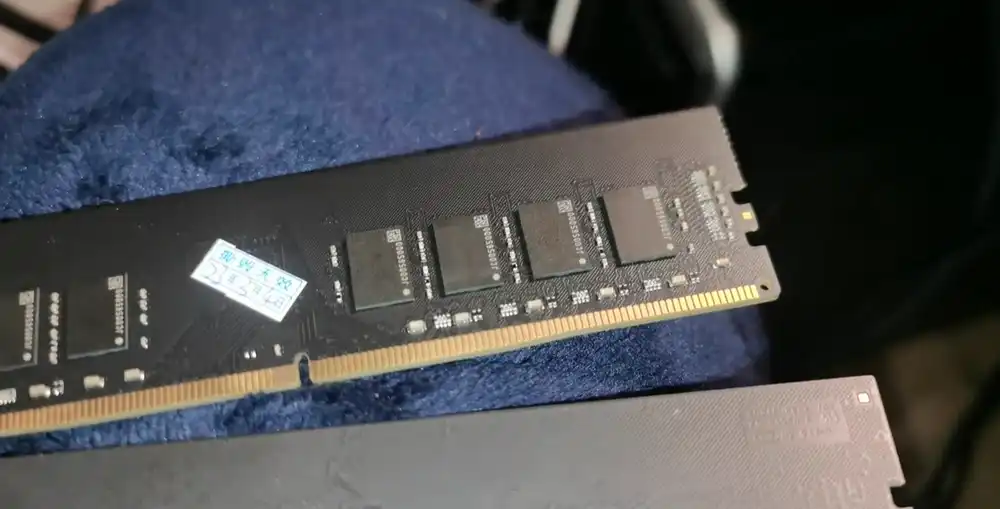
"Jinhua 8G DDR4 2666 Memory Module" reviewed by netizens
Two days later, UMC announced the suspension of its cooperation with Fujian Jinhua. Since the cooperation model was inherently centered on UMC being responsible for process R&D, this meant that Fujian Jinhua's most critical technology development and subsequent support were simultaneously severed.
From equipment and materials to processes, the key links pushing Fujian Jinhua's DRAM towards mass production were almost all simultaneously paused.
Just one month later, the U.S. Department of Justice formally indicted Fujian Jinhua, UMC, and individuals including Chen Zhengkun, escalating the original civil dispute into a criminal case with charges including conspiracy to commit economic espionage.
In the following years, Fujian Jinhua became increasingly worn down by the legal battle with Micron. In 2020, UMC reached a settlement with the U.S. Department of Justice and paid a fine; in 2021, UMC reached another settlement with Micron, ending the multi-year litigation between them. At the end of 2023, Fujian Jinhua and Micron announced a global settlement, with both parties withdrawing all litigation worldwide. In February 2024, the U.S. District Court for the Northern District of California further ruled that U.S. prosecutors had failed to prove Fujian Jinhua had stolen Micron's trade secrets. This legal battle, lasting about six years, finally concluded with Fujian Jinhua being found not guilty.
However, by the time the lawsuit finally drew to a close, over five years had passed since Fujian Jinhua's originally planned production start date. After 2023, driven by AI, the global memory industry entered a new upcycle, with DRAM prices continuously rising, and domestic memory companies ushered in an unprecedented development window. ChangXin grew rapidly during this cycle, eventually going public; while Fujian Jinhua, the company that had once been just one step away from mass production, missed this golden era for China's memory industry.
Currently, Fujian Jinhua has not exited the stage of history. The company remains in operation, its factory and team still exist, and it continues recruitment and related business activities. However, that production line originally planned for mass production in 2018 with a monthly capacity of 60,000 DRAM wafers ultimately did not become the starting point for the rise of China's DRAM industry as initially envisioned.
Why Was ChangXin Able to Succeed?
Reading this far, many would have a question. The experience of Fujian Jinhua demonstrates that the DRAM industry not only has extremely high technical barriers but is also subject to multiple constraints like intellectual property, supply chains, and export controls. So why didn't ChangXin, also focused on DRAM and starting around the same time in 2016, follow Fujian Jinhua's path?
The answer is not that ChangXin didn't face challenges, but that the international environment, technological pathways, and industrial foundations the two companies encountered had already changed.
Firstly, from its inception, ChangXin placed greater emphasis on building its R&D system and intellectual property. On one hand, ChangXin continuously recruited international talent and built its R&D team; on the other, it improved its intellectual property portfolio through methods like patent licensing and patent purchases. At the end of 2019, ChangXin signed a patent license and patent purchase agreement with Polaris Innovations Ltd. (owned by Canadian IP firm WiLAN), obtaining partial DRAM patent licenses and assets originally from Germany's Qimonda, providing intellectual property protection for subsequent product commercialization.
More importantly, by the time ChangXin truly began mass production, the industrial foundation had shifted. When Fujian Jinhua was sanctioned, China's DRAM industry and its supporting upstream and downstream sectors were very weak. However, by the time ChangXin gradually entered the mass production stage, China had made significant progress in wafer manufacturing, packaging and testing, equipment, materials, and other segments. ChangXin's development was not entirely smooth sailing either. According to its IPO prospectus, as late as 2024, the company still reported a loss of approximately 9.05 billion RMB; in 2025, with the recovery of DRAM prices, optimization of product mix, and expansion of production and sales scale, the company achieved its first annual profit.
In fact, the U.S. has never given up on suppressing the development of Chinese memory chips, including ChangXin. Currently, the U.S. Department of Defense has listed ChangXin on the 1260H list of Chinese military-industrial enterprises; the U.S. Department of Commerce has also considered adding it to the Entity List; and the U.S. Congress has repeatedly called for further strengthening export controls on ChangXin.
The reason the U.S. has been hesitant to take definitive action is not because of a sudden change of heart, but because there is ongoing internal debate weighing the effectiveness of restrictive measures against their costs. The U.S. academic and policy communities have come to realize that overly harsh export controls, instead, accelerate the autonomous development of China's semiconductor supply chain. The rapid rise of ChangXin and Yangtze Memory Technologies (YMTC) validates this point, which is not the outcome the U.S. desires.
Conclusion
After experiencing challenges such as U.S. sanctions and production line shutdowns, today's Fujian Jinhua has fully resumed operations. Its 12-inch wafer fab currently maintains a stable monthly capacity of 40,000 wafers. According to plans, monthly capacity will be further expanded to 60,000 wafers in 2026. Once, it was just one final step away from mass production; now, it has finally returned to the track of industrial development.
The greatest regret for Fujian Jinhua is not losing an international lawsuit, but missing the most critical development window for China's memory industry.
However, from another perspective, this was not entirely without meaning. Fujian Jinhua was the first to truly expose Chinese enterprises to the intellectual property barriers in the DRAM industry, the first to face supply chain disruptions caused by the Entity List, and the first to realize that in the global semiconductor competition, having only capital and factories is far from sufficient.
Many paths later taken by Chinese chip companies were precisely places where Fujian Jinhua once stumbled. Therefore, looking back at Fujian Jinhua today, it may not have become the answer for China's DRAM industry, but it certainly provided one of the most important lessons in its growth process.
This article is from WeChat Official Account: Ke Gong Li Liang , Author: Ke Gong Li Liang, Original Title: "ChangXin's 'Peer': The Fate of Fujian Jinhua Integrated Circuit Co., Ltd. Is Regrettable!"